

At first glance, Tiger Woods and Bill Ackman seem to have little in common. One became one of the most successful golfers in history, while the other built his reputation through investment management and corporate strategy. Yet their careers share an interesting connection through Nike, a brand that played an important role in Woods’ professional journey and attracted investment from Ackman’s firm, Pershing Square.
The Tiger Woods and Bill Ackman connection is primarily an indirect business overlap, not a publicly established partnership between the two men. Woods spent nearly three decades associated with Nike as a sponsored athlete, while Ackman’s investment firm purchased Nike shares in 2024. These separate relationships explain why their names can appear together in discussions about sports business, brand value, and investment strategy.
Beyond Nike, their professional paths offer an interesting comparison. Woods expanded his sporting reputation into golf-course design, hospitality, philanthropy, and sports entertainment. Ackman built an investment-management business focused on selecting companies, allocating capital, and influencing corporate decisions. Understanding their individual careers helps explain the connection without confusing an endorsement deal with an investment or a business partnership.
Who Are Tiger Woods and Bill Ackman?
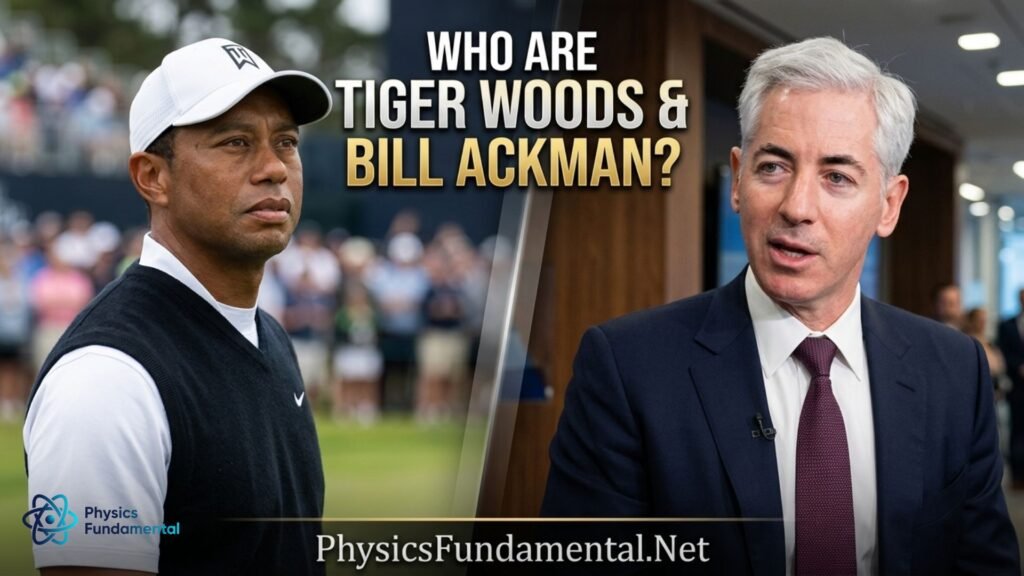
Tiger Woods and Bill Ackman are prominent figures in different industries, but both have used their expertise to build influence beyond their main professional activities.
Who Is Tiger Woods?
Tiger Woods, whose full name is Eldrick Tont Woods, was born on December 30, 1975, in Cypress, California. He became a professional golfer in 1996 and quickly established himself as one of the sport’s biggest stars.
Woods has won 15 major championships and 82 PGA TOUR events. His achievements include five Masters Tournament victories and the historic feat of holding all four professional major championship titles simultaneously after winning the 2001 Masters. His competitive success helped transform professional golf’s commercial appeal and made him an internationally recognized athlete.
However, Tiger Woods is known for more than golf. He is an entrepreneur and philanthropist who leads TGR, a business and charitable enterprise that includes golf-course design, event production, a charitable foundation, and hospitality. His work with TMRW Sports has also connected his career to technology-driven sports entertainment.
His official Tiger Woods biography outlines both his competitive achievements and business activities. His career shows how an athlete’s reputation can develop into a wider business ecosystem.
Who Is Bill Ackman?
Bill Ackman, whose full name is William Albert Ackman, is an American investor and the founder of Pershing Square Capital Management. He established the investment firm in 2003 after working in investment management through Gotham Partners.
Ackman is known for evaluating public companies, making concentrated investments, and sometimes pressing company leadership to make strategic or operational changes. This approach is commonly associated with shareholder activism, in which investors seek changes they believe could improve a company’s performance or value.
His work extends beyond managing an investment portfolio. According to Pershing Square’s official biography, Ackman serves as the firm’s founder and CEO and as chairman of its board. He also serves as executive chairman of Howard Hughes Holdings and is involved with the Pershing Square Foundation, which he founded in 2006.
Unlike Woods, whose reputation was built first through sporting achievement and athlete endorsements, Ackman’s influence comes primarily from capital allocation, financial analysis, investment decisions, and corporate governance.
What Is the Connection Between Tiger Woods and Bill Ackman?
The strongest documented connection between Tiger Woods and Bill Ackman is their separate association with Nike.
Woods entered a long-term endorsement partnership with Nike when he turned professional in 1996. Over the following decades, his performances and public profile helped make him one of the most recognizable athletes associated with the sportswear company.
Ackman, meanwhile, became connected to Nike through the financial markets. Pershing Square Capital Management purchased Nike shares during the second quarter of 2024, according to a regulatory filing reported by Reuters.
These are two different kinds of business relationships. Woods represented a brand as a sponsored athlete, while Pershing Square acquired an ownership stake in a publicly traded company. An endorsement relationship and a stock investment can overlap around the same company without involving the same people in a direct business arrangement.
The public records reviewed for this article do not establish that Woods and Ackman are business partners, co-investors in a joint venture, or collaborators in a shared enterprise. Their Nike connections should not be treated as proof that they work together.
This distinction is important because the Tiger Woods and Bill Ackman connection is more accurately understood through corporate and commercial overlap than through a confirmed personal relationship.
Their professional paths intersect indirectly through Nike, the sportswear company, which had a long-running endorsement relationship with Tiger Woods, while Bill Ackman’s investment firm separately purchased Nike shares in 2024.
The Nike Connection Explained
Nike is the most useful starting point for understanding why these two public figures are compared. The company’s relationship with Woods developed through sports marketing, while its connection with Ackman developed through public-market investing.
Tiger Woods’ Long Nike Partnership
Woods’ Nike relationship began in 1996, before he won his first major championship. The partnership became one of the best-known examples of athlete branding in modern sports.
Woods wore Nike apparel throughout much of his professional career, appearing in advertising campaigns and helping connect the brand with golf audiences around the world. His success, visibility, and reputation for competitive excellence gave Nike a recognizable figure through whom it could promote its products.
The relationship lasted approximately 27 years. In January 2024, Woods announced that the partnership had ended. The PGA TOUR’s report on the Nike split documented the end of the long-running agreement.
The Tiger Woods Nike partnership illustrates how athlete endorsements can create commercial value for both sides. An athlete receives compensation and brand exposure, while a company gains access to the athlete’s audience and public identity. The actual terms of a private endorsement agreement may not be fully public, so it would be inappropriate to invent contract values or other undisclosed details.
Woods has continued to pursue business activities outside golf, meaning his commercial identity is not limited to any single sponsor.
Bill Ackman’s Historical Nike Investment
Bill Ackman’s connection with Nike followed a different path.
On August 14, 2024, Reuters reported that Pershing Square had acquired approximately three million Nike shares during the second quarter of that year. The position represented about 0.19% of Nike at the time, according to the regulatory filing discussed in the report.
The investment was notable because Ackman had previously invested in Nike in 2017. Reuters reported that the earlier investment generated a profit for Pershing Square.
This history helps explain interest in the Bill Ackman Nike investment. As an investor, Ackman assesses a company’s financial position, market prospects, competitive challenges, and potential value. An investment may reflect a belief that a company is undervalued or has opportunities to improve, although the existence of a shareholding alone doesn’t reveal every reason behind the decision.
It’s also important to distinguish historical information from current holdings. Pershing Square’s quarterly Form 13F filing for June 30, 2026 does not list Nike among its reported holdings. A regulatory filing reflects specified reportable positions at a particular reporting date, rather than every possible financial exposure or every transaction occurring afterward.
Therefore, the article should not describe Nike as a current Pershing Square holding based solely on the 2024 investment. The documented point is that Ackman’s firm invested in Nike historically.
What the Nike Connection Does—and Doesn’t—Prove
The Nike connection demonstrates that two people working in different industries can have separate relationships with the same public company.
Woods was a prominent sponsored athlete whose commercial relationship helped connect Nike with golf audiences. Ackman approached Nike as an investor evaluating the company’s business and financial prospects.
Their interests therefore intersect around a company, but the nature of those interests differs. Woods’ endorsement relationship concerned sports marketing and brand representation. Ackman’s investment involved buying shares in a publicly traded business.
Neither connection, by itself, establishes that Woods influenced Ackman’s investment decision, that Ackman invested directly in Woods, or that the two men jointly developed a commercial project.
This is the central distinction readers should understand when researching their relationship.
Tiger Woods: From Athlete to Business Ecosystem
Tiger Woods’ business ventures demonstrate how professional success can support activities beyond an athlete’s original field. His career created opportunities in sponsorships, hospitality, design, charity, and sports technology.
TGR Ventures and Its Business Activities
Woods serves as founder and CEO of TGR, a multibrand enterprise that brings together several business and philanthropic activities.
Its main components include:
- TGR Design: A golf-course design business focused on creating golf facilities.
- TGR Foundation: A charitable organization supporting education and youth development.
- TGR Live: An event-production operation associated with golf and other experiences.
- The Woods Jupiter: A sports restaurant that extends the brand into hospitality.
These activities show that the Tiger Woods business empire is broader than prize money, sponsorships, and product endorsements. His name and expertise can support different kinds of enterprises, each with its own purpose and audience.
That diversification is meaningful, but it doesn’t mean every business activity is equally profitable or that all ventures operate under the same commercial model. A charitable foundation, for example, has a different purpose from a restaurant or a golf-course design company.
Golf, Sports Technology, and Philanthropy
Woods has also been involved in TMRW Sports, a sports, media, and technology company co-founded by Woods, Rory McIlroy, and Mike McCarley.
One of its major projects is TGL, an indoor team golf competition designed to combine golf with a technology-enabled viewing experience. The concept introduces a different presentation format while retaining core elements of competitive golf.
The wider strategy illustrates how a familiar sport can develop new ways to reach audiences. Technology, production design, team identity, and entertainment all influence how a sporting product is experienced by viewers.
Philanthropy is another important part of Woods’ activities. Through the TGR Foundation, his name supports educational initiatives rather than purely commercial projects.
Together, these ventures show how an athlete can build a diversified professional identity. They also explain why Tiger Woods is often discussed in conversations about entrepreneurship, sports marketing, and business expansion.
Bill Ackman’s Career and Investment Strategy
Ackman’s business model centers on investment management. Rather than developing a consumer brand around sporting achievement, he seeks opportunities in publicly traded companies and uses financial analysis to guide capital allocation.
Pershing Square and Investment Management
Pershing Square Capital Management was founded in 2003. The firm is known for a focused investment approach and for selecting businesses that it believes have attractive long-term prospects.
According to Pershing Square’s investment strategy, the firm emphasizes factors such as company quality, predictable cash generation, competitive advantages, financial strength, and valuation.
These principles help explain its approach to investment portfolio construction. A fund manager must consider not only whether a company appears attractive but also how a position fits alongside other holdings, what risks could affect the investment, and how long the investment thesis might take to develop.
Capital allocation is central to this work. Money committed to one company cannot simultaneously be committed to another opportunity, so the investor must compare expected returns, valuation, business quality, and risk.
Ackman’s work is also associated with concentrated investing. A focused portfolio can make successful decisions more influential, but it can also leave an investor exposed when a major holding performs poorly.
The difference between a successful business and an attractive investment is important. Even a respected company can be a disappointing investment if its shares are purchased at a price that already assumes too much future growth.
Corporate Strategy and Shareholder Activism
Ackman has built part of his professional reputation through shareholder activism. In this approach, an investor seeks to influence company decisions when they believe changes could improve performance or shareholder value.
Those changes may concern leadership, capital allocation, business operations, or corporate governance. The investor’s influence depends on factors such as ownership, engagement with management, other shareholders’ views, and the company’s response.
Ackman’s experience with Chipotle is one example of his involvement in corporate strategy. Pershing Square helped recruit Brian Niccol as CEO in 2018, according to Reuters’ reporting on Ackman’s investment history.
However, shareholder activism does not guarantee success. A proposed change may be rejected, take longer than expected, or fail to deliver the anticipated results. Market conditions can also undermine an otherwise reasonable investment thesis.
This makes Ackman’s profession fundamentally different from Woods’ entrepreneurial career. Ackman evaluates and seeks to influence businesses in which his firm invests. Woods develops and supports ventures connected to golf, his personal brand, hospitality, and philanthropy.
You May Like to Read: John Collison and Al Pacino: Amazing Facts (2026)
Tiger Woods and Bill Ackman: A Useful Business Comparison
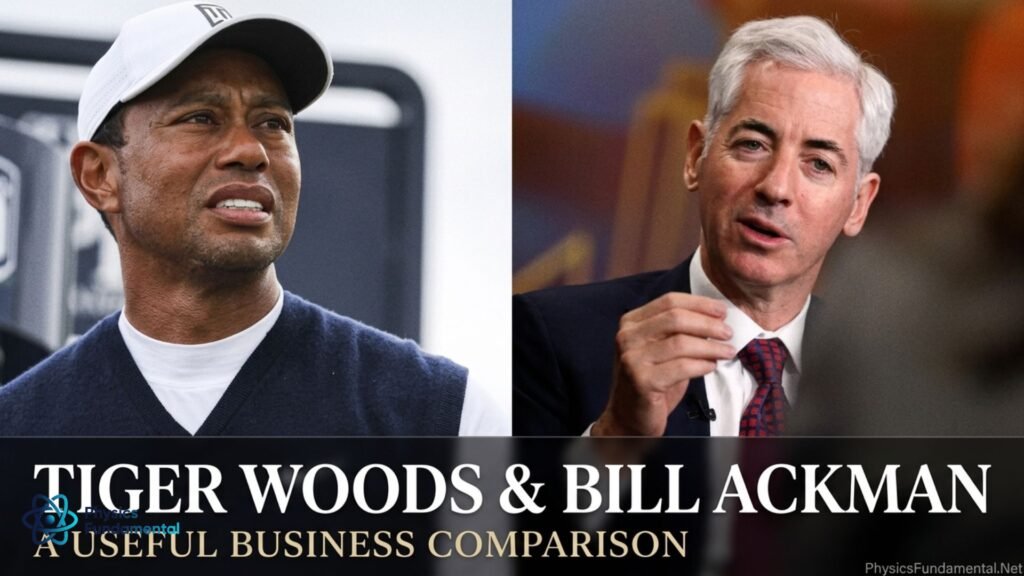
A Tiger Woods and Bill Ackman comparison reveals two different ways to build business influence.
Woods developed public recognition through extraordinary sporting performance and then expanded into additional activities. Ackman developed influence through financial analysis, investment decisions, and engagement with corporate leadership.
| Dimension | Tiger Woods | Bill Ackman |
|---|---|---|
| Primary field | Professional golf | Investment management |
| Source of recognition | Sporting achievements | Financial analysis and investment decisions |
| Business model | Athlete-led brands and ventures | Investor-led portfolio strategy |
| Main activities | Golf, design, events, hospitality, philanthropy | Capital allocation, public-market investing, corporate governance |
| Major commercial connection discussed here | Nike endorsement relationship | Pershing Square’s historical Nike investment |
| Main risks | Performance, reputation, sponsorship, venture execution | Valuation, market conditions, concentrated positions, investment decisions |
Athlete-Led Brand Building vs. Investment Management
Woods’ business model begins with a recognizable personal identity. His sporting achievements created an audience, and businesses could use that recognition to build partnerships, promote products, or attract interest in new ventures.
This type of athlete-led business depends on trust, reputation, relevance, and the ability to connect with an audience. A long-term sponsorship relationship may be valuable, but partnerships can end as an athlete’s career and commercial priorities change.
Ackman’s approach depends less on public recognition by consumers and more on analytical judgment. His firm evaluates businesses, estimates their value, and chooses where to commit investment capital.
Both approaches require decision-making, but the methods differ. Woods builds commercial opportunities around expertise and public recognition, while Ackman seeks returns by investing in companies and evaluating their ability to generate long-term value.
Different Approaches to Business Growth and Risk
Both careers demonstrate the importance of managing risk, but the risks themselves are different.
For Woods, a change in sporting performance can affect sponsorship opportunities. A reputational issue can also influence how the public views a brand associated with his name. Business diversification can create additional opportunities, but it also brings operating responsibilities beyond golf.
For Ackman, the central challenges include inaccurate valuation, market volatility, concentration risk, and decisions that fail to improve a company’s performance. A strong investment idea may still produce poor results if the purchase price is too high or circumstances change.
Neither strategy eliminates uncertainty. Their careers instead show why growth needs a clear purpose, sensible risk management, and a realistic understanding of the strengths that made the business successful in the first place.
Frequently Asked Questions
What Connects Tiger Woods and Bill Ackman?
The clearest documented connection is through Nike. Woods had a long-running endorsement relationship with Nike, while Ackman’s investment firm acquired Nike shares in 2024. These were separate business relationships, and they do not establish a direct partnership between the two men.
Are Tiger Woods and Bill Ackman Business Partners?
No publicly documented direct business partnership between Tiger Woods and Bill Ackman has been established by the records reviewed for this article. Their professional activities have developed in different industries, and their historical Nike connections do not demonstrate that they operate a joint business.
Did Bill Ackman Invest Directly in Tiger Woods?
There is no verified evidence in the sources reviewed that Bill Ackman invested directly in Tiger Woods. The documented investment discussed here involved Pershing Square purchasing shares in Nike, a company that previously sponsored Woods. Investing in a company associated with an athlete is not the same as investing in that athlete personally.
Does Bill Ackman Still Have a Nike Investment?
Pershing Square’s reported holdings for June 30, 2026, do not list Nike among the reported positions. Its earlier investment was documented in 2024. Because regulatory filings reflect holdings at specific dates and cover specified types of securities, they should not be treated as a complete real-time picture of every financial exposure.
What Is Tiger Woods Known for Outside Golf?
Outside professional golf, Woods is known for his business and charitable activities through TGR, including golf-course design, event production, hospitality, and the TGR Foundation. He has also helped develop TGL through TMRW Sports, bringing a technology-enabled format to team golf entertainment.
What Does Bill Ackman Do Professionally?
Bill Ackman is an investor and the founder and CEO of Pershing Square Capital Management. He is known for investment management, financial analysis, capital allocation, and shareholder activism. He also has leadership and philanthropic roles outside the firm’s core investment-management business.
Why Are Tiger Woods and Bill Ackman Compared?
Tiger Woods and Bill Ackman may be compared because both have developed professional influence that extends beyond their main careers. Woods built businesses around golf, his reputation, and sports-related ventures, while Ackman built an investment-management firm. Their historical Nike connections provide an additional reason to discuss them together, but they do not establish a direct partnership.
Conclusion
Tiger Woods and Bill Ackman represent two very different approaches to business success. Woods used his sporting achievements to develop opportunities in design, hospitality, philanthropy, and sports entertainment. Ackman built his reputation through investment management, capital allocation, and efforts to influence corporate strategy.
The most relevant Tiger Woods and Bill Ackman connection is their separate historical association with Nike: Woods through an endorsement relationship and Ackman’s firm through a stock investment. The available evidence does not establish that the two men are business partners or that Ackman invested directly in Woods.
Their careers offer different lessons about building influence, evaluating opportunities, and managing risk. More importantly, their story shows why a shared connection to a company should not be confused with a shared business venture. Understanding that distinction gives readers a more accurate picture of both men and the relationship between their professional worlds.