7+ Powerful First Law of Thermodynamics Formulas & Examples
Internal energy, heat and work — how the first law of thermodynamics ties them together, with real-world applications and worked examples.

Internal energy, heat and work — how the first law of thermodynamics ties them together, with real-world applications and worked examples.
Why does a metal spoon become hot when placed in a cup of tea? Why does water require so much energy to heat up? The answers involve Thermal Energy, temperature, particle motion, and internal energy. Thermal energy is associated with the microscopic motion and interactions of particles within matter. When a substance absorbs energy, its…
Thermal expansion: ΔL = αL₀ΔT for linear, ΔV = βV₀ΔT for volumetric. Coefficients explained, 4 worked examples, and why bridges have expansion gaps.
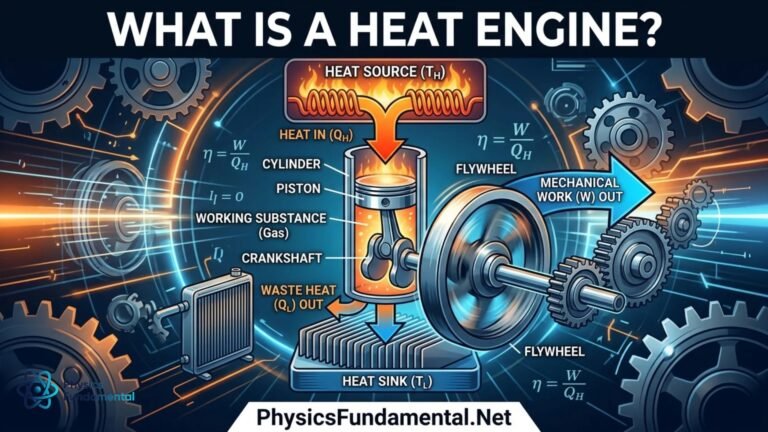
The Carnot cycle explained: maximum possible heat engine efficiency, eta = 1 – Tc/Th, the four-stage cycle, and why no real engine can beat it. Worked examples.
Kinetic molecular theory: how molecular motion creates pressure and temperature. Covers the 5 postulates, RMS speed, and ideal gas law derivation.
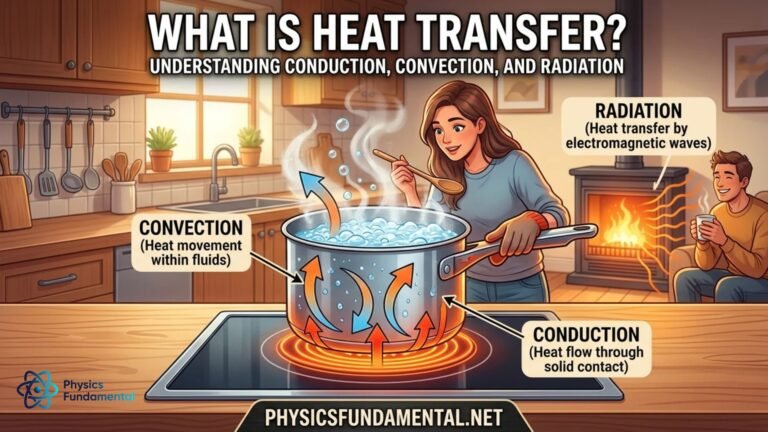
Have you ever wondered why a metal spoon becomes hot in a cup of tea, why warm air rises, or how heat from the Sun reaches Earth through empty space? These everyday examples are all connected to heat transfer. Heat can move from one place to another in several ways. The three main types are…
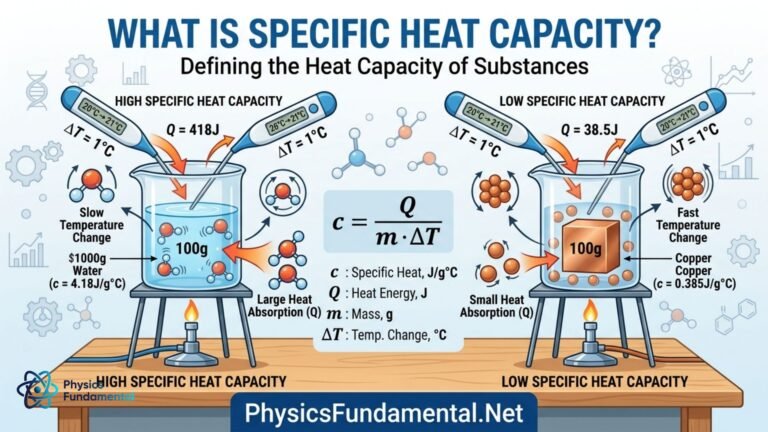
Why does a metal spoon become hot quickly when placed in hot water, while a large amount of water can absorb plenty of heat without its temperature changing as quickly? The answer is related to a physical property called specific heat capacity. Specific heat capacity tells us how much thermal energy is needed to raise…