Heat Transfer Explained: 3 Powerful Types, Examples & Facts 2026
Have you ever wondered why a metal spoon becomes hot in a cup of tea, why warm air rises, or how heat from the Sun reaches Earth through empty space? These everyday examples are all connected to heat transfer.
Heat can move from one place to another in several ways. The three main types are conduction, convection, and radiation. Each method transfers thermal energy differently, depending on the material and conditions involved.
Understanding these three types of heat transfer makes it easier to explain everything from cooking and home heating to weather, engines, and the energy received from the Sun. Once you know how each process works, the differences between them become much easier to remember.
What Is Heat Transfer?

Heat transfer is the movement of thermal energy from a region of higher temperature to a region of lower temperature.
Heat transfer continues until the temperature difference becomes smaller or thermal equilibrium is reached.
The three main methods are:
- Conduction
- Convection
- Radiation
Although all three involve the transfer of thermal energy, they work in different ways.
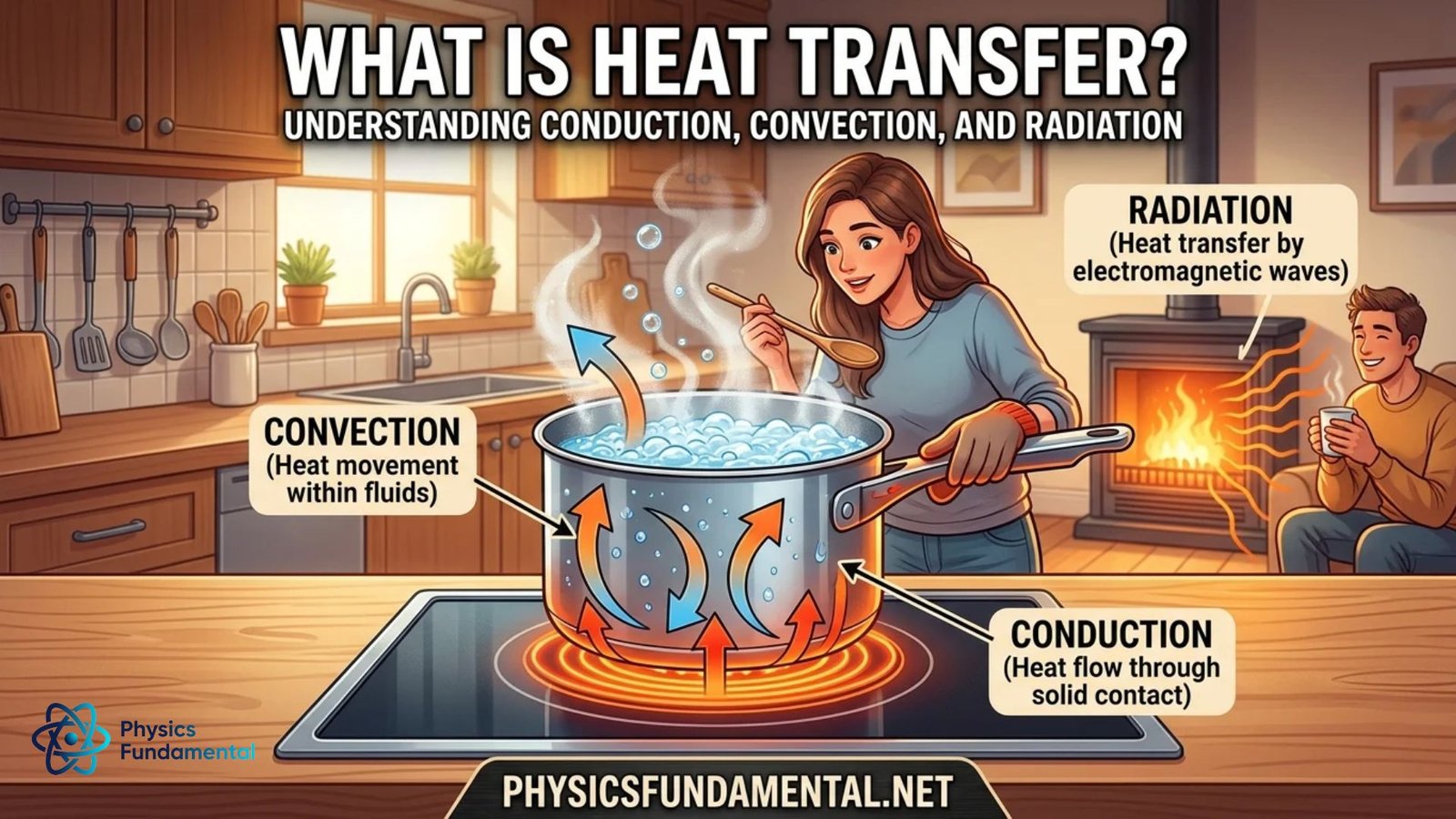
Conduction generally occurs through direct interactions between particles. Convection involves the movement of a fluid such as a liquid or gas. Radiation transfers energy through electromagnetic waves and does not require matter between the source and receiver.
What Is Conduction?
Conduction is the transfer of thermal energy through a material or between materials that are in direct contact.
When one part of an object becomes hot, its particles gain energy and interact with nearby particles. Energy is transferred progressively through the material.
In solids, especially metals, conduction can be an efficient way for thermal energy to travel.
For example, imagine placing one end of a metal rod in a flame. The end closest to the flame heats first. After some time, thermal energy travels through the rod, causing the other end to become hotter.
This is conduction.
How Does Conduction Work?
In conduction, particles do not need to move from one side of an object to the other as a whole.
Instead, energy is transferred through interactions between neighboring particles.
In metals, mobile electrons can also contribute significantly to thermal conduction. This helps explain why many metals are effective conductors of heat.
The rate at which conduction occurs depends on factors such as the material, temperature difference, distance over which heat travels, and surface area involved.
Examples of Conduction
Conduction happens in many everyday situations.
A Metal Spoon in Hot Tea
When a metal spoon is placed in hot tea, thermal energy moves from the hotter tea into the spoon. The spoon gradually becomes warmer.
Cooking on a Pan
Heat from a stove is transferred into a cooking pan. The pan then conducts thermal energy through its material to the food.
Touching a Hot Object
If you touch a hot object, thermal energy can move from the object into your hand through direct contact.
Ironing Clothes
A hot iron transfers thermal energy to clothing when its heated surface touches the fabric.
Ice Melting in Your Hand
Thermal energy moves from your warmer hand into the colder ice through direct contact, causing the ice to warm and eventually melt.
Conductors and Insulators
Materials differ in how easily they conduct thermal energy.
Materials that transfer heat relatively easily are called thermal conductors.
Many metals, including copper and aluminium, are good thermal conductors.
Materials that resist the transfer of thermal energy are called thermal insulators.
Examples include materials such as:
- Wood
- Plastic
- Rubber
- Foam
- Fiberglass
- Air
This difference is useful in everyday products. A metal cooking pan can transfer heat efficiently, while a plastic or wooden handle can reduce heat transfer to your hand.
What Is Convection?
Convection is the transfer of thermal energy through the movement of a fluid.
A fluid can be either a liquid or a gas.
Unlike conduction, convection involves the bulk movement of the heated fluid.
When a fluid is heated, it can expand and become less dense. The warmer, less-dense fluid tends to rise while cooler, denser fluid moves downward.
This creates a circulating motion called a convection current.
How Does Convection Work?
Consider a pot of water being heated from below.
The water closest to the heat source becomes warmer. As it warms, it expands and becomes less dense. The warmer water rises.
At the same time, cooler and denser water moves downward toward the heat source.
The cycle continues, producing convection currents that distribute thermal energy through the water.
This is an example of natural convection.
Convection can also be produced artificially using fans, pumps, or other devices. This is called forced convection.
Natural and Forced Convection
There are two common forms of convection.
Natural Convection
Natural convection occurs because of density differences created by temperature differences.
For example, warm air rising above a heater is an example of natural convection.
Forced Convection
Forced convection occurs when an external device causes the fluid to move.
A fan moving warm or cool air through a room is one example.
A pump circulating coolant through an engine is another.
Both methods transfer thermal energy through fluid movement, but the motion is produced differently.
Examples of Convection
Boiling Water
When water is heated in a pot, warmer water rises while cooler water sinks. This creates convection currents.
Room Heating
A heater warms nearby air. The warm air rises, while cooler air moves downward, producing circulation throughout the room.
Sea and Land Breezes
Temperature differences between land and water can create air movements that contribute to local breezes.
Weather Systems
Convection plays an important role in atmospheric processes. Warm air can rise and cooler air can sink, contributing to cloud formation and other weather patterns.
Car Cooling Systems
Liquid coolant can circulate through an engine and radiator, transporting thermal energy away from hot engine components.
What Is Radiation?
Radiation is the transfer of thermal energy through electromagnetic waves.
Unlike conduction and convection, radiation does not require a material medium.
This means thermal radiation can travel through a vacuum.
The most familiar example is sunlight. Energy from the Sun travels through the near-vacuum of space before reaching Earth.
This is one of the reasons radiation is fundamentally different from conduction and convection.
How Does Thermal Radiation Work?
Objects emit electromagnetic radiation because of their temperature.
The amount and characteristics of radiation emitted depend on factors including temperature and surface properties.
Hotter objects generally emit more thermal radiation.
Thermal radiation can travel through empty space and can be absorbed by another object. When radiation is absorbed, it can increase the object’s thermal energy.
This process is closely connected with electromagnetic radiation, which includes a broad range of electromagnetic waves.
Examples of Radiation
Heat From the Sun
The Sun transfers energy to Earth primarily through electromagnetic radiation. No physical material is required to carry this energy through space.
Feeling Heat From a Fire
You can feel thermal radiation from a fire even without touching it.
Infrared Heaters
Some heaters transfer energy through infrared radiation, warming objects and surfaces that absorb the radiation.
Hot Metal
A very hot piece of metal can emit visible light as well as infrared radiation.
Thermal Cameras
Thermal imaging systems detect infrared radiation emitted by objects and use it to produce information about temperature differences.
You May Like to Read: Specific Heat Capacity: Powerful Formula, Examples & Facts 2026
Difference Between Conduction, Convection, and Radiation
The three methods can be compared using several important features.
| Feature | Conduction | Convection | Radiation |
|---|---|---|---|
| Main mechanism | Direct particle interactions | Bulk fluid movement | Electromagnetic waves |
| Requires matter? | Yes | Yes | No |
| Common in | Solids | Liquids and gases | Vacuum or matter |
| Example | Hot metal spoon | Boiling water | Sun heating Earth |
| Fluid movement required? | No | Yes | No |
The biggest distinction is the way thermal energy moves.
Conduction involves direct transfer through contact.
Convection involves the movement of fluids.
Radiation involves electromagnetic waves and can occur through empty space.
Conduction vs Convection
Conduction and convection can both occur in fluids, but they operate differently.
Conduction transfers energy through particle interactions without requiring the bulk movement of the material.
Convection involves the movement of the fluid itself.
For example, when water is heated in a pot, conduction transfers energy from the hot surface into nearby water. The resulting movement of the water then distributes energy through convection.
Therefore, conduction and convection can occur together in the same system.
Convection vs Radiation
Convection requires a fluid medium and involves fluid movement.
Radiation does not require a medium and can transfer energy through a vacuum.
For example, heat can travel from the Sun to Earth through space by radiation. Convection cannot perform this part of the journey because there is no fluid connecting the Sun and Earth.
Conduction vs Radiation
Conduction requires matter and normally involves direct interactions between particles.
Radiation can travel through a vacuum.
A hot object can therefore transfer thermal energy to another object without physical contact through radiation.
For example, you can feel heat from a fire while standing several feet away.
Can All Three Types of Heat Transfer Happen Together?
Yes. In many real-world situations, conduction, convection, and radiation occur simultaneously.
Consider a pot of water on a stove.
First, thermal energy is transferred from the stove to the pot. Conduction then transfers energy through the pot and into the water.
Inside the water, convection currents distribute thermal energy.
At the same time, the hot pot and surrounding surfaces emit thermal radiation.
Therefore, real heating systems often involve more than one type of heat transfer at the same time.
Heat Transfer in the Human Body
The human body exchanges thermal energy with its surroundings through several mechanisms.
Conduction can occur when the body touches another object.
Convection can transfer heat through moving air or water around the body.
Radiation allows the body to exchange thermal energy with surrounding surfaces.
Evaporation is another important cooling mechanism, although it is not one of the three main heat-transfer methods described by conduction, convection, and radiation.
Heat Transfer in Buildings
Buildings are designed with heat transfer in mind.
During cold weather, insulation can reduce conduction through walls, roofs, and floors.
Windows and air movement can affect convection.
Surfaces can absorb and emit thermal radiation.
Good building design attempts to manage these processes to maintain comfortable indoor temperatures while reducing unnecessary energy use.
Heat Transfer in Cooking
Cooking provides many simple examples of heat transfer.
A frying pan receives energy from a stove through conduction. The pan then conducts energy through its material and into the food.
In an oven, hot air transfers thermal energy through convection, while heated surfaces and heating elements can transfer energy through radiation.
Boiling water mainly involves convection within the liquid after energy has been transferred from the heated container.
Different cooking methods therefore use different combinations of heat-transfer mechanisms.
Heat Transfer in the Environment
Heat transfer plays a major role in Earth’s environment.
Solar radiation supplies energy to Earth’s surface and atmosphere.
The surface can then transfer energy to nearby air through conduction.
Warm air can rise and move through the atmosphere by convection.
Earth’s surface and atmosphere also emit thermal radiation.
These processes interact continuously and are important for understanding Earth’s energy balance.
Why Heat Transfer Matters
Understanding heat transfer is useful in both science and everyday life.
Engineers use these principles when designing engines, refrigerators, heating systems, buildings, electronics, and industrial equipment.
Scientists use heat-transfer concepts to study weather, climate, planetary environments, and many other physical processes.
Even simple activities such as cooking, heating a room, or choosing insulated clothing involve the movement of thermal energy.
Common Misconceptions About Heat Transfer
Heat and Temperature Are the Same
Heat and temperature are related but different concepts.
Temperature describes the thermal state of a system, while heat refers to energy transferred because of a temperature difference.
Radiation Requires Air
It does not.
Thermal radiation can travel through a vacuum. This is how energy from the Sun reaches Earth.
Convection Happens in Solids
Convection is associated with the bulk movement of fluids, meaning liquids and gases. Heat transfer through a solid is primarily discussed in terms of conduction.
Conduction Means the Whole Material Moves
The material itself does not need to move as a whole during conduction. Energy is transferred through interactions within the material.
How to Remember the Three Types
A simple way to remember them is:
Conduction = Contact
Energy transfers through direct contact and interactions within a material.
Convection = Circulation
Energy is carried by the movement of a fluid.
Radiation = Rays
Energy travels through electromagnetic radiation and does not require a material medium.
These three words provide a useful starting point for identifying heat-transfer processes in everyday examples.
Frequently Asked Questions
What are the three types of heat transfer?
The three main types are conduction, convection, and radiation.
What is conduction?
Conduction is the transfer of thermal energy through direct contact and interactions between particles within a material.
What is convection?
Convection is the transfer of thermal energy through the bulk movement of a liquid or gas.
What is radiation?
Radiation is the transfer of thermal energy through electromagnetic waves and does not require a material medium.
Which type of heat transfer can occur through empty space?
Radiation can transfer thermal energy through empty space. This is how energy from the Sun reaches Earth.
Conclusion
Conduction, convection, and radiation are the three main ways thermal energy moves from one place to another. Conduction transfers energy through direct interactions, convection transfers energy through moving fluids, and radiation transfers energy through electromagnetic waves.
These processes often work together rather than occurring separately. A heated pot, for example, can involve conduction through the metal, convection within the water, and radiation from the hot surfaces.
Once you understand the mechanism behind each type, it becomes much easier to identify heat transfer in everyday life and apply these ideas to physics problems. From cooking and heating buildings to engines, weather, and energy from the Sun, heat transfer is an essential part of the physical world.