Thermal Energy Explained: Powerful Q = mcΔT Formula & Examples 2026
Why does a metal spoon become hot when placed in a cup of tea? Why does water require so much energy to heat up? The answers involve Thermal Energy, temperature, particle motion, and internal energy.
Thermal energy is associated with the microscopic motion and interactions of particles within matter. When a substance absorbs energy, its particles can move more rapidly, causing its temperature to increase. One of the most useful equations for calculating the energy required to change the temperature of a substance is Q = mcΔT.
Understanding Thermal Energy also helps explain heating, cooling, specific heat capacity, phase changes, and the difference between temperature and internal energy.
What Is Thermal Energy?
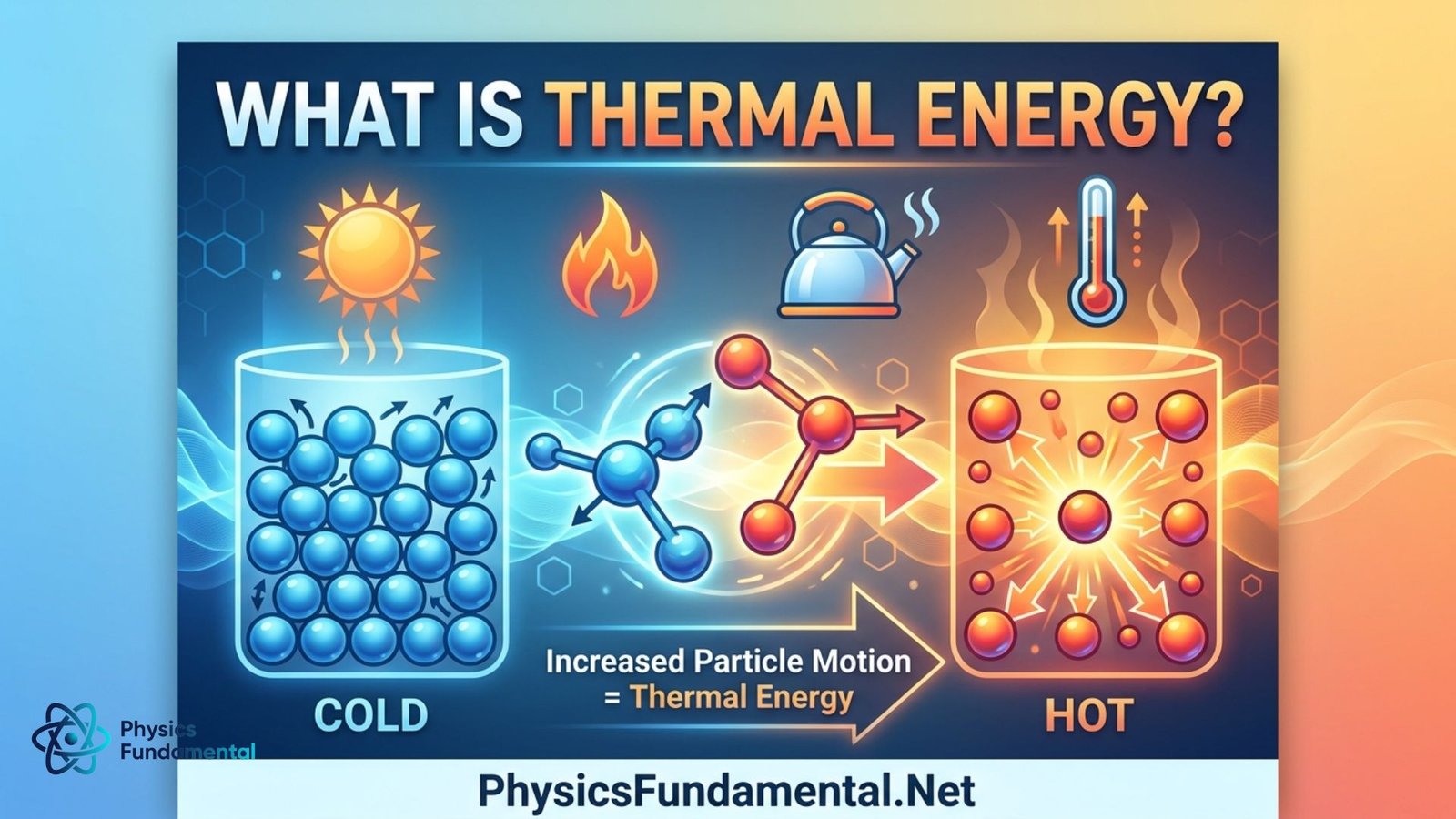
Thermal Energy is energy associated with the microscopic motion and interactions of particles within a substance.
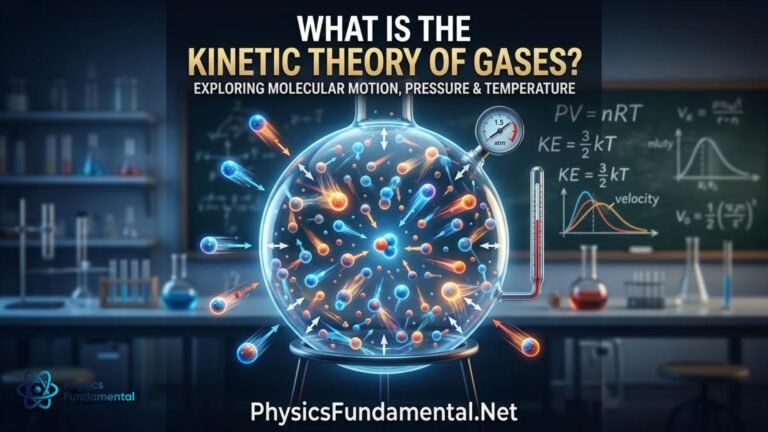
Matter is made of atoms and molecules that are constantly moving. In general, when the microscopic motion of particles increases, the thermal energy of a system can increase.
Thermal energy is related to, but not identical to, temperature.
Temperature describes the average kinetic energy associated with the random motion of particles, while thermal energy depends on the total energy of the particles and therefore also depends on the amount and nature of matter.
For example, a bathtub of warm water can contain more thermal energy than a small cup of very hot water because the bathtub contains much more matter.
What Is Internal Energy?
Internal energy is the total microscopic energy contained within a system.
It includes contributions from:
- Random kinetic energy of particles
- Potential energy associated with interactions between particles
- Other microscopic forms of energy within the material
Internal energy is represented by:
U
A change in internal energy is written as:
ΔU
Thermal energy is often discussed in connection with internal energy, although the terms should not always be treated as exact synonyms.
Thermal Energy vs Temperature
Temperature and thermal energy are different physical quantities.
Temperature indicates the average thermal state of particles.
Thermal energy refers to the energy associated with microscopic particle motion and interactions throughout a system.
Consider two containers of water at the same temperature.
If one contains 1 kg of water and the other contains 10 kg, the larger amount of water contains much more total thermal energy even though both have the same temperature.
This is because thermal energy depends on the amount of matter as well as its temperature.
What Does Q = mcΔT Mean?
The equation:
Q = mcΔT
is commonly used to calculate the thermal energy transferred when a substance changes temperature without undergoing a phase change.
Here:
- Q = thermal energy transferred
- m = mass
- c = specific heat capacity
- ΔT = change in temperature
The temperature change is:
ΔT = T_f − T_i
where:
- T_f = final temperature
- T_i = initial temperature
Therefore:
Q = mc(T_f − T_i)
This equation is useful for heating and cooling calculations.
What Is Specific Heat Capacity?
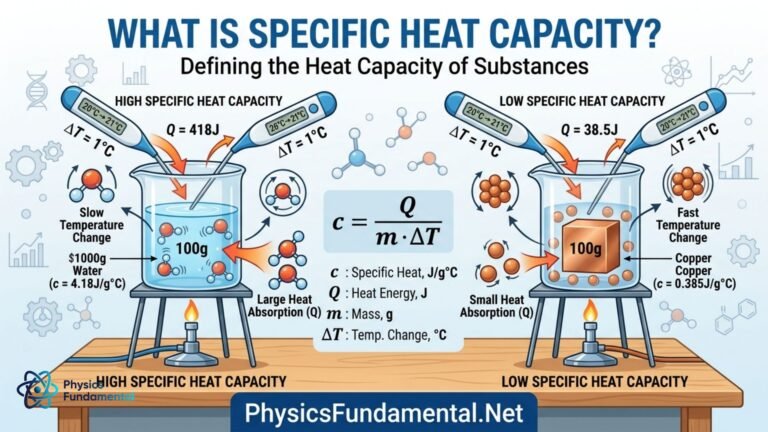
Specific heat capacity tells us how much energy is required to raise the temperature of 1 kilogram of a substance by 1°C or 1 K.
It is represented by:
c
Its SI unit is:
J/(kg·K)
A substance with a high specific heat capacity requires more energy to produce the same temperature increase.
Water has a relatively high specific heat capacity:
c ≈ 4186 J/(kg·K)
This means approximately 4186 joules of energy are needed to raise the temperature of 1 kg of water by 1°C under typical conditions.
Why Does Specific Heat Capacity Matter?
Different materials respond differently to heating.
For example:
- Water heats relatively slowly.
- Many metals heat relatively quickly.
- Sand can become hot rapidly under sunlight.
- Materials with high specific heat capacities can absorb large amounts of energy with relatively smaller temperature changes.
The specific heat capacity therefore helps determine how much energy is required for a particular temperature change.
Worked Example: Heating Water
Suppose 2 kg of water is heated from 20°C to 50°C.
Take:
c = 4186 J/(kg·K)
First calculate the temperature change:
ΔT = 50 − 20
ΔT = 30°C
Now use:
Q = mcΔT
Substitute:
Q = 2 × 4186 × 30
Therefore:
Q = 251,160 J
So approximately:
Q = 2.51 × 10⁵ J
of thermal energy is required, assuming no energy is lost to the surroundings.
Worked Example: Heating Aluminum
Suppose 0.5 kg of aluminum is heated from 25°C to 75°C.
Take the specific heat capacity of aluminum as approximately:
c = 900 J/(kg·K)
Temperature change:
ΔT = 75 − 25 = 50°C
Now:
Q = mcΔT
Q = 0.5 × 900 × 50
Q = 22,500 J
Therefore, approximately 22,500 J of energy is required.
What Happens to Particles When Thermal Energy Increases?
When energy is transferred to a substance and its temperature rises, the average microscopic kinetic energy of its particles generally increases.
For a solid, atoms vibrate more strongly around their positions.
In a liquid, molecules can move and rearrange more actively.
In a gas, molecules generally move faster.
However, the relationship between energy and particle motion becomes more complicated during phase changes.
Thermal Energy During a Phase Change
The equation:
Q = mcΔT
does not directly describe the energy required during a phase change because the temperature can remain constant while energy is being transferred.
Examples include:
- Melting
- Freezing
- Boiling
- Condensation
During a phase change, energy is associated with changing the arrangement and interactions of particles rather than simply increasing their average kinetic energy.
The relevant equation is often:
Q = mL
where:
- Q = energy transferred
- m = mass
- L = specific latent heat
Heating and Temperature
When energy is transferred to a substance without a phase change, its temperature can increase.
For a given material:
Q ∝ m
and:
Q ∝ ΔT
assuming specific heat capacity remains constant.
Therefore, increasing either the mass or the temperature change increases the energy required.
For example, heating twice as much of the same material through the same temperature change requires twice as much energy.
Cooling and Thermal Energy
The same equation can describe cooling.
Suppose an object cools from 100°C to 40°C.
Then:
ΔT = 40 − 100
ΔT = −60°C
Therefore:
Q = mc(−60)
The negative value indicates that energy has been transferred out of the object under the usual sign convention.
The magnitude of the energy transferred is:
|Q| = mc(60)
So the sign tells us the direction of energy transfer.
Thermal Equilibrium
When two objects at different temperatures are placed in thermal contact, thermal energy tends to transfer from the hotter object to the colder object.
This continues until they reach thermal equilibrium, assuming suitable conditions.
At thermal equilibrium:
T₁ = T₂
The objects have the same temperature.
Energy conservation means that, in an isolated system:
Energy lost by hot object = Energy gained by cold object
This principle is commonly used in calorimetry calculations.
Calorimetry
Calorimetry is the measurement of heat transfer.
A simple calorimetry problem might involve mixing hot and cold water.
If the system is sufficiently insulated:
Q_lost + Q_gained = 0
or:
Q_lost = −Q_gained
Using:
Q = mcΔT
we can calculate unknown temperatures, masses, or specific heat capacities.
Worked Example: Mixing Water
Suppose 0.2 kg of hot water at 80°C is mixed with 0.3 kg of water at 20°C. Assume no heat is lost to the surroundings.
Because both samples are water, their specific heat capacities cancel when applying energy conservation.
Energy lost by hot water equals energy gained by cold water:
0.2c(80 − T_f) = 0.3c(T_f − 20)
Cancel c:
0.2(80 − T_f) = 0.3(T_f − 20)
Expand:
16 − 0.2T_f = 0.3T_f − 6
Therefore:
22 = 0.5T_f
So:
T_f = 44°C
The final temperature is approximately 44°C.
You May Like to Read: Transverse Wave Explained: Powerful Properties, Diagrams & Examples 2026
Thermal Energy and the First Law of Thermodynamics
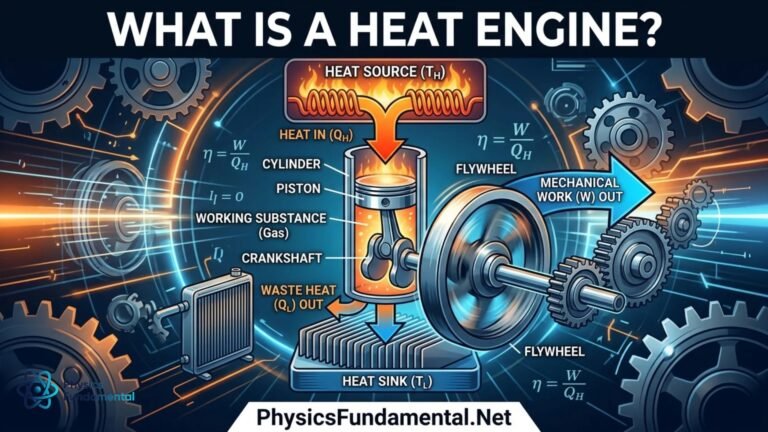
Thermal energy is closely connected to the first law of thermodynamics.
The first law can be expressed as:
ΔU = Q − W
when W represents work done by the system.
Here:
- ΔU = change in internal energy
- Q = energy transferred to the system as heat
- W = work done by the system
This equation expresses conservation of energy.
Energy transferred into a system can increase its internal energy, be transferred out as work, or be distributed between different processes.
Heat vs Thermal Energy
The words heat and thermal energy are sometimes used interchangeably in everyday conversation, but physics distinguishes them.
Thermal energy is energy associated with a system’s microscopic state.
Heat refers to energy transferred between systems because of a temperature difference.
Therefore, heat is a process of energy transfer rather than simply something an object contains.
For example, saying that a hot cup “contains heat” is less precise than saying that it has internal energy and transfers energy as heat to its surroundings.
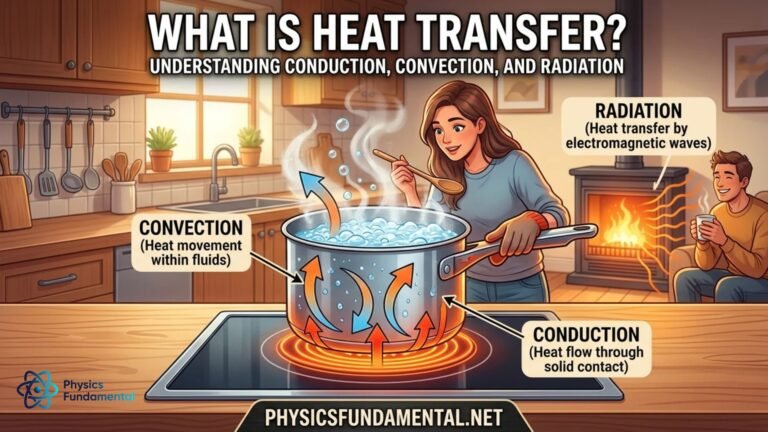
Thermal Energy Transfer
Thermal energy can be transferred through several mechanisms.
Conduction
Conduction transfers energy through microscopic interactions between particles, especially in solids.
Metals are generally good thermal conductors.
Convection
Convection involves the movement of fluids.
Warm fluid can rise while cooler fluid moves downward, producing circulation.
Radiation
Thermal radiation transfers energy through electromagnetic radiation.
Unlike conduction and convection, radiation does not require matter and can transfer energy through a vacuum.
Thermal Energy in Everyday Life
Thermal energy is involved in countless everyday processes.
Cooking
Stoves transfer energy to pots and food, increasing their internal energy and temperature.
Refrigeration
Refrigerators remove thermal energy from their interior and transfer it to the surrounding environment.
Car Engines
Fuel releases chemical energy, and some of that energy eventually appears as thermal energy.
Solar Heating
Solar radiation transfers energy to Earth’s surface, increasing its thermal energy.
Home Insulation
Insulation reduces the rate at which thermal energy is transferred between a building and its surroundings.
Why Water Is Used in Heating Systems
Water is commonly used in heating systems because of its relatively high specific heat capacity.
A large amount of energy can be transferred to water while producing a comparatively moderate temperature increase.
This makes water useful in:
- Central heating
- Cooling systems
- Industrial processes
- Car cooling systems
- Hot-water storage
The equation:
Q = mcΔT
shows exactly why a high specific heat capacity is useful.
Factors Affecting Thermal Energy Required
The energy needed to change a substance’s temperature depends mainly on:
Mass
A larger mass requires more energy for the same temperature change.
Specific Heat Capacity
A substance with a larger c requires more energy for the same mass and temperature change.
Temperature Change
A larger ΔT requires more energy.
These relationships are summarized by:
Q = mcΔT
Common Mistakes With Q = mcΔT
Mistake 1: Forgetting the Temperature Difference
You should use:
ΔT = T_f − T_i
rather than simply inserting the final temperature.
Mistake 2: Using the Wrong Specific Heat Capacity
Different substances have different specific heat capacities.
Always check the material before calculating Q.
Mistake 3: Mixing Units
Mass should normally be expressed in kilograms and specific heat capacity in J/(kg·K).
Mistake 4: Using Q = mcΔT During a Phase Change
During melting or boiling, use latent heat:
Q = mL
when appropriate.
Mistake 5: Confusing Heat With Temperature
A large amount of thermal energy does not automatically mean a high temperature. Mass and material properties matter.
Thermal Energy Formula Summary
The most useful equations include:
Heating or Cooling
Q = mcΔT
Temperature Change
ΔT = T_f − T_i
Specific Heat Capacity
Rearranging Q = mcΔT:
c = Q/(mΔT)
Mass
m = Q/(cΔT)
Temperature Change
ΔT = Q/(mc)
Phase Change
Q = mL
First Law of Thermodynamics
ΔU = Q − W
These equations cover many basic thermal-energy and thermodynamics problems.
Frequently Asked Questions
What is Thermal Energy?
Thermal energy is energy associated with the microscopic motion and interactions of particles within a substance.
What does Q = mcΔT calculate?
It calculates the energy transferred when a substance changes temperature without undergoing a phase change.
What does specific heat capacity mean?
Specific heat capacity is the energy required to raise the temperature of 1 kg of a substance by 1°C or 1 K.
Is thermal energy the same as temperature?
No. Temperature describes the average thermal state of particles, while thermal energy depends on the total microscopic energy of a system.
What happens to thermal energy during a phase change?
Energy can be transferred while the temperature remains constant because the energy is used to change particle interactions and the physical state of the substance.
Conclusion
Thermal Energy is an essential concept for understanding heating, cooling, temperature changes, and thermodynamics. It is associated with microscopic particle motion and interactions, while internal energy describes the total microscopic energy within a system.
The equation Q = mcΔT provides a simple and powerful way to calculate energy transferred when a substance changes temperature without changing phase. The amount of energy depends on the mass, specific heat capacity, and temperature change.
Thermal energy also connects to larger ideas such as conduction, convection, radiation, calorimetry, phase changes, and the first law of thermodynamics. Once you understand the difference between temperature, heat transfer, and internal energy, many everyday thermal processes become much easier to explain.