Thermal Expansion Explained: Powerful ΔL = αL₀ΔT Formula 2026
Have you ever wondered why a metal bridge has small gaps between its sections or why railway tracks are not placed tightly against each other? These designs account for a basic property of matter: materials change size when their temperature changes. This phenomenon is known as Thermal Expansion.
When most materials are heated, their particles gain thermal energy and vibrate more strongly. The average separation between particles increases, causing the material to expand. When the material cools, it generally contracts. The amount of expansion depends on the material, its original size, and the change in temperature.
The simplest case is the expansion of a solid rod or wire. Its change in length can be calculated using ΔL = αL₀ΔT. Understanding this equation makes it much easier to solve thermal expansion problems and understand how engineers account for temperature changes in buildings, bridges, pipes, machines, and other structures.
What Is Thermal Expansion?
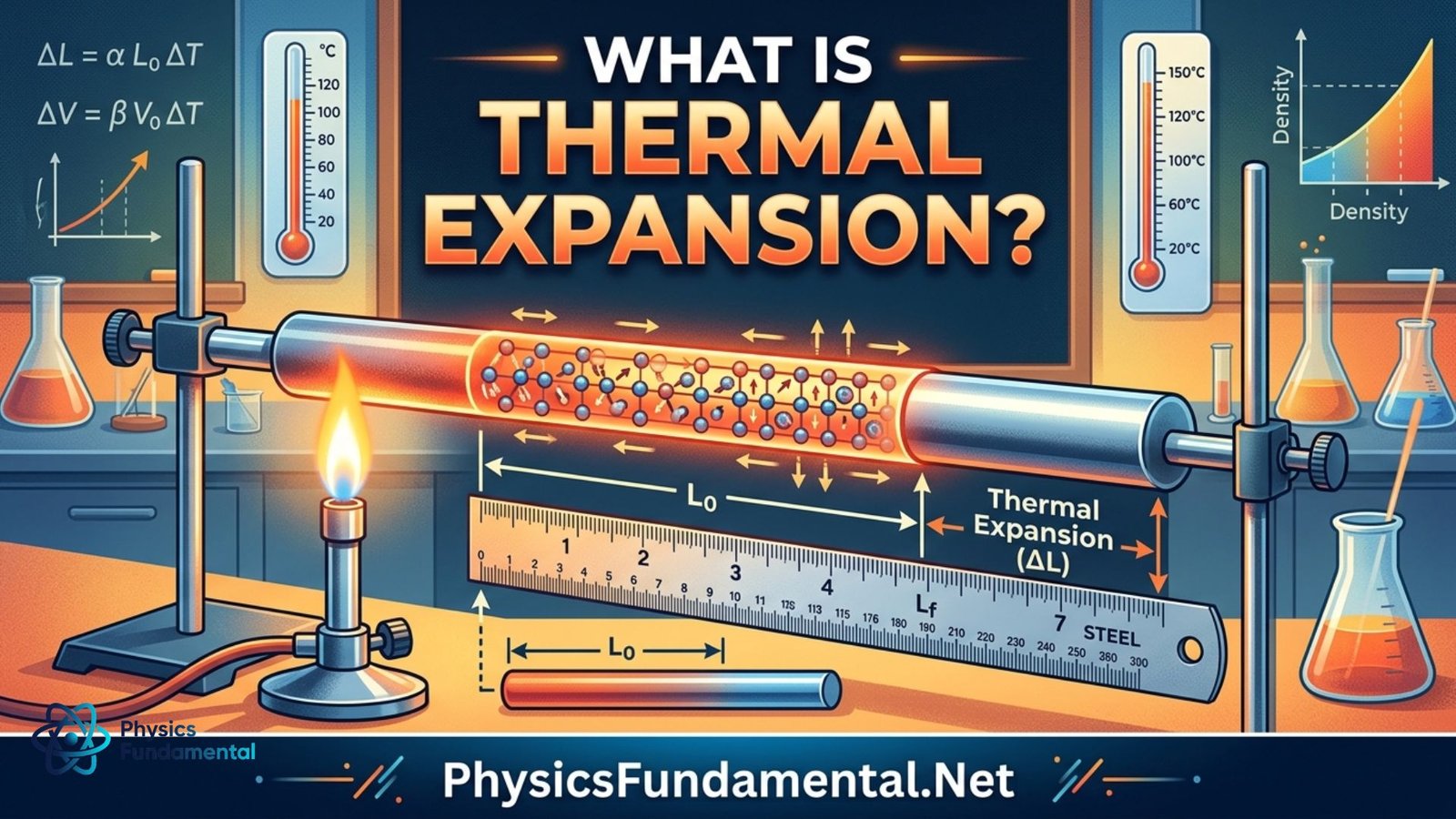
Thermal expansion is the change in the dimensions of a material caused by a change in temperature.
For most materials:
- Heating causes expansion.
- Cooling causes contraction.
Thermal expansion can occur in solids, liquids, and gases, although the behavior is different for each.
For solids, we commonly study three types:
- Linear expansion
- Area expansion
- Volume expansion
The idea is closely connected with thermal expansion and changes in material dimensions.
Why Do Materials Expand When Heated?
Matter is made of atoms or molecules that are constantly moving.
In a solid, particles are held near fixed equilibrium positions by intermolecular forces. When temperature increases, the particles vibrate with greater energy.
Because the forces between particles are not perfectly symmetric, increased vibration can produce a small increase in their average separation.
As a result, the overall dimensions of the material increase.
When temperature decreases, the average separation generally decreases, producing contraction.
This microscopic behavior explains why a solid rod becomes slightly longer when heated.
Linear Thermal Expansion
Linear expansion refers to the change in the length of a material.
The most important equation is:
ΔL = αL₀ΔT
Where:
- ΔL = change in length
- α = coefficient of linear expansion
- L₀ = original length
- ΔT = change in temperature
The temperature change is:
ΔT = T₂ − T₁
Therefore, the final length is:
L = L₀ + ΔL
Substituting the expansion equation:
L = L₀(1 + αΔT)
This is one of the most useful formulas for Thermal Expansion problems involving rods, wires, rails, and similar objects.
What Is the Coefficient of Linear Expansion?
The coefficient of linear expansion, represented by α, describes how much a material expands per unit length for each degree of temperature change.
Its SI unit is:
K⁻¹
It can also be expressed as:
°C⁻¹
For temperature differences, a change of 1 K is equivalent to a change of 1°C.
Different materials have different coefficients of expansion.
For example, metals generally have measurable thermal expansion, while some specialized materials are designed to have extremely low thermal expansion.
Worked Example 1: Expansion of a Metal Rod
A steel rod is 2 m long at 20°C. Its coefficient of linear expansion is approximately:
α = 12 × 10⁻⁶ °C⁻¹
The rod is heated to 70°C. Find its change in length.
First calculate the temperature change:
ΔT = 70 − 20 = 50°C
Use:
ΔL = αL₀ΔT
Substitute:
ΔL = (12 × 10⁻⁶)(2)(50)
ΔL = 1.2 × 10⁻³ m
Therefore:
ΔL = 0.0012 m
or:
ΔL = 1.2 mm
The rod expands by approximately 1.2 mm.
Its final length is:
L = 2 + 0.0012
L = 2.0012 m
Worked Example 2: Finding Final Length
An aluminum rod is 5 m long at 15°C. Its coefficient of linear expansion is:
α = 23 × 10⁻⁶ °C⁻¹
The temperature increases to 95°C. Find the final length.
Temperature change:
ΔT = 95 − 15 = 80°C
First find the change in length:
ΔL = αL₀ΔT
ΔL = (23 × 10⁻⁶)(5)(80)
ΔL = 0.0092 m
Therefore:
ΔL = 9.2 mm
The final length is:
L = 5 + 0.0092
L = 5.0092 m
So the aluminum rod becomes approximately 5.0092 m long.
Worked Example 3: Finding the Coefficient of Expansion
A 3 m metal rod expands by 1.8 mm when its temperature increases by 50°C. Find its coefficient of linear expansion.
We start with:
ΔL = αL₀ΔT
Rearrange:
α = ΔL/(L₀ΔT)
Convert 1.8 mm into meters:
1.8 mm = 0.0018 m
Now substitute:
α = 0.0018/(3 × 50)
α = 1.2 × 10⁻⁵ °C⁻¹
Therefore:
α = 12 × 10⁻⁶ °C⁻¹
Area Thermal Expansion
When a solid surface is heated, its area also increases.
The change in area can be approximated by:
ΔA = βA₀ΔT
Where:
- ΔA = change in area
- β = coefficient of area expansion
- A₀ = original area
- ΔT = temperature change
For an isotropic solid, the coefficient of area expansion is approximately:
β ≈ 2α
Therefore:
ΔA ≈ 2αA₀ΔT
The final area is:
A = A₀ + ΔA
or:
A ≈ A₀(1 + 2αΔT)
Worked Example 4: Area Expansion
A metal plate has an area of 2 m². Its coefficient of linear expansion is:
α = 20 × 10⁻⁶ °C⁻¹
The temperature increases by 50°C.
Find the change in area.
First:
β ≈ 2α
So:
β ≈ 40 × 10⁻⁶ °C⁻¹
Now:
ΔA = βA₀ΔT
ΔA = (40 × 10⁻⁶)(2)(50)
ΔA = 0.004 m²
The area increases by approximately 0.004 m².
Volume Thermal Expansion
When a material expands in all three dimensions, its volume changes.
The equation is:
ΔV = γV₀ΔT
Where:
- ΔV = change in volume
- γ = coefficient of volume expansion
- V₀ = original volume
- ΔT = temperature change
For an isotropic solid:
γ ≈ 3α
Therefore:
ΔV ≈ 3αV₀ΔT
The final volume becomes:
V = V₀ + ΔV
or approximately:
V ≈ V₀(1 + 3αΔT)
Worked Example 5: Volume Expansion
A metal block has a volume of 0.5 m³. Its coefficient of linear expansion is:
α = 15 × 10⁻⁶ °C⁻¹
Its temperature increases by 100°C.
Find the approximate change in volume.
First:
γ ≈ 3α
γ ≈ 45 × 10⁻⁶ °C⁻¹
Now:
ΔV = γV₀ΔT
ΔV = (45 × 10⁻⁶)(0.5)(100)
ΔV = 0.00225 m³
So the volume increases by approximately:
0.00225 m³
Thermal Expansion of Liquids
Liquids do not have a fixed shape, so linear expansion is not normally used to describe them.
Instead, we usually consider volume expansion.
The basic relationship is:
ΔV = γV₀ΔT
Liquids generally expand when heated, but their expansion can be more complicated because the container holding the liquid may also expand.
This is important in devices such as thermometers.
Thermal Expansion of Gases
Gases generally show much greater thermal expansion than solids.
For an ideal gas, the relationship between pressure, volume, and temperature is described by:
PV = nRT
At constant pressure:
V/T = constant
Therefore, if the absolute temperature increases, the volume of a gas increases when pressure remains constant.
This behavior is different from the relatively small expansion typically seen in solids.
Thermal Expansion in Bridges
Bridges can experience significant temperature changes throughout the year.
If a bridge were constructed without allowing for expansion and contraction, temperature changes could produce large mechanical stresses.
Engineers therefore use expansion joints and other design features to allow sections of a bridge to move slightly.
The amount of movement can be estimated using:
ΔL = αL₀ΔT
Even a small expansion coefficient can produce noticeable movement when the original structure is very long.
Thermal Expansion in Railway Tracks
Railway tracks are another important example.
Steel rails expand when their temperature rises and contract when temperatures fall.
If expansion is not properly accommodated, thermal stresses can develop.
Modern railway systems use engineering methods and appropriate track construction to manage temperature-related changes in rail length.
Thermal Expansion in Buildings
Buildings contain many materials that respond to temperature changes.
Concrete, steel, glass, metals, and other construction materials can expand or contract.
Engineers account for these dimensional changes when designing:
- Buildings
- Roads
- Bridges
- Pipelines
- Railway systems
- Industrial equipment
Small dimensional changes can become important when structures are large or when temperatures vary significantly.
Thermal Expansion in Pipes
Pipes carrying hot fluids can become longer as their temperature increases.
For example, pipes in power plants and industrial facilities may experience substantial temperature changes.
If the pipe is completely constrained, its expansion can create large thermal stresses.
Engineers can use bends, expansion loops, sliding supports, and expansion joints to accommodate movement.
You May Like to Read: Wave Particle Duality Explained: Powerful Light & Matter Facts 2026
Thermal Expansion and Gaps
Small gaps are intentionally included in many structures.
Examples include:
- Expansion gaps in bridges
- Spaces between railway tracks
- Gaps in concrete structures
- Expansion joints in buildings
- Flexible connections in pipelines
These spaces allow materials to expand without producing excessive stress.
Thermal Stress
What happens if a material wants to expand but cannot?
A thermal stress can develop.
For a simple fully constrained material, thermal strain is approximately:
ε = αΔT
If the material is prevented from expanding, the resulting stress can be related to Young’s modulus:
σ = EαΔT
where:
- σ = thermal stress
- E = Young’s modulus
- α = coefficient of linear expansion
- ΔT = temperature change
This simplified equation assumes idealized conditions and a fully constrained material.
Thermal stress is important in engineering because excessive stress can cause cracking, bending, deformation, or structural failure.
Thermal Strain
Thermal strain measures the fractional change in length.
It is defined as:
ε = ΔL/L₀
For thermal expansion:
ε = αΔT
This shows that thermal strain depends on the material’s coefficient of expansion and the temperature change.
It does not directly depend on the object’s original length.
However, the actual change in length does depend on the original length:
ΔL = αL₀ΔT
What Happens to a Hole in a Metal Plate?
A common conceptual question asks whether a hole in a metal plate becomes smaller or larger when the plate is heated.
The hole becomes larger.
Imagine that the hole is surrounded by metal. If the entire plate expands uniformly, every length scale increases, including the diameter of the hole.
If the original diameter is D₀, its approximate change is:
ΔD = αD₀ΔT
Therefore:
D = D₀(1 + αΔT)
This is an important example of why thermal expansion affects the overall geometry of an object.
Factors Affecting Thermal Expansion
The amount of expansion depends mainly on:
Material
Different materials have different coefficients of expansion.
Original Size
A longer object undergoes a larger absolute change in length for the same material and temperature change.
Temperature Change
A larger temperature change generally produces greater expansion.
The linear relationship is:
ΔL ∝ αL₀ΔT
Positive and Negative Thermal Expansion
Most materials expand when heated, giving them a positive coefficient of thermal expansion.
However, some materials and structures can exhibit unusual behavior over particular temperature ranges.
For example, certain engineered materials are designed to have very low or controlled thermal expansion.
Water also has unusual thermal behavior near its freezing point. Between 0°C and 4°C, water contracts as it is heated, reaching its maximum density near 4°C under ordinary atmospheric pressure.
This behavior is important in natural bodies of water and aquatic ecosystems.
Thermal Expansion and Temperature Scales
For equations involving temperature differences, Celsius and Kelvin differences have the same numerical size.
For example:
ΔT = 50°C
corresponds to:
ΔT = 50 K
However, absolute temperature calculations involving gas laws require the Kelvin scale.
This distinction is important when selecting equations.
Common Mistakes in Thermal Expansion Problems
Mistake 1: Using Final Length Instead of Original Length
The basic equation is:
ΔL = αL₀ΔT
Use the original length L₀.
Mistake 2: Forgetting to Calculate Temperature Change
Do not automatically use the final temperature.
Calculate:
ΔT = T₂ − T₁
Mistake 3: Forgetting Unit Conversions
Convert millimeters, centimeters, or kilometers into the units required by the equation.
Mistake 4: Confusing α, β, and γ
Remember:
- α → linear expansion
- β → area expansion
- γ → volume expansion
For an isotropic solid:
β ≈ 2α
γ ≈ 3α
Mistake 5: Assuming Every Material Expands by the Same Amount
Thermal expansion depends strongly on the material.
Two objects with the same size and temperature change can expand by different amounts because their coefficients of expansion are different.
How to Solve Thermal Expansion Problems
A reliable approach is:
- Identify the original dimension.
- Find the coefficient of expansion.
- Calculate the temperature change.
- Select the correct expansion equation.
- Substitute values with consistent units.
- Calculate the dimensional change.
- Add the change to the original dimension if the final dimension is required.
- Check whether the result is physically reasonable.
For linear expansion, the main equation is:
ΔL = αL₀ΔT
For area:
ΔA = βA₀ΔT
For volume:
ΔV = γV₀ΔT
Thermal Expansion Formula Summary
| Type | Formula |
|---|---|
| Linear expansion | ΔL = αL₀ΔT |
| Final length | L = L₀(1 + αΔT) |
| Area expansion | ΔA = βA₀ΔT |
| Area coefficient | β ≈ 2α |
| Volume expansion | ΔV = γV₀ΔT |
| Volume coefficient | γ ≈ 3α |
| Thermal strain | ε = αΔT |
| Thermal stress, constrained | σ = EαΔT |
| Temperature change | ΔT = T₂ − T₁ |
These formulas provide the foundation for most introductory Thermal Expansion calculations.
Frequently Asked Questions
What is the formula for Thermal Expansion?
For linear expansion, the main formula is ΔL = αL₀ΔT, where α is the coefficient of linear expansion.
What does α mean in thermal expansion?
The symbol α represents the coefficient of linear expansion and indicates how much a material expands per unit length per degree of temperature change.
Does a hole expand when a metal plate is heated?
Yes. A hole in a uniformly heated metal plate becomes larger because all dimensions of the plate expand.
What are the three types of thermal expansion?
The three main types are linear expansion, area expansion, and volume expansion.
Why are expansion gaps used in bridges?
Expansion gaps allow bridge materials to expand and contract with temperature changes, reducing the buildup of damaging thermal stresses.
Conclusion
Thermal Expansion describes the change in the dimensions of a material as its temperature changes. In most ordinary materials, heating increases the dimensions while cooling causes contraction. The effect may be small for a short object, but it can become significant in long bridges, railway tracks, pipes, buildings, and other large structures.
The most important equation for linear expansion is ΔL = αL₀ΔT. For changes in area and volume, the corresponding relationships are ΔA = βA₀ΔT and ΔV = γV₀ΔT. These formulas allow you to calculate how much a material expands when its original dimensions, material coefficient, and temperature change are known.
Understanding thermal expansion is important not only for solving physics problems but also for understanding real engineering designs. Expansion joints, gaps, flexible pipe connections, and temperature-resistant materials all demonstrate how the principles of thermal expansion are applied in the real world.