Why Is Projectile Motion a Parabola? Powerful Physics Explained 2026
Why does a thrown ball follow a curved path instead of moving in a straight line? The answer comes from the combination of horizontal motion and vertical motion under gravity. When air resistance is ignored, these two components combine to produce a mathematical curve called a parabola.
The question why is projectile motion a parabola can be answered directly by looking at the equations of motion. Horizontally, a projectile moves with constant velocity, while vertically it accelerates downward at a constant rate due to gravity. When time is eliminated from these two equations, the resulting position equation has a squared term, which is the mathematical form of a parabola.
This principle applies to many ideal projectile problems, including a ball thrown through the air, a stone launched from a cliff, or an object fired at an angle. Understanding the derivation makes projectile-motion formulas much easier to remember and use.
What Is Projectile Motion?
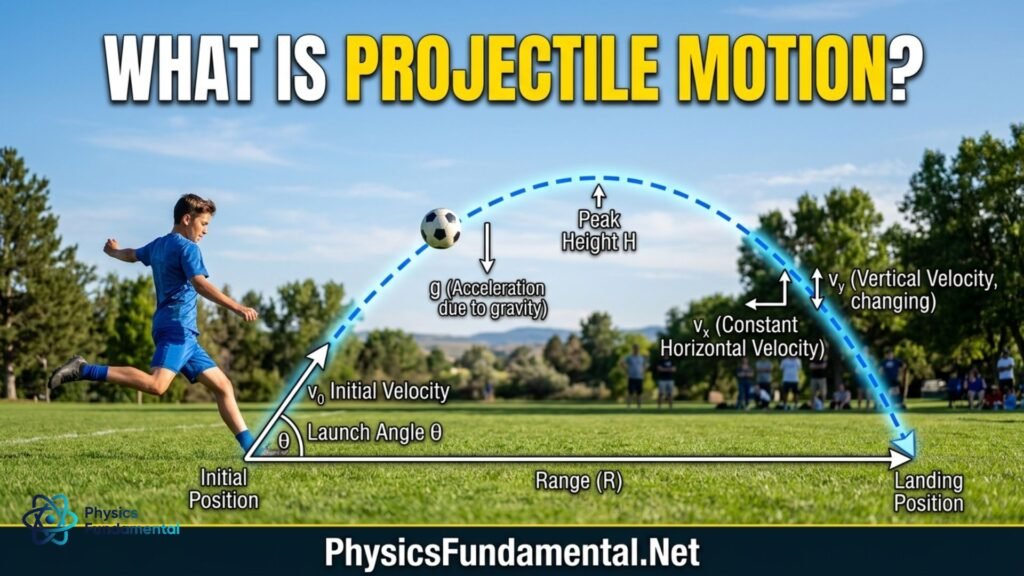
Projectile motion is the motion of an object launched into the air that subsequently moves under the influence of gravity, assuming air resistance is negligible.
Examples include:
- A ball thrown at an angle
- A stone launched from the ground
- Water leaving a fountain
- A basketball traveling toward a hoop
- An object launched from a platform
The path followed by the projectile is called its trajectory.
In ideal conditions, the trajectory is a parabola.
Why Is Projectile Motion a Parabola?
The key reason is that projectile motion combines:
- Uniform horizontal motion
- Uniformly accelerated vertical motion
Suppose an object is launched with an initial velocity u at an angle θ above the horizontal.
The initial velocity has two components:
uₓ = u cosθ
uᵧ = u sinθ
Since gravity acts vertically downward, the horizontal acceleration is zero:
aₓ = 0
The vertical acceleration is:
aᵧ = −g
Therefore, the horizontal position after time t is:
x = u cosθ · t
The vertical position is:
y = u sinθ · t − ½gt²
The important part is the t² term in the vertical equation.
To find the shape of the trajectory, we eliminate time from these equations.
Deriving the Parabolic Equation
Start with the horizontal equation:
x = u cosθ · t
Solve for time:
t = x/(u cosθ)
Now substitute this into the vertical equation:
y = u sinθ · t − ½gt²
Therefore:
y = u sinθ [x/(u cosθ)] − ½g[x/(u cosθ)]²
Simplifying the first term:
y = x tanθ − ½g x²/(u²cos²θ)
So the trajectory equation becomes:
y = x tanθ − gx²/(2u²cos²θ)
This is the equation of a parabola because it has the general form:
y = ax − bx²
where a and b are constants for a particular launch.
The squared x² term is the mathematical reason the projectile follows a parabolic trajectory.
The Role of Gravity
Gravity is essential to the curved trajectory.
Without gravity, an object moving through the air with no other force would continue in a straight line at constant velocity.
With gravity acting downward:
- Horizontal velocity remains constant.
- Vertical velocity continuously changes.
- The object rises, reaches a maximum height, and then falls.
The combination creates the curved path.
The projectile motion and trajectory in classical mechanics of an ideal projectile can therefore be described using these kinematic equations.
Horizontal Motion
The horizontal motion is particularly simple because gravity does not directly accelerate the object horizontally.
Therefore:
aₓ = 0
and:
vₓ = u cosθ
The horizontal position is:
x = u cosθ · t
This means the projectile travels equal horizontal distances in equal intervals of time.
Vertical Motion
The vertical motion is affected by gravity.
The initial vertical velocity is:
uᵧ = u sinθ
The vertical velocity after time t is:
vᵧ = u sinθ − gt
The vertical position is:
y = u sinθ · t − ½gt²
Because of the negative gt² term, the vertical position does not increase linearly with time.
This changing vertical motion combined with constant horizontal motion produces the parabola.
A Simple Way to Understand the Parabola
Imagine taking photographs of a projectile at equal time intervals.
During each interval, the object moves approximately the same horizontal distance because its horizontal velocity is constant.
But its vertical movement changes because gravity continuously accelerates it downward.
For example, the projectile might move:
Horizontal: equal distances
Vertical: increasingly downward relative to what it would do without gravity
The resulting points form a parabolic curve.
Worked Example: Finding the Trajectory
A ball is launched at:
u = 20 m/s
at an angle of:
θ = 30°
Find the equation of its trajectory. Take:
g = 9.8 m/s²
The trajectory equation is:
y = x tanθ − gx²/(2u²cos²θ)
For θ = 30°:
tan30° ≈ 0.577
and:
cos30° ≈ 0.866
Therefore:
u² = 20² = 400
and:
cos²30° ≈ 0.75
Substitute:
y = 0.577x − (9.8x²)/(2 × 400 × 0.75)
The denominator is:
2 × 400 × 0.75 = 600
So:
y ≈ 0.577x − 0.0163x²
The equation contains the x² term, confirming that the trajectory is parabolic.
Why Does the Projectile Rise First?
When a projectile is launched upward at an angle, it initially has an upward vertical velocity:
uᵧ = u sinθ
Gravity acts downward and gradually reduces this upward velocity.
At the highest point:
vᵧ = 0
Using:
vᵧ = u sinθ − gt
we get:
0 = u sinθ − gt
Therefore, the time to reach maximum height is:
tₕ = u sinθ/g
After this point, gravity causes the projectile to move downward.
Maximum Height
For a projectile launched and landing at the same vertical level, the maximum height is:
H = u²sin²θ/(2g)
This equation shows that maximum height depends on:
- Initial speed
- Launch angle
- Gravitational acceleration
A larger initial vertical velocity produces a greater maximum height.
Horizontal Range
The horizontal range is the total horizontal distance traveled before the projectile returns to its original vertical level.
For an ideal projectile:
R = u²sin2θ/g
The maximum range occurs when:
θ = 45°
provided the launch and landing heights are the same and air resistance is neglected.
Time of Flight
For a projectile that starts and ends at the same vertical level:
T = 2u sinθ/g
This is the total time the object remains in the air.
The three major projectile-motion equations are therefore:
Range:
R = u²sin2θ/g
Maximum height:
H = u²sin²θ/(2g)
Time of flight:
T = 2u sinθ/g
Why Is the Path Symmetrical?
In ideal projectile motion, when the projectile lands at the same height from which it was launched, the path is symmetrical.
The projectile has:
- The same speed magnitude at equal heights.
- Equal time intervals going up and coming down.
- Equal vertical displacements on corresponding sides of the highest point.
For example, if a projectile takes 2 seconds to reach its maximum height, it will take another 2 seconds to return to its original height.
This symmetry is a consequence of constant gravitational acceleration and the absence of air resistance.
Is Every Projectile Path a Perfect Parabola?
No.
The parabolic trajectory applies to the ideal projectile-motion model, where air resistance is ignored and gravitational acceleration is treated as constant.
In the real world, air resistance can significantly change the trajectory.
Drag depends on factors such as:
- Speed
- Shape
- Cross-sectional area
- Air density
- Surface characteristics
Because of air resistance, real projectiles generally follow paths that are not perfect mathematical parabolas.
What Happens When Air Resistance Is Included?
When air resistance is significant, the horizontal velocity is no longer constant.
The projectile loses horizontal speed as it moves through the air.
The vertical motion is also affected by drag.
As a result:
- The path becomes asymmetric.
- The range becomes shorter.
- The maximum height decreases.
- The descending path differs from the ascending path.
The exact trajectory then requires more complicated equations, often involving differential equations and numerical methods.
Projectile Motion From a Height
A projectile does not have to be launched from ground level.
Suppose an object is launched from a platform at height h.
Its vertical position can be written as:
y = h + u sinθ · t − ½gt²
The horizontal position remains:
x = u cosθ · t
Eliminating time still produces a quadratic relationship between x and y when gravity is constant and air resistance is ignored.
Therefore, the trajectory remains parabolic.
Horizontal Projectile
What happens if an object is launched horizontally?
In this case:
θ = 0°
Therefore:
uᵧ = 0
The horizontal motion is:
x = ut
The vertical displacement is:
y = −½gt²
Since:
t = x/u
we get:
y = −gx²/(2u²)
Again, the equation contains x².
Therefore, a horizontally launched projectile also follows a parabola under ideal conditions.
Worked Example: Horizontal Projectile
A ball rolls horizontally off a 20 m high cliff with a horizontal speed of 10 m/s. Ignoring air resistance, how far does it travel horizontally before hitting the ground?
First find the fall time.
Use:
h = ½gt²
Therefore:
t = √(2h/g)
Substitute:
t = √(40/9.8)
t ≈ 2.02 s
Horizontal distance:
x = ut
x = 10 × 2.02
x ≈ 20.2 m
The ball travels approximately 20.2 m horizontally.
Why the Horizontal and Vertical Motions Can Be Treated Separately
One of the most useful ideas in projectile motion is that the horizontal and vertical components can be analyzed independently.
Gravity affects the vertical component but not the horizontal component in the ideal model.
Therefore:
Horizontal:
x = uₓt
Vertical:
y = uᵧt − ½gt²
These equations are connected because both use the same time t.
When time is eliminated, the two independent components combine into the parabolic trajectory.
You May Like to Read: Thermal Expansion Explained: Powerful ΔL = αL₀ΔT Formula 2026
Projectile Motion and Quadratic Equations
The mathematical structure of projectile motion is closely related to quadratic equations.
The vertical displacement has the form:
y = At − Bt²
After replacing time using the horizontal equation, we get:
y = Ax − Bx²
A quadratic relationship between y and x represents a parabola.
This provides a simple mathematical explanation for the trajectory without needing advanced mathematics.
Common Examples of Projectile Motion
Projectile motion appears in many situations.
Sports
Examples include:
- Basketball shots
- Football passes
- Tennis balls
- Baseball throws
- Soccer kicks
Water Fountains
Water leaving a nozzle can form an approximately parabolic path when the flow speed and gravity dominate and air resistance is relatively small.
Engineering
Projectile calculations are used to analyze the paths of objects launched through the air.
Physics Experiments
Projectile motion is frequently used in laboratories to study acceleration due to gravity and two-dimensional motion.
Common Mistakes
Mistake 1: Assuming Horizontal Acceleration Is g
Gravity acts vertically downward, so in the ideal model:
aₓ = 0
and:
aᵧ = −g
Mistake 2: Using the Total Velocity as the Horizontal Velocity
The horizontal component is:
uₓ = u cosθ
The vertical component is:
uᵧ = u sinθ
Mistake 3: Forgetting That Gravity Acts During the Entire Flight
Gravity does not stop acting when the projectile reaches maximum height.
At the highest point, only the vertical velocity is zero. The acceleration is still:
−g
Mistake 4: Assuming Every Real Projectile Has a Perfect Parabolic Path
The ideal parabolic model ignores air resistance.
Real objects can deviate significantly from a parabola.
Mistake 5: Confusing Maximum Height With Range
Maximum height describes the greatest vertical displacement.
Range describes horizontal displacement.
They are different quantities.
How to Recognize a Parabolic Trajectory
You can identify the ideal projectile trajectory by checking three conditions:
- The object is moving under constant gravitational acceleration.
- Air resistance is negligible.
- The horizontal acceleration is zero.
Under these assumptions:
x ∝ t
while:
y ∝ t²
Eliminating t gives:
y ∝ x²
which is the mathematical signature of a parabola.
Key Formulas for Projectile Motion
Horizontal Velocity
uₓ = u cosθ
Vertical Velocity
uᵧ = u sinθ
Horizontal Position
x = u cosθ · t
Vertical Position
y = u sinθ · t − ½gt²
Trajectory Equation
y = x tanθ − gx²/(2u²cos²θ)
Time to Maximum Height
tₕ = u sinθ/g
Maximum Height
H = u²sin²θ/(2g)
Total Time of Flight
T = 2u sinθ/g
Horizontal Range
R = u²sin2θ/g
The trajectory equation is especially important for answering why is projectile motion a parabola, because it directly contains the squared horizontal coordinate.
Frequently Asked Questions
Why is projectile motion a parabola?
Projectile motion is a parabola because horizontal position is proportional to time while vertical position contains a time-squared term due to gravity. Eliminating time produces a quadratic equation in x.
Does every projectile follow a parabolic path?
Only under ideal conditions where air resistance is ignored and gravitational acceleration is treated as constant.
Why does gravity make projectile motion curved?
Gravity continuously accelerates the projectile downward while its horizontal velocity remains constant, creating a curved trajectory.
What is the equation of a projectile’s path?
For an ideal projectile, the trajectory is y = x tanθ − gx²/(2u²cos²θ).
Is horizontal projectile motion also a parabola?
Yes. A horizontally launched object follows a parabolic path under ideal conditions because its vertical displacement is proportional to the square of its horizontal position.
Conclusion
The answer to why is projectile motion a parabola comes directly from the combination of horizontal and vertical motion. A projectile has constant horizontal velocity when air resistance is ignored, while gravity gives it constant downward acceleration.
The horizontal position varies linearly with time:
x = u cosθ · t
while the vertical position varies quadratically:
y = u sinθ · t − ½gt²
When time is eliminated, the result is:
y = x tanθ − gx²/(2u²cos²θ)
This equation has a squared x term, making the trajectory a parabola. The same principle applies to angled and horizontal projectiles, provided the ideal assumptions of constant gravity and negligible air resistance are valid.
Understanding this derivation is more useful than simply memorizing that projectile motion is parabolic. It shows exactly how gravity, velocity components, time, and mathematics combine to produce one of the most familiar trajectories in classical physics.