Young’s Modulus: 7 Powerful Benefits, Facts & Formula Explained 2026
What happens when you pull on a metal wire? It stretches. The amount it stretches depends on the material, the applied force, and the dimensions of the object. Young’s modulus gives us a way to describe how strongly a material resists stretching or compression.
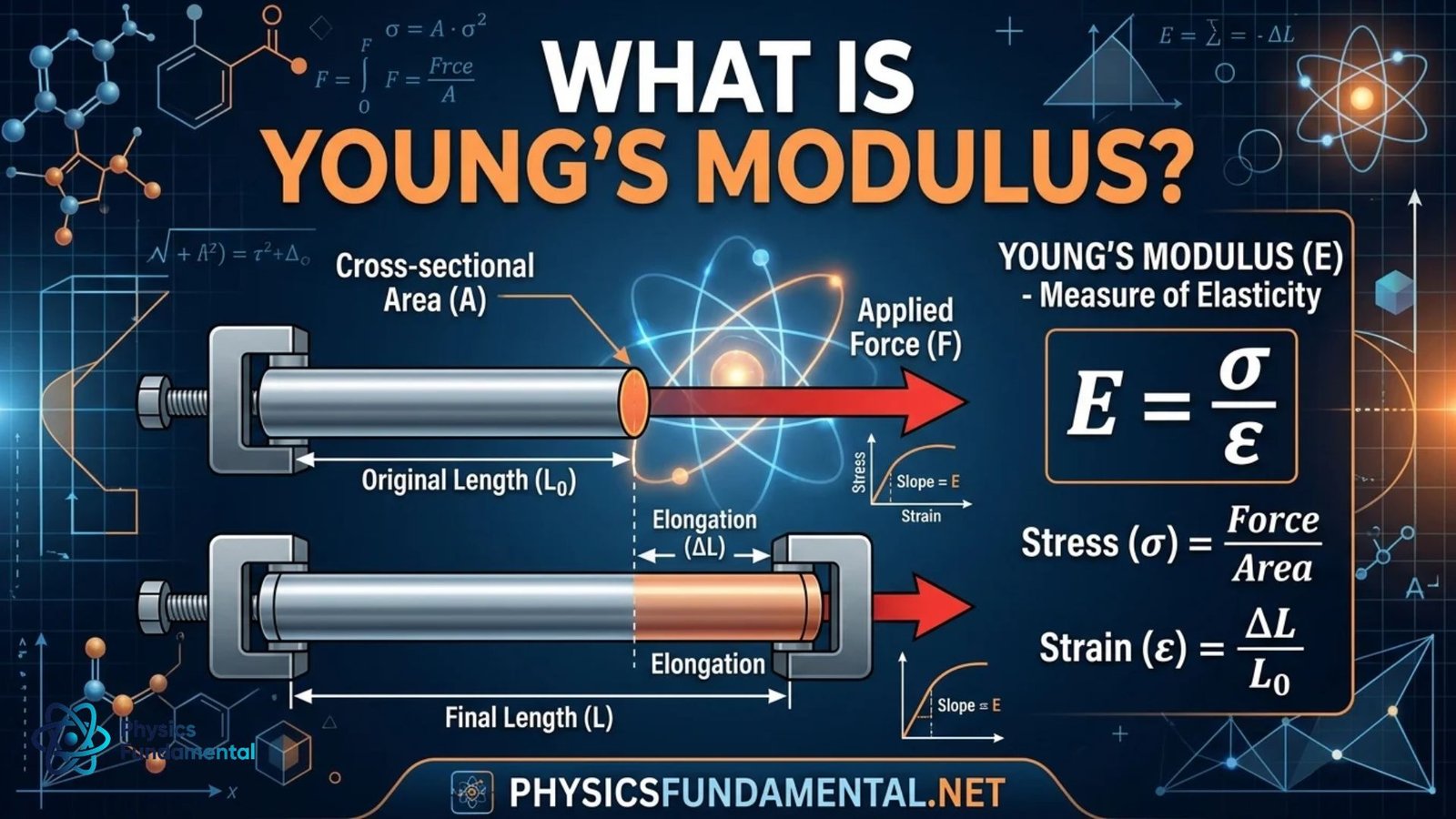
Young’s modulus is an important measure of the stiffness of a material. It connects stress and strain through the equation E = σ/ε. In simple terms, a material with a high Young’s modulus is difficult to stretch, while a material with a low Young’s modulus deforms more easily.
The concept is widely used in physics and engineering to understand how materials behave under forces. It helps engineers select materials for buildings, bridges, machines, vehicles, medical devices, and many other structures.
What Is Young’s Modulus?

Young’s modulus is a measure of a material’s resistance to elastic deformation when subjected to tensile or compressive stress.
It is represented by the letter E.
The basic equation is:
E = σ/ε
where:
- E = Young’s modulus
- σ = stress
- ε = strain
Young’s modulus is commonly measured in pascals (Pa).
Because stress has units of pascals and strain is dimensionless, Young’s modulus also has units of pascals.
A high value of Young’s modulus means the material is relatively stiff. A low value means the material is relatively easy to deform elastically.
What Is Stress?
Stress describes the internal force per unit cross-sectional area that develops within a material when an external force is applied.
For normal tensile or compressive stress:
σ = F/A
where:
- σ = stress
- F = applied force
- A = cross-sectional area
The SI unit of stress is the pascal (Pa).
Since:
1 Pa = 1 N/m²
stress can also be expressed in newtons per square meter.
Tensile Stress
Tensile stress occurs when forces pull an object apart.
For example, imagine a metal wire being pulled from both ends. The wire experiences tensile stress.
Compressive Stress
Compressive stress occurs when forces push an object together.
A column supporting a heavy building, for example, can experience significant compressive stress.
Young’s modulus can be used for both tensile and compressive deformation as long as the material is behaving within the appropriate elastic range.
What Is Strain?
Strain measures how much an object deforms relative to its original dimensions.
For linear tensile strain:
ε = ΔL/L₀
where:
- ε = strain
- ΔL = change in length
- L₀ = original length
Strain has no SI unit because it is a ratio of two lengths.
It is often written as a decimal or percentage.
For example, if a 2 m rod becomes 2.01 m long:
ΔL = 2.01 − 2.00
ΔL = 0.01 m
Therefore:
ε = 0.01/2
ε = 0.005
As a percentage:
ε = 0.5%
The rod has experienced a tensile strain of 0.5%.
Understanding E = σ/ε
The equation:
E = σ/ε
is the central formula for Young’s modulus.
It tells us that, in the linear elastic region, Young’s modulus is the ratio of stress to strain.
Rearranging the equation gives:
σ = Eε
This form can be useful when you know the material’s Young’s modulus and the strain.
For example, if a material has a Young’s modulus of 200 GPa and experiences a strain of 0.001:
σ = Eε
σ = (200 GPa)(0.001)
σ = 0.2 GPa
or:
σ = 200 MPa
The relationship shows that a stiffer material requires greater stress to produce the same strain.
Young’s Modulus Formula
The complete relationship can be written by substituting the formulas for stress and strain into E = σ/ε.
We know:
σ = F/A
and:
ε = ΔL/L₀
Therefore:
E = (F/A)/(ΔL/L₀)
which becomes:
E = FL₀/(AΔL)
This equation is useful when the applied force, original length, cross-sectional area, and change in length are known.
Variables in the Formula
- E = Young’s modulus
- F = applied force
- L₀ = original length
- A = original cross-sectional area
- ΔL = change in length
Young’s Modulus Unit
The SI unit of Young’s modulus is the pascal (Pa).
Because one pascal is relatively small compared with the stiffness of many engineering materials, Young’s modulus is often expressed using larger units such as:
- kPa = kilopascal
- MPa = megapascal
- GPa = gigapascal
For example:
1 GPa = 10⁹ Pa
Many metals have Young’s modulus values in the range of tens to hundreds of gigapascals.
Young’s Modulus and Elasticity
Young’s modulus is closely connected to elasticity.
An object is elastically deformed when it can return to its original shape and dimensions after the applied load is removed, provided the deformation remains within the material’s elastic limits.
For small deformations in the linear elastic region, stress and strain are proportional:
σ ∝ ε
Therefore:
σ = Eε
Young’s modulus represents the slope of this linear relationship between stress and strain.
The concept of elasticity in materials is therefore important when interpreting Young’s modulus and the stress-strain curve.
Stress-Strain Curve
A stress-strain curve shows how a material responds as stress is increased.
A simplified curve can be represented as:
Stress
  ↑
  |                         /
  |                       /
  |                     /
  |                   /
  |                 /
  |_______________/____________→ Strain
          Elastic region
The exact shape depends on the material.
In the initial linear portion of the curve, stress is proportional to strain. The slope of this region is Young’s modulus.
A steep slope indicates a high Young’s modulus, while a shallow slope indicates a lower Young’s modulus.
Young’s Modulus as the Slope of a Graph
If stress is plotted on the vertical axis and strain on the horizontal axis, Young’s modulus is the slope of the linear elastic region.
The slope is:
E = Δσ/Δε
Because strain has no unit, the slope has the same unit as stress: pascals.
This provides a useful graphical interpretation of Young’s modulus.
High Young’s Modulus
A steep stress-strain graph indicates that a relatively large stress is needed to produce a small amount of strain.
The material is relatively stiff.
Low Young’s Modulus
A less steep graph indicates that a smaller stress can produce a larger strain.
The material is relatively flexible or compliant.
Worked Example 1: Finding Stress
A force of 1,000 N is applied to a rod with a cross-sectional area of 0.002 m².
Use:
σ = F/A
Substitute:
σ = 1000/0.002
σ = 500,000 Pa
Therefore:
σ = 5 × 10⁵ Pa
or:
σ = 0.5 MPa
Worked Example 2: Finding Strain
A wire has an original length of 2 m and stretches by 1 mm.
First convert the change in length:
1 mm = 0.001 m
Now use:
ε = ΔL/L₀
ε = 0.001/2
ε = 0.0005
As a percentage:
ε = 0.05%
Therefore, the strain is 0.0005, or 0.05%.
Worked Example 3: Finding Young’s Modulus
Suppose a material experiences a stress of 150 MPa and a strain of 0.00075 within its linear elastic region.
Use:
E = σ/ε
Convert stress to pascals:
150 MPa = 150 × 10⁶ Pa
Then:
E = (150 × 10⁶)/0.00075
E = 200 × 10⁹ Pa
Therefore:
E = 200 GPa
This result is consistent with the order of magnitude expected for a stiff engineering material.
Worked Example 4: Finding Extension
Suppose a wire has:
- Young’s modulus = 100 GPa
- Length = 2 m
- Cross-sectional area = 1 × 10⁻⁴ m²
- Applied force = 5,000 N
We use:
E = FL₀/(AΔL)
Rearrange for extension:
ΔL = FL₀/(AE)
Convert Young’s modulus:
E = 100 × 10⁹ Pa
Now substitute:
ΔL = (5000)(2) / [(1 × 10⁻⁴)(100 × 10⁹)]
ΔL = 0.001 m
Therefore:
ΔL = 1 mm
The wire stretches by approximately 1 mm under the given assumptions.
What Does a High Young’s Modulus Mean?
A high Young’s modulus means that a material strongly resists elastic stretching or compression.
For the same stress, a material with a higher Young’s modulus experiences less strain than a material with a lower Young’s modulus, assuming both remain within the same linear elastic type of behavior.
This makes high-modulus materials useful where stiffness and dimensional stability are important.
What Does a Low Young’s Modulus Mean?
A low Young’s modulus means that a material deforms more easily under a given stress.
Such materials can be useful when flexibility is desirable.
However, Young’s modulus alone does not tell us everything about how a material behaves. Strength, toughness, ductility, fatigue resistance, and other properties are also important when selecting a material.
You May Like to Read: Magnetic Flux & Faraday’s Law: Powerful Formula, Examples & Facts 2026
Young’s Modulus vs Elastic Limit
Young’s modulus and elastic limit describe different properties.
Young’s modulus measures stiffness in the linear elastic region.
The elastic limit is the greatest stress a material can experience while still returning to its original shape after the load is removed, within the relevant idealization.
A material can have a high Young’s modulus but still have a particular elastic limit determined by its material structure and processing.
Therefore, stiffness and maximum elastic stress should not be treated as the same thing.
Young’s Modulus vs Strength
Strength describes how much stress a material can withstand before a particular type of failure or permanent deformation occurs.
Young’s modulus describes stiffness.
This distinction is important.
A material can be very stiff but not necessarily have the highest strength. Likewise, a material can be relatively flexible while still being capable of handling substantial loads.
Engineers therefore consider both stiffness and strength when designing structures.
Young’s Modulus vs Stiffness
Young’s modulus is a material property, while stiffness can refer to how strongly a particular object or structure resists deformation.
The dimensions of an object matter when determining its overall stiffness.
For example, two rods made from the same material have the same Young’s modulus, but a thicker rod generally stretches less than a thinner rod under the same force because their cross-sectional areas are different.
Young’s modulus describes the material itself, while structural stiffness depends on material properties and geometry.
Factors Affecting Measured Young’s Modulus
Young’s modulus is generally considered a material property, but experimental measurements can be influenced by several factors.
Material Composition
Different materials have different atomic structures and bonding characteristics, producing different stiffness values.
Temperature
Temperature can affect material behavior and therefore influence measured mechanical properties.
Material Processing
Manufacturing processes such as heat treatment, alloying, and forming can affect the mechanical behavior of materials.
Direction
Some materials have properties that depend on direction. These are called anisotropic materials.
For such materials, the relationship between stress and strain can vary depending on the direction of loading.
Applications of Young’s Modulus
Young’s modulus is used in many areas of engineering and science.
Building and Structural Engineering
Engineers need to understand how structural materials deform under loads.
Young’s modulus helps estimate deformation in beams, rods, columns, and other structural components.
Mechanical Engineering
Machine components can experience tensile and compressive loads.
Young’s modulus helps engineers predict how components will stretch or compress under operating conditions.
Aerospace Engineering
Aircraft and spacecraft require materials that combine appropriate stiffness with other properties such as strength and low mass.
Young’s modulus is one of many properties considered during material selection.
Automotive Engineering
Vehicle components can experience different mechanical loads.
Understanding elastic deformation helps engineers design components that maintain their required dimensions during operation.
Biomedical Engineering
Materials used in medical devices and implants need mechanical properties appropriate for their intended environment.
Young’s modulus can help compare the stiffness of candidate materials.
Why Is Young’s Modulus Important?
Young’s modulus helps predict how much a material will deform under a particular load.
This is important because excessive deformation can cause a component to stop functioning properly even if it has not broken.
For example, a structural beam may remain below its failure stress but bend too much for the structure to function as intended.
By using Young’s modulus along with the geometry and loading conditions, engineers can estimate deformation and design components with appropriate stiffness.
Common Mistakes When Using Young’s Modulus
Confusing Stress and Force
Stress is force divided by area:
σ = F/A
Force and stress are not the same quantity.
Giving Strain a Unit
Strain is a ratio of two lengths and is therefore dimensionless.
It can be expressed as a decimal or percentage.
Using the Wrong Area
For simple tensile stress calculations, use the appropriate original cross-sectional area.
Forgetting Unit Conversions
Make sure quantities are converted to compatible SI units before substituting them into formulas.
For example:
1 mm = 0.001 m
and:
1 GPa = 10⁹ Pa
Using E = σ/ε Outside the Linear Region
The simple constant ratio represents Young’s modulus in the linear elastic region. Real materials can behave differently once they move beyond that region.
A Simple Summary of Young’s Modulus
The main ideas can be remembered as follows:
Stress tells you how much force is applied per unit area.
Strain tells you how much the material changes relative to its original size.
Young’s modulus tells you how strongly the material resists elastic deformation.
The central equation is:
E = σ/ε
Since:
σ = F/A
and:
ε = ΔL/L₀
we can also write:
E = FL₀/(AΔL)
These equations allow you to calculate stress, strain, Young’s modulus, or extension when the other relevant quantities are known.
Frequently Asked Questions
What is Young’s modulus in simple terms?
Young’s modulus measures how resistant a material is to elastic stretching or compression. A higher value generally means a stiffer material.
What is the formula for Young’s modulus?
The main formula is E = σ/ε, where E is Young’s modulus, σ is stress, and ε is strain.
What is the SI unit of Young’s modulus?
The SI unit of Young’s modulus is the pascal (Pa), although MPa and GPa are commonly used.
Is strain dimensionless?
Yes. Strain is a ratio of change in length to original length, so it has no physical unit.
What does a high Young’s modulus mean?
A high Young’s modulus means the material requires more stress to produce a given amount of elastic strain, indicating greater stiffness.
Conclusion
Young’s modulus is a fundamental property used to describe the stiffness of materials. It connects stress and strain through the equation E = σ/ε and helps explain how materials respond to tensile and compressive loading.
Stress is calculated as σ = F/A, while strain is calculated as ε = ΔL/L₀. Combining these relationships gives E = FL₀/(AΔL), which can be used to calculate deformation when the relevant properties are known.
By understanding Young’s modulus, stress, strain, and the stress-strain relationship, students can build a strong foundation for studying elasticity, material mechanics, and engineering applications.