
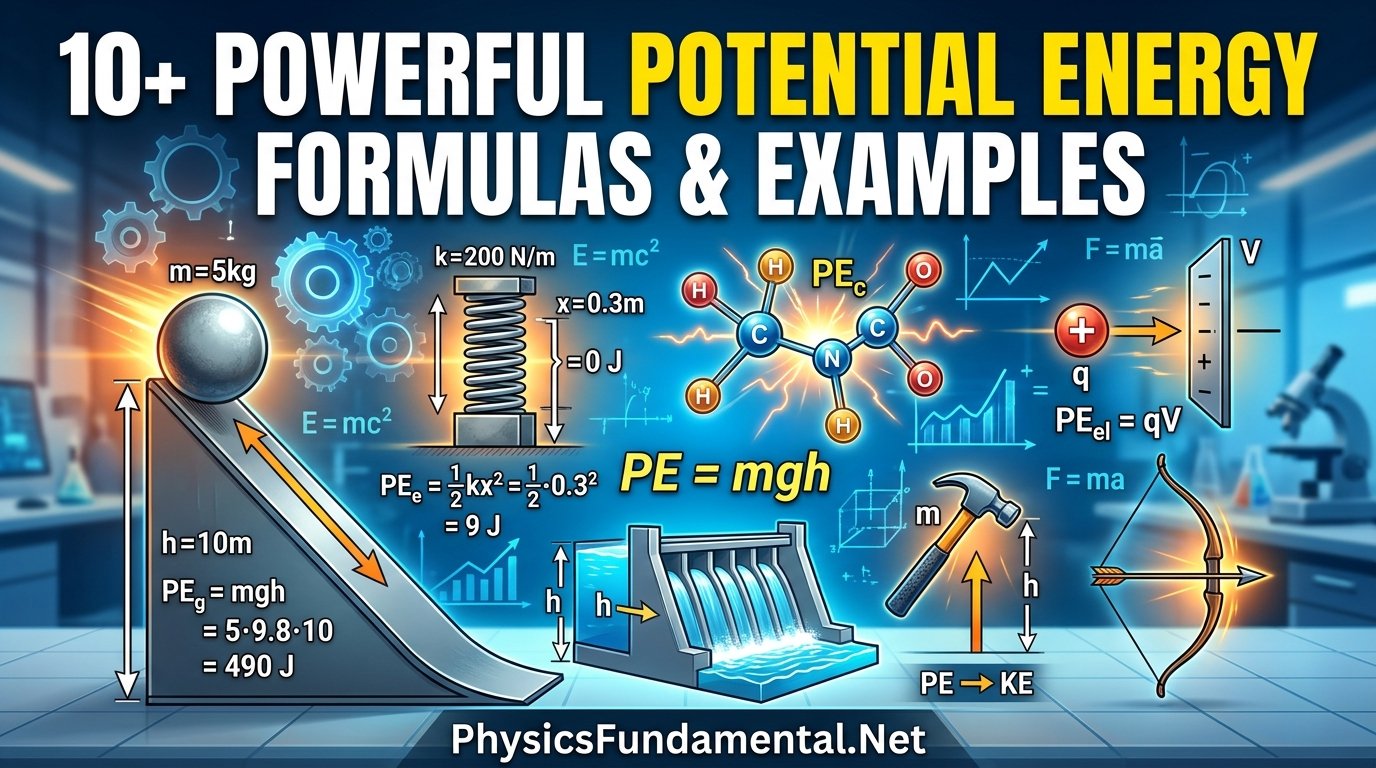
Potential Energy is a fundamental concept in physics that describes the energy stored in an object or system because of its position, arrangement, or configuration. Unlike kinetic energy, which is associated with motion, Potential Energy is connected to what can happen when an object or system changes its position or configuration.
A raised object has stored gravitational energy because it can fall. A stretched rubber band stores elastic energy because it can return toward its original shape. Two electric charges can also have stored energy because of their positions relative to one another. These are all examples of Potential Energy.
The amount of Potential Energy depends on the physical system and the chosen reference point. In mechanics, it is often associated with gravitational and elastic forces, while in electricity it is related to the positions of charged particles in an electric field.
In this article, we will explain Potential Energy in simple terms and explore its major forms, including gravitational, elastic, and electric Potential Energy. We will also cover the important formulas, examples, units, and the relationship between Potential Energy and kinetic energy.
What Is Potential Energy?
Potential Energy is the energy stored in an object or system because of its position, arrangement, or configuration.
The word “potential” refers to the ability to do work. An object with stored Potential Energy has the potential to produce motion or cause a change when the conditions allow it.
For example, a book resting on a high shelf has gravitational Potential Energy. If the book falls, that stored energy is converted mainly into kinetic energy.
Similarly, when a spring is compressed, work is done to change its shape. The spring stores this energy as elastic Potential Energy. When the spring is released, the stored energy can be transformed into kinetic energy.
Potential Energy is therefore not a single type of energy. It is a broad category that includes energy stored by different types of forces.
Potential Energy Formula
There is no single formula that applies to every form of Potential Energy because the formula depends on the type of force involved.
For gravitational Potential Energy near Earth’s surface:
where:
- is Potential Energy.
- is mass.
- is gravitational acceleration.
- is height relative to a chosen reference level.
For elastic Potential Energy:
where:
- is the spring constant.
- is the displacement from the spring’s equilibrium position.
For electric Potential Energy between two point charges:
where:
- is Coulomb’s constant.
- and are the charges.
- is the distance between them.
These equations describe different physical situations, but they all represent stored energy associated with position or configuration.
You May Like to Read: 7+ Powerful First Law of Thermodynamics Formulas & Examples
Gravitational Potential Energy
Gravitational Potential Energy is the energy an object has because of its position in a gravitational field.
Near Earth’s surface, the commonly used formula is:
An object’s gravitational Potential Energy increases when its height increases.
For example, lifting a 5 kg object to a height of 4 m gives it more gravitational Potential Energy than when it is at ground level.
Taking:
we get:
So the object has gained 196 J of gravitational Potential Energy relative to the chosen reference level.
Why Height Matters
In the equation:
Potential Energy depends directly on height.
If the height doubles while mass and gravitational acceleration remain constant, the gravitational Potential Energy also doubles.
For example:
At m:
At m:
The second value is twice the first.
This is why a heavy object lifted to a greater height can store a significant amount of energy.
You May Like to Read: Makau Kitchen and Bar Menu: Prices & Best Dishes 2026
Reference Level for Gravitational Potential Energy
Gravitational Potential Energy depends on the reference level you choose.
We often choose the ground as:
but this is simply a convenient choice.
A table, floor, or another position can also be chosen as the zero level.
What matters physically is usually the change in Potential Energy:
Near Earth’s surface:
An object can therefore have negative gravitational Potential Energy relative to a chosen reference level. The zero point is arbitrary.
Gravitational Potential Energy at Large Distances
The equation:
works well close to Earth’s surface where gravitational acceleration can be treated as approximately constant.
For larger distances, gravitational acceleration changes significantly with distance from Earth’s center. In that case, the gravitational Potential Energy of a mass can be written as:
where:
- is the gravitational constant.
- is the mass of the attracting body.
- is the object’s mass.
- is the distance between their centers.
The negative sign comes from choosing zero Potential Energy at infinite separation.
As an object moves farther away from Earth, its gravitational Potential Energy becomes less negative and approaches zero.
Elastic Potential Energy
Elastic Potential Energy is the energy stored when an elastic object is stretched or compressed.
Springs are a common example.
According to Hooke’s law, the restoring force of an ideal spring is:
The corresponding elastic Potential Energy is:
Here, describes how stiff the spring is and is the displacement from its equilibrium position.
Because is squared, stretching a spring twice as far stores four times as much elastic Potential Energy.
Example of Elastic Potential Energy
Suppose a spring has a spring constant of:
and is compressed by:
The stored elastic Potential Energy is:
Therefore, the spring stores 1 J of elastic Potential Energy.
You May Like to Read: Samsung Smart Watch: 7+ Powerful Features & Hidden Downsides
How a Spring Releases Potential Energy
When a compressed or stretched spring is released, its stored Potential Energy can be converted into kinetic energy.
For example, consider a toy launcher containing a compressed spring. When the spring is released, it pushes the object forward.
The sequence can be represented as:
The total energy remains conserved if losses such as friction and sound are ignored.
Electric Potential Energy
Electric Potential Energy is the energy associated with the position of electric charges in an electric field.
Two charged particles interact through the electric force. Their relative positions determine the amount of Electric Potential Energy stored in the system.
For two point charges:
where:
The sign of the Electric Potential Energy depends on the signs of the charges.
For two positive charges:
so:
For two negative charges, the product is also positive, so the Potential Energy is positive.
For opposite charges:
so:
This reflects the attractive nature of opposite electric charges.
Example of Electric Potential Energy
Suppose two point charges are:
and:
separated by:
Using:
we obtain:
The positive result indicates that the two charges have positive Electric Potential Energy relative to the chosen reference.
Electric Potential and Electric Potential Energy
Electric Potential and Electric Potential Energy are related but different quantities.
Electric Potential is energy per unit charge:
Therefore:
Electric Potential is measured in volts, while Electric Potential Energy is measured in joules.
For example, if a charge of C is placed at an electric potential of V, then:
The charge has 20 J of Electric Potential Energy relative to the reference potential.
Potential Energy and Work
Potential Energy is closely connected to work.
When a conservative force acts on an object, the work done by the force is related to the change in Potential Energy:
This means that when a conservative force does positive work, Potential Energy decreases.
For example, when an object falls under gravity, the gravitational force does positive work on the object while its gravitational Potential Energy decreases.
In contrast, when you lift an object upward at constant speed, you do positive work against gravity and increase its gravitational Potential Energy.
You May Like to Read: 183397gbc: 7+ Powerful Facts & Hidden Risks
Potential Energy and Kinetic Energy
Potential Energy and kinetic energy are both forms of mechanical energy.
Kinetic energy is associated with motion:
Potential Energy is associated with position or configuration.
In an ideal system with only conservative forces:
This is the principle of conservation of mechanical energy.
For example, as a ball falls from a height, its gravitational Potential Energy decreases while its kinetic energy increases.
At the highest point:
As the ball falls:
Ignoring air resistance, the total remains constant.
Conservation of Potential Energy and Kinetic Energy
Consider an object of mass dropped from height .
At the starting point, assume its velocity is zero.
Then:
and:
Just before reaching the ground, if the ground is the zero reference level:
The conservation of mechanical energy gives:
Therefore:
The mass cancels:
So:
This demonstrates how gravitational Potential Energy can be converted into kinetic energy.
Potential Energy Diagrams
A Potential Energy diagram shows how the Potential Energy of a system changes with position.
These diagrams are especially useful in mechanics, oscillations, and modern physics.
A stable equilibrium position usually corresponds to a minimum in Potential Energy.
At a minimum:
and small displacements tend to produce a restoring force that moves the system back toward equilibrium.
Since force and Potential Energy are related by:
the slope of a Potential Energy curve provides information about the force acting on the system.
You May Like to Read: Ambrai Restaurant Menu: 7+ Best Picks & Hidden Costs
Stable and Unstable Equilibrium
Potential Energy can help us understand equilibrium.
An object is in stable equilibrium when a small displacement creates a force that tends to return it to its original position.
A simple example is a ball resting at the bottom of a bowl.
The bottom corresponds to a minimum in Potential Energy.
An unstable equilibrium occurs when a small displacement causes the object to move farther away from its original position.
A ball balanced on the top of a hill is a simple example.
The top corresponds to a maximum in Potential Energy.
Potential Energy of a Pendulum
A pendulum provides another example of energy conversion.
At the highest point of its swing, the pendulum has maximum gravitational Potential Energy and relatively low kinetic energy.
As it moves downward, Potential Energy decreases and kinetic energy increases.
At the lowest point:
and:
As the pendulum rises again, kinetic energy is converted back into Potential Energy.
In an ideal pendulum with no air resistance or friction, the total mechanical energy remains constant.
Potential Energy in Hydroelectric Power
Potential Energy also plays an important role in energy production.
Water stored at a height behind a dam has gravitational Potential Energy.
The gravitational Potential Energy can be approximated by:
When the water flows downward, this stored energy is converted into kinetic energy. The moving water turns turbines, and the turbines drive generators that produce electrical energy.
The overall process can be represented as:
This is an important real-world application of energy conservation.
Potential Energy in Chemical Systems
Potential Energy is not limited to gravity, springs, and electric charges.
Chemical systems can also store energy through the arrangement of atoms and molecules and their chemical bonds.
When a chemical reaction occurs, the system may move to a lower-energy or higher-energy state depending on the reaction.
The difference in stored energy can appear as heat, light, motion, or other forms of energy.
This is one reason the concept of Potential Energy is broader than simply the formula .
You May Like to Read: Antera Kitchen and Bar Menu 2026: Prices, Best Dishes & Locations
Potential Energy and Conservative Forces
Potential Energy is particularly useful for conservative forces.
A conservative force has work that depends only on the initial and final positions, not on the path taken.
Gravity and the ideal spring force are common examples.
For a conservative force:
This means we can describe the effect of the force using a Potential Energy function.
Non-conservative forces such as friction do not have a Potential Energy function in the same simple sense because the work done by friction depends on the path traveled.
Common Mistakes When Studying Potential Energy
One common mistake is assuming that Potential Energy always has to be positive. Its numerical value depends on the chosen reference point, so it can be zero or negative depending on the situation.
Another mistake is using for situations where the change in gravitational acceleration cannot be ignored. The formula is intended for motion near Earth’s surface with approximately constant .
Students also sometimes forget that elastic Potential Energy depends on the square of displacement:
Doubling the displacement therefore increases the stored energy by a factor of four.
Another important mistake is confusing electric potential with Electric Potential Energy. Electric potential is energy per unit charge, whereas Electric Potential Energy is the energy associated with a particular charge in that potential.
Finally, remember that Potential Energy belongs to a system involving an interaction or configuration. For example, gravitational Potential Energy is associated with an object and the gravitational field, not simply with the object by itself.
Potential Energy Formula Summary
The most important formulas depend on the type of Potential Energy.
For gravitational Potential Energy near Earth’s surface:
For gravitational Potential Energy at large distances:
For elastic Potential Energy:
For Electric Potential Energy between two point charges:
For Electric Potential:
For the relationship between a conservative force and Potential Energy:
For total mechanical energy:
These equations provide the foundation for solving many Potential Energy problems.
Frequently Asked Questions
What is Potential Energy?
Potential Energy is stored energy associated with an object’s position, configuration, or arrangement. Examples include gravitational, elastic, and electric Potential Energy.
What is the formula for gravitational Potential Energy?
Near Earth’s surface, the formula is:
where is mass, is gravitational acceleration, and is height relative to a chosen reference level.
What is elastic Potential Energy?
Elastic Potential Energy is the energy stored when an elastic object such as a spring is stretched or compressed. For an ideal spring:
What is Electric Potential Energy?
Electric Potential Energy is the energy associated with the positions of electric charges relative to one another. For two point charges:
What is the difference between Potential Energy and kinetic energy?
Potential Energy is associated with position or configuration, while kinetic energy is associated with motion. In an ideal conservative system, the two can transform into each other while total mechanical energy remains constant.
Conclusion
Potential Energy is the stored energy associated with the position, arrangement, or configuration of a physical system. It is one of the key ideas used to understand how energy moves and changes form in physics.
Gravitational Potential Energy depends on position in a gravitational field, elastic Potential Energy is stored when an elastic object is stretched or compressed, and Electric Potential Energy depends on the positions of charged particles. Each form has its own mathematical expression, but all are connected by the broader principle of energy conservation.
The most familiar relationship is:
for gravitational Potential Energy near Earth’s surface, while springs and electric charges are described by different equations.
Understanding Potential Energy also makes it easier to study kinetic energy, mechanical energy, conservative forces, equilibrium, oscillations, electric fields, and energy conservation. Once you understand how stored energy changes from one form to another, many seemingly difficult physics problems become much easier to solve.