Normal Force Explained: Powerful Formula, Examples & 2026 Guide
Why doesn’t a book simply fall through a table when gravity pulls it downward? The answer is the normal force. This contact force acts between surfaces and can support an object against gravity or other forces.
The normal force is a contact force that acts perpendicular, or normal, to the surface touching an object. In the simplest situation, such as a book resting on a horizontal table, the normal force points upward while gravity pulls the book downward.
Normal force becomes more interesting when an object is on an inclined surface, inside an elevator, or moving through a circular path. Its magnitude and direction depend on the forces acting on the object and the geometry of the surface.
What Is Normal Force?
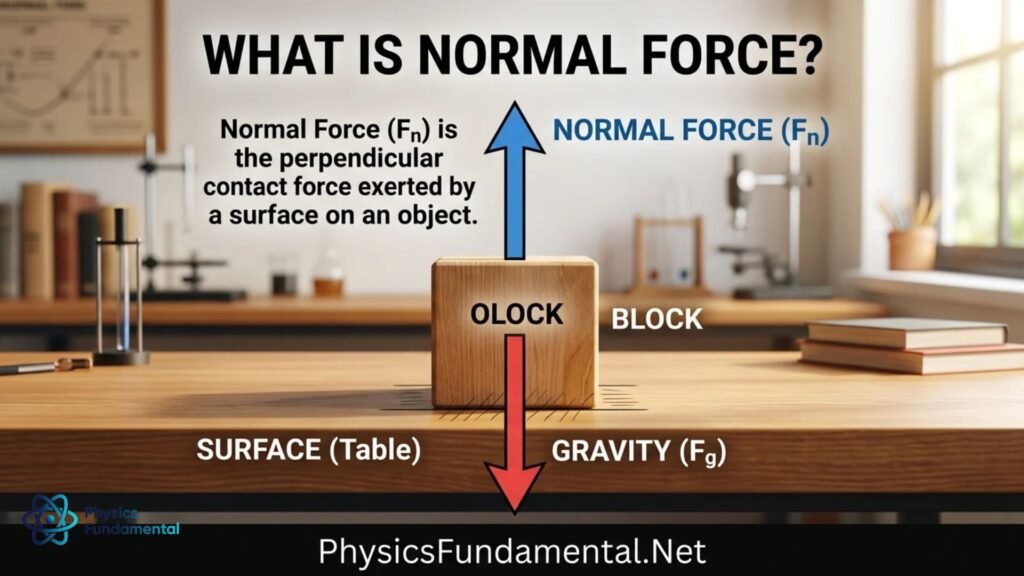
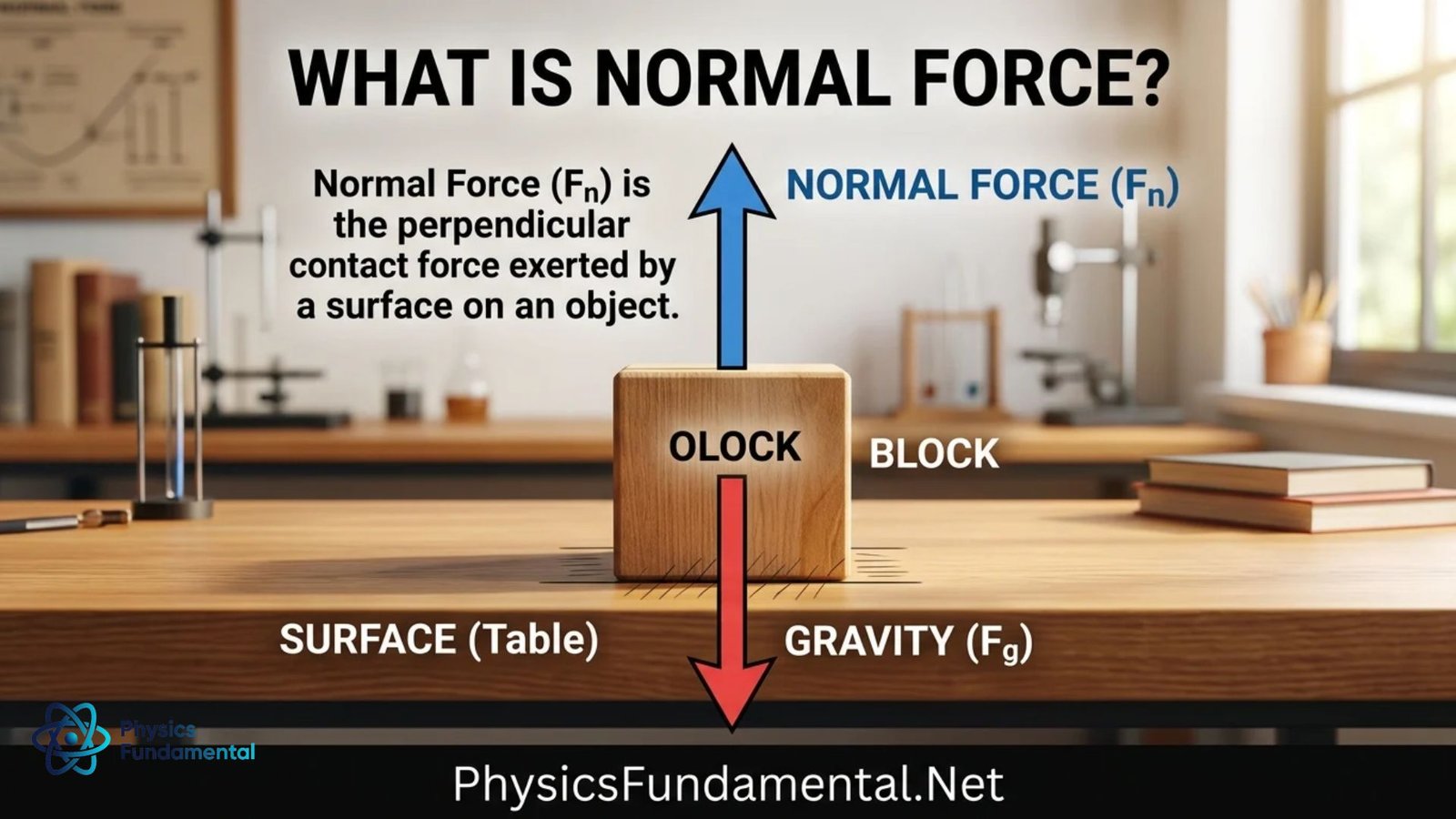
Normal force is the force exerted by a surface on an object in contact with it. The force acts perpendicular to the contact surface.
The word “normal” in physics means perpendicular.
For example, place a book on a horizontal table. Earth’s gravity pulls the book downward. The table pushes upward on the book, producing the normal force.
A simple representation is:
             ↑ N
             │
          ┌───────┐
          │ Book  │
          └───────┘
             │
             ↓ mg
────────────────────────
           Table
Here:
- N = normal force
- mg = gravitational force
If the book is stationary and there are no other vertical forces, the upward normal force balances the downward gravitational force.
Why Is It Called the Normal Force?
In mathematics and physics, a normal direction is perpendicular to a surface.
Therefore, the normal force is named after its direction rather than because it is an “ordinary” force.
For a horizontal surface, the normal direction is vertical.
For an inclined surface, the normal direction is tilted relative to the ground.
This means the normal force is not always vertically upward.
Is Normal Force a Contact Force?
Yes.
Normal force occurs because two physical surfaces are in contact and resist being pushed into one another.
At the microscopic level, interactions between atoms and molecules in the contacting materials contribute to the force.
Normal force is therefore different from forces such as gravity, which can act without direct physical contact.
Normal Force Formula
There is no single formula that works for every situation.
For a simple object resting on a horizontal surface with no other vertical forces:
N = mg
where:
- N = normal force
- m = mass
- g = gravitational acceleration
Near Earth’s surface, we commonly use:
g ≈ 9.8 m/s²
Therefore, for a 5 kg object:
N = (5)(9.8)
N = 49 N
The normal force is 49 N upward if the object is stationary and no other vertical forces act on it.
Normal Force on a Horizontal Surface
The simplest example is an object resting on a flat horizontal surface.
Suppose a 10 kg box sits on the floor.
Its weight is:
W = mg
W = (10)(9.8)
W = 98 N
If the box is not accelerating vertically, Newton’s second law gives:
ΣFᵧ = 0
Therefore:
N − mg = 0
So:
N = mg
N = 98 N
The floor provides a 98 N normal force upward.
Normal Force Is Not Always Equal to Weight
A common mistake is assuming:
N = mg
in every situation.
That is only true under certain conditions.
If additional vertical forces act on an object, the normal force may be greater or smaller than its weight.
For example, if you push downward on a box, the surface must provide a larger normal force to prevent the box from accelerating into the floor.
If you pull upward on the box, the normal force can become smaller.
Therefore, normal force should be calculated from the actual force balance rather than assumed to equal weight.
Normal Force on an Inclined Plane
Normal force becomes particularly important when an object rests on a sloped surface.
Consider a block on an incline:
                 ↑ N
                /
               /|
              / |
         [Block]
            /
           / θ
──────────/────────
The normal force points perpendicular to the inclined surface.
It does not point straight upward.
For an object resting on a frictionless incline, the normal force is:
N = mg cosθ
where:
- m = mass
- g = gravitational acceleration
- θ = angle of inclination
As the angle of the incline increases, the normal force becomes smaller.
This happens because only part of the gravitational force acts perpendicular to the surface.
Why Is the Normal Force Smaller on an Incline?
Gravity always points vertically downward.
On an inclined plane, we resolve gravity into two components:
- mg cosθ perpendicular to the surface
- mg sinθ parallel to the surface
The perpendicular component pushes the object into the surface.
The normal force balances this component when there is no acceleration perpendicular to the surface.
Therefore:
N = mg cosθ
for a simple stationary or sliding block on a straight incline with no other perpendicular forces.
Normal Force and Friction
Normal force is closely related to friction.
The frictional force between surfaces often depends on the normal force.
For kinetic friction:
fₖ = μₖN
For the maximum static friction:
fₛ,max = μₛN
where:
- f = frictional force
- μ = coefficient of friction
- N = normal force
This means changing the normal force can change the amount of friction that can act between two surfaces.
For example, pushing a box downward against the floor increases the normal force and can increase the maximum frictional force.
The two forces are different, however. Normal force acts perpendicular to the surface, while friction acts parallel to the surface.
Normal Force in an Elevator
An elevator provides a useful example of how normal force can differ from an object’s weight.
Imagine a person standing on a scale inside an accelerating elevator.
The scale measures the normal force exerted on the person.
If the elevator accelerates upward:
N = m(g + a)
The normal force is greater than the person’s weight.
If the elevator accelerates downward:
N = m(g − a)
The normal force is smaller than the person’s weight, as long as the elevator remains in contact with the floor.
If the elevator is in free fall, the apparent normal force can approach zero.
This is why a person can feel heavier or lighter depending on the elevator’s acceleration.
Normal Force in a Car
Normal force also appears when a vehicle moves over roads and curves.
On a level road with no significant vertical acceleration, the normal force from the road can approximately balance the vehicle’s weight.
However, when the vehicle travels over a hill, dip, or curved track, the required vertical acceleration changes the force balance.
For example, at the bottom of a dip, the road may exert a normal force greater than the vehicle’s weight because the vehicle needs an upward net force to follow the curved path.
Normal Force in Circular Motion
Normal force can contribute to the centripetal force required for circular motion.
Consider an object moving through a circular track or a roller coaster loop. The surface can exert a normal force toward the center of the circular path.
The normal force is therefore one of the real forces that can contribute to the net centripetal force.
It is important not to treat centripetal force as a separate force. Instead, identify the actual forces, including the normal force, and determine their net inward component.
Normal Force on a Vertical Wall
Imagine a person pushing a box horizontally against a vertical wall.
The wall exerts a normal force on the box.
In this case, the normal force is horizontal rather than vertical because it is perpendicular to the wall.
             Wall
              │
              │ ← N
              │ [Box] → F
              │
              │
If the box is not accelerating horizontally, the normal force can balance the horizontal applied force:
N = F
If friction also acts between the box and wall, that friction may help prevent the box from sliding downward.
This example demonstrates why normal force should not automatically be assumed to point upward.
Normal Force and Newton’s Laws
Newton’s laws are essential for calculating normal force.
Newton’s second law states:
ΣF = ma
For vertical motion, we can write:
ΣFᵧ = maᵧ
If there is no vertical acceleration:
ΣFᵧ = 0
For a simple object on a horizontal surface:
N − mg = 0
Therefore:
N = mg
If the object accelerates vertically, however, the equation changes.
This is why the motion of the object must be considered before calculating the normal force.
Worked Example 1: Box on a Flat Surface
A 6 kg box rests on a horizontal floor. Find the normal force.
Given:
m = 6 kg
g = 9.8 m/s²
Use:
N = mg
Therefore:
N = (6)(9.8)
N = 58.8 N
So the floor exerts a normal force of 58.8 N upward.
Worked Example 2: Box on an Incline
A 10 kg box rests on a frictionless incline at an angle of 30°.
Find the normal force.
Use:
N = mg cosθ
Substitute:
N = (10)(9.8)cos30°
Since:
cos30° ≈ 0.866
we get:
N ≈ 84.9 N
Therefore, the normal force is approximately 84.9 N.
Notice that this is less than the box’s weight:
mg = 98 N
The normal force is smaller because the surface is inclined.
You May Like to Read: Young’s Modulus: 7 Powerful Benefits, Facts & Formula Explained 2026
Worked Example 3: Person in an Accelerating Elevator
A person has a mass of 60 kg and stands on a scale in an elevator accelerating upward at 2 m/s².
Use:
N = m(g + a)
Substitute:
N = 60(9.8 + 2)
N = 60(11.8)
N = 708 N
The scale would therefore read a normal force of approximately 708 N.
The person’s weight is:
mg = 60(9.8) = 588 N
The normal force is greater because the elevator accelerates upward.
Worked Example 4: Pulling a Box Upward
Suppose a 10 kg box rests on a horizontal floor while an upward force of 20 N is applied to it.
The vertical forces are:
- Normal force upward
- Applied force upward
- Weight downward
If the box has no vertical acceleration:
N + 20 − mg = 0
Therefore:
N = mg − 20
N = 98 − 20
N = 78 N
The upward pull reduces the normal force.
This example shows why the normal force does not always equal the object’s weight.
Normal Force and Free-Body Diagrams
A free-body diagram is one of the best ways to solve normal-force problems.
For a basic object on a table:
             ↑ N
             │
          ┌─────┐
          │  m  │
          └─────┘
             │
             ↓ mg
────────────────────
The diagram identifies the forces acting on the object.
When solving a problem:
- Draw the object.
- Identify every external force.
- Choose coordinate axes.
- Resolve forces into components when necessary.
- Apply Newton’s second law.
- Solve for the normal force.
On an incline, it is often convenient to choose one axis perpendicular to the surface and another parallel to it.
Normal Force vs Weight
Normal force and weight are different forces.
Weight is the gravitational force acting on an object.
Normal force is the contact force exerted by a surface on the object.
They may have equal magnitudes in some situations, but they do not represent the same physical interaction.
For example, a book resting on a horizontal table can have:
N = mg
but the two forces remain different forces acting in opposite directions.
Normal Force vs Friction
Normal force and friction both arise from contact between surfaces, but they act in different directions.
| Feature | Normal Force | Friction |
|---|---|---|
| Direction | Perpendicular to surface | Parallel to surface |
| Contact required? | Yes | Yes |
| Common role | Supports/resists penetration | Opposes relative or impending sliding |
| Simple equation | N = mg in some cases | f = μN in simple models |
The normal force can influence the magnitude of friction, but the forces should not be confused.
What Determines the Normal Force?
Several factors can affect normal force:
Mass
A heavier object generally produces a greater gravitational force, which can increase the normal force on a horizontal surface when no other vertical forces act.
Surface Angle
On an incline, the normal force depends on the angle:
N = mg cosθ
for the simple case described earlier.
Applied Forces
An upward or downward applied force can change the normal force.
Acceleration
If an object accelerates, the force balance changes. Elevators provide a common example.
Other Forces
Tension, electric forces, magnetic forces, and other interactions can also affect the normal force when they have components perpendicular to the surface.
Does Normal Force Do Work?
In many simple situations, the normal force does no work on an object.
For example, if a box slides across a horizontal floor, its displacement is horizontal while the normal force is vertical. Because the force and displacement are perpendicular, the normal force does no work.
However, whether a normal force does work depends on the motion and the interaction. In situations where the point of contact moves in a direction with a component along the normal force, the normal force can contribute to work.
Therefore, it is not universally correct to say that normal force can never do work.
Common Mistakes About Normal Force
Mistake 1: Always using N = mg
This only works in certain situations.
If the object accelerates or additional forces act vertically, the equation must be modified.
Mistake 2: Drawing normal force vertically
Normal force is perpendicular to the surface.
On an incline, it points perpendicular to the incline rather than straight upward.
Mistake 3: Confusing normal force with weight
Weight is gravitational force. Normal force is a contact force from a surface.
Mistake 4: Forgetting other forces
Applied forces, tension, and other interactions can change the normal force.
Mistake 5: Assuming normal force always causes friction
Normal force and friction are separate forces. Friction may depend on normal force in common friction models, but the normal force itself is not friction.
How to Calculate Normal Force
A reliable method is:
Step 1: Draw a free-body diagram.
Step 2: Identify the direction perpendicular to the surface.
Step 3: Resolve forces into components if necessary.
Step 4: Apply Newton’s second law:
ΣF = ma
Step 5: Solve for N.
For a simple stationary object on a horizontal surface:
N = mg
For a simple object on a frictionless incline:
N = mg cosθ
For an elevator accelerating vertically upward:
N = m(g + a)
For an elevator accelerating downward:
N = m(g − a)
These formulas apply to their respective simplified situations.
Frequently Asked Questions
What is normal force in simple words?
Normal force is the contact force a surface exerts on an object, acting perpendicular to the surface.
What is the formula for normal force?
For an object at rest on a horizontal surface with no other vertical forces, N = mg. Other situations require Newton’s second law.
Is normal force always equal to weight?
No. Normal force equals weight only in certain situations, such as an object at rest on a horizontal surface with no other vertical forces.
What direction does normal force act?
Normal force always acts perpendicular to the contact surface.
What is normal force on an inclined plane?
For a simple object on a frictionless incline, the normal force is N = mg cosθ, where θ is the incline angle.
Conclusion
Normal force is a contact force that acts perpendicular to the surface supporting or contacting an object. It plays an important role in everyday situations, from a book resting on a table to a car traveling around a curve.
The simple equation N = mg applies only when an object is on a horizontal surface with no other vertical forces and no vertical acceleration. On an incline, the normal force can be N = mg cosθ, while accelerating systems such as elevators require Newton’s second law.
The key idea is simple: normal force always acts perpendicular to the surface, and its magnitude must be determined from the complete set of forces acting on the object.