Lens and Mirror Equation: Powerful Formula, Examples & Facts 2026
Understanding how lenses and mirrors form images is one of the most important parts of basic optics. Whether you are studying cameras, microscopes, eyeglasses, or curved mirrors, the relationship between the object, image, and optical device can be described mathematically.
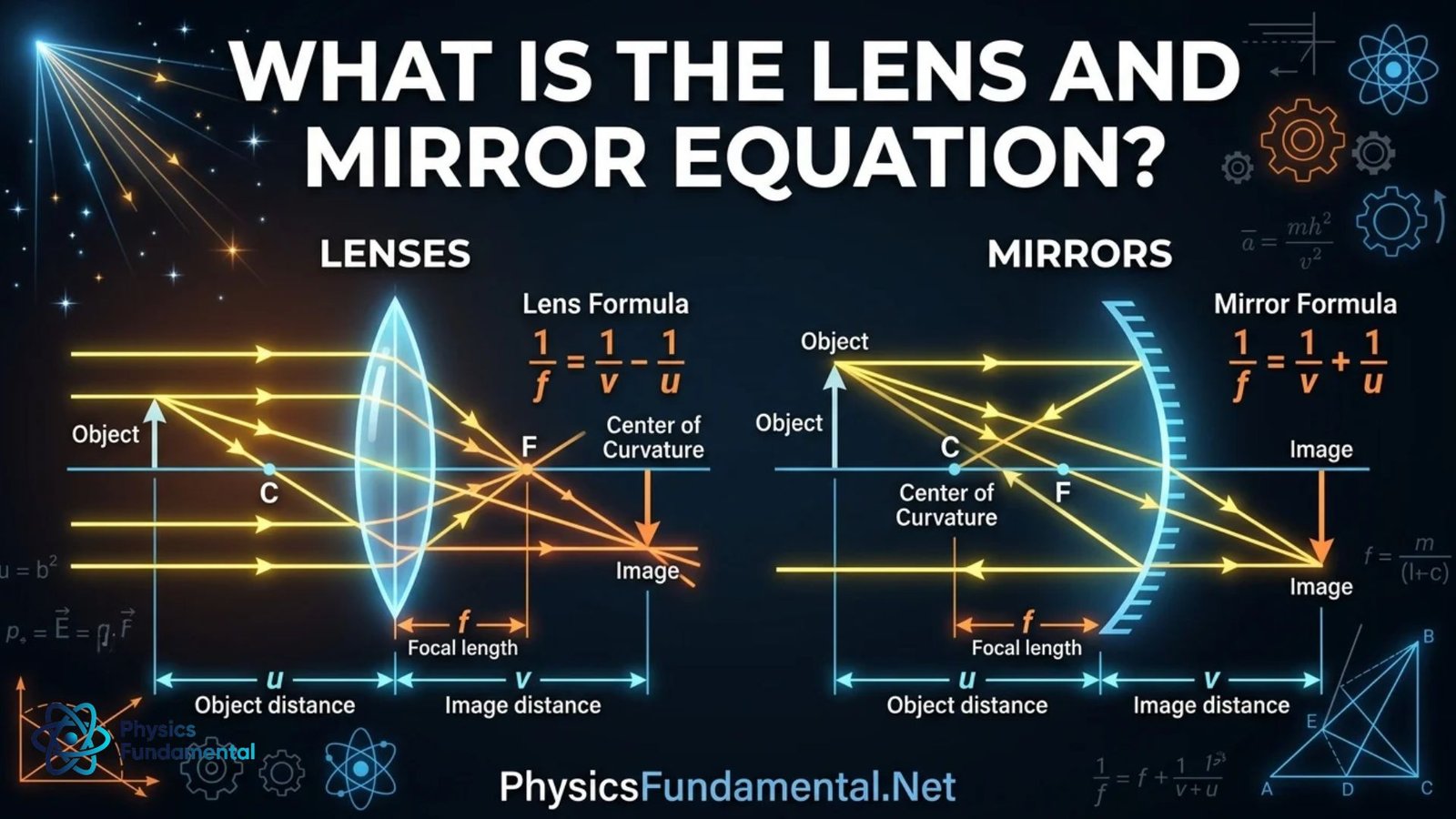
The equation 1/f = 1/u + 1/v is commonly known as the lens formula in introductory optics. It connects the focal length of a lens with the object distance and image distance. Similar relationships are used for spherical mirrors, although the signs of the quantities depend on the sign convention being used.
Once you understand what f, u, and v represent and how signs are assigned, the formula becomes much easier to use. It can help you calculate an unknown distance and predict where an image will form.
What Is the Lens and Mirror Equation?
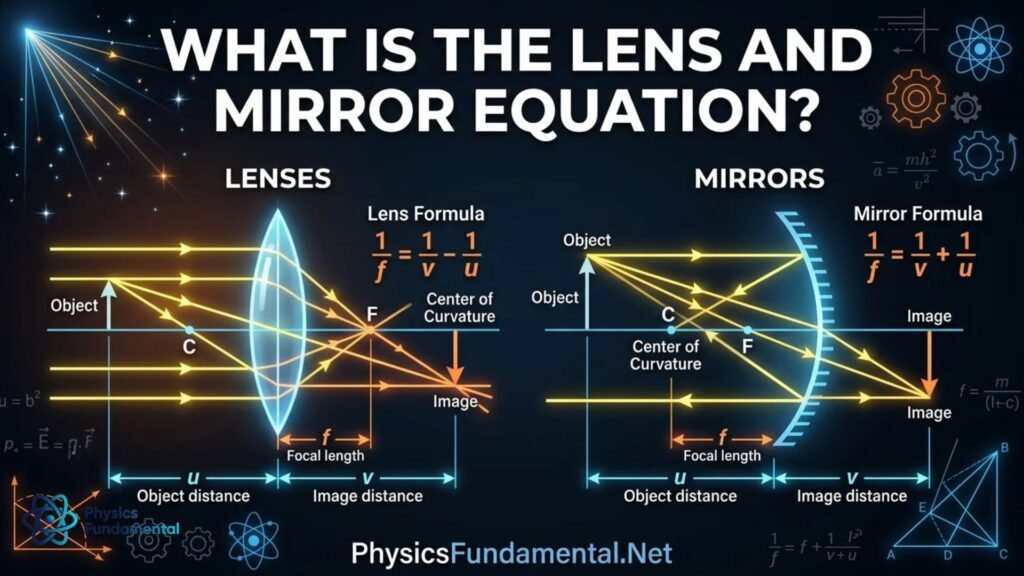
The equation is written as:
1/f = 1/u + 1/v
where:
- f = focal length
- u = object distance
- v = image distance
The equation describes the relationship between these three quantities in geometrical optics.
For a thin converging lens, the formula can be used to determine the position of an image when the object distance and focal length are known. It can also be rearranged to find the focal length or object distance.
For spherical mirrors, the mirror formula has the same mathematical form:
1/f = 1/u + 1/v
However, the signs of u, v, and f must be assigned according to the particular sign convention being used.
Understanding Focal Length, Object Distance and Image Distance
Before using the formula, it is important to understand each quantity.
Focal Length (f)
The focal length is the distance between the optical center of a lens and its principal focus. For a spherical mirror, it is the distance between the pole and the principal focus.
A shorter focal length generally means stronger optical convergence or divergence, depending on the type of optical device.
Object Distance (u)
Object distance is the distance between the object and the optical center of a lens or the pole of a mirror.
It tells us how far the object is positioned from the optical device.
Image Distance (v)
Image distance is the distance between the image and the optical center of a lens or the pole of a mirror.
The image may be real or virtual, and its position determines the appropriate sign for v under the selected sign convention.
The Formula in Lens Optics
For a thin lens, the equation can be used to determine where an image forms.
Consider a convex lens. When parallel rays of light enter the lens, they are refracted and converge toward a point called the principal focus.
The relationship between object distance, image distance, and focal length allows us to calculate the image position without drawing a complete ray diagram.
This is part of geometrical optics, where light is treated as rays that travel in predictable paths through optical systems.
Lens Formula Sign Convention
Different textbooks may use different sign conventions, so it is essential to follow the convention specified in your course.
One commonly used Cartesian sign convention takes the optical center of the lens as the origin.
Under this convention:
- Distances measured in the direction of incident light are positive.
- Distances measured opposite to the direction of incident light are negative.
- Heights above the principal axis are positive.
- Heights below the principal axis are negative.
For a typical real object placed in front of a convex lens, the object distance u is generally negative under this convention.
The focal length of a convex lens is positive, while the focal length of a concave lens is negative.
Lens Formula Example
Suppose a convex lens has a focal length of 10 cm, and an object is placed 30 cm in front of it.
Using the Cartesian sign convention:
f = +10 cm
u = −30 cm
The lens formula is:
1/f = 1/v − 1/u
So:
1/10 = 1/v − 1/(−30)
Therefore:
1/10 = 1/v + 1/30
Rearranging:
1/v = 1/10 − 1/30
1/v = 3/30 − 1/30
1/v = 2/30
Therefore:
v = 15 cm
The positive value of v means that the image is formed on the opposite side of the lens from the object under this convention.
Why Different Versions of the Formula Exist
Students sometimes become confused because they see the equation written in different forms.
For example:
1/f = 1/u + 1/v
may appear in one textbook, while another textbook may use:
1/f = 1/v − 1/u
This does not necessarily mean that one equation is wrong.
The difference often comes from the sign convention being used.
If distances are treated as signed quantities, the algebraic form of the equation changes depending on how positive and negative directions are defined.
Therefore, do not memorize the formula without understanding its sign convention.
Mirror Formula
For spherical mirrors, the mirror formula is commonly written as:
1/f = 1/u + 1/v
Here:
- f = focal length of the mirror
- u = object distance
- v = image distance
The formula applies to both concave and convex spherical mirrors when the appropriate signs are used.
A concave mirror can form real or virtual images depending on the position of the object. A convex mirror generally forms a virtual, upright, and diminished image for a real object.
Concave Mirror Example
Suppose a concave mirror has a focal length of 15 cm, and an object is placed 30 cm in front of the mirror.
Using the Cartesian sign convention:
f = −15 cm
u = −30 cm
Using:
1/f = 1/v + 1/u
we get:
1/(−15) = 1/v + 1/(−30)
So:
−1/15 = 1/v − 1/30
Therefore:
1/v = −1/15 + 1/30
1/v = −2/30 + 1/30
1/v = −1/30
Therefore:
v = −30 cm
The negative image distance indicates that the image is formed in front of the mirror under this sign convention. This is consistent with a real image produced by a concave mirror when the object is positioned at the center of curvature.
You May Like to Read: Normal Force Explained: Powerful Formula, Examples & 2026 Guide
Lens Formula vs Mirror Formula
Although both equations have the same basic mathematical structure, lenses and mirrors work differently.
| Feature | Lens | Mirror |
|---|---|---|
| Main process | Refraction | Reflection |
| Common types | Convex and concave | Concave and convex |
| Formula | 1/f = 1/u + 1/v* | 1/f = 1/u + 1/v |
| Focal length | Depends on lens type | Depends on mirror type |
| Image formation | Through transmitted/refracted light | Through reflected light |
| Sign convention | Must be specified | Must be specified |
*The exact algebraic form can differ depending on the sign convention.
How to Rearrange the Equation
The equation can be rearranged to calculate any one of the three quantities.
Starting with:
1/f = 1/u + 1/v
To find v:
1/v = 1/f − 1/u
Therefore:
v = fu/(u − f)
To find u:
1/u = 1/f − 1/v
Therefore:
u = fv/(v − f)
To find f:
f = uv/(u + v)
These rearrangements are useful when solving numerical problems.
Magnification and the Lens Formula
The lens or mirror equation tells us where an image forms, but it does not directly tell us how large the image is.
For a thin lens, magnification can be expressed as:
m = v/u
with the appropriate sign convention.
Magnification tells us the ratio of image height to object height.
It can be written as:
m = image height / object height
For a mirror, a commonly used expression is:
m = −v/u
Again, the exact expression depends on the convention being followed.
A positive or negative magnification can provide information about the orientation of the image.
Real and Virtual Images
The lens and mirror equations are also useful for distinguishing different image situations.
A real image is formed when light rays actually meet at the image location. Real images can generally be projected onto a screen.
A virtual image occurs when light rays do not actually meet but appear to originate from a particular location when traced backward.
For example, a convex lens can produce either a real or virtual image depending on the object’s position. A concave mirror can also produce different types of images depending on where the object is placed.
What Happens When the Object Is at the Focus?
For a converging lens, when an object is positioned at the focal point, the refracted rays emerge approximately parallel.
As a result, the image is formed effectively at infinity.
Mathematically, if:
u = f
then the denominator in the rearranged expression for image distance approaches zero, causing v to become extremely large.
This explains why objects placed at the focal point of a converging lens do not produce a normal finite image on the other side.
What Happens When the Object Is Far Away?
When an object is very far from a converging lens or concave mirror, the incoming rays are approximately parallel.
The image is then formed close to the principal focus.
This is why distant objects can often be focused near the focal plane of a camera lens.
Applications of the Lens and Mirror Equation
The equation is not simply a classroom formula. It has practical applications in many optical devices.
Cameras
Camera lenses use image formation principles to focus light onto a sensor. Changing the position or focal properties of the lens allows objects at different distances to be focused clearly.
Eyeglasses
Corrective lenses alter the path of light entering the eye. Their focal properties are selected to help compensate for particular refractive errors.
Microscopes
Microscopes use multiple lenses to produce enlarged images of small objects. The lens formula helps describe the image formation of individual optical elements.
Telescopes
Telescopes use lenses or mirrors to collect and focus light from distant objects. Understanding focal length is essential for analyzing their optical behavior.
Projectors
A projector uses lenses to create an enlarged image from a smaller source. The relationship between object distance and image distance is important for achieving proper focus.
Vehicle Mirrors
Convex mirrors are commonly used where a wider field of view is useful. Their image-forming properties allow drivers to see a larger area behind or beside a vehicle.
Common Mistakes When Using the Formula
Ignoring the Sign Convention
One of the most common mistakes is inserting distances as positive numbers without checking the sign convention.
Always identify the direction of each distance before substituting values.
Mixing Lens and Mirror Conventions
Do not switch between conventions halfway through a problem. Choose the convention required by your textbook or instructor and use it consistently.
Confusing Focal Length With Radius of Curvature
For a spherical mirror under the paraxial approximation:
f = R/2
where R is the radius of curvature.
Focal length and radius of curvature are therefore related, but they are not the same quantity.
Forgetting Units
All distances should normally be expressed in the same unit before applying the formula.
For example, do not use f = 10 cm and u = 2 m without converting one of them.
Quick Formula Summary
The basic relationship is:
1/f = 1/u + 1/v
Important rearrangements include:
v = fu/(u − f)
u = fv/(v − f)
f = uv/(u + v)
For magnification, commonly used relationships include:
m = v/u for a thin lens under one common convention.
For mirrors:
m = −v/u
Always check the sign convention used in your problem.
Frequently Asked Questions
What is the formula 1/f = 1/u + 1/v used for?
It relates the focal length, object distance, and image distance of spherical mirrors and, with the appropriate sign convention, thin lenses.
What do f, u, and v mean?
f is focal length, u is object distance, and v is image distance.
Is the lens formula the same as the mirror formula?
They have the same basic mathematical relationship, but the physical processes differ: lenses use refraction, while mirrors use reflection.
Why can the signs in the formula be different?
Different textbooks use different sign conventions. The algebraic form changes according to how positive and negative distances are defined.
How do I find image distance?
Substitute the known focal length and object distance into the appropriate form of the equation, then rearrange it to solve for v.
Conclusion
The equation 1/f = 1/u + 1/v provides a simple mathematical way to understand image formation in basic optics. It connects focal length with the positions of the object and image and is widely used when studying lenses and spherical mirrors.
The most important part is not simply memorizing the equation. You should understand what f, u, and v represent and apply the correct sign convention consistently. Once these ideas are clear, numerical problems involving lenses and mirrors become much easier to solve.
The same principles also help explain how everyday optical devices such as cameras, eyeglasses, microscopes, telescopes, projectors, and vehicle mirrors form useful images.