Longitudinal Waves: Powerful Definition, Diagram & 7 Examples 2026
Have you ever watched a slinky move back and forth when one end is pushed and pulled? The coils move in the same direction as the wave travels. This simple demonstration shows the basic idea behind a longitudinal wave.
A longitudinal wave is a type of mechanical wave in which the particles of the medium vibrate parallel to the direction in which the wave travels. Sound waves traveling through air are the most familiar example. Understanding this motion makes it easier to understand sound, pressure changes, and several other wave phenomena.
Longitudinal waves can travel through solids, liquids, and gases, although the details of their motion depend on the material. They are made up of alternating regions called compressions and rarefactions, which are responsible for changes in pressure and particle spacing.
What Is a Longitudinal Wave?

A longitudinal wave is a wave in which particles of the medium oscillate back and forth parallel to the direction of wave propagation.
In simple terms, imagine pushing a row of balls forward and then pulling them backward. Each ball moves back and forth along the same line that the disturbance travels. The individual particles do not travel with the wave over a large distance. Instead, they transfer energy to neighboring particles.
For example, when sound travels through air, air molecules vibrate back and forth. These vibrations create areas where molecules are pushed closer together and areas where they are spread farther apart.
The energy moves through the medium, while the particles mainly oscillate around their equilibrium positions.
Longitudinal Wave Diagram
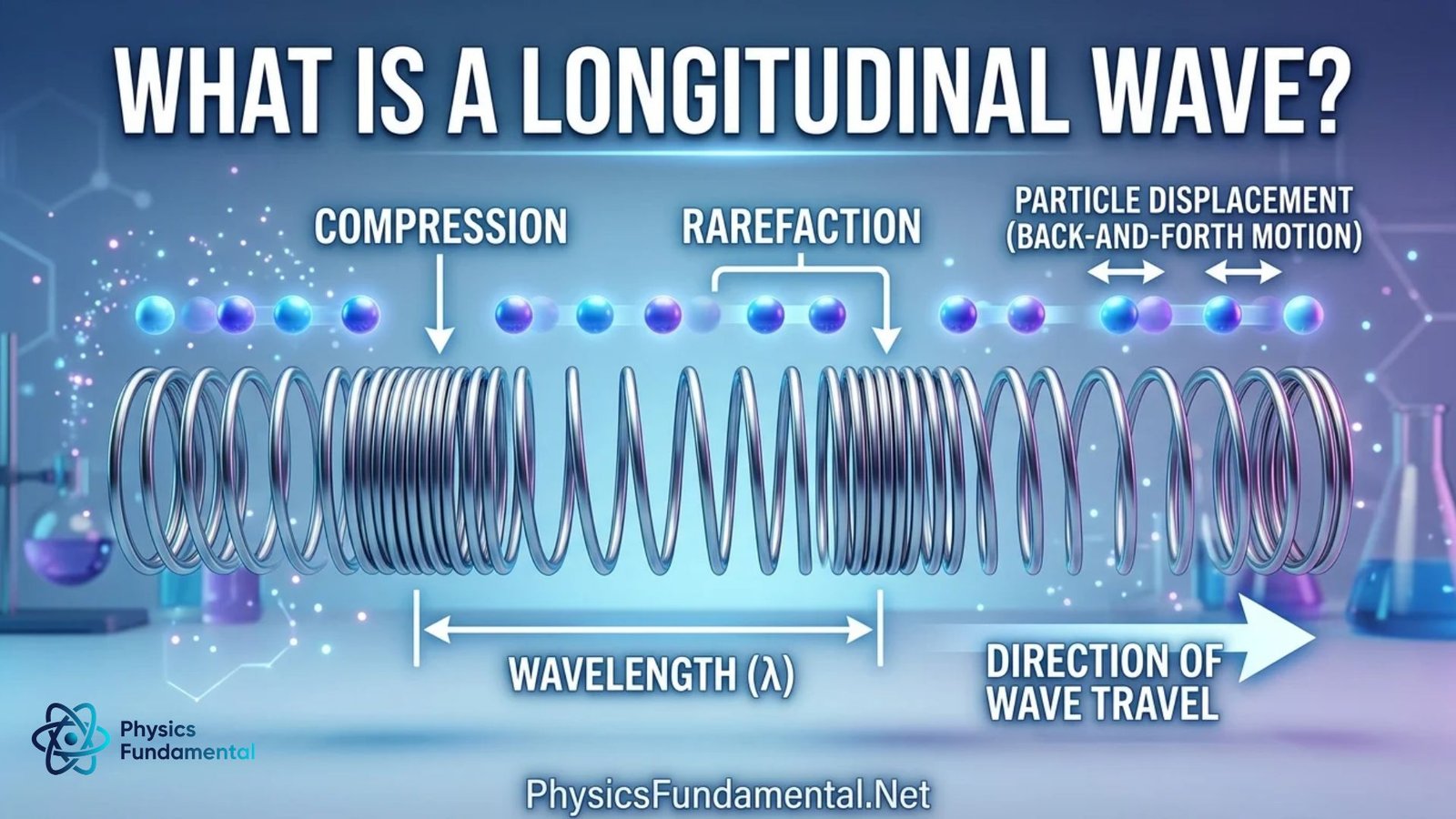
A longitudinal wave can be represented using alternating compressed and expanded regions:
Direction of wave →

|||||||||     | | | |     |||||||||     | | | |
Compression   Rarefaction  Compression   Rarefaction

<---- One wavelength (λ) ---->
The closely packed particles represent a compression, while the particles that are farther apart represent a rarefaction.
The distance from one compression to the next compression, or from one rarefaction to the next rarefaction, is one wavelength.
What Are Compressions?
A compression is a region of a longitudinal wave where the particles of the medium are closer together.
When particles are pushed toward one another, the pressure and density of the medium increase in that region. In a sound wave traveling through air, compressions correspond to regions of relatively high air pressure.
For example, if you push one end of a slinky forward, several coils become crowded together. That crowded region represents a compression.
What Are Rarefactions?
A rarefaction is a region where particles are spread farther apart.
Compared with a compression, a rarefaction has lower particle density and pressure. In a sound wave, rarefactions occur between successive compressions.
In a slinky demonstration, rarefactions appear as sections where the coils are separated from one another.
Therefore, a longitudinal wave can be thought of as a repeating pattern of:
Compression → Rarefaction → Compression → Rarefaction
How Does a Longitudinal Wave Travel?
A longitudinal wave transfers energy through the repeated vibration of particles.
Suppose you push a row of particles to the right. The first particles collide or interact with neighboring particles, transferring energy to them. Those particles then interact with the next particles, continuing the disturbance through the medium.
The particles themselves move back and forth rather than continuously moving from the source to the destination.
This is an important distinction between particle motion and wave motion. The wave carries energy, while the particles of the medium oscillate around their equilibrium positions.
Examples of Longitudinal Waves
Longitudinal waves occur in many physical situations. Some common examples include sound waves, waves in springs, and seismic waves.
1. Sound Waves
Sound waves are the most common example of longitudinal waves in gases such as air.
When an object vibrates, it causes nearby air molecules to move back and forth. This creates alternating compressions and rarefactions that travel through the air.
When these pressure variations reach your ears, your eardrums vibrate, allowing your auditory system to interpret the disturbance as sound.
Sound can also travel through liquids and solids, where particle interactions transfer the vibration.
2. Slinky Waves
A slinky provides one of the easiest ways to visualize a longitudinal wave.
If one end of a stretched slinky is pushed and pulled along its length, compressions and rarefactions travel through the spring.
The coils move approximately parallel to the direction in which the disturbance travels, demonstrating the defining feature of a longitudinal wave.
3. Seismic P-Waves
Some earthquake waves are longitudinal. These are known as primary waves, or P-waves.
P-waves compress and expand material as they travel through Earth. They can travel through solids and fluids, which is one reason they are detected at different locations during earthquakes.
Seismic P-waves are an important example of longitudinal wave motion in the study of earthquakes and Earth’s interior.
4. Ultrasound Waves
Ultrasound consists of sound waves with frequencies above the upper range of normal human hearing.
In medical imaging, ultrasound waves are transmitted into the body. Different tissues reflect and transmit the waves in different ways, allowing equipment to create images of internal structures.
The wave motion in the tissue is primarily longitudinal.
5. Pressure Waves in Air
A sudden change in air pressure can produce a longitudinal pressure disturbance.
For example, a loudspeaker creates vibrations that push and pull nearby air molecules. The resulting pressure variations travel outward as a sound wave.
6. Waves in Liquids
Longitudinal waves can travel through liquids because liquid particles can transfer pressure disturbances to neighboring particles.
Sound traveling through water is an example. This principle is important in underwater communication and acoustic measurements.
7. Waves in Solids
Longitudinal waves can also travel through solid materials.
When particles in a solid are compressed and released, the disturbance can move through the material. Engineers use this behavior in several forms of material testing and ultrasonic inspection.
Characteristics of Longitudinal Waves
Longitudinal waves have several important characteristics.
Particle Motion Is Parallel to Wave Motion
The defining characteristic is that particles vibrate parallel to the direction of propagation.
If the wave travels horizontally, the particles oscillate horizontally along approximately the same line.
They Have Compressions and Rarefactions
Unlike the peaks and troughs commonly used to represent transverse waves, longitudinal waves are described using compressions and rarefactions.
Compressions are high-density regions, while rarefactions are low-density regions.
They Transfer Energy
A wave transfers energy from one location to another without requiring the medium’s particles to travel along with the wave.
This energy transfer occurs through interactions between neighboring particles.
They Require a Medium
Mechanical longitudinal waves require matter through which they can travel.
Sound, for example, cannot travel through a perfect vacuum because there are no particles available to transmit the disturbance.
They Have Wavelength and Frequency
Longitudinal waves have measurable wavelength, frequency, amplitude, and speed.
These quantities help describe how the wave behaves and how much energy it can transfer.
Wavelength of a Longitudinal Wave
The wavelength of a longitudinal wave is the distance between two corresponding points in consecutive cycles.
For example, the distance between the center of one compression and the center of the next compression is one wavelength.
It can also be measured from the center of one rarefaction to the center of the next rarefaction.
The symbol for wavelength is λ (lambda), and its SI unit is the meter (m).
Frequency of a Longitudinal Wave
Frequency describes how many complete wave cycles occur per second.
It is measured in hertz (Hz).
For a sound wave, frequency is closely related to the pitch that we perceive. Higher-frequency sound generally corresponds to a higher pitch, while lower-frequency sound corresponds to a lower pitch.
The relationship between frequency and period is:
f = 1/T
where:
- f = frequency
- T = time period
Speed of a Longitudinal Wave
Wave speed describes how quickly a disturbance travels through a medium.
The basic wave equation is:
v = fλ
where:
- v = wave speed
- f = frequency
- λ = wavelength
The speed of a mechanical wave depends on the properties of the medium.
For sound, factors such as the medium’s elasticity, density, and temperature can affect wave speed.
Amplitude of a Longitudinal Wave
Amplitude describes the maximum displacement of particles from their equilibrium positions.
In a longitudinal wave, larger particle displacements generally produce stronger variations in pressure and density.
For sound waves, greater amplitude is generally associated with greater intensity and perceived loudness, although loudness also depends on how the sound is received.
Longitudinal Wave vs Transverse Wave
Longitudinal and transverse waves differ mainly in the direction of particle vibration.
| Feature | Longitudinal Wave | Transverse Wave |
|---|---|---|
| Particle vibration | Parallel to wave direction | Perpendicular to wave direction |
| Main features | Compressions and rarefactions | Crests and troughs |
| Example | Sound in air | Light |
| Mechanical examples | Sound, P-waves | Waves on a string |
| Medium | Mechanical examples require a medium | Some require a medium, while electromagnetic waves do not |
The key difference is the relationship between particle motion and wave propagation.
In a longitudinal wave, the particles vibrate parallel to the wave’s direction. In a transverse wave, they vibrate perpendicular to it.
Are Sound Waves Longitudinal?
Sound waves in air are longitudinal mechanical waves.
When a sound source vibrates, it causes nearby air particles to move back and forth. This produces alternating compressions and rarefactions that travel outward from the source.
However, the behavior of sound can be more complicated in some materials and situations. In solids, for example, sound can propagate through different wave modes, including both longitudinal and transverse components.
The basic sound-wave model in air is nevertheless longitudinal.
Can Longitudinal Waves Travel Through a Vacuum?
Mechanical longitudinal waves cannot travel through a vacuum.
A vacuum has essentially no particles available to transmit the mechanical disturbance. Since a longitudinal mechanical wave depends on interactions between particles, it needs a material medium.
This is why sound cannot travel through empty space.
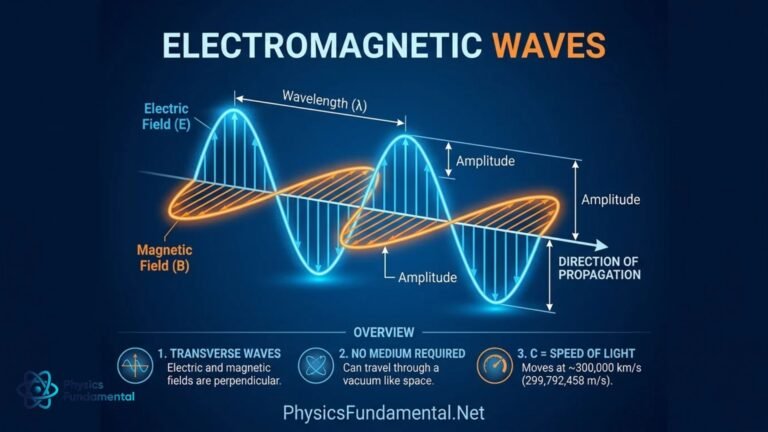
This differs from electromagnetic waves, which can propagate through a vacuum.
Longitudinal Waves in Different Mediums
The behavior of longitudinal waves depends on the medium through which they travel.
In Gases
In gases, particles are relatively far apart. Sound waves travel by producing alternating changes in pressure and density.
Air is the most familiar example.
In Liquids
Particles in liquids are closer together than in gases, allowing pressure disturbances to propagate.
Sound can therefore travel through water and other liquids.
In Solids
Particles in solids are strongly connected and can transfer mechanical disturbances efficiently.
Longitudinal waves can travel through solid materials and are useful in applications such as ultrasonic testing.
You May Like to Read: Torque in Physics: Powerful Formula, Examples, Types & Facts 2026
Applications of Longitudinal Waves
Longitudinal waves have many practical applications.
Medical Imaging
Ultrasound uses high-frequency sound waves to examine structures inside the human body. Reflected waves can be processed to produce images.
Earthquake Detection
Seismic P-waves are used by scientists to study earthquakes and investigate Earth’s internal structure.
Industrial Testing
Ultrasonic longitudinal waves can be used to inspect materials for internal cracks, voids, or other defects without cutting the material open.
Underwater Communication
Sound waves can travel through water, making acoustic waves useful for communication and sensing underwater.
Acoustic Technology
Speakers, microphones, musical instruments, and many other technologies rely on the production or detection of pressure variations associated with sound.
Longitudinal Wave Formula
The fundamental wave equation is:
v = fλ
This formula applies to many types of waves, including longitudinal waves.
For example, suppose a sound wave has a frequency of 500 Hz and a wavelength of 0.68 m.
Using:
v = fλ
we get:
v = 500 × 0.68
v = 340 m/s
Therefore, the wave travels at approximately 340 m/s under the assumed conditions.
The exact speed of sound varies with the medium and conditions, so this example is intended to demonstrate the calculation.
How to Identify a Longitudinal Wave
You can identify a longitudinal wave by looking at the direction of particle vibration.
Ask one simple question:
Do the particles vibrate parallel to the direction in which the wave travels?
If the answer is yes, the wave is longitudinal.
You should also look for alternating regions of compression and rarefaction.
For example, in a slinky, if the coils move back and forth along the same line as the traveling disturbance, you are observing longitudinal wave motion.
Transverse vs Longitudinal Waves
The main difference between transverse and longitudinal waves is the direction in which particles vibrate compared with the direction the wave travels. In transverse waves, particles move perpendicular to the wave’s direction, as seen in waves on a rope. In longitudinal waves, particles move parallel to the wave’s direction, creating compressions and rarefactions. Sound waves traveling through air are a common example of longitudinal waves.
Longitudinal Wave vs Transverse Wave
A longitudinal wave transfers energy through vibrations parallel to its direction of travel, while a transverse wave transfers energy through vibrations perpendicular to that direction. Transverse waves can have crests and troughs, whereas longitudinal waves contain compressions and rarefactions. Understanding these differences helps explain how sound, light, and waves on strings travel through different materials.
Common Misconceptions About Longitudinal Waves
The particles travel with the wave
Not usually. The particles oscillate around their equilibrium positions while energy propagates through the medium.
Longitudinal waves only occur in air
No. Longitudinal mechanical waves can travel through gases, liquids, and solids.
All sound waves are exactly the same
Sound behaves differently depending on the medium and conditions. In air, the basic sound wave is longitudinal, while solids can support additional wave modes.
Longitudinal waves cannot have a wavelength
They can. Wavelength is the distance between corresponding points in successive cycles, such as two neighboring compressions.
Frequently Asked Questions
What is a longitudinal wave in simple words?
A longitudinal wave is a wave in which particles vibrate back and forth in the same direction that the wave travels.
What is the best example of a longitudinal wave?
Sound traveling through air is the most familiar example. A compression wave moving through a slinky is another simple example.
What are compression and rarefaction?
Compression is a region where particles are close together, while rarefaction is a region where particles are farther apart.
Can longitudinal waves travel through solids?
Yes. Longitudinal waves can travel through solids, liquids, and gases when the medium supports the required mechanical disturbance.
Can longitudinal waves travel through a vacuum?
Mechanical longitudinal waves cannot travel through a vacuum because they need particles in a medium to transfer the disturbance.
Conclusion
A longitudinal wave is a mechanical wave in which particles vibrate parallel to the direction of wave propagation. Its most recognizable features are compressions and rarefactions, which represent changes in particle spacing, pressure, and density.
Sound waves in air, slinky waves, ultrasound, and seismic P-waves are important examples. Longitudinal waves are also used in medical imaging, earthquake studies, underwater acoustics, and industrial material testing.
Understanding particle motion, wavelength, frequency, amplitude, and wave speed provides a strong foundation for studying waves and sound in physics.