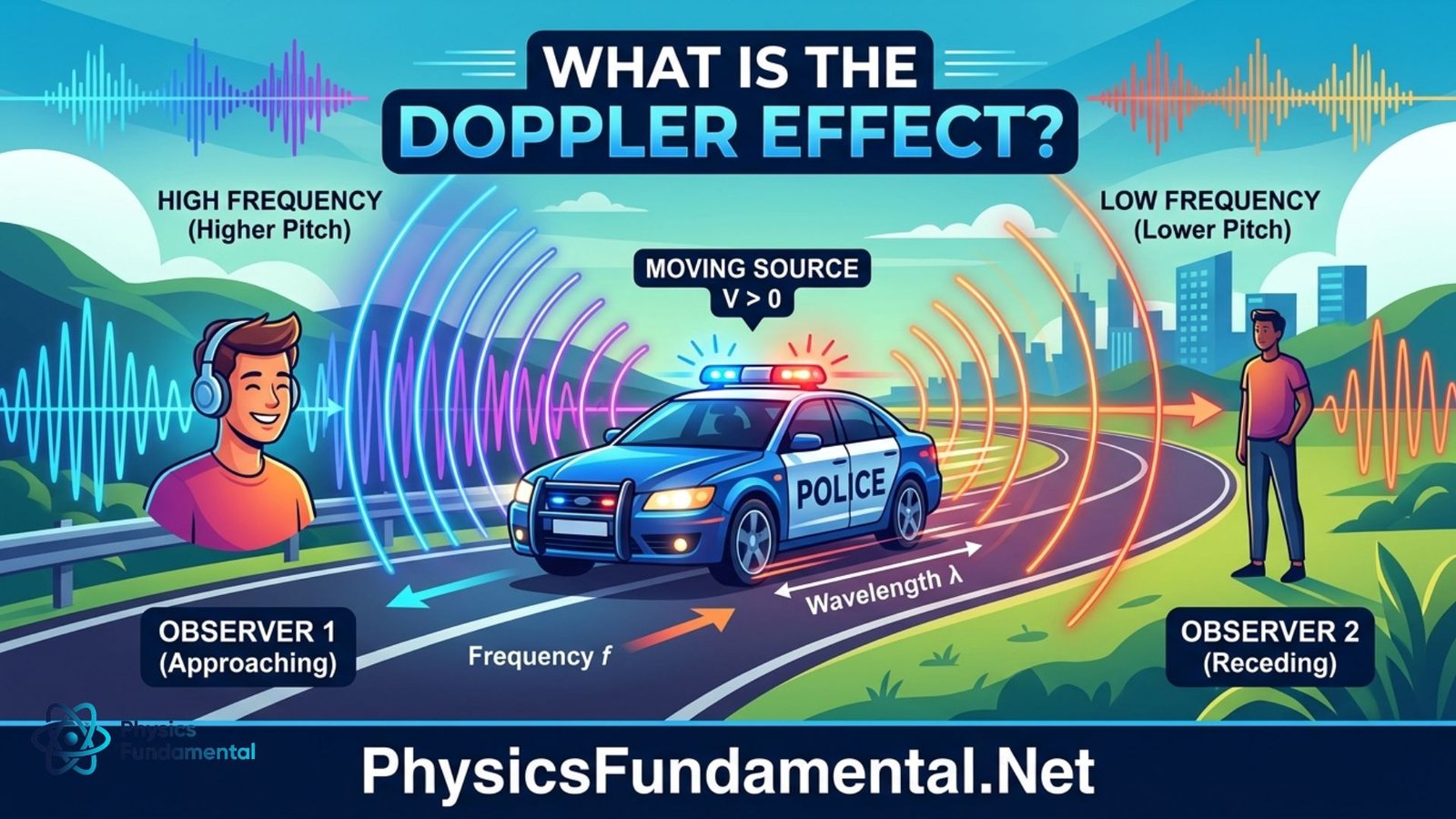
Doppler Effect Explained: Powerful Pitch, Frequency & Wave Facts 2026
Have you ever noticed how an ambulance siren sounds higher as it approaches you and suddenly becomes lower after it passes? The siren itself may be producing a steady sound, yet the pitch you hear changes as the source moves relative to you. This familiar phenomenon is called the Doppler Effect.
The Doppler Effect occurs when there is relative motion between a wave source and an observer. The motion changes the frequency of the waves reaching the observer, which can produce a noticeable change in perceived pitch for sound. The same basic principle also applies to light, radio waves, radar signals, and many other types of waves.
Understanding the Doppler Effect helps explain everyday sounds as well as important technologies used in astronomy, medicine, weather monitoring, and transportation. The key idea is simple: when a source and observer move toward each other, the observed frequency increases; when they move apart, the observed frequency decreases.
What Is the Doppler Effect?
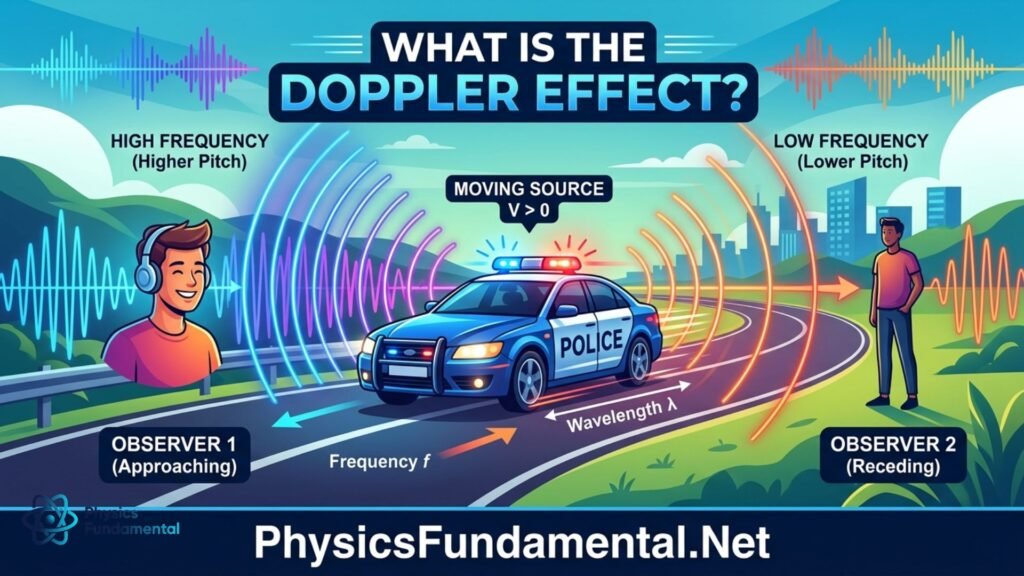
The Doppler Effect is the apparent change in the observed frequency of a wave caused by relative motion between the source of the wave and the observer.
For sound waves, this means the observer may hear a different pitch even though the source is producing sound at a constant frequency.
For example, consider an ambulance approaching a stationary listener. As the ambulance moves toward the listener, each new wave crest is produced closer to the previous crest in the direction of motion. The waves reach the listener more frequently, so the observed frequency increases.
After the ambulance passes and moves away, the wave crests become more spread out in the direction of the observer. The observed frequency decreases.
The Doppler Effect is closely related to Doppler effect and frequency shift, a principle that applies to many types of waves.
Why Does the Doppler Effect Happen?
To understand the effect, imagine a stationary source producing circular waves on the surface of water.
If the source remains stationary, successive waves spread outward evenly. An observer anywhere at a fixed distance receives the waves at a regular frequency.
Now imagine that the source begins moving toward the observer.
The source produces each new wave from a position closer to the observer than where the previous wave was produced. As a result, the waves become compressed in front of the moving source.
This decreases the wavelength in front of the source.
Since wave speed is related to frequency and wavelength by:
v = fλ
if the wave speed remains approximately constant, a decrease in wavelength corresponds to an increase in observed frequency.
Behind the moving source, the opposite happens. The waves become more spread out, increasing the wavelength and decreasing the observed frequency.
Doppler Effect Formula
The general Doppler Effect formula for sound depends on whether the source, observer, or both are moving.
For a stationary observer and moving source, a commonly used formula is:
f’ = f v/(v ± v_s)
Where:
- f’ = observed frequency
- f = actual source frequency
- v = speed of sound in the medium
- v_s = speed of the source
The sign depends on whether the source is moving toward or away from the observer.
For a source moving toward the observer:
f’ = fv/(v − v_s)
For a source moving away from the observer:
f’ = fv/(v + v_s)
The approaching-source equation produces a larger observed frequency, while the receding-source equation produces a smaller observed frequency.
General Doppler Formula for Sound
When both the source and observer are moving, the Doppler equation can be written as:
f’ = f (v ± v_o)/(v ∓ v_s)
Where:
- f’ = observed frequency
- f = emitted frequency
- v = speed of sound relative to the medium
- v_o = observer velocity
- v_s = source velocity
The signs depend on the directions of motion.
A useful way to remember the physical result is:
Moving toward each other → higher observed frequency
Moving away from each other → lower observed frequency
Rather than memorizing signs without understanding them, determine whether the motion causes wavefronts to reach the observer more frequently or less frequently.
Doppler Effect When the Source Moves
Suppose a stationary observer hears a sound from a source moving toward them.
The source emits waves at frequency f.
Because the source moves forward while emitting successive wavefronts, the distance between wavefronts in front of the source becomes smaller.
The wavelength in front of the source is approximately:
λ’ = (v − v_s)/f
Since:
f’ = v/λ’
substitute the wavelength:
f’ = v / [(v − v_s)/f]
Therefore:
f’ = fv/(v − v_s)
This shows mathematically why the observed frequency increases when the source approaches the observer.
Worked Example: Moving Source
An ambulance siren produces a frequency of 700 Hz. The ambulance moves toward a stationary observer at 20 m/s. Assume the speed of sound is 343 m/s.
Find the observed frequency.
Use:
f’ = fv/(v − v_s)
Substitute:
f’ = (700)(343)/(343 − 20)
f’ = 240100/323
f’ ≈ 743.3 Hz
The observer therefore hears approximately:
743 Hz
The observed frequency is higher than the original 700 Hz.
Worked Example: Source Moving Away
Now suppose the same ambulance moves away from the observer at 20 m/s.
Use:
f’ = fv/(v + v_s)
Substitute:
f’ = (700)(343)/(343 + 20)
f’ = 240100/363
f’ ≈ 661.7 Hz
The observed frequency is approximately:
662 Hz
So the pitch sounds lower as the ambulance moves away.
What Happens to Pitch?
For sound, frequency is closely related to perceived pitch.
A higher frequency generally corresponds to a higher pitch, while a lower frequency corresponds to a lower pitch.
Therefore:
Approaching source → frequency increases → pitch rises
Receding source → frequency decreases → pitch falls
This is why a passing siren appears to change pitch.
The important point is that the source does not necessarily have to change the frequency it produces. The observer experiences a different frequency because of relative motion.
Doppler Effect With a Moving Observer
The observer can also move while the source remains stationary.
If the observer moves toward a stationary source, the observer encounters wavefronts more frequently.
The observed frequency can be written as:
f’ = f(v + v_o)/v
when the observer moves toward the source.
If the observer moves away from the source:
f’ = f(v − v_o)/v
The difference occurs because the observer’s motion changes the rate at which they encounter the incoming wavefronts.
Worked Example: Moving Observer
A stationary sound source produces a frequency of 500 Hz. An observer moves toward the source at 10 m/s. Take the speed of sound as 343 m/s.
Use:
f’ = f(v + v_o)/v
Substitute:
f’ = 500(343 + 10)/343
f’ = 500(353)/343
f’ ≈ 514.6 Hz
The observer hears approximately:
515 Hz
The observed frequency is higher because the observer is moving toward the source.
What If Both Source and Observer Move?
In real situations, both the source and observer can move.
The general expression for sound is:
f’ = f (v ± v_o)/(v ∓ v_s)
The correct signs depend on the direction of motion.
A practical approach is to ask two questions:
- Is the observer moving toward or away from the incoming waves?
- Is the source moving toward or away from the observer?
If both movements bring the source and observer closer together, the observed frequency increases.
If both movements increase their separation, the observed frequency decreases.
If one moves toward and the other moves away, their effects partially oppose each other.
Doppler Effect and Wavelength
Frequency and wavelength are related through:
v = fλ
where:
- v = wave speed
- f = frequency
- λ = wavelength
For a moving source, the wave speed through the medium does not simply increase because the source moves faster.
Instead, the spacing between wavefronts changes.
In front of a source moving toward an observer:
Wavelength decreases
Therefore:
Observed frequency increases
Behind the source:
Wavelength increases
Therefore:
Observed frequency decreases
This distinction is particularly important for understanding sound waves.
You May Like to Read: How to Solve Multi-Loop Circuits With Kirchhoff’s Laws: Powerful Circuit Guide 2026
Sound Speed and the Medium
For ordinary sound waves, the speed of sound depends mainly on the properties of the medium.
In air at approximately room temperature, it is around:
343 m/s
But the speed can vary with temperature and atmospheric conditions.
Sound travels at different speeds in different materials.
For example, it generally travels faster through solids than through gases.
The Doppler formulas for sound therefore need to account for the speed of the wave relative to the medium.
Doppler Effect Does Not Change the Wave Speed in the Same Way
A common misconception is that a moving source simply makes sound travel faster or slower through the air.
For a stationary medium, the speed of sound relative to that medium is determined primarily by the medium’s properties.
The source’s motion changes the spacing of the emitted wavefronts, which changes the observed frequency and wavelength.
Similarly, an observer moving through the medium changes the rate at which they encounter the wavefronts.
Doppler Effect for Light
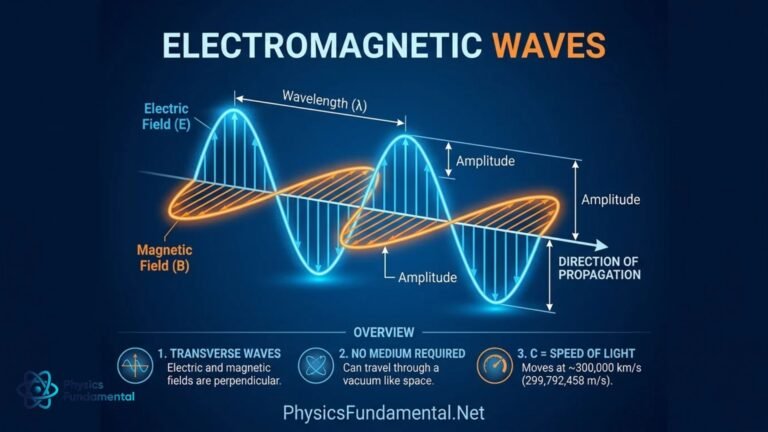
The Doppler Effect also occurs with electromagnetic waves such as visible light.
When an object emitting or reflecting light moves relative to an observer, the observed frequency can shift.
If an astronomical object is moving away from an observer, its spectral lines can shift toward longer wavelengths. This is called redshift.
If the object is moving toward the observer, the wavelengths can shift toward shorter wavelengths, known as blueshift.
The light-based Doppler Effect is extremely useful in astronomy because scientists can analyze changes in spectral lines to study the motion of distant objects.
Redshift and Blueshift
Redshift
Redshift occurs when the observed wavelength becomes longer.
For many astronomical observations, redshift is associated with an object moving away from the observer, although cosmological redshift has a broader explanation involving the expansion of space.
Blueshift
Blueshift occurs when the observed wavelength becomes shorter.
It can occur when a source is moving toward the observer.
These shifts provide information about the relative motion of astronomical objects.
Relativistic Doppler Effect
At speeds approaching the speed of light, the classical Doppler formulas are no longer sufficient.
Special relativity must be considered.
For electromagnetic radiation, the relativistic Doppler Effect accounts for the effects of time dilation and relativistic motion.
This is especially important when studying high-speed particles, astronomical objects, and other systems involving velocities close to the speed of light.
Doppler Effect in Astronomy
Astronomers use frequency shifts in electromagnetic radiation to investigate the motion of stars, galaxies, and other celestial objects.
Spectral lines provide characteristic signatures associated with atoms and molecules.
When those lines shift in wavelength or frequency, scientists can determine information about relative motion along the line of sight.
The Doppler Effect has therefore become an important tool for studying:
- Stars
- Galaxies
- Binary star systems
- Exoplanets
- Gas clouds
- Stellar rotation
- Large-scale astronomical motion
Doppler Effect in Medical Imaging
The Doppler Effect also has important medical applications.
Doppler ultrasound uses changes in the frequency of reflected ultrasound waves to estimate the motion of blood cells.
This can provide information about:
- Blood flow direction
- Blood flow speed
- Circulation
- Blood vessels
- Heart function
Because blood cells move relative to the ultrasound source and detector, the reflected frequency changes.
Medical professionals can use these frequency shifts to create useful information about blood flow.
Doppler Radar
Weather radar systems use the Doppler Effect to measure the motion of particles such as raindrops and snowflakes.
A radar system sends electromagnetic waves toward a region of the atmosphere. The waves reflect from particles, and the frequency of the returning signal can shift because the particles are moving.
This allows Doppler radar to provide information about:
- Wind motion
- Precipitation
- Storm structure
- Rotation within storms
- Movement of weather systems
Doppler radar is therefore an important technology in modern weather observation.
Doppler Effect in Vehicle Speed Detection
Police radar systems can use the Doppler Effect to estimate the speed of moving vehicles.
A radar signal is transmitted toward a vehicle and reflected back toward the detector.
The frequency shift in the returned signal provides information about the vehicle’s motion along the radar’s line of sight.
This is another practical example of how a basic wave phenomenon can be converted into useful measurements.
Doppler Effect in Sound and Music
Musicians and sound engineers can also encounter Doppler shifts when sound sources or listeners move.
For example, imagine a loudspeaker mounted on a moving vehicle.
A listener standing still can hear a different frequency as the speaker approaches and then passes.
The effect can be noticeable even when the source produces a constant tone.
Doppler Effect vs Sonic Boom
The Doppler Effect and a sonic boom are related to wave motion, but they are not the same phenomenon.
The Doppler Effect involves a change in observed frequency caused by relative motion.
A sonic boom occurs when an object travels faster than the local speed of sound and produces a shock wave.
Therefore, simply hearing a changing pitch from a moving siren is a Doppler Effect, not a sonic boom.
Common Mistakes About the Doppler Effect
Mistake 1: Thinking the Source Changes Its Frequency
A moving source can produce a constant frequency while the observer measures a different frequency.
The observed frequency changes because of relative motion.
Mistake 2: Using the Wrong Sign
For sound, approaching motion generally increases the observed frequency, while receding motion decreases it.
Always establish the direction of motion before selecting the equation.
Mistake 3: Confusing Frequency With Wave Speed
Frequency is the number of cycles per second, while wave speed describes how quickly the disturbance travels through the medium.
They are related by:
v = fλ
but they are not the same quantity.
Mistake 4: Forgetting the Medium for Sound
The classical sound Doppler equation depends on the speed of sound in the medium.
Mistake 5: Assuming Every Frequency Shift Is Classical
At very high velocities, especially when electromagnetic radiation is involved, relativistic effects may need to be considered.
Doppler Effect Formula Summary
| Situation | Formula |
|---|---|
| Basic wave relationship | v = fλ |
| Moving source toward observer | f’ = fv/(v − v_s) |
| Moving source away from observer | f’ = fv/(v + v_s) |
| Moving observer toward source | f’ = f(v + v_o)/v |
| Moving observer away from source | f’ = f(v − v_o)/v |
| Both source and observer moving | f’ = f(v ± v_o)/(v ∓ v_s) |
Here f’ is the observed frequency, f is the emitted frequency, v is the wave speed in the medium, v_o is observer speed, and v_s is source speed.
Key Facts About the Doppler Effect
The most important ideas to remember are:
- The Doppler Effect is caused by relative motion between a wave source and observer.
- Approaching motion generally produces a higher observed frequency.
- Receding motion generally produces a lower observed frequency.
- For sound, frequency is related to perceived pitch.
- A moving source changes the spacing of wavefronts.
- A moving observer changes the rate at which wavefronts are encountered.
- The effect applies to sound and electromagnetic waves.
- Astronomy uses frequency shifts to study the motion of distant objects.
- Doppler ultrasound measures blood flow.
- Doppler radar measures motion in the atmosphere.
- Radar speed detectors can use frequency shifts to estimate vehicle velocity.
Frequently Asked Questions
What is the Doppler Effect?
The Doppler Effect is the apparent change in observed wave frequency caused by relative motion between a source and an observer.
Why does a siren change pitch as it passes?
As the siren approaches, the wavefronts reach the listener more frequently, producing a higher observed frequency. After it passes, the observed frequency decreases.
Does the Doppler Effect change the speed of sound?
Not simply because the source is moving. For a stationary medium, the speed of sound is mainly determined by the properties of that medium.
What is the Doppler Effect formula?
For a stationary observer and moving sound source, the formula is f’ = fv/(v ± v_s), with the sign determined by whether the source approaches or moves away.
Where is the Doppler Effect used?
It is used in astronomy, Doppler ultrasound, weather radar, vehicle speed detection, navigation, and many other scientific and engineering applications.
Conclusion
The Doppler Effect explains why the frequency of a wave appears to change when there is relative motion between the source and observer. With sound, this produces the familiar change in pitch of a passing siren: higher as the source approaches and lower as it moves away.
The key relationship is based on the wave equation v = fλ, while the appropriate Doppler formula depends on whether the source, observer, or both are moving. Once the direction of motion and sign conventions are understood, the calculations become straightforward.
Beyond everyday sound, the Doppler Effect has major applications in astronomy, medical ultrasound, weather radar, and speed measurement. It is a powerful example of how a fundamental wave principle can be used to understand and measure motion in the real world.