How Waves Add Together: Powerful Superposition, Phase & Beats 2026
Waves are constantly overlapping in the world around us. Water ripples meet on a pond, sound waves from different instruments combine in the air, and electromagnetic waves can pass through the same region of space. When waves meet, they do not simply stop or bounce away from one another. Instead, their disturbances combine.
This process is described by the principle of superposition. It explains how waves add together and why their combination can produce larger amplitudes, smaller amplitudes, complete cancellation, or changing patterns over time.
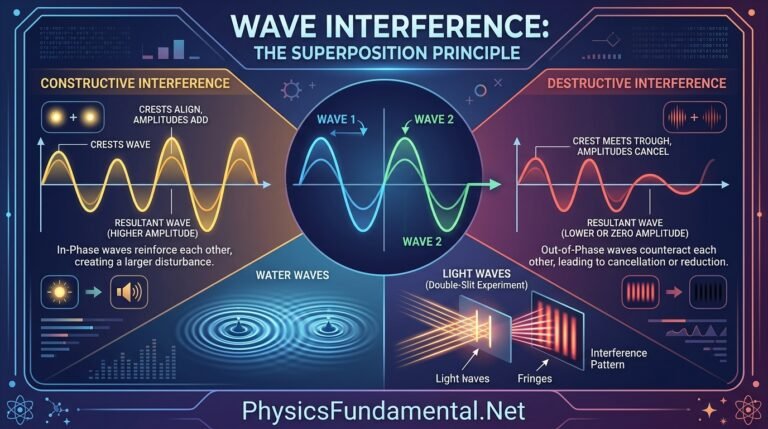
The result depends strongly on the phase difference between the waves. When waves arrive in step, they can reinforce each other through constructive interference. When they arrive out of step, they can partially or completely cancel through destructive interference. When two waves have slightly different frequencies, their changing phase relationship produces a phenomenon called beats.
What Is Wave Superposition?
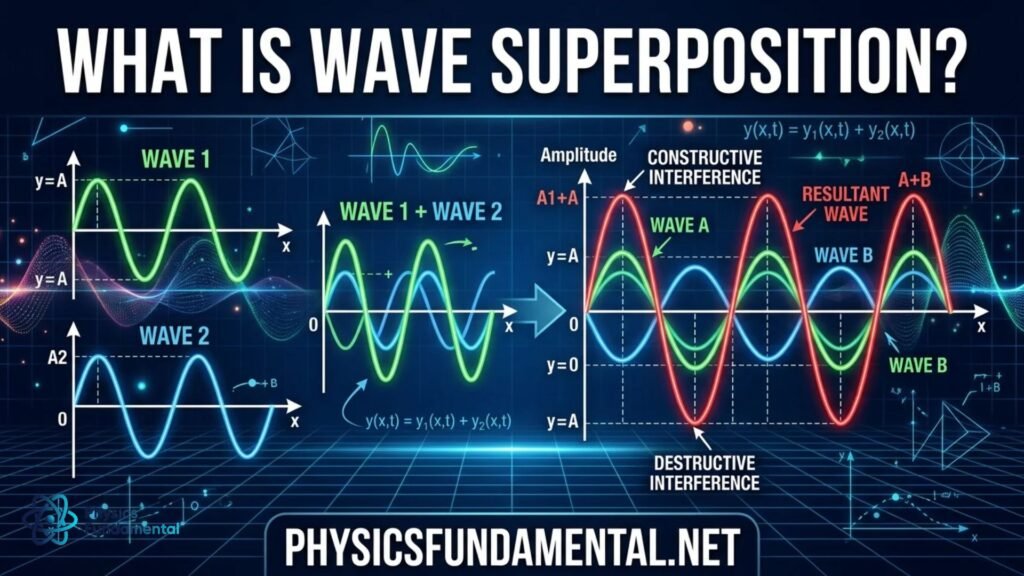
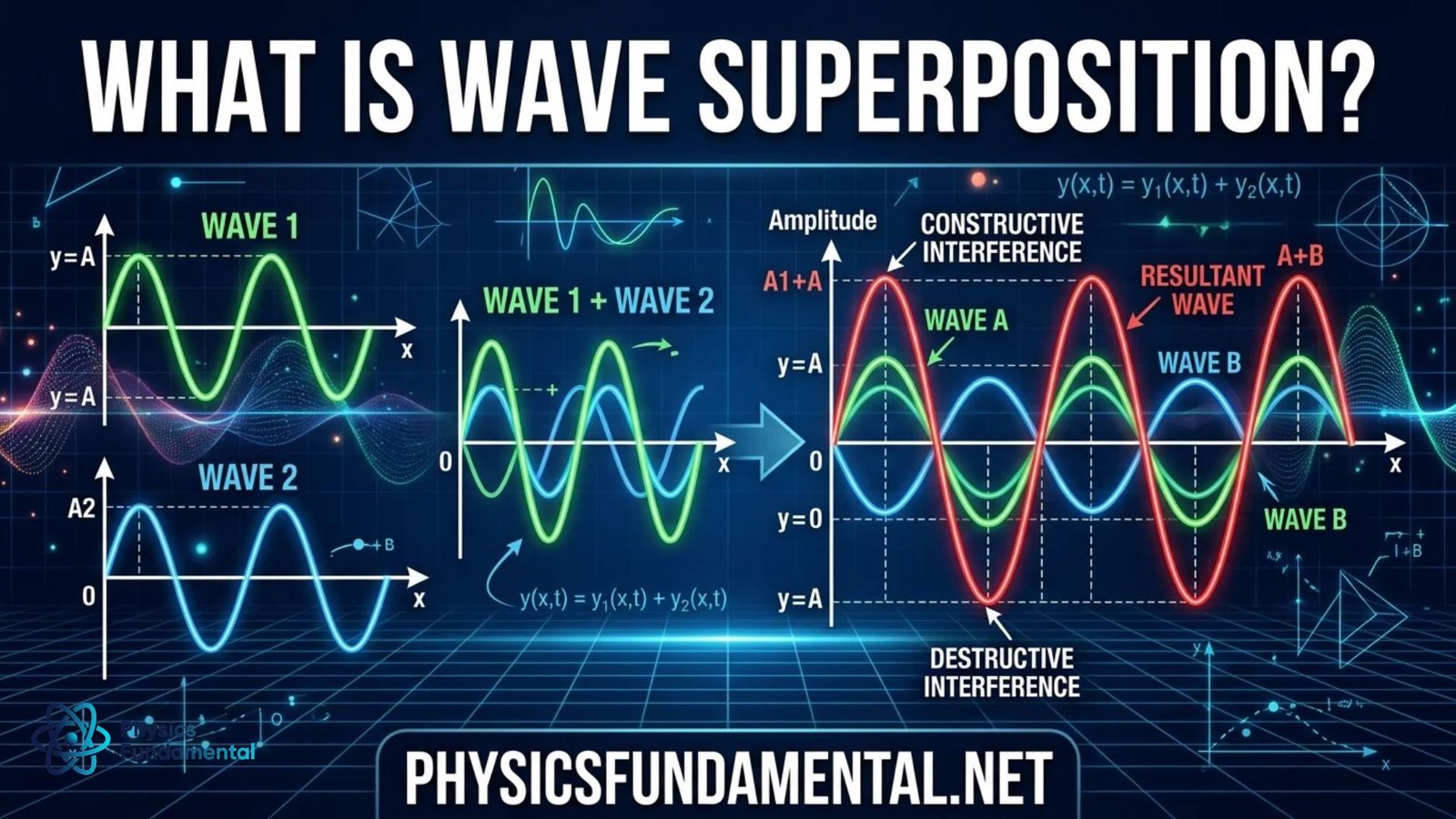
Wave superposition is the principle that when two or more waves overlap at the same location, the resulting disturbance is the algebraic sum of the individual disturbances.
In simple form:
y = y₁ + y₂ + y₃ + …
where:
- y = total displacement
- y₁, y₂, y₃ = displacements produced by individual waves
For two waves:
y = y₁ + y₂
This means that the waves are mathematically added at the point where they overlap.
The principle applies to many types of waves, including:
- water waves
- waves on strings
- sound waves
- light waves
- electromagnetic waves
For linear waves, the individual disturbances combine without permanently changing the waves themselves.
How Waves Add Together
Imagine two waves traveling along a rope.
At one particular point, the first wave produces an upward displacement of 3 cm while the second produces an upward displacement of 2 cm.
The total displacement is:
y = 3 + 2
y = 5 cm
The disturbances reinforce one another.
Now imagine the first wave produces an upward displacement of 3 cm, while the second produces a downward displacement of 2 cm.
Taking upward as positive:
y = 3 + (-2)
y = 1 cm
The waves partially cancel.
This simple addition of disturbances is the foundation of wave interference.
What Is Interference?
Interference is the result of two or more waves overlapping and combining.
There are two important types:
- Constructive interference
- Destructive interference
Both are consequences of superposition.
Constructive interference increases the resulting amplitude, while destructive interference decreases it.
The amount of reinforcement or cancellation depends on the relative phase of the waves.
Constructive Interference
Constructive interference occurs when waves combine so that their disturbances reinforce each other.
For two identical waves that are perfectly in phase:
Aᵣ = A₁ + A₂
If both waves have amplitude A:
Aᵣ = 2A
So the resulting wave has twice the amplitude of either individual wave.
Example
Suppose two waves each have an amplitude of:
A = 4 cm
If they are completely in phase:
Aᵣ = 4 + 4
Aᵣ = 8 cm
The resultant amplitude is 8 cm.
The wavelength and frequency do not simply double. It is the amplitude that doubles for two identical, perfectly in-phase waves.
Destructive Interference
Destructive interference occurs when the disturbances of two waves oppose each other.
For two identical waves that are exactly 180° out of phase, the crest of one aligns with the trough of the other.
If their amplitudes are equal:
Aᵣ = A − A
Therefore:
Aᵣ = 0
The waves completely cancel at that location.
Example
Two waves each have an amplitude of:
5 cm
but they are 180° out of phase.
Therefore:
Aᵣ = 5 − 5
Aᵣ = 0 cm
The resulting displacement is zero.
However, it is important to understand that the individual waves have not been permanently destroyed. The cancellation occurs where and when their disturbances oppose each other.
What Is Phase Difference?
Phase difference describes how far one wave is shifted relative to another in its cycle.
It is commonly represented by:
Δφ
and measured in:
- degrees
- radians
One complete cycle corresponds to:
360° = 2π radians
Some important phase differences are:
| Phase Difference | Result |
|---|---|
| 0° | Completely in phase |
| 90° | Quarter-cycle difference |
| 180° | Completely out of phase |
| 270° | Three-quarter-cycle difference |
| 360° | Back in phase |
The phase difference determines how strongly two waves reinforce or cancel each other.
Phase Difference and Resultant Amplitude
For two sinusoidal waves with the same amplitude A, frequency, and wavelength, but a phase difference Δφ, the resultant amplitude is:
Aᵣ = 2A cos(Δφ/2)
This equation shows how the resultant amplitude depends on phase difference.
When Δφ = 0°
Aᵣ = 2A cos 0°
Aᵣ = 2A
This is maximum constructive interference.
When Δφ = 180°
Aᵣ = 2A cos 90°
Aᵣ = 0
This is complete destructive interference.
For intermediate phase differences, the resulting amplitude lies between these extremes.
Phase Difference and Path Difference
Phase difference can also result from waves traveling different distances.
For waves with wavelength λ, a path difference of one complete wavelength corresponds to a phase difference of:
360°
A path difference of half a wavelength corresponds to:
180°
Therefore:
Δφ = 2π(Δx/λ)
where:
- Δφ = phase difference in radians
- Δx = path difference
- λ = wavelength
This relationship is especially useful when studying interference patterns.
Conditions for Constructive Interference
For waves of the same frequency, constructive interference occurs when the phase difference is:
Δφ = 0, 2π, 4π, …
In terms of path difference:
Δx = nλ
where:
n = 0, 1, 2, 3, …
Therefore, constructive interference occurs when the path difference is an integer multiple of the wavelength.
Examples include:
Δx = 0
Δx = λ
Δx = 2λ
Δx = 3λ
and so on.
Conditions for Destructive Interference
Destructive interference occurs when the phase difference is:
Δφ = π, 3π, 5π, …
In terms of path difference:
Δx = (n + ½)λ
Therefore, destructive interference occurs when the path difference is an odd multiple of half a wavelength.
Examples include:
Δx = λ/2
Δx = 3λ/2
Δx = 5λ/2
and so on.
Worked Example: Constructive Interference
Two identical waves have a wavelength of 2 m.
Suppose their path difference is:
Δx = 4 m
Determine whether they interfere constructively or destructively.
Use:
Δx = nλ
Since:
4 = 2 × 2
we have:
n = 2
The path difference is an integer multiple of the wavelength.
Therefore, the waves produce constructive interference.
Worked Example: Destructive Interference
Suppose two waves have a wavelength of:
λ = 6 m
and their path difference is:
Δx = 3 m
Since:
3 = λ/2
the waves differ by half a wavelength.
Therefore, they produce destructive interference.
How Beats Are Produced
Beats occur when two waves with slightly different frequencies overlap.
Suppose two sound waves have frequencies:
f₁ = 256 Hz
and:
f₂ = 260 Hz
Because their frequencies are close but not identical, their relative phase continuously changes.
Sometimes the waves are nearly in phase, producing constructive interference.
At other times they become nearly out of phase, producing destructive interference.
This causes the combined sound to become alternately louder and quieter.
That repeating variation in amplitude is called a beat.
Beat Frequency Formula
The beat frequency is:
fᵦ = |f₁ − f₂|
where:
- fᵦ = beat frequency
- f₁ = frequency of the first wave
- f₂ = frequency of the second wave
Example
Suppose:
f₁ = 256 Hz
f₂ = 260 Hz
Then:
fᵦ = |260 − 256|
fᵦ = 4 Hz
Therefore, the sound has 4 beats per second.
Why Do Beats Get Louder and Softer?
The two waves continually move in and out of phase because their frequencies are slightly different.
When their crests and troughs align:
Constructive interference → larger amplitude
A short time later, the waves may oppose one another:
Destructive interference → smaller amplitude
This cycle repeats, producing regular increases and decreases in amplitude. For sound, we perceive these changes as a periodic rise and fall in loudness.
Beat Frequency Is Not the Average Frequency
A common mistake is to confuse the beat frequency with the frequency of the resulting oscillation.
The beat frequency is:
fᵦ = |f₁ − f₂|
The average frequency is:
fₐᵥ = (f₁ + f₂)/2
For example, if:
f₁ = 256 Hz
and:
f₂ = 260 Hz
then:
fᵦ = 4 Hz
while:
fₐᵥ = (256 + 260)/2
fₐᵥ = 258 Hz
So the combined sound oscillates around an average frequency of 258 Hz, while its amplitude varies at 4 Hz.
Beats in Musical Instruments
Beats are especially useful in music.
Musicians can use beats to compare frequencies between instruments or tuning devices.
Suppose one instrument produces a note slightly above the desired frequency.
As the two frequencies approach one another, the beat frequency becomes smaller.
When the frequencies become equal:
f₁ = f₂
there are no regular beats caused by their frequency difference.
This makes beats a useful practical method for tuning musical instruments.
You May Like to Read: F = Gm₁m₂/r²: 7 Powerful Newton’s Gravitation Facts 2026
Beats and Tuning
Imagine a reference tone has a frequency of:
440 Hz
and a musical instrument produces:
444 Hz
The beat frequency is:
fᵦ = |444 − 440|
fᵦ = 4 Hz
The listener hears approximately four loudness variations per second.
If the instrument is adjusted to:
441 Hz
then:
fᵦ = |441 − 440|
fᵦ = 1 Hz
The beats become slower.
When the instrument reaches:
440 Hz
the beat frequency becomes:
fᵦ = 0 Hz
The two frequencies match.
Standing Waves and Superposition
Superposition can also produce standing waves.
A standing wave can be formed when two waves with the same frequency and appropriate wavelength travel in opposite directions and overlap.
The resulting pattern contains:
- nodes
- antinodes
A node is a point where the displacement remains zero.
An antinode is a point where the amplitude is maximum.
Standing waves occur in:
- guitar strings
- violin strings
- organ pipes
- air columns
- microwave cavities
They are a major application of wave superposition.
Nodes and Antinodes
In an ideal standing wave:
Nodes are locations of minimum displacement.
Antinodes are locations of maximum displacement.
The distance between adjacent nodes is:
λ/2
The distance between a node and the nearest antinode is:
λ/4
These relationships are important when analyzing vibrating strings and air columns.
Superposition in Sound
Sound waves can easily overlap.
For example, in a room, sound from:
- speakers
- musical instruments
- voices
- reflections from walls
can arrive at the same location.
These sound waves superimpose and can create areas where the sound is louder or quieter.
This is one reason the sound level in a room can vary from one location to another.
Noise Cancellation and Destructive Interference
Destructive interference has an important technological application in active noise cancellation.
Noise-cancelling headphones use microphones and electronic processing to detect unwanted sound.
The system generates another sound signal designed to oppose the unwanted sound at the listener’s ears.
When the two sound waves combine appropriately, destructive interference reduces the resulting sound.
The cancellation is not perfect for every frequency or position, but the principle is directly based on wave interference.
Superposition of Different Waves
Waves do not have to be identical to superimpose.
If two waves have different amplitudes, frequencies, or wavelengths, their disturbances can still add together.
The resulting wave may have a more complicated shape.
For example:
y = y₁ + y₂
If:
y₁ = A sin(kx − ω₁t)
and:
y₂ = B sin(kx − ω₂t)
then the combined wave is:
y = A sin(kx − ω₁t) + B sin(kx − ω₂t)
The resulting pattern may not look like a simple sine wave.
This is one reason real-world waves can have complicated shapes even when they are produced by relatively simple sources.
Does Superposition Change the Waves Permanently?
In an ideal linear system, waves can pass through one another and continue traveling after the overlap.
For example, two pulses traveling toward each other on a string may temporarily produce a larger or smaller displacement while they overlap. Afterward, each pulse continues along its path.
This is an important feature of linear wave behavior.
The interaction changes the resultant disturbance during the overlap, not necessarily the individual waves permanently.
Superposition of Light Waves
Light is an electromagnetic wave, and electromagnetic fields also obey the superposition principle in the appropriate linear regime.
When light waves overlap, they can produce interference patterns.
This principle is used in:
- thin-film interference
- optical instruments
- interferometers
- holography
- diffraction experiments
- laser technology
The same basic idea applies: the electromagnetic fields add together.
Common Mistakes About Wave Superposition
Mistake 1: Thinking Waves Destroy Each Other
Destructive interference does not generally mean the waves permanently disappear.
The waves can continue after passing through the region of overlap.
Mistake 2: Adding Frequencies
Superposition means adding the instantaneous disturbances, not simply adding the frequencies.
The resultant behavior depends on the amplitudes, frequencies, phases, and directions involved.
Mistake 3: Confusing Phase Difference With Frequency Difference
Phase difference describes the relative position of two waves within their cycles.
Frequency describes how many cycles occur per second.
They are related but different quantities.
Mistake 4: Forgetting the Absolute Value in Beat Frequency
The beat frequency is:
fᵦ = |f₁ − f₂|
It must be positive or zero.
Mistake 5: Confusing Beat Frequency With Average Frequency
For two nearby frequencies, the beat frequency describes the amplitude variation:
fᵦ = |f₁ − f₂|
The average frequency is:
fₐᵥ = (f₁ + f₂)/2
These are different quantities.
Important Wave Superposition Formulas
The main formulas to remember are:
Superposition
y = y₁ + y₂
General interference phase relationship
Δφ = 2π(Δx/λ)
Resultant amplitude for two identical waves
Aᵣ = 2A cos(Δφ/2)
Constructive interference
Δx = nλ
Destructive interference
Δx = (n + ½)λ
Beat frequency
fᵦ = |f₁ − f₂|
Average frequency
fₐᵥ = (f₁ + f₂)/2
These equations provide a useful starting point for solving problems involving superposition, interference, phase, and beats.
Frequently Asked Questions
How do waves add together?
Waves add together through the principle of superposition. The resulting disturbance is the algebraic sum of the individual wave disturbances.
What is constructive interference?
Constructive interference occurs when waves reinforce each other, producing a larger resultant amplitude.
What is destructive interference?
Destructive interference occurs when wave disturbances oppose each other, reducing the resultant amplitude. Identical waves 180° out of phase can completely cancel.
What is phase difference?
Phase difference describes how far one wave is shifted relative to another in its cycle. It is commonly measured in degrees or radians.
What are beats in physics?
Beats are periodic changes in amplitude produced when two waves with slightly different frequencies interfere. Their beat frequency is fᵦ = |f₁ − f₂|.
Conclusion
How Waves Add Together is explained by the principle of superposition: when waves overlap, their disturbances combine to produce a resultant wave. Depending on their relative phase, the result can be constructive interference, destructive interference, or something in between.
Phase difference determines how strongly waves reinforce or cancel one another. When two identical waves are in phase, their amplitudes can add. When they are 180° out of phase, they can completely cancel. When waves have slightly different frequencies, their changing phase relationship produces beats with a frequency given by fᵦ = |f₁ − f₂|.
These ideas are fundamental to understanding sound, light, standing waves, musical instruments, noise cancellation, optical interference, and many other wave phenomena. Once superposition and phase are understood, many seemingly complicated wave patterns become much easier to explain.