F = Gm₁m₂/r²: 7 Powerful Newton’s Gravitation Facts 2026
Why does an apple fall toward Earth instead of floating away? Why does the Moon remain in orbit around Earth, and why do planets continue moving around the Sun? The answer to these questions lies in one of the most important ideas in classical physics: gravity.
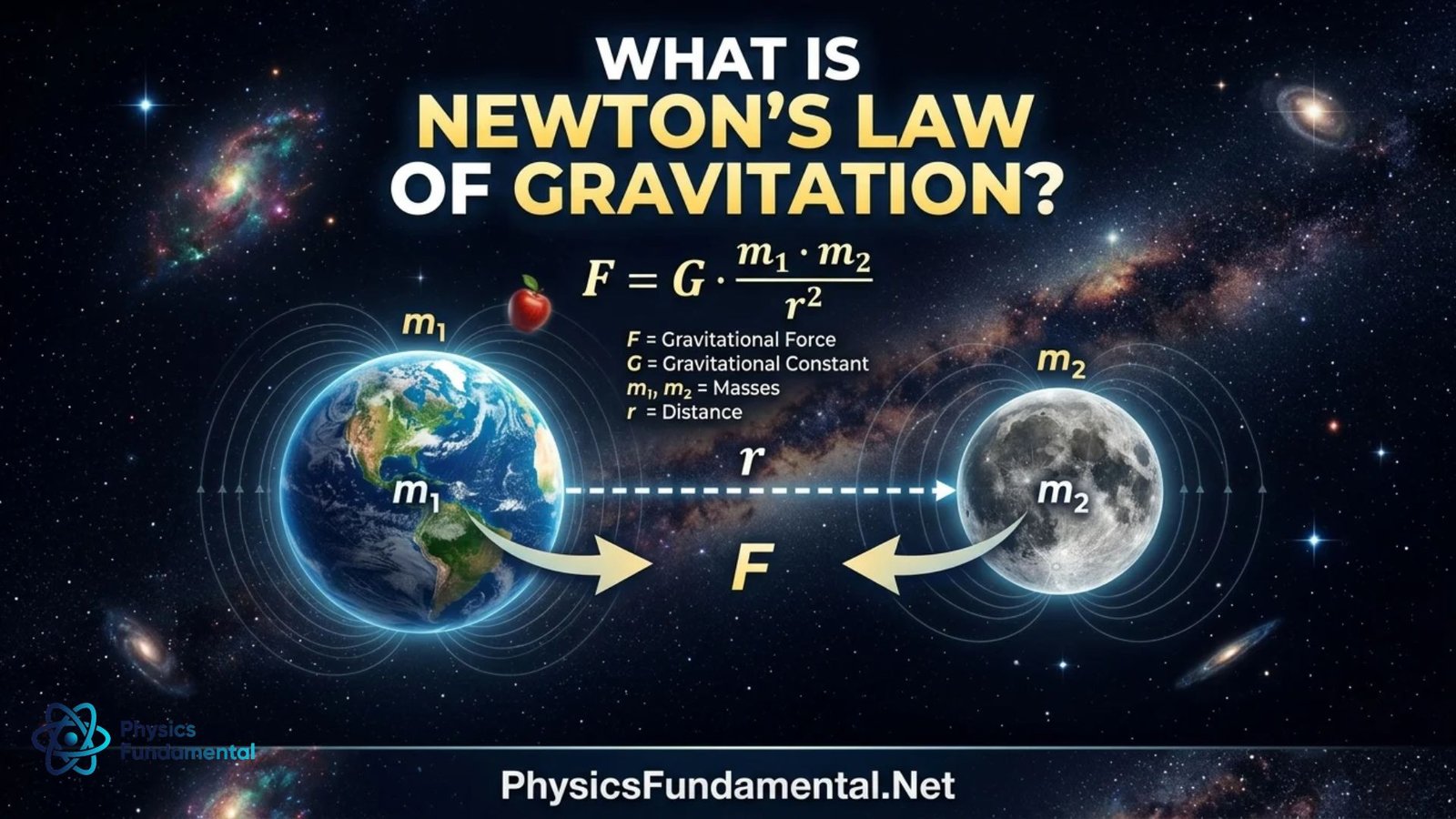
The equation F = Gm₁m₂/r² describes the gravitational force between two masses. It is known as Newton’s law of universal gravitation and shows that every object with mass attracts every other object with mass.
The strength of this attraction depends on the masses involved and the distance between their centers. Larger masses produce a stronger gravitational force, while increasing the distance weakens the force according to the inverse-square law.
What Is Newton’s Law of Gravitation?
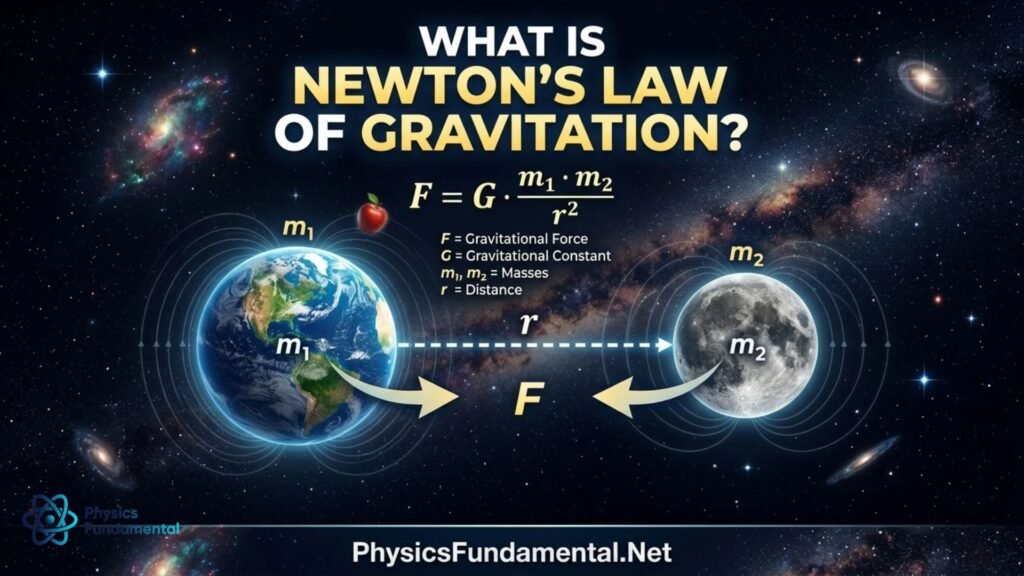
Newton’s law of universal gravitation states that every two objects with mass attract each other with a force proportional to the product of their masses and inversely proportional to the square of the distance between their centers.
The mathematical formula is:
F = Gm₁m₂/r²
Where:
- F = gravitational force in newtons (N)
- G = universal gravitational constant
- m₁ = mass of the first object in kilograms (kg)
- m₂ = mass of the second object in kilograms (kg)
- r = distance between the centers of the two objects in meters (m)
The gravitational force is always attractive.
For additional background, Newton’s law of universal gravitation provides a broader overview of the law and its historical development.
The Meaning of F = Gm₁m₂/r²
The equation contains several important relationships.
Force Depends on Mass
The gravitational force increases when either mass increases.
From:
F = Gm₁m₂/r²
we can see that:
F ∝ m₁
and:
F ∝ m₂
If one mass doubles while everything else stays constant, the gravitational force doubles.
If both masses double, the force becomes four times greater.
Force Depends on Distance
The equation also shows:
F ∝ 1/r²
This is called the inverse-square relationship.
If the distance doubles:
r → 2r
then:
F’ = Gm₁m₂/(2r)²
Therefore:
F’ = Gm₁m₂/4r²
So:
F’ = F/4
The gravitational force becomes one-quarter of its original value.
If the distance triples, the force becomes one-ninth as large.
What Is the Gravitational Constant G?
The symbol G represents the universal gravitational constant.
Its approximate value is:
G = 6.674 × 10⁻¹¹ N·m²/kg²
The value of G is extremely small, which helps explain why gravitational attraction between ordinary objects is usually difficult to notice.
For example, two people standing near each other exert gravitational forces on each other, but the forces are extremely small compared with Earth’s gravitational pull.
The constant G is universal, meaning the same constant appears in Newton’s gravitational law throughout classical gravitational calculations.
Why Is Gravity Always Attractive?
Gravity between ordinary masses is attractive.
If two objects have masses m₁ and m₂, each object experiences a gravitational force directed toward the other.
For example:
- Earth attracts the Moon.
- The Moon attracts Earth.
- Earth attracts you.
- You also attract Earth.
The forces acting between two objects have equal magnitudes and opposite directions, consistent with Newton’s third law.
Gravitational Force Is a Vector
The equation:
F = Gm₁m₂/r²
usually gives the magnitude of the gravitational force.
Force itself is a vector, meaning it has both magnitude and direction.
The direction of the gravitational force lies along the line connecting the centers of the two masses.
For two spherical bodies with spherical symmetry, the gravitational interaction outside the bodies can be treated as though their masses were concentrated at their centers.
Worked Example 1: Gravitational Force Between Two Masses
Suppose two objects have masses:
m₁ = 10 kg
m₂ = 20 kg
and their centers are:
r = 2 m
apart.
Find the gravitational force.
Use:
F = Gm₁m₂/r²
Substitute:
F = (6.674 × 10⁻¹¹)(10)(20)/(2)²
Since:
(2)² = 4
we get:
F = (6.674 × 10⁻¹¹)(200)/4
F ≈ 3.337 × 10⁻⁹ N
Therefore, the gravitational force is approximately:
3.34 × 10⁻⁹ N
This is extremely small, which illustrates how weak gravity is between everyday objects.
Worked Example 2: Force Between Earth and an Object
Suppose an object has a mass of 10 kg and is near Earth’s surface.
Approximate values:
Mₑ = 5.97 × 10²⁴ kg
Rₑ = 6.37 × 10⁶ m
Using:
F = GMₑm/Rₑ²
we obtain a force of approximately:
F ≈ 98 N
This agrees with the familiar relationship:
F = mg
because near Earth’s surface:
g ≈ 9.8 m/s²
Therefore:
F = 10 × 9.8
F = 98 N
This shows how Newton’s universal gravitation leads naturally to the familiar weight equation near Earth’s surface.
Mass vs Weight
Mass and weight are not the same thing.
Mass
Mass measures the amount of matter in an object.
Its SI unit is:
kilogram (kg)
Mass remains the same regardless of location.
Weight
Weight is the gravitational force acting on an object.
It is calculated near a planetary surface using:
W = mg
Its SI unit is:
newton (N)
For example, a person with a mass of 60 kg has approximately:
W = 60 × 9.8
W = 588 N
on Earth.
On the Moon, the person’s mass would remain 60 kg, but their weight would be much smaller because the Moon has a weaker surface gravitational acceleration.
How Newton’s Law Explains Earth’s Gravity
Newton’s law can be used to calculate the gravitational acceleration near Earth.
Start with:
F = G Mₑm/r²
From Newton’s second law:
F = ma
Therefore:
ma = GMₑm/r²
Cancel the object’s mass m:
a = GMₑ/r²
Near Earth’s surface:
g = GMₑ/Rₑ²
This gives approximately:
g ≈ 9.8 m/s²
Therefore, Earth’s gravitational acceleration is a direct consequence of its mass and radius.
Why Objects Fall at the Same Acceleration
Ignoring air resistance, objects near Earth’s surface fall with approximately the same gravitational acceleration.
From:
F = GMₑm/r²
and:
F = ma
we get:
ma = GMₑm/r²
Cancel m:
a = GMₑ/r²
The mass of the falling object disappears from the equation.
Therefore, a heavier object does not automatically fall faster than a lighter object when air resistance is ignored.
For objects near Earth’s surface:
a ≈ g ≈ 9.8 m/s²
This is why, in an ideal vacuum, objects of different masses fall together.
The Inverse-Square Law
One of the most important features of Newton’s gravitational equation is the inverse-square relationship.
The equation can be written as:
F ∝ 1/r²
This means that gravitational force decreases rapidly as distance increases.
Consider the following changes:
| Distance | Gravitational Force |
|---|---|
| r | F |
| 2r | F/4 |
| 3r | F/9 |
| 4r | F/16 |
| 5r | F/25 |
This relationship is extremely important in planetary motion, satellite orbits, astronomy, and gravitational calculations.
What Happens If the Mass Changes?
Because:
F ∝ m₁m₂
changing either mass changes the gravitational force proportionally.
If One Mass Doubles
If:
m₁ → 2m₁
then:
F → 2F
The force doubles.
If Both Masses Double
If:
m₁ → 2m₁
and:
m₂ → 2m₂
then:
F → 4F
The force becomes four times larger.
If One Mass Is Halved
If:
m₁ → m₁/2
then:
F → F/2
The gravitational force becomes half as large.
You May Like to Read: Work Done in Physics: 7 Powerful Formulas, Examples & Facts 2026
Gravitational Force Between Earth and the Moon
The Earth and Moon continuously attract each other through gravity.
The force can be described by:
F = GMₑMₘ/r²
where:
- Mₑ = mass of Earth
- Mₘ = mass of the Moon
- r = distance between their centers
This gravitational attraction provides the force responsible for maintaining the Moon’s orbit around Earth.
The Moon is continuously moving forward due to its inertia while Earth’s gravity continually changes the direction of its motion.
The result is an orbit rather than a straight-line path.
Gravity and Planetary Orbits
Newton’s gravitational law also explains why planets orbit the Sun.
The Sun has enormous mass, so it produces a strong gravitational field.
A planet moving around the Sun experiences a gravitational force directed toward the Sun.
The planet’s velocity carries it forward while gravity continually changes the direction of that motion.
This combination produces orbital motion.
The same basic gravitational interaction applies to:
- planets
- moons
- asteroids
- comets
- artificial satellites
Gravity and Artificial Satellites
Satellites orbit Earth because Earth’s gravitational attraction provides the force needed to continuously change their direction of motion.
For a circular orbit, gravitational force provides centripetal force.
The gravitational force is:
F = GMm/r²
The required centripetal force is:
F = mv²/r
Equating them:
GMm/r² = mv²/r
Cancel m:
GM/r² = v²/r
Therefore:
v² = GM/r
and:
v = √(GM/r)
This gives the orbital speed for an ideal circular orbit.
Why Satellites Do Not Simply Fall to Earth
A satellite is technically falling toward Earth under gravity, but it also has significant sideways velocity.
As the satellite falls, Earth’s curved surface drops away beneath its path.
If its speed and orbit are appropriate, it continually falls around Earth rather than directly into the surface.
This is the basic idea behind orbital motion.
Escape Velocity and Gravity
Gravity also determines the escape velocity from a celestial body.
The escape velocity is:
vₑ = √(2GM/r)
where:
- vₑ = escape velocity
- G = gravitational constant
- M = mass of the body
- r = distance from the body’s center
For Earth near its surface, the escape velocity is approximately:
11.2 km/s
This means an object needs sufficient speed to escape Earth’s gravitational influence without further propulsion, assuming idealized conditions.
Gravitational Potential Energy
Gravity can also be described using potential energy.
Near Earth’s surface:
PE = mgh
For larger distances from a massive body, the gravitational potential energy is:
U = −GMm/r
The negative sign indicates that the conventional zero of gravitational potential energy is taken at infinite separation.
As an object moves farther away from a massive body, its gravitational potential energy increases toward zero.
Newton’s Law and Kepler’s Laws
Newton’s gravitational theory provided a physical explanation for the planetary motion described by Kepler’s laws.
Kepler’s laws describe how planets move around the Sun, while Newton’s laws explain the force responsible for that motion.
For an ideal circular orbit, combining gravity with centripetal motion gives:
v = √(GM/r)
This relationship shows that orbital speed decreases as orbital radius increases.
Applications of Newton’s Law of Gravitation
Newton’s law of gravitation has many important applications.
1. Planetary Motion
It helps explain the motion of planets around stars.
2. Moon and Satellite Orbits
It describes the gravitational attraction responsible for orbital motion.
3. Space Missions
Scientists use gravitational calculations when planning spacecraft trajectories.
4. Tides
The gravitational influence of the Moon and Sun contributes significantly to Earth’s tides.
5. Astronomy
Gravity is fundamental to understanding the motion of stars, planets, moons, and other astronomical objects.
6. Determining Masses
Astronomers can use gravitational interactions and orbital motion to estimate the masses of astronomical bodies.
Newtonian Gravity vs Einstein’s General Relativity
Newton’s law of universal gravitation is extremely useful and accurately describes many situations involving relatively weak gravitational fields and ordinary speeds.
However, modern physics describes gravity more generally through Einstein’s general theory of relativity.
In general relativity, gravity is associated with the curvature of spacetime caused by mass and energy.
Newton’s equation remains an excellent approximation for many everyday and astronomical calculations, while general relativity becomes especially important in situations involving very strong gravity, very high precision, or speeds approaching the speed of light.
Examples include:
- black holes
- gravitational waves
- precise satellite timing
- strong gravitational fields
Common Mistakes With F = Gm₁m₂/r²
Mistake 1: Forgetting to Square the Distance
The denominator is:
r²
not simply r.
Mistake 2: Using the Distance Between Surfaces
For idealized spherical objects, the relevant distance is generally measured between their centers.
Mistake 3: Confusing G and g
These symbols represent different quantities.
G is the universal gravitational constant.
g is gravitational acceleration near a particular celestial body or location.
Their approximate values are:
G = 6.674 × 10⁻¹¹ N·m²/kg²
g ≈ 9.8 m/s² near Earth’s surface.
Mistake 4: Confusing Mass With Weight
Mass is measured in kilograms, while weight is a gravitational force measured in newtons.
Mistake 5: Forgetting That Gravity Is Attractive
The gravitational force between ordinary masses acts toward each other.
Mistake 6: Assuming Gravity Stops at a Certain Distance
Gravity does not suddenly become zero at a particular distance. Its strength decreases continuously according to the inverse-square relationship.
Important Formulas Related to Gravitation
The main gravitational formula is:
F = Gm₁m₂/r²
Gravitational acceleration near a spherical body:
g = GM/r²
Weight:
W = mg
Gravitational potential energy near Earth’s surface:
PE = mgh
Gravitational potential energy at larger distances:
U = −GMm/r
Circular orbital speed:
v = √(GM/r)
Escape velocity:
vₑ = √(2GM/r)
These formulas connect gravitational force with falling objects, orbits, energy, and spaceflight.
Frequently Asked Questions
What is F = Gm₁m₂/r²?
It is Newton’s law of universal gravitation. It calculates the gravitational force between two masses based on their masses and the distance between their centers.
What is the value of G?
The universal gravitational constant is approximately 6.674 × 10⁻¹¹ N·m²/kg².
Why is r squared in Newton’s gravity equation?
Gravity follows an inverse-square relationship, meaning the force decreases with the square of the distance between the masses.
What is the difference between G and g?
G is the universal gravitational constant, while g is gravitational acceleration near a particular celestial body. Near Earth’s surface, g is approximately 9.8 m/s².
Does a heavier object fall faster?
Ignoring air resistance, objects near Earth’s surface fall with approximately the same acceleration because the object’s mass cancels when Newton’s gravitational law is combined with Newton’s second law.
Conclusion
The equation F = Gm₁m₂/r² is one of the most important formulas in classical physics. Newton’s law of universal gravitation explains how every mass attracts every other mass and provides a mathematical description of the strength of that attraction.
The force increases with the masses involved and decreases with the square of the distance between their centers. This inverse-square relationship explains why nearby massive bodies can produce strong gravitational effects while distant objects have much weaker interactions.
From falling objects and Earth’s weight to the Moon’s orbit, artificial satellites, planetary motion, and spacecraft trajectories, F = Gm₁m₂/r² provides a powerful foundation for understanding gravity and motion throughout the universe.