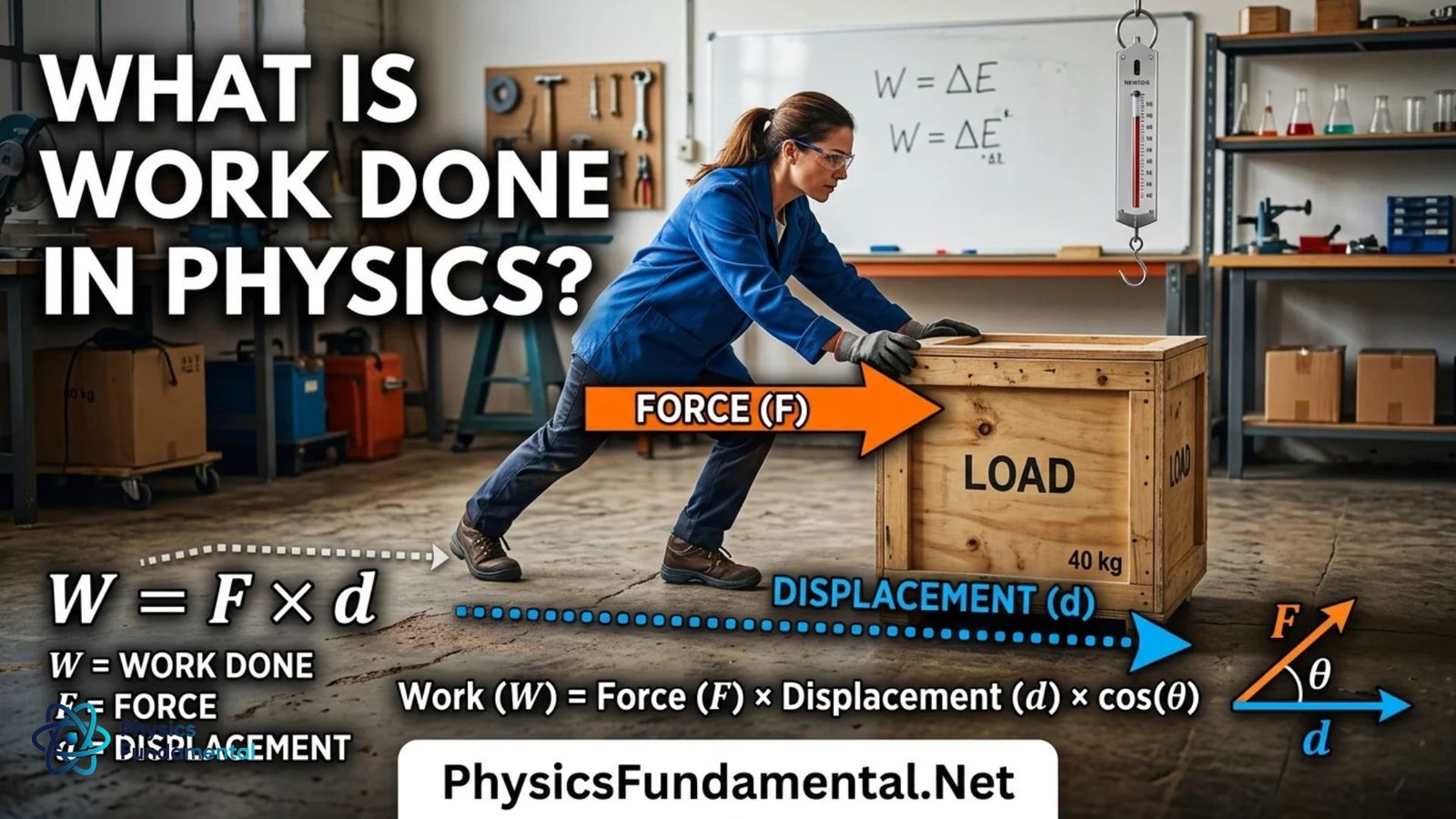
Work Done in Physics: 7 Powerful Formulas, Examples & Facts 2026
When you push a heavy box across the floor, lift a bag from the ground, or pull an object with a rope, you are applying a force. But in physics, simply applying force does not always mean that work has been done. For work to occur, a force must cause an object to move, with the force having a component in the direction of that movement.
Work Done in Physics is a fundamental concept used to describe how energy is transferred when a force moves an object through a distance. It connects force, displacement, and energy and is important in mechanics, machines, transportation, engineering, and everyday activities.
The basic formula is W = Fd cos θ, where W is work, F is force, d is displacement, and θ is the angle between the force and displacement. Understanding this formula makes it easier to determine whether work is positive, negative, or zero and how it relates to kinetic and potential energy.
What Is Work Done in Physics?
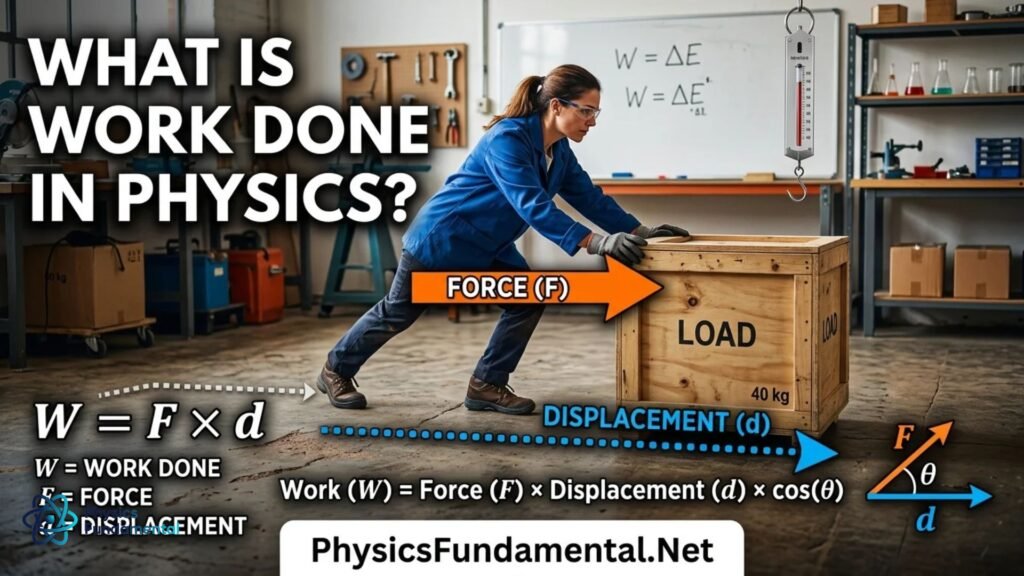
In physics, work is done when a force acting on an object causes displacement.
The simplest form of the work equation is:
W = Fd
This equation applies when the force and displacement are in the same direction.
Where:
- W = work done
- F = applied force
- d = displacement
The SI unit of work is the joule (J).
One joule is the amount of work done when a force of one newton moves an object through one meter in the direction of the force.
Therefore:
1 J = 1 N·m
For a broader treatment of the relationship between force, motion, and energy, see force and mechanical work.
Work Done Formula
The general formula for work is:
W = Fd cos θ
Here:
- W = work done in joules
- F = magnitude of force in newtons
- d = displacement in meters
- θ = angle between force and displacement
The cos θ term is important because only the component of force acting along the direction of displacement contributes to work.
When Force and Displacement Are in the Same Direction
If force and displacement are in the same direction:
θ = 0°
Since:
cos 0° = 1
the formula becomes:
W = Fd
For example, if you push a box with a force of 50 N for a distance of 4 m in the same direction as the force:
W = 50 × 4
W = 200 J
Therefore, the work done is 200 joules.
Positive Work
Work is positive when the force has a component in the same direction as the displacement.
For positive work:
0° ≤ θ < 90°
The value of cos θ is positive, so:
W > 0
Example of Positive Work
Suppose you lift a 10 kg object upward by 2 m at constant speed.
The gravitational force acts downward, while the lifting force acts upward.
The force you apply is in the same direction as the object’s upward displacement, so the work done by your lifting force is positive.
If the applied force is approximately equal to the object’s weight:
F = mg
Taking:
m = 10 kg
g = 9.8 m/s²
we get:
F = 10 × 9.8
F = 98 N
Therefore:
W = Fd
W = 98 × 2
W = 196 J
The work done by the lifting force is approximately 196 J.
Negative Work
Work is negative when the force acts partly or completely opposite to the direction of displacement.
For example, friction usually acts opposite to an object’s motion.
If a box slides forward across a floor, friction acts backward. Therefore, friction does negative work on the box.
For exactly opposite force and displacement:
θ = 180°
Since:
cos 180° = -1
the equation becomes:
W = -Fd
Example of Negative Work
A frictional force of 20 N acts on a box moving 5 m forward.
The friction force acts opposite to the displacement.
Therefore:
W = Fd cos 180°
W = 20 × 5 × (-1)
W = -100 J
The work done by friction is −100 J.
The negative sign indicates that friction removes mechanical energy from the moving object.
Zero Work
Work can also be zero.
This happens when:
- There is no displacement.
- There is no force.
- The force is perpendicular to the displacement.
The general equation is:
W = Fd cos θ
If:
θ = 90°
then:
cos 90° = 0
Therefore:
W = 0
Example: Carrying a Bag Horizontally
Imagine carrying a bag horizontally at constant height.
The force you apply to support the bag is approximately upward, while the bag’s displacement is horizontal.
The angle between the supporting force and horizontal displacement is about 90°.
Therefore, the work done by the upward supporting force on the bag is approximately zero.
This does not mean you experience no physical effort. It means that, according to the mechanical-work definition, that particular force does no work because it has no component along the displacement.
Work Done by a Constant Force
When a constant force acts on an object and causes displacement, the work can be calculated directly using:
W = Fd cos θ
Worked Example
A force of 30 N pulls an object through 6 m at an angle of 60° to the direction of motion.
Find the work done.
Given:
F = 30 N
d = 6 m
θ = 60°
Use:
W = Fd cos θ
Since:
cos 60° = 0.5
we get:
W = 30 × 6 × 0.5
W = 90 J
Therefore, the work done is 90 J.
Work Done by a Variable Force
The simple equation:
W = Fd cos θ
is most convenient when the force is constant.
If the force changes during the motion, the work is found from the area under a force-displacement graph.
For a one-dimensional variable force:
W = ∫ F(x) dx
This means that work is calculated by summing very small contributions of force over the displacement.
On an F–x graph, the area between the force curve and the displacement axis represents the work done.
Why This Matters
Many real systems involve changing forces.
Examples include:
- stretching a spring
- compressing a spring
- moving objects with changing resistance
- accelerating particles
- operating mechanical systems
For these situations, calculus provides a more general way to calculate work.
Work Done by Gravity
Gravity can do work when an object moves vertically.
When an object falls downward, gravity and displacement are in the same direction, so gravity does positive work.
The work done by gravity during a downward displacement can be written as:
W = mgh
where:
- m = mass
- g = gravitational acceleration
- h = vertical distance
Example
A 5 kg object falls through a height of 4 m.
Taking:
g = 9.8 m/s²
the work done by gravity is:
W = mgh
W = 5 × 9.8 × 4
W = 196 J
So gravity does approximately 196 J of positive work on the object.
When the same object is lifted upward, gravity acts opposite to the displacement, so gravity does negative work:
W₍gravity₎ = −mgh
Work Done Against Gravity
When you lift an object upward, you perform positive work against gravity.
If an object of mass m is raised through a height h, the increase in gravitational potential energy is:
ΔPE = mgh
For a slow lift where kinetic energy does not change significantly, the work done by the external force is approximately:
W = mgh
Example
A 20 kg box is lifted 3 m.
Using:
W = mgh
W = 20 × 9.8 × 3
W = 588 J
Therefore, approximately 588 J of work is required to increase its gravitational potential energy by that amount, ignoring losses.
You May Like to Read: P = IV = I²R = V²/R: Powerful Electrical Power 7 Facts 2026
Work-Energy Theorem
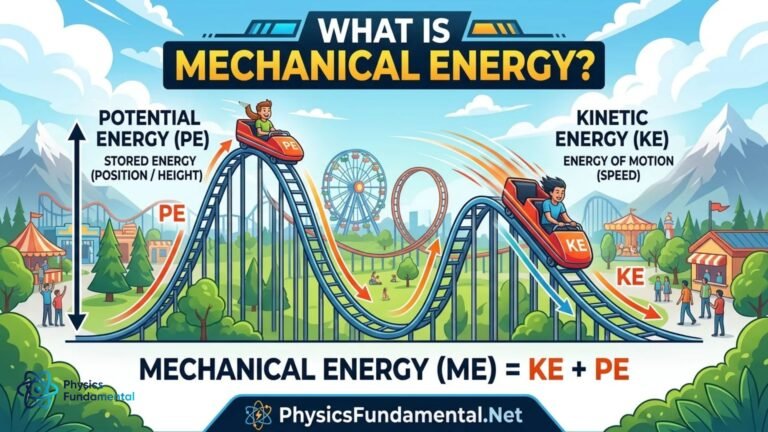
One of the most important relationships in mechanics is the work-energy theorem.
It states that the net work done on an object equals its change in kinetic energy.
Mathematically:
Wₙₑₜ = ΔKE
Since:
KE = ½mv²
we can write:
Wₙₑₜ = ½mv² − ½mv₀²
where:
- v₀ = initial velocity
- v = final velocity
This equation provides a powerful way to solve motion problems without directly using time.
Example
A 2 kg object starts from rest and reaches a speed of 6 m/s.
Its initial kinetic energy is:
KEᵢ = 0
Its final kinetic energy is:
KEf = ½mv²
KEf = ½ × 2 × 6²
KEf = 36 J
Therefore:
Wₙₑₜ = 36 − 0
Wₙₑₜ = 36 J
The net work done on the object is 36 J.
Work and Kinetic Energy
Work can change an object’s kinetic energy.
If the net work done is positive:
ΔKE > 0
the object’s kinetic energy increases.
If the net work is negative:
ΔKE < 0
the object’s kinetic energy decreases.
If the net work is zero:
ΔKE = 0
the object’s kinetic energy remains unchanged.
This is why pushing an object forward can increase its speed, while friction can reduce its speed.
Work and Potential Energy
For conservative forces such as gravity and ideal spring forces, work is closely related to changes in potential energy.
For a conservative force:
W = −ΔPE
This means that when a conservative force does positive work, the corresponding potential energy generally decreases.
For gravity:
ΔPE = mgΔh
Therefore, when an object falls:
- gravitational potential energy decreases
- gravity does positive work
- kinetic energy can increase
This is an example of energy transformation.
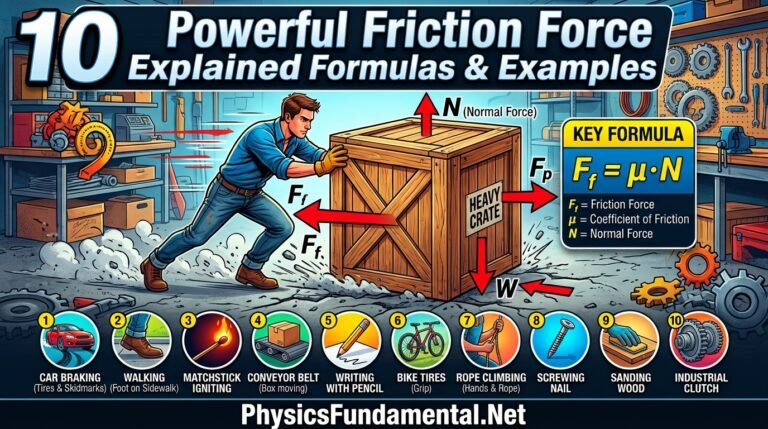
Work Done by Friction
Friction commonly does negative work because it acts opposite to an object’s displacement.
If friction has magnitude f and the object moves through distance d:
Wf = −fd
Example
A box experiences a frictional force of 15 N while moving 10 m.
The work done by friction is:
Wf = −15 × 10
Wf = −150 J
Therefore, friction does −150 J of work.
This negative work represents mechanical energy being transferred primarily into thermal energy.
Work Done by a Spring
A spring produces a force that changes with displacement.
According to Hooke’s Law:
F = −kx
where:
- k = spring constant
- x = displacement from equilibrium
- the negative sign indicates that the restoring force acts opposite to displacement
Because the force changes as the spring is stretched or compressed, the work requires the variable-force relationship.
The elastic potential energy stored in an ideal spring is:
PE = ½kx²
The work required to stretch the spring slowly from equilibrium to displacement x is:
W = ½kx²
Example
A spring has a spring constant of 200 N/m and is stretched by 0.1 m.
The work required is:
W = ½kx²
W = ½ × 200 × (0.1)²
W = 1 J
Therefore, 1 joule of work is stored as elastic potential energy.
Work Done in Circular Motion
Circular motion provides an interesting example of zero work.
For an object moving in a circle at constant speed, the centripetal force points toward the center of the circle.
The instantaneous displacement is tangent to the circular path.
Therefore, the centripetal force is perpendicular to the instantaneous displacement.
Since:
θ = 90°
we get:
W = Fd cos 90° = 0
Thus, the centripetal force does no work in uniform circular motion.
The force changes the direction of velocity without changing its speed.
Work Done by an Electric Force
Electric forces can also do work.
When a charged particle moves through an electric field, the electric force can transfer energy to or from the particle.
For a constant force:
W = Fd cos θ
Electric potential energy is closely related to this work.
For a charge q moving through a potential difference ΔV, the change in electric potential energy is:
ΔU = qΔV
and the work done by the electric field is:
W = −ΔU
This principle is important in batteries, capacitors, particle accelerators, and electronic devices.
Work Done in Machines
Machines make it easier to perform useful tasks by changing the magnitude or direction of forces.
Examples include:
- levers
- pulleys
- gears
- inclined planes
- hydraulic systems
- electric motors
An ideal machine does not create energy. Instead, it transfers mechanical work between input and output.
In a real machine, some energy is lost through friction, deformation, electrical resistance, and other processes.
The efficiency of a machine can be expressed as:
Efficiency = Useful output work / Input work × 100%
Example
A machine receives 500 J of input work and produces 400 J of useful output work.
Therefore:
Efficiency = 400/500 × 100%
Efficiency = 80%
The remaining energy is associated with losses.
Work Done vs Power
Work and power are closely related, but they are not the same.
Work tells us how much energy has been transferred.
Power tells us how quickly that work is done.
The formula for average power is:
P = W/t
where:
- P = power
- W = work
- t = time
For example, two people may perform the same amount of work, but the person who completes it in less time produces greater average power.
Example
A person does 600 J of work in 10 seconds.
P = W/t
P = 600/10
P = 60 W
The average power is 60 W.
Work Done in Physics and Energy Conservation
Work is one of the main mechanisms through which energy is transferred.
For example, when you push a stationary object:
Chemical energy → Mechanical work → Kinetic energy
When you lift an object:
Chemical energy → Mechanical work → Gravitational potential energy
When friction acts on a moving object:
Mechanical energy → Thermal energy
The total energy is conserved, although it may change from one form to another.
Important Differences Between Work and Force
Force and work are related, but they describe different physical quantities.
| Quantity | Meaning | SI Unit |
|---|---|---|
| Force | A push or pull that can change motion | Newton (N) |
| Work | Energy transferred by a force through displacement | Joule (J) |
| Power | Rate of doing work | Watt (W) |
| Energy | Capacity to perform work or cause physical change | Joule (J) |
A force can exist without work being done.
For example, if you push against an immovable wall, you exert force, but the wall does not move. Therefore, the mechanical work done on the wall is zero.
Common Mistakes When Calculating Work
Mistake 1: Assuming Every Force Does Work
A force does not necessarily do work. There must be displacement, and the force must have a component along that displacement.
Mistake 2: Ignoring the Angle
When force and displacement are not parallel, use:
W = Fd cos θ
Do not automatically use W = Fd.
Mistake 3: Forgetting Negative Work
Forces acting opposite to displacement generally do negative work.
Friction is a common example.
Mistake 4: Confusing Work With Power
Work is measured in joules, while power is measured in watts.
Mistake 5: Confusing Distance With Displacement
The work formula involving a force and displacement uses the relevant displacement vector or its component along the force.
Mistake 6: Forgetting That Perpendicular Forces Do Zero Work
If:
θ = 90°
then:
W = 0
because:
cos 90° = 0
Work Done in Physics Formula Sheet
Here are the most important formulas to remember:
W = Fd cos θ
For force and displacement in the same direction:
W = Fd
For opposite directions:
W = −Fd
For perpendicular force:
W = 0
Work-energy theorem:
Wₙₑₜ = ΔKE
Kinetic energy:
KE = ½mv²
Gravitational potential energy:
PE = mgh
Work against gravity:
W = mgh
Elastic potential energy:
PE = ½kx²
Average power:
P = W/t
Variable force:
W = ∫F(x)dx
Efficiency:
Efficiency = Useful output work / Input work × 100%
Frequently Asked Questions
What is work done in physics?
Work is done when a force causes an object to undergo displacement. The general formula is W = Fd cos θ.
What is the SI unit of work?
The SI unit of work is the joule (J). One joule equals one newton-meter.
When is work done zero?
Work is zero when there is no displacement, no force, or the force is perpendicular to the displacement.
What is positive and negative work?
Positive work occurs when a force has a component in the direction of displacement. Negative work occurs when the force acts opposite to the displacement.
What is the work-energy theorem?
The work-energy theorem states that the net work done on an object equals its change in kinetic energy: Wₙₑₜ = ΔKE.
Conclusion
Work Done in Physics describes the transfer of energy that occurs when a force causes an object to move. The general equation W = Fd cos θ shows that both the magnitude of the force and its direction relative to displacement matter.
Work can be positive, negative, or zero depending on the relationship between force and displacement. Gravity, friction, springs, electric forces, and many other forces can perform work, making the concept essential for understanding energy transformations and motion.
By mastering the work formula, work-energy theorem, potential energy relationships, and the difference between work and power, you can solve a wide range of mechanics problems and better understand how forces transfer energy in the physical world.