P = IV = I²R = V²/R: Powerful Electrical Power 7 Facts 2026
Electrical circuits transfer energy whenever electric charge moves through a component. A light bulb produces light and heat, a motor converts electrical energy into mechanical motion, and a resistor turns electrical energy mainly into heat. All of these processes involve electrical power.
The key relationship P = IV = I²R = V²/R gives several ways to calculate how quickly electrical energy is transferred or converted in a circuit. Which version you use depends on whether you know the voltage, current, or resistance.
Understanding these formulas makes it much easier to analyze circuits, calculate energy consumption, select components, and understand the ratings printed on everyday electrical devices.
What Is Electrical Power?
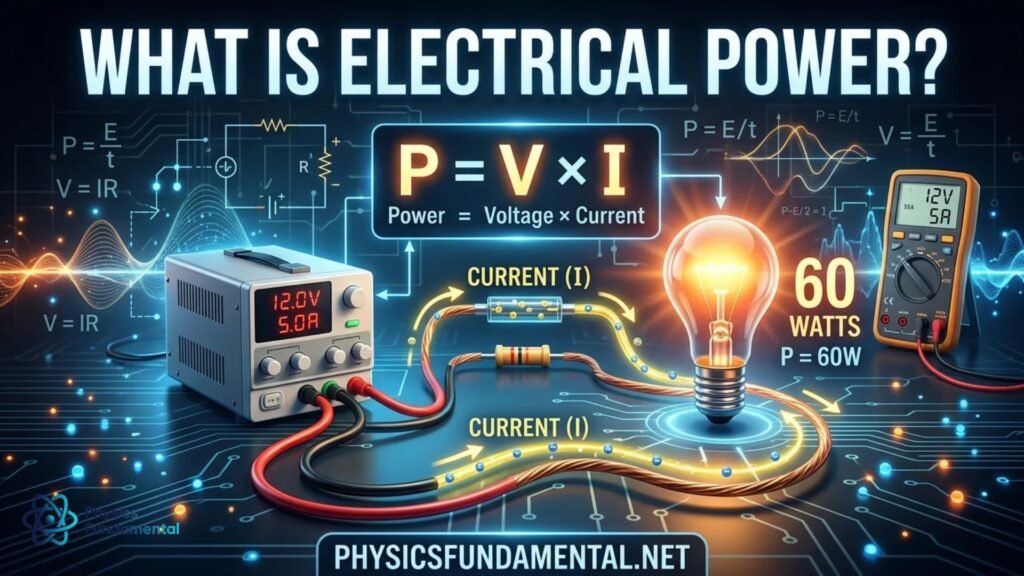
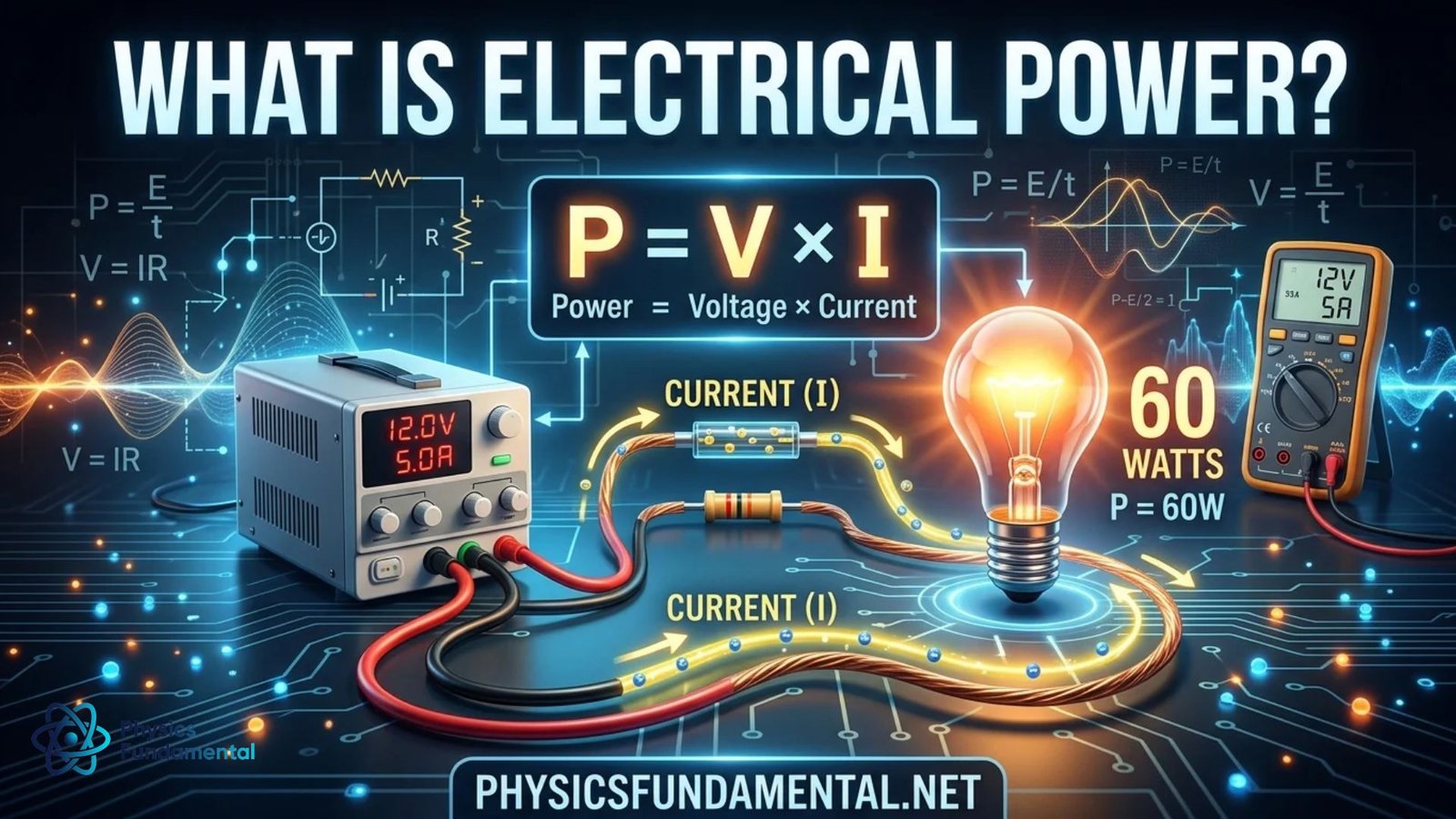
Electrical power is the rate at which electrical energy is transferred or converted.
It is represented by the symbol P and measured in watts (W).
The basic definition of power is:
P = E/t
where:
- P = power in watts
- E = energy in joules
- t = time in seconds
One watt means that one joule of energy is transferred every second.
For example, a 60 W light bulb transfers electrical energy at a rate of 60 joules per second under its rated operating conditions.
The concept is closely connected to electrical power and circuit theory, which provides broader background on how electrical energy is transferred in circuits.
What Does P = IV Mean?
The first and most fundamental electrical power equation is:
P = IV
Here:
- P = electrical power
- I = electric current
- V = potential difference or voltage
This equation says that electrical power depends on both the current flowing through a component and the voltage across it.
For example, suppose a device operates at:
V = 12 V
and draws:
I = 2 A
Then:
P = IV
P = 12 × 2
P = 24 W
Therefore, the device uses or converts electrical power at a rate of 24 watts.
How Do We Get P = I²R?
The equation P = I²R comes from combining the power equation with Ohm’s Law.
Start with:
P = IV
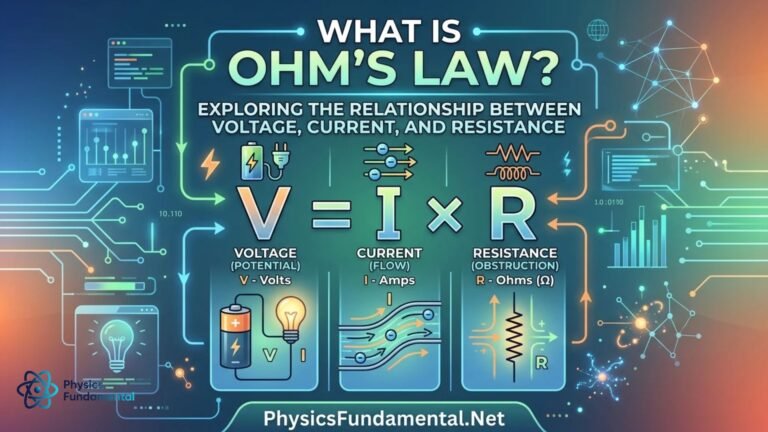
Ohm’s Law states:
V = IR
Substitute IR for V:
P = I(IR)
Therefore:
P = I²R
This form is particularly useful when you know the current and resistance but do not know the voltage.
Example
A resistor has a resistance of 5 Ω and carries a current of 3 A.
Using:
P = I²R
we get:
P = (3)² × 5
P = 9 × 5
P = 45 W
The resistor converts electrical energy into heat at a rate of 45 watts.
How Do We Get P = V²/R?
We can also derive another useful form from:
P = IV
From Ohm’s Law:
V = IR
Solving for current gives:
I = V/R
Substitute this into the power equation:
P = V(V/R)
Therefore:
P = V²/R
This version is useful when voltage and resistance are known.
Example
A 20 Ω resistor is connected across a 10 V supply.
Using:
P = V²/R
we get:
P = 10²/20
P = 100/20
P = 5 W
So the resistor dissipates 5 watts of power.
The Three Main Electrical Power Formulas
The relationship can be written as:
P = IV = I²R = V²/R
Each form uses different known quantities.
| Formula | Best Used When You Know | Main Variables |
|---|---|---|
| P = IV | Voltage and current | P, I, V |
| P = I²R | Current and resistance | P, I, R |
| P = V²/R | Voltage and resistance | P, V, R |
These equations are mathematically equivalent when Ohm’s Law applies.
Understanding Each Quantity
Power (P)
Power measures how quickly energy is transferred.
Its SI unit is the watt (W).
A higher wattage means more energy is transferred per unit of time.
Voltage (V)
Voltage is the potential difference between two points.
It can be thought of as the electrical energy available per unit charge.
Voltage is measured in volts (V).
Current (I)
Current describes the rate at which electric charge flows.
It is measured in amperes (A), commonly called amps.
Mathematically:
I = Q/t
where Q is electric charge and t is time.
Resistance (R)
Resistance describes how strongly a component opposes electric current.
It is measured in ohms (Ω).
For an ohmic component:
R = V/I
Resistance determines how much current flows for a given voltage and also affects how much power a resistor dissipates.
A Simple Way to Remember the Formulas
The three main equations can be remembered using the basic power relationship:
P = IV
Then use Ohm’s Law to replace either voltage or current.
If:
V = IR
then:
P = I²R
If:
I = V/R
then:
P = V²/R
So the easiest approach is not to memorize three unrelated equations. Remember:
P = IV
and:
V = IR
Then derive the other forms when necessary.
Worked Example 1: Finding Power From Voltage and Current
A phone charger supplies 5 V and draws 2 A from a circuit.
Find the power.
Use:
P = IV
Substitute:
P = 5 × 2
P = 10 W
Therefore, the electrical power is:
10 W
Worked Example 2: Finding Power From Current and Resistance
A resistor has a resistance of 8 Ω and carries a current of 2 A.
Find its power dissipation.
Use:
P = I²R
Therefore:
P = (2)² × 8
P = 4 × 8
P = 32 W
The resistor dissipates 32 W.
Worked Example 3: Finding Power From Voltage and Resistance
A 50 Ω resistor is connected to a 20 V source.
Using:
P = V²/R
we get:
P = 20²/50
P = 400/50
P = 8 W
Therefore, the resistor dissipates 8 watts.
Worked Example 4: Finding Current From Power
Suppose an electrical heater consumes 1,000 W from a 200 V supply.
Starting with:
P = IV
Rearrange:
I = P/V
Therefore:
I = 1000/200
I = 5 A
The heater draws 5 A.
Worked Example 5: Finding Resistance From Power and Voltage
A component consumes 100 W while connected to a 50 V supply.
Using:
P = V²/R
rearrange:
R = V²/P
Therefore:
R = 50²/100
R = 2500/100
R = 25 Ω
The resistance is 25 Ω, assuming the component behaves as an ohmic load under these conditions.
Electrical Power and Energy
Power and energy are related but they are not the same thing.
Power tells us how quickly energy is transferred.
Energy tells us how much energy has been transferred.
The relationship is:
E = Pt
where:
- E = energy in joules
- P = power in watts
- t = time in seconds
For example, a 100 W device operating for 60 seconds uses:
E = 100 × 60
E = 6,000 J
So it transfers 6,000 joules of energy during that minute.
Electrical Energy in Kilowatt-Hours
Household electricity consumption is commonly measured in kilowatt-hours (kWh) rather than joules.
One kilowatt is:
1 kW = 1,000 W
If a 2 kW heater operates for 3 hours, its energy consumption is:
E = 2 × 3
E = 6 kWh
This is the type of quantity used when calculating electricity consumption on utility bills.
You May Like to Read: What Is Capacitance? 7 Powerful C = Q/V Facts & Examples 2026
Power Dissipation in a Resistor
A resistor converts electrical energy primarily into thermal energy.
The power dissipated by a resistor can be calculated using:
P = IV
P = I²R
or:
P = V²/R
The appropriate formula depends on which quantities are known.
For example, increasing current can have a particularly strong effect on resistive heating because:
P ∝ I²
That means doubling the current, while resistance remains constant, makes the power dissipation four times greater.
Example
Suppose a resistor has constant resistance and its current increases from 2 A to 4 A.
Initially:
P₁ = (2)²R = 4R
After the increase:
P₂ = (4)²R = 16R
Therefore:
P₂/P₁ = 16R/4R = 4
The power becomes four times larger.
Why Electrical Wires Can Heat Up
Electrical wires have resistance, even though good conductors such as copper have relatively low resistance.
When current passes through a wire, some electrical energy is converted into heat.
The heating can be described by:
P = I²R
This is important in electrical engineering because high currents can produce significant heating.
If a wire carries excessive current, its temperature can rise. Electrical systems therefore use appropriately sized conductors and protective devices to help prevent dangerous overheating.
Power Ratings of Electrical Components
Electrical components often have maximum power ratings.
A resistor, for example, may be rated at:
- 0.25 W
- 0.5 W
- 1 W
- 2 W
- 5 W
If a circuit causes a resistor to dissipate more power than its rating, excessive heating can damage the component.
Example
Suppose a resistor is rated for 0.5 W, but circuit calculations show that it will dissipate 2 W.
The calculated power is four times the rated power:
2/0.5 = 4
That means the selected resistor is not appropriately rated for that operating condition.
In practical circuit design, engineers consider operating conditions, temperature, tolerances, and safety margins rather than relying only on the nominal calculation.
Power in Series Circuits
In a series circuit, the same current flows through each component.
For each resistor:
P = I²R
Because the current is the same, a resistor with greater resistance dissipates more power.
Example
Two resistors are connected in series:
R₁ = 2 Ω
R₂ = 6 Ω
The current is:
I = 2 A
For the first resistor:
P₁ = I²R₁
P₁ = 2² × 2
P₁ = 8 W
For the second resistor:
P₂ = I²R₂
P₂ = 2² × 6
P₂ = 24 W
So the second resistor dissipates three times as much power because its resistance is three times larger.
Power in Parallel Circuits
In a parallel circuit, each branch has the same voltage across it.
Therefore, for each resistor:
P = V²/R
If the voltage is constant, a smaller resistance dissipates more power.
Example
Two resistors are connected in parallel across 12 V.
Let:
R₁ = 6 Ω
R₂ = 12 Ω
For R₁:
P₁ = 12²/6
P₁ = 24 W
For R₂:
P₂ = 12²/12
P₂ = 12 W
The 6 Ω resistor dissipates twice as much power as the 12 Ω resistor.
Total Power in a Circuit
The total power supplied or consumed by a circuit can be found by adding the individual powers:
P_total = P₁ + P₂ + P₃ + …
For example, if three components consume:
- 10 W
- 15 W
- 25 W
then:
P_total = 10 + 15 + 25
P_total = 50 W
In an ideal circuit, the power supplied by the source equals the total power absorbed by the components.
Power Supplied by a Battery
A battery provides electrical energy to a circuit.
If its terminal voltage is V and the current delivered is I, the electrical power delivered under those conditions is:
P = VI
For example, a battery delivering 12 V at 3 A supplies:
P = 12 × 3
P = 36 W
Real batteries and power supplies have losses, so practical systems can have differences between electrical power generated, delivered, and converted into useful output.
Electrical Power in Motors and Other Devices
Not all electrical devices simply convert electrical energy into heat.
Motors convert electrical energy into mechanical energy, while speakers convert electrical signals into sound and many electronic circuits convert electrical energy into information processing and other forms of output.
The input electrical power is still calculated from:
P = VI
However, the useful output power may be smaller because of losses.
The efficiency of a device can be expressed as:
Efficiency = Useful output power / Input power × 100%
Example
Suppose a motor receives 500 W of electrical power and produces 400 W of useful mechanical power.
Its efficiency is:
Efficiency = 400/500 × 100%
Efficiency = 80%
The remaining power is associated with losses such as heating, friction, electrical resistance, and other mechanisms.
AC Electrical Power
For simple DC circuits, the relationship:
P = VI
is straightforward.
In alternating-current circuits, however, voltage and current can vary with time and may not be perfectly in phase.
For a sinusoidal AC circuit, real power is commonly expressed as:
P = VᵣₘₛIᵣₘₛcosφ
where:
- Vᵣₘₛ = RMS voltage
- Iᵣₘₛ = RMS current
- φ = phase difference between voltage and current
- cosφ = power factor
For a purely resistive AC load, the voltage and current are in phase, so:
cosφ = 1
and:
P = VᵣₘₛIᵣₘₛ
This distinction becomes important when analyzing motors, transformers, industrial equipment, and other AC systems.
Common Applications of Electrical Power Formulas
The formulas P = IV, P = I²R, and P = V²/R are used in many areas of electrical engineering and everyday technology.
Household Appliances
Power ratings help describe how much electrical power appliances consume.
Examples include:
- heaters
- refrigerators
- televisions
- fans
- microwaves
- air conditioners
- washing machines
Electronics
Engineers use power calculations to determine whether components can safely operate within their limits.
Electrical Transmission
Power calculations are important when designing systems that transmit electrical energy over long distances.
Batteries
Power calculations help determine how much power a battery can deliver to a load.
Circuit Design
Engineers use electrical power equations when selecting resistors, wires, switches, power supplies, and other components.
Common Mistakes to Avoid
1. Confusing Power With Energy
Power is measured in watts, while energy can be measured in joules or kilowatt-hours.
They are related but represent different quantities.
2. Forgetting to Square the Current
In:
P = I²R
the current must be squared.
For example:
I = 3 A
means:
I² = 9 A²
not 3 A.
3. Forgetting to Square Voltage
In:
P = V²/R
the voltage is squared before dividing by resistance.
4. Mixing Units
Always use compatible SI units:
- voltage in volts
- current in amperes
- resistance in ohms
- power in watts
5. Using the Wrong Circuit Conditions
The formulas involving resistance rely on the relationship between voltage, current, and resistance. For components that do not behave as simple constant-resistance elements, you must consider their actual voltage-current behavior.
6. Ignoring Component Ratings
A calculated power value is not automatically a safe operating value. Components have maximum ratings that should be respected.
Quick Formula Summary
The most important equations are:
P = IV
P = I²R
P = V²/R
From these:
I = P/V
V = P/I
R = V²/P
R = P/I²
For energy:
E = Pt
For electrical efficiency:
Efficiency = Useful output power / Input power × 100%
These formulas provide a practical toolkit for analyzing electrical power in many basic circuits.
Frequently Asked Questions
What is the formula P = IV?
P = IV calculates electrical power by multiplying voltage by current. Power is measured in watts.
Why is P = I²R used?
P = I²R is useful when current and resistance are known. It comes from combining P = IV with Ohm’s Law.
When should I use P = V²/R?
Use P = V²/R when voltage and resistance are known. It avoids needing to calculate current first.
What unit is electrical power measured in?
Electrical power is measured in watts (W). One watt equals one joule of energy transferred per second.
What happens to power if current doubles?
For a constant resistance, P = I²R, so doubling the current makes the power four times larger.
Conclusion
The relationship P = IV = I²R = V²/R provides several equivalent ways to calculate electrical power. The best form depends on which circuit quantities are already known.
Use P = IV when voltage and current are available, P = I²R when current and resistance are known, and P = V²/R when voltage and resistance are given.
These formulas are fundamental to understanding resistors, household appliances, batteries, electrical wiring, electronic circuits, and many other systems. Once you understand how voltage, current, resistance, power, and energy are connected, electrical circuit calculations become much more straightforward.