Torque in Physics: Powerful Formula, Examples, Types & Facts 2026
Why is it easier to open a door by pushing near the handle than by pushing close to the hinges? The force may be the same, but the distance from the pivot changes the turning effect. This turning effect is known as torque.
Torque is one of the most important concepts in rotational motion. It explains how forces make objects rotate around a fixed point or axis. From opening doors and tightening bolts to bicycle pedals, engines, and rotating machines, torque appears in many everyday and engineering applications.
Understanding torque becomes much easier when you know its formula, direction, units, and relationship with force and distance. With a few simple examples, you can also learn how to calculate torque and understand when an object will rotate or remain balanced.
What Is Torque in Physics?
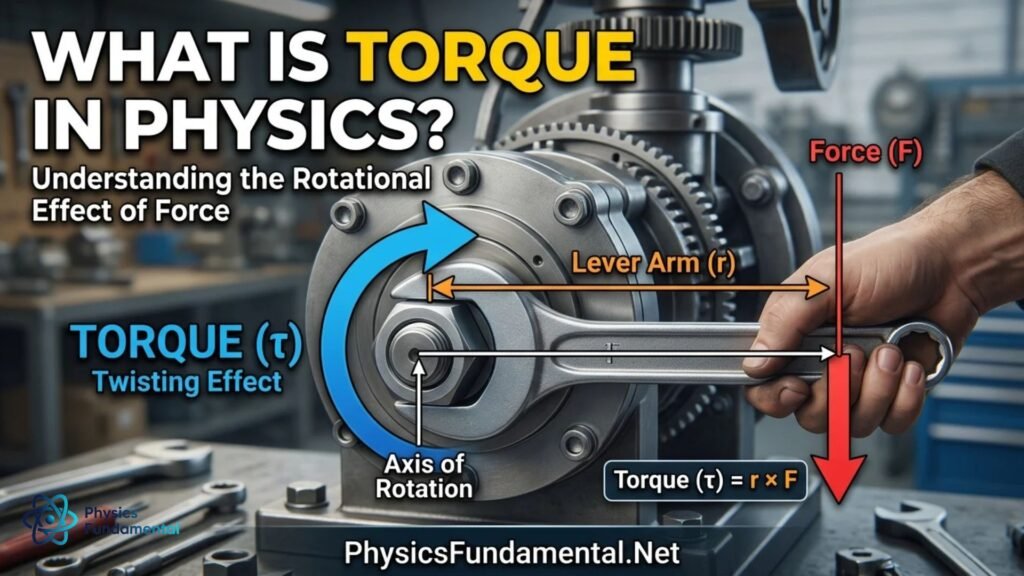
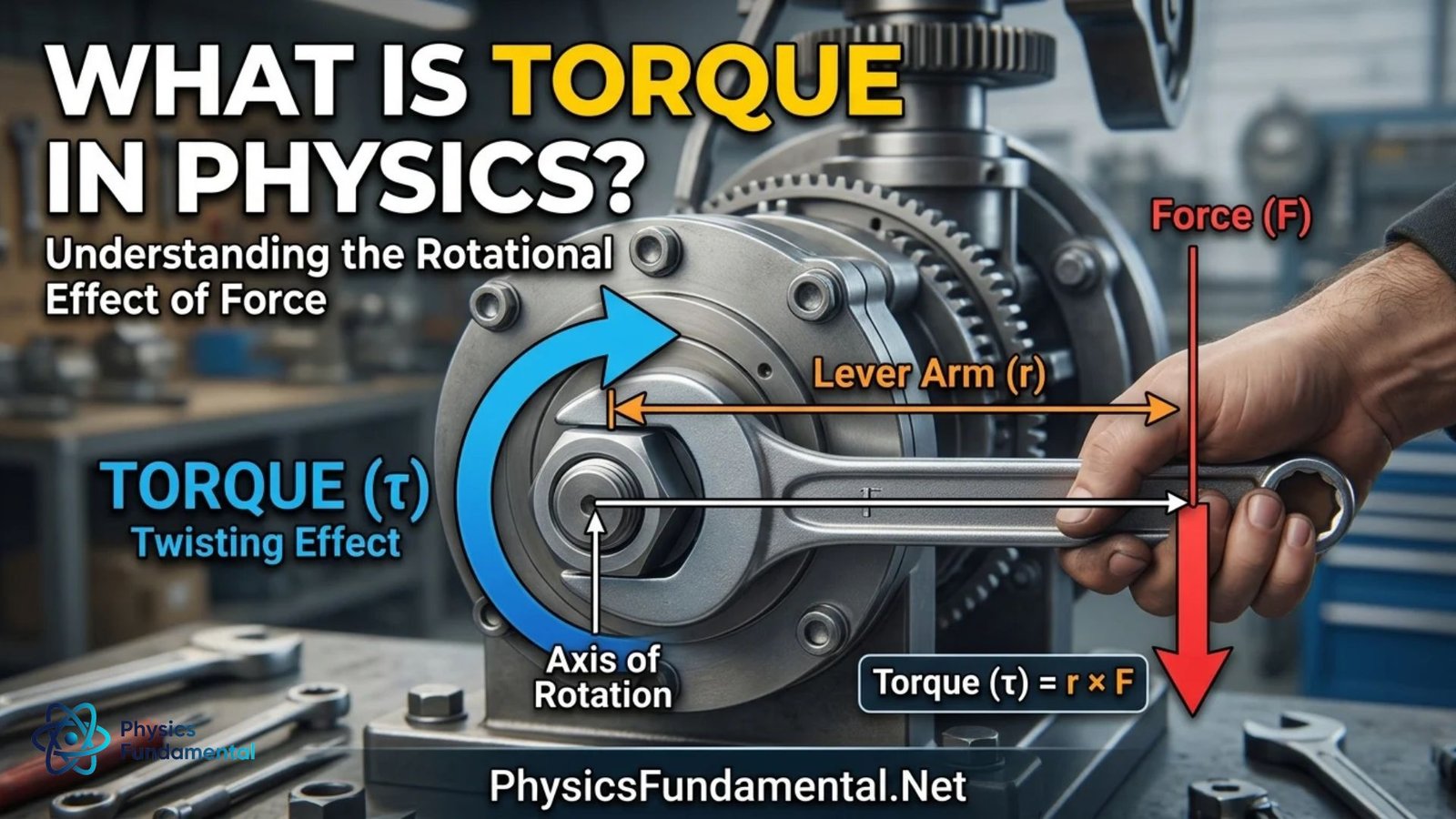
Torque is the turning effect produced by a force about a particular point or axis.
It describes how effectively a force can cause an object to rotate.
Torque is sometimes called the moment of force. The amount of torque depends on both the applied force and the perpendicular distance between the axis of rotation and the line along which the force acts.
For example, when you push a door near its handle, you are farther from the hinges. This produces more torque than pushing with the same force close to the hinges.
The basic idea is:
More force → more torque
and:
Greater perpendicular distance → more torque
Torque Formula
The basic torque formula is:
τ = rF sin θ
Where:
- τ = torque
- r = distance from the axis of rotation to the point where the force is applied
- F = applied force
- θ = angle between the position vector and the force
When the force acts perpendicular to the lever arm, the angle is 90°.
Since:
sin 90° = 1
the formula becomes:
τ = rF
This is the most commonly used form in basic torque problems.
Another way to write the formula is:
τ = Fd
where d is the perpendicular distance from the pivot to the line of action of the force.
SI Unit of Torque
The SI unit of torque is the newton-meter (N·m).
It comes from:
Torque = force × distance
So:
N × m = N·m
Torque and energy both can be expressed using combinations of newtons and meters, but they represent different physical quantities. Torque describes a turning effect, while joules measure energy.
What Is the Lever Arm?
The lever arm is the perpendicular distance between the axis of rotation and the line of action of the force.
This distance is important because torque depends on it.
Suppose you apply a force to a wrench. If the force is applied farther from the bolt, the lever arm is larger, producing greater torque.
This is why long-handled tools can make it easier to rotate or loosen certain objects.
Worked Example 1: Basic Torque
A force of 20 N is applied perpendicular to a lever at a distance of 0.5 m from its pivot.
Find the torque.
Use:
τ = rF
Substitute:
τ = 0.5 × 20
τ = 10 N·m
Therefore, the torque is:
10 N·m
Worked Example 2: Finding Force
A torque of 30 N·m is produced by a force acting at a perpendicular distance of 0.75 m from a pivot.
Find the force.
Start with:
τ = rF
Rearrange:
F = τ/r
Substitute:
F = 30/0.75
F = 40 N
Therefore, the required force is:
40 N
Worked Example 3: Torque at an Angle
A force of 50 N is applied to a lever that is 0.4 m long. The force makes an angle of 30° with the lever.
Find the torque.
Use:
τ = rF sin θ
Substitute:
τ = 0.4 × 50 × sin 30°
Since:
sin 30° = 0.5
we get:
τ = 0.4 × 50 × 0.5
τ = 10 N·m
Therefore, the torque is:
10 N·m
Why Does the Angle Matter?
The angle between the force and the lever arm affects the amount of torque produced.
The formula is:
τ = rF sin θ
When the force is perpendicular to the lever:
θ = 90°
and:
sin 90° = 1
So the torque is maximum:
τ = rF
When the force acts along the lever arm:
θ = 0°
and:
sin 0° = 0
Therefore:
τ = 0
This means a force can be large but still produce no torque about a particular pivot if its line of action passes through the pivot.
Direction of Torque
Torque has both magnitude and direction, so it is a vector quantity.
In basic two-dimensional problems, torque is usually described as either:
- Clockwise
- Counterclockwise
For example, pushing the right side of a wheel upward might produce a counterclockwise turning effect, while pushing it downward could produce a clockwise effect, depending on the setup.
When several torques act on an object, their directions must be considered when finding the net torque.
Net Torque
When multiple forces act on a rotating object, the total or net torque is the sum of the individual torques.
For example, suppose one force produces:
+20 N·m
and another produces:
−8 N·m
Then:
Net torque = 20 − 8
Net torque = 12 N·m
The positive or negative sign depends on the chosen convention for rotational direction.
A common convention is to take counterclockwise torque as positive and clockwise torque as negative.
Torque and Rotational Equilibrium
An object is in rotational equilibrium when the net torque acting on it is zero.
In simple form:
Στ = 0
This means the clockwise torques balance the counterclockwise torques.
For example, a balanced seesaw remains stationary when the turning effects on both sides are equal.
If one side produces more torque than the other, the seesaw will rotate toward the side with the greater net torque.
Torque and Force Are Not the Same
Force and torque are related, but they are not identical.
Force describes a push or pull that can change an object’s motion.
Torque describes the turning effect of a force around an axis or pivot.
A force can produce torque if its line of action does not pass through the axis.
For example, pushing directly toward the center of a wheel may produce little or no torque about the center. Pushing tangentially at the edge can produce a much greater turning effect.
Torque vs Moment
The terms torque and moment of force are closely related and are often used interchangeably in introductory physics.
Both describe the turning effect of a force about a point or axis.
The exact terminology can vary depending on the field or textbook. In engineering and mechanics, “moment” is often used when discussing the turning effect of a force about a point, while “torque” is commonly associated with rotational effects and twisting.
The underlying calculation is often based on:
τ = Fd
Torque in Everyday Life
Torque is present in many ordinary activities.
Opening a Door
A door handle is positioned away from the hinges so that a force applied at the handle produces a useful turning effect.
Using a Wrench
A longer wrench provides a greater lever arm. For the same applied force, this produces greater torque.
Riding a Bicycle
When you push down on a bicycle pedal, your force produces torque around the crank axle.
Turning a Steering Wheel
Applying force away from the center of a steering wheel creates torque that rotates the wheel.
Using a Screwdriver
A screwdriver applies torque to a screw. The handle provides a radius through which your force acts.
Torque in Engines
Torque is particularly important in engines and motors.
An engine produces rotational torque that can be transferred through mechanical components to perform useful work.
In a vehicle, engine torque contributes to the rotational force available at the drivetrain. Gears can change the relationship between torque and rotational speed.
This is why torque is an important specification when discussing motors, engines, and mechanical systems.
Torque and Gears
Gears can change the torque and rotational speed delivered by a mechanical system.
A gear system can provide a mechanical advantage by using different gear sizes.
In an idealized system, increasing torque is generally accompanied by a corresponding decrease in rotational speed, while reducing torque can allow greater rotational speed.
This relationship is important in bicycles, vehicles, machinery, and many mechanical devices.
You May Like to Read: Heat Transfer Explained: 3 Powerful Types, Examples & Facts 2026
Torque and Angular Acceleration
Torque is closely related to rotational dynamics in the same way that force is related to linear acceleration.
The rotational equivalent of Newton’s second law can be written as:
τ = Iα
Where:
- τ = net torque
- I = moment of inertia
- α = angular acceleration
This equation shows that a net torque can produce angular acceleration.
The moment of inertia describes how strongly an object resists changes in its rotational motion.
For the same torque, an object with a smaller moment of inertia can experience a greater angular acceleration than an object with a larger moment of inertia.
What Is Moment of Inertia?
The moment of inertia is a measure of an object’s resistance to changes in rotational motion.
It depends on both the object’s mass and how that mass is distributed relative to the axis of rotation.
For a simple point mass:
I = mr²
where:
- I = moment of inertia
- m = mass
- r = distance from the axis
For larger objects with extended shapes, different formulas are used depending on their geometry and axis of rotation.
Torque and Angular Momentum
Torque is also related to angular momentum.
A net external torque can change an object’s angular momentum.
The relationship can be expressed as:
τ = dL/dt
where L represents angular momentum.
This relationship is important in advanced rotational mechanics and helps explain how rotational motion changes when external torques act on a system.
Types of Torque
Torque can be discussed in several ways depending on the situation.
Static Torque
Static torque is associated with situations where an object is not accelerating rotationally.
For example, a balanced beam can have several forces acting on it while the net torque remains zero.
Dynamic Torque
Dynamic torque occurs when the net torque produces angular acceleration.
For example, applying torque to a stationary wheel can cause it to begin rotating.
Driving Torque
Driving torque is the torque supplied by a motor or engine to cause a mechanical system to rotate.
Resistive Torque
Resistive torque opposes rotational motion. Friction, air resistance, mechanical loads, and other effects can produce opposing torque.
Torque and Mechanical Advantage
Levers use torque to make certain tasks easier.
The principle can be expressed using:
Torque = Force × perpendicular distance
Increasing the distance between the applied force and the pivot can increase the torque.
This allows a smaller force to produce the same turning effect when applied farther from the pivot.
This principle is used in tools such as:
- Wrenches
- Crowbars
- Pliers
- Wheelbarrows
- Bottle openers
- Scissors
Common Mistakes When Calculating Torque
Using the Wrong Distance
The relevant distance is the perpendicular distance to the line of action of the force, not always simply the distance to the point where the force is applied.
Forgetting the Angle
If the force is not perpendicular to the lever arm, use:
τ = rF sin θ
rather than simply:
τ = rF
Ignoring Direction
When several torques act on an object, clockwise and counterclockwise torques should be assigned appropriate signs.
Using the Wrong Units
Make sure distance is expressed in meters when using newtons and meters.
For example:
50 cm = 0.50 m
Confusing Torque With Energy
Torque is measured in N·m, while energy is measured in joules. Although their base units can look similar, they represent different physical quantities.
How to Solve Torque Problems
A useful method for solving torque questions is:
Step 1: Identify the pivot or axis.
Determine the point around which rotation is being considered.
Step 2: Identify the force.
Find the magnitude and direction of the applied force.
Step 3: Determine the lever arm.
Find the perpendicular distance from the pivot to the force’s line of action.
Step 4: Choose the correct equation.
For a general force:
τ = rF sin θ
For a perpendicular force:
τ = rF
Step 5: Consider direction.
Determine whether the force creates clockwise or counterclockwise rotation.
Step 6: Check the units.
Torque should normally be expressed in N·m.
Frequently Asked Questions
What is torque in physics?
Torque is the turning effect of a force about a pivot or axis of rotation.
What is the formula for torque?
The general formula is τ = rF sin θ. When the force is perpendicular to the lever arm, it becomes τ = rF.
What is the SI unit of torque?
The SI unit of torque is the newton-meter (N·m).
Why does increasing the distance increase torque?
For the same force and angle, torque is proportional to the distance from the pivot. A larger lever arm therefore produces a greater turning effect.
What is the difference between torque and force?
Force is a push or pull that can change linear motion, while torque describes the turning effect of a force around an axis or pivot.
Conclusion
Torque is the turning effect produced by a force around a pivot or axis. It depends on the magnitude of the force, its direction, and the perpendicular distance from the axis to its line of action.
The key formula is τ = rF sin θ, which becomes τ = rF when the force acts perpendicular to the lever arm. Torque helps explain how doors open, wrenches turn bolts, bicycles move, engines rotate, and mechanical systems transmit rotational motion.
Once you understand the relationship between force, distance, angle, and torque, rotational mechanics becomes much easier to analyze. Torque is also a foundation for more advanced concepts such as rotational equilibrium, moment of inertia, angular acceleration, and angular momentum.