Centripetal vs Centrifugal Force: 7 Powerful Facts & Differences 2026
When a car turns around a corner, you may feel yourself pushed toward the outside of the turn. When a stone is tied to a string and swung in a circle, the string pulls the stone toward the center. These two experiences often create confusion: centripetal vs centrifugal force — which one is actually real?
The key difference is that centripetal force is the inward net force required for circular motion, while centrifugal force is an apparent force that appears when motion is described from a rotating reference frame. They are not simply two equal forces pulling in opposite directions on the same object.
Understanding this distinction makes circular motion much easier. It also explains why passengers lean outward in turning cars, why objects appear to move away from the center in rotating systems, and why the tension in a string can keep an object moving in a circle.
What Is Centripetal Force?
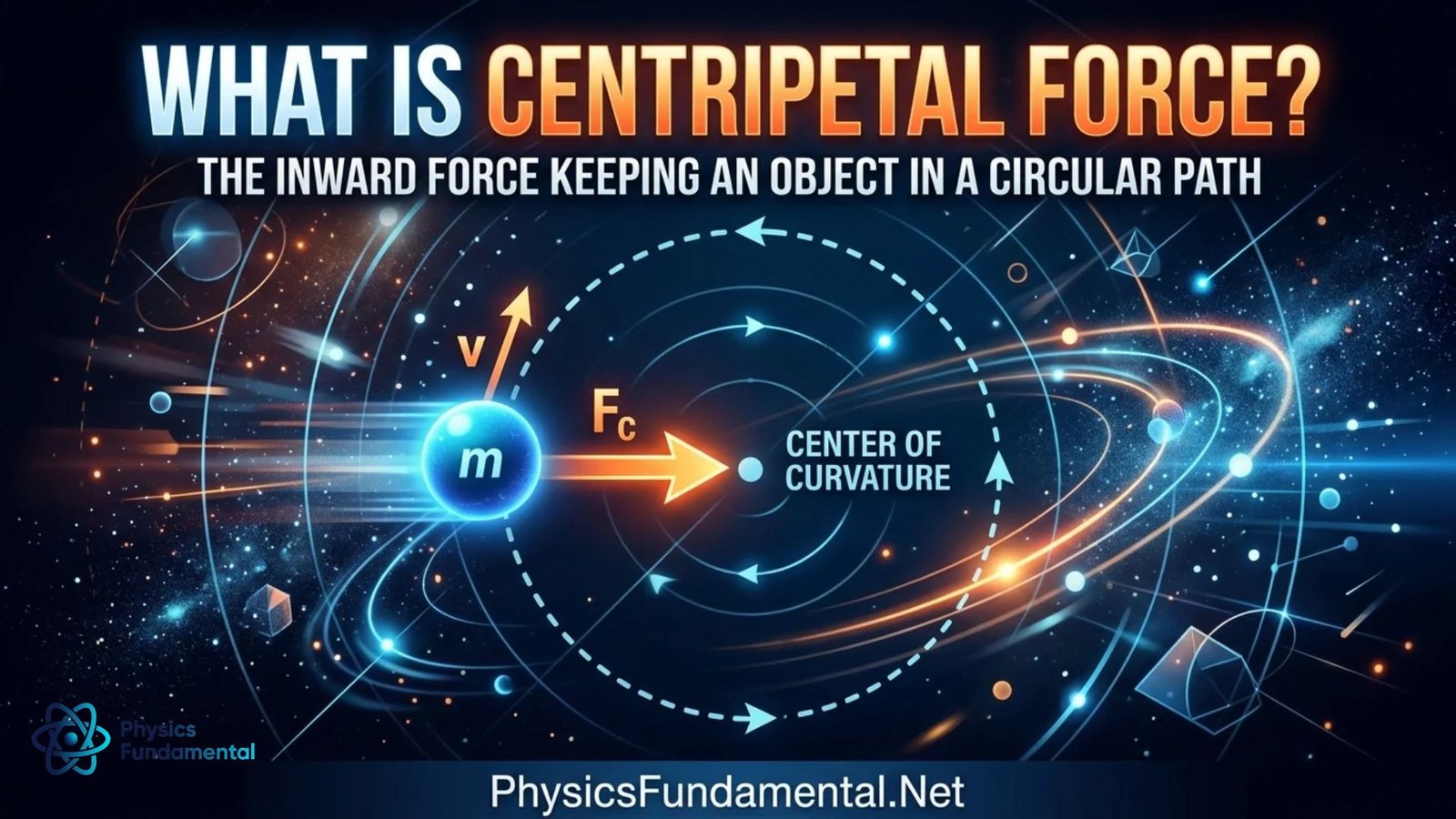
Centripetal force is the net force directed toward the center of a circular path.
The word centripetal means “center-seeking.” It does not necessarily refer to a special type of force. Instead, it describes the direction of the net force responsible for changing an object’s velocity toward the center.
The formula is:
F₍c₎ = mv²/r
Where:
- F₍c₎ = centripetal force
- m = mass of the object
- v = tangential speed
- r = radius of the circular path
The SI unit of centripetal force is the newton (N).
For example, if a 2 kg object moves at 4 m/s around a circle with a radius of 8 m:
F₍c₎ = mv²/r
F₍c₎ = (2)(4²)/8
F₍c₎ = 4 N
The required inward net force is therefore 4 N.
Why Is Centripetal Force Needed?
An object moving in a circle is constantly changing the direction of its velocity.
Even if its speed remains constant, its velocity changes because velocity includes both magnitude and direction. A change in velocity means the object is accelerating.
This inward acceleration is called centripetal acceleration.
The formula is:
a₍c₎ = v²/r
The corresponding net force is obtained from Newton’s Second Law:
F = ma
Therefore:
F₍c₎ = m(v²/r)
which gives:
F₍c₎ = mv²/r
The centripetal force is therefore not an additional mysterious force. It is the net inward force produced by real interactions.
What Can Provide Centripetal Force?
Different physical forces can act as the centripetal force.
Tension
When an object is attached to a string and swung in a circle, tension in the string can provide the inward force.
Friction
When a car turns on a road, static friction between the tires and road can provide the centripetal force.
Gravity
The gravitational attraction between planets, moons, and stars can provide the centripetal force needed for orbital motion.
Normal Force
On certain curved tracks or surfaces, the normal force can contribute to or provide the required inward force.
Electric or Magnetic Forces
Charged particles can follow curved paths because electric or magnetic forces can change their direction of motion.
So, centripetal force is a role played by a real force, not a separate fundamental force.
What Is Centrifugal Force?
Centrifugal force is commonly described as a force that appears to push an object outward when viewed from a rotating reference frame.
The word centrifugal means “center-fleeing.”
In a rotating frame, an observer can introduce centrifugal force to make Newton’s laws work in that non-inertial frame.
Its magnitude is:
F₍cf₎ = mv²/r
and its direction is outward from the center.
However, this does not mean that there is always a real outward interaction acting on the object.
This distinction is central to Newtonian mechanics and circular motion.
Is Centrifugal Force Real?
The answer depends on what is meant by “real.”
From an inertial reference frame, centrifugal force is not required to explain ordinary circular motion. The object experiences a real inward net force, while its tendency to continue along its instantaneous straight-line path is explained by inertia.
From a rotating reference frame, centrifugal force is a useful fictitious or inertial force. It allows an observer in that accelerating frame to apply Newton’s laws using the forces that appear in that frame.
So, centrifugal force is not a conventional interaction like gravity, tension, or friction. It arises because the reference frame itself is accelerating.
Centripetal vs Centrifugal Force
The difference can be summarized as follows:
| Feature | Centripetal Force | Centrifugal Force |
|---|---|---|
| Direction | Toward the center | Away from the center |
| Role | Provides required inward net force | Appears in a rotating reference frame |
| Reference frame | Commonly analyzed in an inertial frame | Rotating frame |
| Type | Net force from real interactions | Inertial/apparent force |
| Required for circular motion? | Yes | No, not in an inertial frame |
| Magnitude in uniform circular-motion analysis | mv²/r | mv²/r in the rotating-frame description |
| Example | Friction turning a car | Apparent outward force felt in rotating frame |
The most important point is that these should not normally be treated as two real forces acting on the same object and canceling each other.
Why Do We Feel Pushed Outward in a Turning Car?
Imagine sitting in a car traveling straight ahead. When the driver suddenly turns left, your body tends to continue moving in its original direction because of inertia.
Relative to the turning car, however, you appear to move toward the right side.
The car changes direction beneath you, while your body tends to maintain its previous state of motion.
If you analyze the situation from the road, there is no mysterious outward force pushing you. The car’s seat, door, or seat belt exerts forces on your body as the car turns.
From inside the accelerating car, it can be convenient to describe the sensation using an apparent centrifugal force.
Why Does a Stone on a String Move in a Circle?
Suppose a stone is attached to a string and swung horizontally.
The stone naturally tends to continue moving in a straight line. The string continuously pulls it toward the center.
That inward tension changes the direction of the stone’s velocity, causing circular motion.
If the string suddenly breaks, the stone does not fly directly outward from the center. Instead, it travels approximately along a straight line tangent to the circular path at the instant the string breaks.
This is one of the clearest demonstrations of why centripetal force is directed inward.
Worked Example: Stone Moving in a Circle
A 0.5 kg stone moves at 6 m/s in a circular path with a radius of 2 m. Find the required centripetal force.
Use:
F₍c₎ = mv²/r
Substitute:
F₍c₎ = (0.5)(6²)/2
F₍c₎ = (0.5)(36)/2
F₍c₎ = 9 N
Answer
The required centripetal force is 9 N.
If the string provides this force, the tension would be 9 N under the simplified conditions of the example.
Worked Example: A Car on a Curved Road
A 1,000 kg car travels at 10 m/s around a curve with a radius of 50 m. What inward force is required?
Use:
F₍c₎ = mv²/r
F₍c₎ = (1000)(10²)/50
F₍c₎ = 2000 N
Answer
The required centripetal force is 2,000 N.
On a level road, static friction between the tires and road can provide this inward force.
What Happens When Speed Increases?
The centripetal force depends on the square of velocity:
F₍c₎ ∝ v²
This means increasing speed has a strong effect.
If the speed doubles while mass and radius remain constant:
F’₍c₎ = m(2v)²/r
F’₍c₎ = 4mv²/r
So the required centripetal force becomes four times larger.
This is particularly important when vehicles travel around curves.
You May Like to Read: V = IR — Ohm’s Law: 7 Powerful Circuit Examples & Facts 2026
What Happens When Radius Increases?
From:
F₍c₎ = mv²/r
we can see that centripetal force is inversely proportional to radius when speed remains constant.
If the radius doubles:
F’₍c₎ = mv²/(2r)
Therefore, the required centripetal force becomes half as large.
A wider curve generally requires less inward force than a tighter curve at the same speed.
Centripetal Acceleration
Centripetal acceleration is the acceleration directed toward the center of a circular path.
Its formula is:
a₍c₎ = v²/r
Another useful form is:
a₍c₎ = ω²r
where ω is angular velocity.
Because:
v = ωr
we can substitute this into the first equation:
a₍c₎ = (ωr)²/r
which simplifies to:
a₍c₎ = ω²r
Both formulas describe the same centripetal acceleration.
Centrifugal Force in a Rotating Frame
Consider a person standing inside a rotating amusement ride.
As the ride rotates, the person may feel as though they are being pushed outward.
For an observer rotating with the ride, introducing a centrifugal force can make the situation easier to analyze.
The outward apparent force is:
F₍cf₎ = mω²r
Using:
v = ωr
we can also write:
F₍cf₎ = mv²/r
This apparent force points away from the axis of rotation.
At the same time, the rotating person requires a real inward force to follow the circular path.
Centripetal and Centrifugal Forces Are Not an Action-Reaction Pair
A common misconception is that centripetal and centrifugal forces are Newton’s Third Law action-reaction pairs.
They are not.
Newton’s Third Law pairs act on different objects.
For example, when a car turns and tire-road friction provides an inward force on the car, the corresponding reaction force is the force exerted by the car’s tires on the road. Those two forces act on different objects.
The outward apparent centrifugal force used in a rotating frame is not simply the Third Law partner of centripetal force.
Circular Motion and Inertia
Inertia explains why an object naturally tends to continue along its current direction of motion.
At every instant during circular motion, the object’s velocity points tangent to the circle.
The inward force continually changes that direction.
Without the inward force, the object would no longer follow the circular path.
This is why saying that an object “wants to fly outward” can be misleading. Its natural inertial motion is along a tangent, not directly away from the center.
Examples of Centripetal Force in Everyday Life
Centripetal effects appear in many situations.
Cars Turning
Static friction between tires and road can provide the inward force.
Satellites
Gravity provides the inward force that keeps a satellite in orbit.
Roller Coasters
Normal force and gravity can contribute to the required centripetal force on curved sections.
Washing Machines
During the spin cycle, the rotating drum causes water and clothing to move in circular motion. The details involve contact forces, inertia, and the motion of water through openings.
Amusement Rides
Rotating rides provide the forces needed to keep riders moving along circular paths.
Planets and Moons
Gravitational attraction supplies the inward force required for orbital motion.
Common Misconceptions
“Centripetal Force Is a New Type of Force”
It is not. It describes the net inward force required for circular motion.
“Centrifugal Force Always Pushes Objects Outward”
In an inertial-frame analysis, there is no need to introduce a real outward centrifugal force. It is an apparent force used in rotating frames.
“Centripetal and Centrifugal Forces Cancel”
They do not normally cancel as a pair acting on one object in an inertial-frame analysis.
“An Object Moves Outward When the String Breaks”
An object released from circular motion moves approximately along the tangent to the circle, not radially outward.
“A Faster Object Needs Proportionally More Centripetal Force”
Because:
F₍c₎ = mv²/r
the dependence on speed is quadratic. Doubling speed requires four times the centripetal force under otherwise identical conditions.
Key Formulas
The most important circular-motion formulas are:
Centripetal force:
F₍c₎ = mv²/r
Centripetal acceleration:
a₍c₎ = v²/r
Angular velocity relationship:
v = ωr
Centripetal acceleration using angular velocity:
a₍c₎ = ω²r
Rotating-frame centrifugal force:
F₍cf₎ = mω²r = mv²/r
Remember that the last expression represents an apparent/inertial force in the rotating-frame description.
Frequently Asked Questions
What is the main difference between centripetal and centrifugal force?
Centripetal force is the real inward net force required for circular motion, while centrifugal force is an apparent outward force used when analyzing motion from a rotating frame.
Is centripetal force a real force?
The inward force is real when it comes from interactions such as gravity, friction, tension, or normal force. “Centripetal” describes its role and direction.
Is centrifugal force real?
Centrifugal force is an inertial or apparent force in a rotating reference frame. It is not required in an inertial-frame description of ordinary circular motion.
Why do passengers feel pushed outward in a turning car?
Their bodies tend to maintain their previous direction of motion while the car changes direction. Relative to the car, this creates the sensation of moving outward.
What happens if centripetal force disappears?
The object no longer follows the circular path. It continues approximately along the tangent to the path at the point where the inward force disappears.
Conclusion
The difference between centripetal vs centrifugal force becomes clear once the reference frame is considered. Centripetal force is the inward net force required to continuously change an object’s direction and maintain circular motion. It can be supplied by tension, friction, gravity, normal force, or another real interaction.
Centrifugal force, by contrast, is an apparent or inertial force used when describing motion from a rotating reference frame. It helps explain why objects appear to move outward relative to rotating systems, but it should not be confused with a second real force that cancels the centripetal force.
The most important idea to remember is simple: circular motion requires an inward net force, while the apparent outward effect depends on the reference frame used to describe the motion.