Free Fall and Terminal Velocity: Powerful Facts, Formulas & Examples 2026
What happens when an object falls through the air? At first, it may speed up rapidly, but after some time, its acceleration can decrease until it moves at a constant speed. This change in motion is explained by two important physics concepts: free fall and terminal velocity.
Free fall describes motion under the influence of gravity, while terminal velocity occurs when air resistance becomes large enough to balance the downward force of gravity. These concepts help explain everything from falling objects near Earth’s surface to raindrops reaching a steady speed as they move through the atmosphere.
Understanding the difference between these two ideas is important because real objects usually fall through air, while ideal free-fall problems often ignore air resistance.
What Is Free Fall?
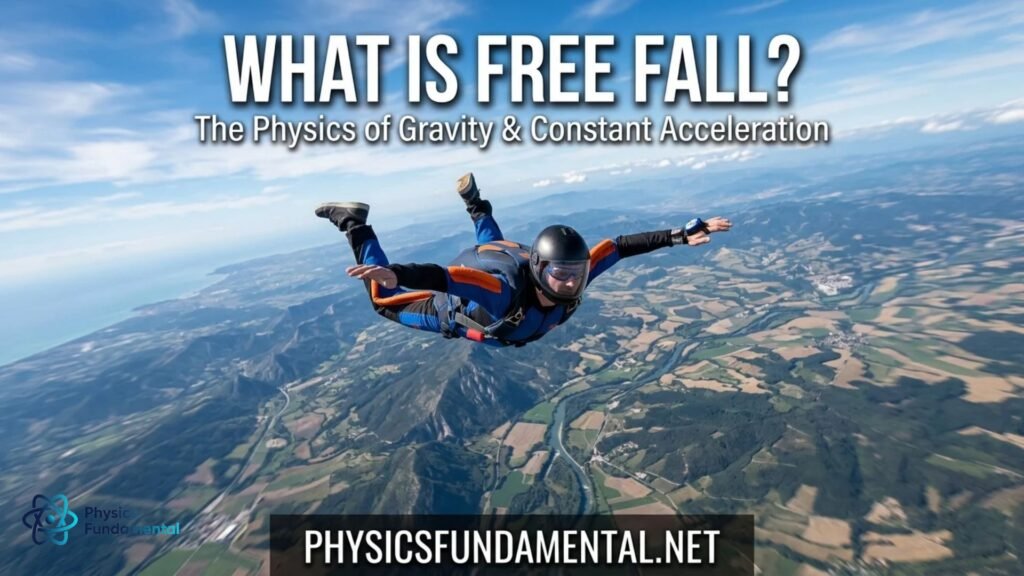
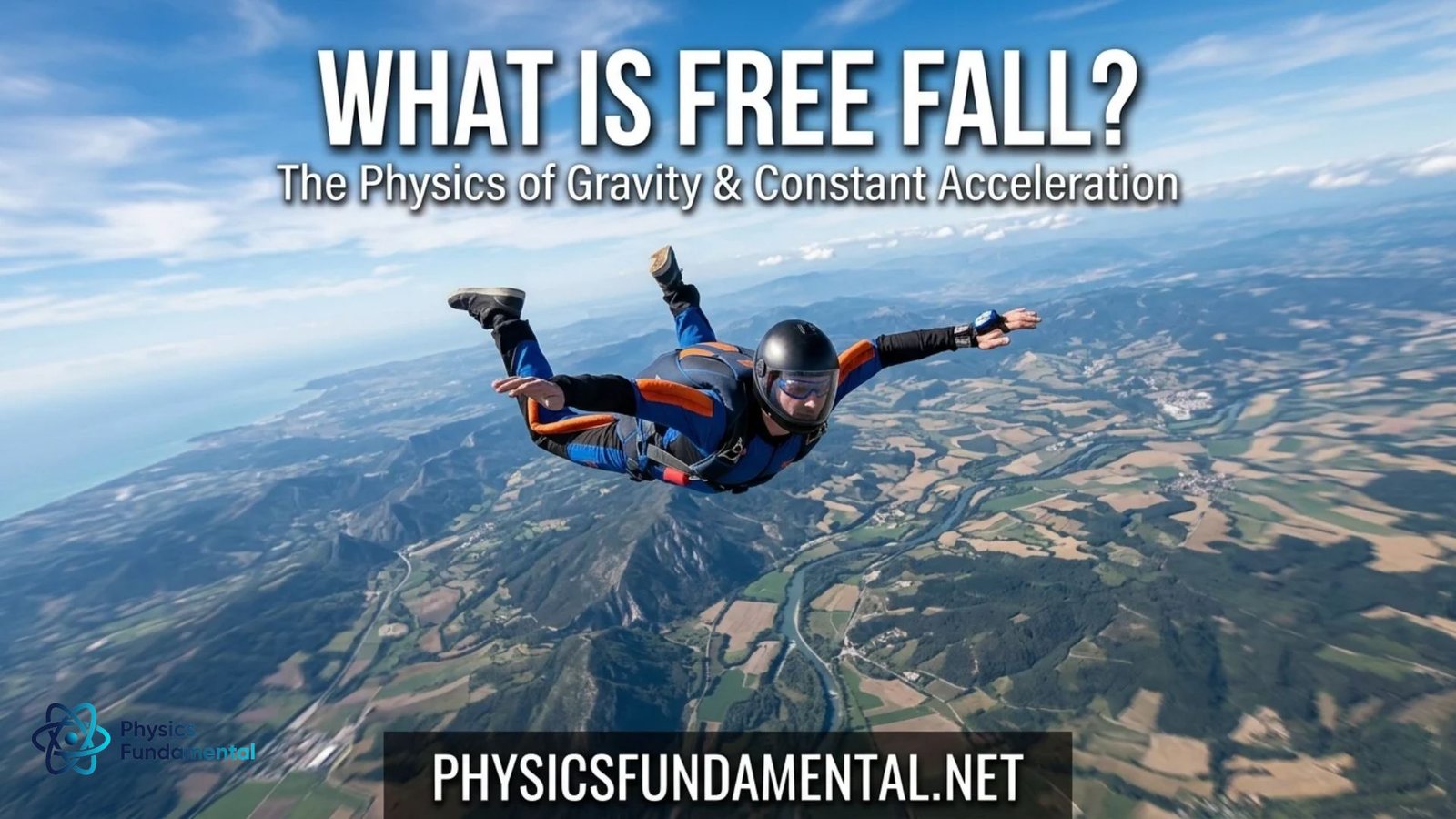
Free fall is the motion of an object when gravity is the only significant force acting on it.
Near Earth’s surface, an object in ideal free fall accelerates downward at approximately:
g = 9.8 m/s²
This means that, if air resistance is ignored, the object’s velocity increases by about 9.8 m/s every second.
For example, an object released from rest has approximately:
- After 1 second: 9.8 m/s downward
- After 2 seconds: 19.6 m/s downward
- After 3 seconds: 29.4 m/s downward
The acceleration remains approximately constant near Earth’s surface.
Gravity and Free-Fall Acceleration
Gravity is the force that attracts objects toward Earth.
The gravitational force on an object is:
F = mg
where:
- F = gravitational force
- m = mass
- g = gravitational acceleration
Using Newton’s second law:
F = ma
we can write:
ma = mg
Canceling the mass gives:
a = g
This explains an important result: in ideal free fall, objects of different masses have the same gravitational acceleration if air resistance is neglected.
The concept is closely connected to free fall motion, which describes gravitational motion when other forces are absent or negligible.
Free-Fall Equations
Free fall is a type of uniformly accelerated motion, so the standard kinematic equations can be used.
The main equations are:
v = u + gt
s = ut + ½gt²
v² = u² + 2gs
where:
- u = initial velocity
- v = final velocity
- g = acceleration due to gravity
- t = time
- s = displacement
If an object is simply dropped from rest, then:
u = 0
So the equations become:
v = gt
and
s = ½gt²
These formulas are useful for calculating the velocity or distance traveled during ideal free fall.
Example of Free Fall
Suppose a ball is dropped from rest and falls for 3 seconds, ignoring air resistance.
Given:
u = 0
g = 9.8 m/s²
t = 3 s
Using:
v = u + gt
we get:
v = 0 + (9.8)(3)
v = 29.4 m/s
So the ball’s velocity after 3 seconds is approximately 29.4 m/s downward.
Now calculate the distance traveled:
s = ut + ½gt²
Since u = 0:
s = ½(9.8)(3²)
s = 4.9 × 9
s = 44.1 m
The ball therefore falls approximately 44.1 meters in 3 seconds under ideal conditions.
What Is Terminal Velocity?
Terminal velocity is the constant maximum speed an object reaches while falling through a fluid such as air when the forces acting on it become balanced.
When an object first begins falling, gravity is greater than air resistance. The object therefore accelerates downward.
As its speed increases, air resistance also increases.
Eventually, air resistance becomes equal to the object’s weight.
At this point:
Air resistance = Weight
The net force becomes zero:
Fₙₑₜ = 0
Therefore:
a = 0
The object stops accelerating and continues falling at a constant speed. That constant speed is called terminal velocity.
How Terminal Velocity Develops
Terminal velocity does not normally occur immediately.
The process can be understood in stages.
Stage 1: Object Starts Falling
When an object is released, gravity pulls it downward.
At the beginning, its speed is small, so air resistance is also relatively small.
Therefore:
Weight > Air resistance
The object accelerates downward.
Stage 2: Speed Increases
As the object falls faster, air resistance increases.
The upward drag force becomes more significant, reducing the net downward force.
The object continues to accelerate, but its acceleration becomes smaller.
Stage 3: Forces Become Balanced
Eventually:
Weight = Air Resistance
The net force becomes zero.
Therefore:
Acceleration = 0
The object now falls at a constant speed.
Stage 4: Terminal Velocity
The object continues moving downward at a constant velocity.
This velocity is its terminal velocity.
Free Fall vs Terminal Velocity
Free fall and terminal velocity describe different parts of an object’s motion.
| Feature | Free Fall | Terminal Velocity |
|---|---|---|
| Main force considered | Gravity | Gravity and drag |
| Air resistance | Usually ignored in ideal problems | Important |
| Acceleration | Approximately 9.8 m/s² near Earth | Zero |
| Velocity | Changes with time | Constant |
| Net force | Downward | Zero |
| Speed | Continues increasing | Remains constant |
An object can initially be in a falling state where gravity dominates and later reach terminal velocity because of air resistance.
Does an Object at Terminal Velocity Stop Moving?
No.
This is a common misconception.
When an object reaches terminal velocity, its acceleration becomes zero, not its velocity.
The object continues moving at a constant speed.
For example, if a falling object reaches a terminal velocity of 50 m/s downward, it continues traveling downward at approximately 50 m/s as long as the conditions remain the same.
The key difference is:
Zero acceleration ≠ zero velocity
An object can move at a constant velocity while having zero acceleration.
What Determines Terminal Velocity?
Terminal velocity depends on several factors.
Mass
A heavier object can have a greater terminal velocity if its shape and other conditions are comparable because its weight is larger.
Shape
Shape strongly affects air resistance.
A streamlined object generally experiences less drag than a broad, flat object moving at the same speed.
Surface Area
A larger exposed area usually produces greater drag.
This is why a person falling with arms and legs spread can experience different drag from someone falling in a streamlined position.
Air Density
Terminal velocity also depends on the density of the surrounding air.
Denser air generally produces more drag for a given speed.
Drag Coefficient
The drag coefficient represents how strongly an object’s shape and surface characteristics affect aerodynamic resistance.
Terminal Velocity Formula
For an object falling through air, a common drag model gives:
Fᴅ = ½ρCᴅAv²
where:
- Fᴅ = drag force
- ρ = fluid density
- Cᴅ = drag coefficient
- A = cross-sectional area
- v = velocity
At terminal velocity, drag force equals weight:
Fᴅ = mg
Therefore:
mg = ½ρCᴅvₜ²A
Solving for terminal velocity:
vₜ = √(2mg / ρCᴅA)
This equation applies under the assumptions of the relevant drag model.
It shows that terminal velocity depends on mass, gravity, air density, drag coefficient, and cross-sectional area.
You May Like to Read: Momentum Conservation: Powerful Elastic vs Inelastic Collisions 2026
Example of Terminal Velocity
Suppose an object has:
m = 2 kg
g = 9.8 m/s²
ρ = 1.2 kg/m³
Cᴅ = 1
A = 0.1 m²
Using:
vₜ = √(2mg / ρCᴅA)
we get:
vₜ = √[(2 × 2 × 9.8)/(1.2 × 1 × 0.1)]
vₜ = √(39.2/0.12)
vₜ ≈ √326.7
vₜ ≈ 18.1 m/s
So, under these assumed conditions, the object’s terminal velocity would be approximately 18.1 m/s.
Why Doesn’t a Falling Object Accelerate Forever?
If air resistance did not exist, an object falling near Earth’s surface would continue accelerating at approximately 9.8 m/s².
But in Earth’s atmosphere, air resistance increases as the object’s speed increases.
Eventually, the upward drag force becomes equal to the downward gravitational force.
At that moment:
Net force = 0
and therefore:
Acceleration = 0
The object continues moving, but its speed no longer increases.
Parachutes and Terminal Velocity
Parachutes provide a practical example of terminal velocity.
When a parachute opens, the person’s effective cross-sectional area increases dramatically. This increases air resistance.
The person’s downward speed decreases until a new balance is reached between weight and drag.
The resulting terminal velocity is much lower than the terminal velocity before the parachute opened.
This illustrates an important principle: changing an object’s area and drag characteristics changes its terminal velocity.
Free Fall in a Vacuum
A vacuum contains essentially no air, so there is little or no aerodynamic resistance.
In an ideal vacuum near Earth’s surface, objects fall with approximately the same gravitational acceleration regardless of their masses.
For example, a heavy object and a light object released from the same height at the same time would accelerate equally if air resistance were absent.
This is why the familiar observation that some objects fall faster than others is often caused by differences in air resistance rather than gravity itself.
Free Fall and Air Resistance
In real life, most falling objects are not in perfect free fall because the atmosphere exerts a drag force.
A useful distinction is:
Ideal free fall: gravity is the only significant force.
Real falling motion: gravity and air resistance both act.
A skydiver, for example, is initially accelerating downward but eventually reaches terminal velocity. After a parachute opens, the terminal velocity changes because the drag force becomes much larger.
Common Examples of Free Fall
Examples of idealized free-fall motion include:
- A stone dropped from a height when air resistance is ignored
- A ball thrown vertically upward after it leaves the hand
- An object falling in a vacuum
- A spacecraft or astronaut experiencing gravitational free-fall conditions in orbit
A thrown object is still considered to be in free fall after it leaves the hand if gravity is the only significant force acting on it.
Common Mistakes
Thinking Free Fall Means Falling From Rest
Free fall does not necessarily mean that an object starts from rest.
An object can be thrown upward or downward and still be in free fall after release if gravity is the only significant force.
Confusing Terminal Velocity With Maximum Possible Speed
Terminal velocity is the steady speed produced by a balance between gravity and drag under particular conditions. Changing the object’s shape, area, or environment can change it.
Thinking Zero Acceleration Means the Object Stops
At terminal velocity, acceleration is zero, but the object continues moving at constant velocity.
Assuming Mass Has No Effect on Terminal Velocity
Mass can affect terminal velocity, depending on the object’s shape, area, and drag properties.
Ignoring Air Resistance in Real Situations
Ideal free-fall equations are approximations. For real objects moving through Earth’s atmosphere, air resistance can become important.
Quick Formula Summary
For ideal free fall near Earth’s surface:
v = u + gt
s = ut + ½gt²
v² = u² + 2gs
For an object dropped from rest:
v = gt
s = ½gt²
For quadratic air drag:
Fᴅ = ½ρCᴅAv²
At terminal velocity:
mg = ½ρCᴅvₜ²A
Therefore:
vₜ = √(2mg / ρCᴅA)
Frequently Asked Questions
What is free fall?
Free fall is motion in which gravity is the only significant force acting on an object.
What is terminal velocity?
Terminal velocity is the constant speed reached when air resistance balances the downward force of gravity.
Does an object accelerate at terminal velocity?
No. At terminal velocity, the net force is zero, so acceleration is zero while the object continues moving at constant speed.
Is free fall affected by mass?
In ideal free fall, all objects have the same gravitational acceleration near Earth’s surface, regardless of mass. Air resistance can make real objects behave differently.
What happens when a parachute opens?
The parachute greatly increases air resistance, reducing the person’s downward speed until a new, lower terminal velocity is reached.
Conclusion
Free fall and terminal velocity describe two important stages of falling motion. In ideal free fall, gravity produces an approximately constant downward acceleration near Earth’s surface. When an object falls through air, however, drag increases as its speed increases.
Eventually, the drag force can balance the object’s weight. The net force then becomes zero, acceleration stops, and the object continues downward at a constant terminal velocity.
These concepts provide a foundation for understanding falling objects, parachutes, atmospheric motion, and many other applications of Newtonian mechanics.