Quantum Numbers Explained: Powerful n, l, mₗ, mₛ Guide 2026
How can physicists describe exactly where an electron exists inside an atom? Electrons do not simply orbit the nucleus in neat circular paths like planets around the Sun. Instead, quantum mechanics uses a set of numbers to describe the allowed states and properties of electrons.
These numbers are called quantum numbers. The four quantum numbers—n, l, mₗ, and mₛ—provide information about an electron’s energy level, orbital shape, orbital orientation, and spin.
Understanding these four numbers is essential for learning electron configurations, atomic structure, orbitals, and many concepts in modern physics and chemistry.
What Are Quantum Numbers?

Quantum numbers are numerical values used to describe the quantum state of an electron in an atom.
An electron in an atom is described by four quantum numbers:
- Principal quantum number (n)
- Azimuthal or angular momentum quantum number (l)
- Magnetic quantum number (mₗ)
- Spin quantum number (mₛ)
Together, these numbers specify the state of an electron within an atom.
They arise from the mathematical description of electrons using the Schrödinger equation and are closely related to the allowed states of electrons in atoms.
The idea is part of quantum mechanics, the theory used to describe matter and energy at atomic and subatomic scales.
The Four Quantum Numbers at a Glance
| Quantum Number | Symbol | Describes | Allowed Values |
|---|---|---|---|
| Principal | n | Energy level and approximate size | 1, 2, 3, … |
| Azimuthal | l | Subshell and orbital shape | 0 to n − 1 |
| Magnetic | mₗ | Orbital orientation | −l to +l |
| Spin | mₛ | Electron spin state | +½ or −½ |
Each quantum number provides a different piece of information about an electron.
1. Principal Quantum Number (n)
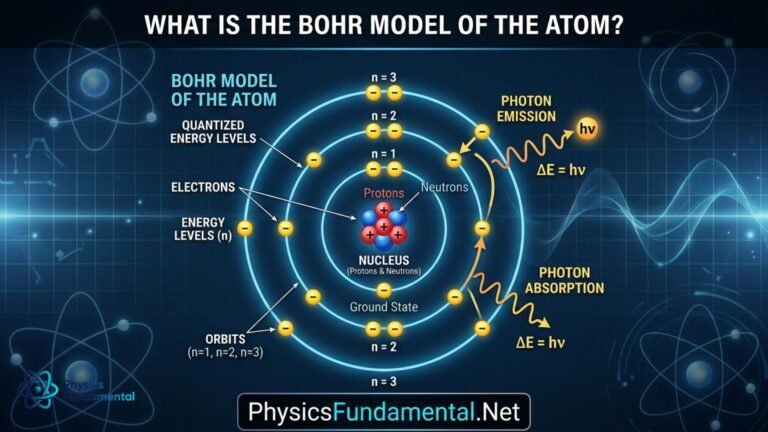
The principal quantum number, represented by n, describes the main energy level or shell occupied by an electron.
The allowed values are:
n = 1, 2, 3, 4, …
As the value of n increases, the electron is generally associated with a higher principal energy level and a larger average distance from the nucleus.
For example:
- n = 1 → first shell
- n = 2 → second shell
- n = 3 → third shell
- n = 4 → fourth shell
The principal quantum number is also important when describing the energy of electrons in hydrogen-like atoms.
What Does n Tell Us?
The principal quantum number gives information about:
- Main energy level
- Approximate orbital size
- Average distance of the electron from the nucleus
- Number of subshells within a shell
For a given value of n, the possible values of l are:
l = 0, 1, 2, …, n − 1
Therefore, when n = 3:
l = 0, 1, 2
This means the third shell contains the 3s, 3p, and 3d subshells.
2. Azimuthal Quantum Number (l)
The azimuthal quantum number, also called the angular momentum quantum number, is represented by l.
It determines the subshell and is associated with the shape of the orbital.
For a given principal quantum number:
l = 0 to n − 1
The values of l correspond to different subshell types:
| l Value | Subshell | General Orbital Shape |
|---|---|---|
| 0 | s | Spherical |
| 1 | p | Dumbbell-like |
| 2 | d | More complex |
| 3 | f | More complex |
For example, if:
n = 3
then:
l = 0, 1, 2
So the third shell contains:
3s, 3p, and 3d
subshells.
What Does l Tell Us?
The azimuthal quantum number provides information about:
- Subshell
- Orbital angular momentum
- General orbital shape
- Type of orbital involved
The number of orbitals in a subshell is determined by the possible values of mₗ.
3. Magnetic Quantum Number (mₗ)
The magnetic quantum number, written as mₗ, describes the orientation of an orbital within a subshell.
For a particular value of l, the allowed values are:
mₗ = −l, …, 0, …, +l
For example, if:
l = 0
then:
mₗ = 0
There is only one possible orbital.
If:
l = 1
then:
mₗ = −1, 0, +1
There are three possible orbitals.
If:
l = 2
then:
mₗ = −2, −1, 0, +1, +2
There are five possible orbitals.
The number of possible orbitals in a subshell is therefore:
2l + 1
Examples
For an s subshell:
l = 0
Number of orbitals:
2(0) + 1 = 1
For a p subshell:
l = 1
Number of orbitals:
2(1) + 1 = 3
For a d subshell:
l = 2
Number of orbitals:
2(2) + 1 = 5
For an f subshell:
l = 3
Number of orbitals:
2(3) + 1 = 7
4. Spin Quantum Number (mₛ)
The fourth quantum number is the spin quantum number, represented by mₛ.
An electron has two possible spin states:
mₛ = +½
or
mₛ = −½
These are often described as spin-up and spin-down.
Electron spin is an intrinsic quantum property. It should not be imagined as the electron literally spinning like a tiny classical ball.
The two possible spin states are important because an orbital can accommodate a maximum of two electrons, and those electrons must have opposite spin quantum numbers.
How the Four Quantum Numbers Work Together
The four quantum numbers provide a complete description of an electron’s quantum state within an atom.
For example, consider an electron with:
n = 2
l = 1
mₗ = 0
mₛ = +½
We can interpret these values as follows:
- n = 2 → second principal energy level
- l = 1 → p subshell
- mₗ = 0 → one of the three possible p-orbital orientations
- mₛ = +½ → one possible electron spin state
Therefore, this electron belongs to a 2p orbital with a particular allowed orientation and spin.
Rules for Allowed Quantum Numbers
Not every combination of quantum numbers is possible.
The numbers must follow specific rules.
Rule 1: Principal Quantum Number
n = 1, 2, 3, …
The principal quantum number must be a positive integer.
Rule 2: Azimuthal Quantum Number
For a particular n:
l = 0, 1, 2, …, n − 1
For example, if n = 2, then:
l = 0 or 1
An l = 2 value would not be allowed for n = 2.
Rule 3: Magnetic Quantum Number
For a particular l:
mₗ = −l to +l
For example, if l = 1:
mₗ = −1, 0, +1
Rule 4: Spin Quantum Number
The only allowed values are:
mₛ = +½ or −½
These rules make it possible to determine whether a proposed set of quantum numbers is valid.
Example of Valid Quantum Numbers
Consider:
n = 3
l = 2
mₗ = −1
mₛ = +½
Is this combination valid?
First:
For n = 3, allowed values of l are:
0, 1, 2
So l = 2 is allowed.
Next, when l = 2, possible values of mₗ are:
−2, −1, 0, +1, +2
So mₗ = −1 is allowed.
Finally:
mₛ = +½
is also allowed.
Therefore, this is a valid set of quantum numbers.
You May Like to Read: Free Fall and Terminal Velocity: Powerful Facts, Formulas & Examples 2026
Example of Invalid Quantum Numbers
Consider:
n = 2
l = 2
mₗ = 0
mₛ = +½
For n = 2, the allowed values of l are only:
0 and 1
Therefore, l = 2 is not allowed.
So this set of quantum numbers is invalid.
Quantum Numbers and Orbitals
Quantum numbers are closely related to the concept of atomic orbitals.
An orbital is a region of space described by a quantum state where there is a high probability of finding an electron.
The four quantum numbers provide increasingly specific information.
You can think of them as a sequence:
n → main energy level
l → subshell and shape
mₗ → orbital orientation
mₛ → spin state
This makes it easier to understand why different electrons can occupy different states within an atom.
How Many Orbitals Are in Each Subshell?
The number of orbitals in a subshell is:
2l + 1
Therefore:
- s subshell → 1 orbital
- p subshell → 3 orbitals
- d subshell → 5 orbitals
- f subshell → 7 orbitals
Since each orbital can contain a maximum of two electrons, the maximum number of electrons in each subshell is:
- s → 2 electrons
- p → 6 electrons
- d → 10 electrons
- f → 14 electrons
This relationship is fundamental to understanding electron configurations.
Quantum Numbers and Electron Configuration
Electron configurations describe how electrons are distributed among orbitals.
For example, oxygen has the electron configuration:
1s² 2s² 2p⁴
The quantum numbers help explain what the notation means.
The first number identifies n, the principal energy level.
The letter identifies the subshell associated with l:
- s → l = 0
- p → l = 1
- d → l = 2
- f → l = 3
The superscript indicates how many electrons occupy that subshell.
The magnetic and spin quantum numbers then distinguish individual electron states within the subshell.
Pauli Exclusion Principle
The quantum numbers are also directly connected to the Pauli exclusion principle.
This principle states that no two electrons in the same atom can have an identical set of all four quantum numbers.
For example, two electrons can occupy the same orbital because they can have the same:
n, l, and mₗ
but they must have different spin values:
mₛ = +½
and
mₛ = −½
This is why an orbital can contain a maximum of two electrons.
Quantum Numbers and the Periodic Table
Quantum numbers help explain the structure of the periodic table.
Different regions of the periodic table correspond to different subshells.
For example:
- s-block → s subshell
- p-block → p subshell
- d-block → d subshell
- f-block → f subshell
The arrangement of elements therefore reflects the way electrons occupy available quantum states.
Understanding quantum numbers makes the connection between atomic structure and periodic trends much clearer.
Why Quantum Numbers Are Important
Quantum numbers are important because they provide a mathematical language for describing electrons in atoms.
They help scientists and students understand:
- Atomic orbitals
- Electron configurations
- Energy levels
- Orbital shapes
- Orbital orientations
- Electron spin
- Chemical bonding
- Spectral lines
- Periodic table structure
They are also part of the foundation of modern atomic physics and quantum chemistry.
Quick Summary of n, l, mₗ, and mₛ
The four quantum numbers can be remembered with this simple sequence:
n → Energy level
l → Subshell and shape
mₗ → Orbital orientation
mₛ → Electron spin
Their allowed values are:
n = 1, 2, 3, …
l = 0 to n − 1
mₗ = −l to +l
mₛ = +½ or −½
Together, they describe the quantum state of an electron in an atom.
Frequently Asked Questions
What are the four quantum numbers?
The four quantum numbers are the principal n, azimuthal l, magnetic mₗ, and spin mₛ quantum numbers.
What does n represent?
The principal quantum number n identifies the main energy level and gives information about the approximate size and energy of an electron’s state.
What does l represent?
The quantum number l identifies the subshell and is associated with the orbital’s angular momentum and general shape.
What does mₗ represent?
The magnetic quantum number mₗ identifies the allowed orientation of an orbital within a particular subshell.
What values can mₛ have?
The spin quantum number can have only two values: +½ or −½.
Conclusion
Quantum numbers provide a powerful way to describe the allowed states of electrons inside atoms. The four numbers—n, l, mₗ, and mₛ—each provide different information about an electron’s state.
The principal quantum number identifies the main energy level, the azimuthal quantum number identifies the subshell and orbital shape, the magnetic quantum number describes orbital orientation, and the spin quantum number identifies one of two possible spin states.
Once these four numbers and their allowed values are understood, concepts such as electron configurations, atomic orbitals, the Pauli exclusion principle, and the structure of the periodic table become much easier to understand.