Bohr Model of the Atom Explained: Powerful Energy Levels & Formula 2026
How can an atom absorb or release a specific amount of energy instead of any random amount? The answer becomes much clearer when we look at the Bohr Model of the Atom, one of the most important early models used to explain atomic energy levels and the spectrum of hydrogen.
The Bohr model proposed that electrons in an atom can occupy specific allowed energy levels around the nucleus. An electron cannot have just any energy while it remains in one of these permitted states. The energy of a hydrogen electron in level n is given by Eₙ = −13.6/n² eV.
Although modern quantum mechanics provides a more complete description of atoms, the Bohr model remains extremely useful for understanding quantized energy, electron transitions, atomic spectra, and the basic idea behind energy levels.
What Is the Bohr Model of the Atom?
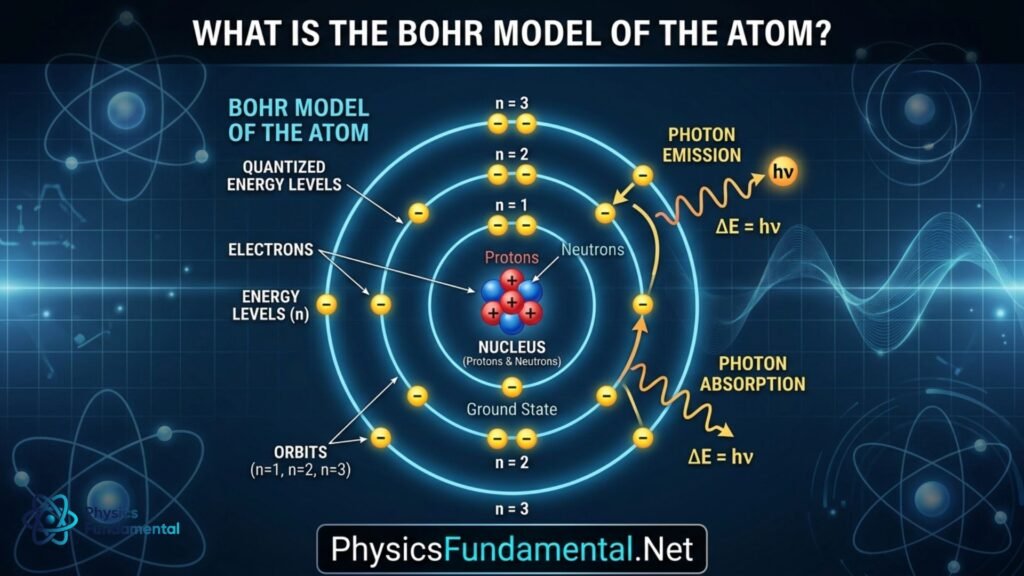
The Bohr Model of the Atom was proposed by Danish physicist Niels Bohr in 1913. It improved upon earlier atomic models by introducing the idea that electrons can exist only in certain allowed energy states.
In the model, the atom contains:
- A small, positively charged nucleus
- Electrons surrounding the nucleus
- Specific allowed energy levels for electrons
These energy levels are often represented by the principal quantum number:
n = 1, 2, 3, 4, …
The first energy level is n = 1, the second is n = 2, and so on.
An electron in a particular allowed energy level is described as being in a stationary state.
The model is part of the historical development of atomic physics and the Bohr model.
Why Did Bohr Propose His Model?
Classical physics had difficulty explaining why atoms are stable and why hydrogen produces discrete spectral lines.
According to classical electromagnetic theory, an accelerating charged particle should continuously lose energy through electromagnetic radiation. An electron orbiting a nucleus would therefore be expected to lose energy and spiral into the nucleus.
Atoms, however, are stable.
Bohr addressed this problem by proposing that electrons could occupy specific allowed states without continuously radiating energy.
When an electron moves between allowed energy levels, it can absorb or emit a specific amount of energy.
This idea introduced quantization into the atomic model.
Bohr’s Main Postulates
The Bohr model is based on several important ideas.
Electrons Occupy Allowed Energy Levels
Electrons can exist only in certain permitted states around the nucleus.
These states have definite energies.
Electrons Do Not Continuously Radiate Energy
While an electron remains in an allowed stationary state, it does not continuously lose energy according to the Bohr model.
Energy Is Absorbed or Emitted During Transitions
An electron can move from one energy level to another.
The energy involved in the transition is related to the difference between the two energy levels.
Angular Momentum Is Quantized
Bohr proposed that the electron’s angular momentum is restricted to specific values:
mvr = nh/2π
Where:
- m = electron mass
- v = electron speed
- r = orbital radius
- n = principal quantum number
- h = Planck’s constant
This quantization condition leads to discrete allowed orbits in the original model.
Bohr Energy Levels
For a hydrogen atom, the energy of an electron in the nth energy level is:
Eₙ = −13.6/n² eV
This is one of the most important formulas associated with the Bohr model.
Here:
- Eₙ = energy of the electron in level n
- n = principal quantum number
- −13.6 eV = ground-state energy of hydrogen
The negative sign has an important physical meaning.
It indicates that the electron is bound to the nucleus.
Energy of the Ground State
The ground state corresponds to:
n = 1
Therefore:
E₁ = −13.6/1²
E₁ = −13.6 eV
So the lowest energy level of hydrogen is:
E₁ = −13.6 eV
This is the most tightly bound state of the hydrogen electron.
Energy of Higher Levels
As n increases, the energy becomes less negative.
For example:
n = 2
E₂ = −13.6/4
E₂ = −3.4 eV
For:
n = 3
E₃ = −13.6/9
E₃ ≈ −1.51 eV
For:
n = 4
E₄ = −13.6/16
E₄ = −0.85 eV
The energy levels therefore become increasingly close together as n increases.
| Energy Level | n | Energy |
|---|---|---|
| Ground state | 1 | −13.6 eV |
| Second level | 2 | −3.40 eV |
| Third level | 3 | −1.51 eV |
| Fourth level | 4 | −0.85 eV |
| Fifth level | 5 | −0.54 eV |
| Ionization limit | ∞ | 0 eV |
Why Is the Energy Negative?
The negative energy does not mean the electron has “negative energy” in an ordinary everyday sense.
The zero-energy reference is defined when the electron is completely free and infinitely far from the nucleus.
A bound electron has less energy than this reference level, so its energy is negative.
Therefore:
E < 0 → electron is bound
E = 0 → electron is free
This energy reference makes it possible to calculate how much energy is required to remove an electron completely from the atom.
Ionization Energy of Hydrogen
Ionization means removing the electron completely from the hydrogen atom.
The ground-state energy is:
E₁ = −13.6 eV
The free-electron reference is:
E∞ = 0 eV
Therefore, the energy required is:
ΔE = 0 − (−13.6)
ΔE = 13.6 eV
So the ionization energy of hydrogen in its ground state is:
13.6 eV
In joules:
13.6 eV ≈ 2.18 × 10⁻¹⁸ J
Worked Example: Finding an Energy Level
Find the energy of a hydrogen electron in the third energy level.
Given:
n = 3
Use:
Eₙ = −13.6/n²
Therefore:
E₃ = −13.6/3²
E₃ = −13.6/9
E₃ ≈ −1.51 eV
Therefore, the energy of the electron is approximately:
−1.51 eV
Electron Transitions
Electrons can move between different allowed energy levels by absorbing or emitting energy.
If an electron moves from a lower energy level to a higher energy level, it must absorb energy.
If an electron moves from a higher energy level to a lower energy level, it emits energy.
The energy of the photon involved is:
ΔE = E_f − E_i
For emission, the emitted photon has energy:
E_photon = E_i − E_f
where the initial state has higher energy than the final state.
The photon energy is also related to frequency:
E = hf
Where:
- E = photon energy
- h = Planck’s constant
- f = photon frequency
Since:
c = fλ
we can also write:
E = hc/λ
These relationships connect atomic energy levels to electromagnetic radiation.
Worked Example: Electron Transition
Suppose a hydrogen electron falls from:
n = 3
to:
n = 2
The energy levels are:
E₃ ≈ −1.51 eV
E₂ = −3.40 eV
The emitted photon energy is:
E_photon = E₃ − E₂
E_photon = −1.51 − (−3.40)
E_photon ≈ 1.89 eV
Therefore, the transition releases a photon with an energy of approximately 1.89 eV.
Bohr Model and Hydrogen Spectrum
One of the major successes of the Bohr model was explaining the discrete spectral lines of hydrogen.
When hydrogen atoms absorb energy, their electrons can move to higher energy levels.
When those electrons return to lower levels, photons are emitted.
Because only specific energy levels are allowed, only specific photon energies are produced.
This creates a line spectrum rather than a continuous spectrum.
Each spectral line corresponds to a particular electron transition.
Hydrogen Spectral Series
Hydrogen’s spectral lines are grouped into different series based on the final energy level of the electron.
Lyman Series
Transitions ending at:
n = 1
These lines occur mainly in the ultraviolet region.
Balmer Series
Transitions ending at:
n = 2
These lines are primarily in the visible region.
The Balmer series is especially important because several of its lines can be observed as visible light.
Paschen Series
Transitions ending at:
n = 3
These lines occur in the infrared region.
Brackett Series
Transitions ending at:
n = 4
These are also infrared lines.
Pfund Series
Transitions ending at:
n = 5
These occur farther into the infrared region.
The Rydberg Formula
The wavelengths of hydrogen spectral lines can also be calculated using the Rydberg formula:
1/λ = R_H(1/n_f² − 1/n_i²)
where:
- λ = wavelength
- R_H = Rydberg constant for hydrogen
- n_f = lower final energy level
- n_i = higher initial energy level
For emission:
n_i > n_f
The Bohr energy-level model provides a physical explanation for why this mathematical relationship works for hydrogen.
Bohr Model and Photon Energy
The energy difference between two levels determines the photon energy.
For a transition from n_i to n_f:
ΔE = E_f − E_i
Using the Bohr energy formula:
Eₙ = −13.6/n²
we can calculate the energy difference directly.
The photon frequency is:
f = ΔE/h
And the wavelength is:
λ = hc/ΔE
Therefore, energy-level transitions allow us to determine the frequency and wavelength of emitted or absorbed light.
Bohr Radius
The Bohr model also gives the radius of an allowed hydrogen orbit.
For hydrogen:
rₙ = n²a₀
where a₀ is the Bohr radius:
a₀ ≈ 5.29 × 10⁻¹¹ m
Therefore:
For n = 1:
r₁ = a₀
For n = 2:
r₂ = 4a₀
For n = 3:
r₃ = 9a₀
The radius increases with the square of the principal quantum number.
Electron Speed in the Bohr Model
In the original Bohr model, electrons were assigned specific orbital speeds.
For hydrogen, the speed in the nth orbit decreases as n increases.
The ground-state electron speed is approximately:
v₁ ≈ 2.19 × 10⁶ m/s
Higher energy levels correspond to lower orbital speeds in the Bohr picture.
This is part of the classical-orbit interpretation of the model, which is useful historically but should not be confused with the modern quantum-mechanical description of electrons.
You May Like to Read: Centre of Gravity Explained: Powerful Stability, Balance & Mass Facts 2026
Bohr Model of Hydrogen-Like Atoms
The Bohr model works especially well for hydrogen-like ions, which contain only one electron.
Examples include:
- H
- He⁺
- Li²⁺
- Be³⁺
For a hydrogen-like species with nuclear charge Z, the energy levels are:
Eₙ = −13.6Z²/n² eV
For hydrogen:
Z = 1
so:
Eₙ = −13.6/n² eV
For He⁺:
Z = 2
so:
Eₙ = −13.6(2²)/n²
Eₙ = −54.4/n² eV
Thus, the nuclear charge has a strong effect on the energy levels.
Worked Example: He⁺ Energy Level
Find the energy of an electron in the n = 2 level of He⁺.
Use:
Eₙ = −13.6Z²/n²
Here:
Z = 2
n = 2
Therefore:
E₂ = −13.6(2²)/(2²)
E₂ = −13.6 eV
So the electron energy is:
−13.6 eV
Absorption and Emission
The Bohr model explains both absorption and emission.
Absorption
An electron absorbs a photon when the photon’s energy matches an allowed energy difference.
The electron moves to a higher energy state.
Lower level → Higher level
Emission
An electron moves from a higher energy level to a lower level and releases a photon.
Higher level → Lower level
The photon energy equals the difference between the two levels.
This explains why atoms interact with particular wavelengths of electromagnetic radiation.
Ground State and Excited State
The ground state is the lowest possible energy state.
For hydrogen:
n = 1
is the ground state.
An excited state is any allowed state with a higher energy than the ground state.
Examples include:
n = 2, 3, 4, …
An excited electron can eventually return to a lower level by emitting one or more photons.
Energy Level Diagram
A simplified hydrogen energy-level diagram looks conceptually like this:
n = ∞ → 0 eV
n = 4 → −0.85 eV
n = 3 → −1.51 eV
n = 2 → −3.40 eV
n = 1 → −13.6 eV
Notice that the energy levels become closer together as n increases.
At:
n → ∞
the energy approaches:
E = 0
This represents the ionization limit.
Why Does the Bohr Model Work for Hydrogen?
Hydrogen contains only one electron.
This makes its electron-nucleus interaction comparatively simple because there is no electron-electron repulsion to consider.
The Bohr model successfully predicts the energy levels and spectral lines of hydrogen and other one-electron systems.
This was a major achievement in the development of atomic physics.
Limitations of the Bohr Model
Despite its historical importance, the Bohr model is not a complete description of atoms.
It Does Not Fully Explain Multi-Electron Atoms
The model works well for hydrogen-like systems but becomes inadequate for atoms containing multiple electrons.
Electron-electron interactions complicate the energy structure.
Fixed Electron Orbits Are an Oversimplification
Modern quantum mechanics does not describe electrons as tiny particles moving in definite circular paths around the nucleus.
Instead, electrons are described by quantum states and probability distributions called orbitals.
It Does Not Fully Explain Atomic Spectra
The Bohr model cannot completely account for fine structure, electron spin effects, and several other spectral details.
It Does Not Explain Chemical Bonding Completely
Modern chemistry requires quantum mechanics to accurately describe bonding, orbitals, and electron configurations.
Therefore, the Bohr model is best understood as an important historical and educational model rather than the final description of atomic structure.
Bohr Model vs Modern Atomic Model
| Feature | Bohr Model | Modern Quantum Model |
|---|---|---|
| Electron description | Fixed allowed orbits | Quantum states/orbitals |
| Energy levels | Quantized | Quantized |
| Works well for hydrogen | Yes | Yes |
| Multi-electron atoms | Limited | Much more accurate |
| Electron position | Definite orbit in model | Probability distribution |
| Electron spin | Not fully included | Fundamental quantum property |
| Modern status | Historical/introductory | Current framework |
Importance of the Bohr Model
The Bohr model played a major role in the development of modern physics.
It helped establish that atomic energy is quantized and demonstrated that classical physics alone could not explain atomic behavior.
The model also provided an intuitive connection between:
- electron energy levels,
- photon energy,
- atomic spectra,
- frequency,
- wavelength,
- ionization energy.
Although later replaced by quantum mechanics, the Bohr model remains a useful stepping stone for learning more advanced atomic physics.
Common Mistakes
Forgetting the Negative Sign
The formula is:
Eₙ = −13.6/n² eV
The negative sign indicates a bound electron relative to the chosen zero-energy reference.
Using the Wrong Energy Level
Make sure the correct value of n is used.
For example:
n = 2 → E = −3.4 eV
not −6.8 eV.
Confusing Photon Energy With Electron Energy
The photon energy is the difference between two energy levels, not simply the energy of either level.
Assuming Higher n Means More Negative Energy
As n increases, the energy becomes less negative and approaches zero.
Applying the Hydrogen Formula to Every Atom
The simple formula:
Eₙ = −13.6/n² eV
is specifically for hydrogen. For hydrogen-like ions, use:
Eₙ = −13.6Z²/n² eV
Multi-electron atoms require more sophisticated models.
Key Bohr Model Formulas
Energy Level
Eₙ = −13.6/n² eV
Hydrogen-Like Ion
Eₙ = −13.6Z²/n² eV
Photon Energy
E = hf
Photon Wavelength
E = hc/λ
Angular Momentum Quantization
mvr = nh/2π
Bohr Radius
rₙ = n²a₀
Rydberg Formula
1/λ = R_H(1/n_f² − 1/n_i²)
These formulas connect the atomic energy structure to observable electromagnetic radiation.
Applications and Uses of the Bohr Model
The Bohr model is particularly useful in introductory atomic physics and spectroscopy.
It helps students understand why atoms have discrete energy levels and why hydrogen produces specific spectral lines.
The ideas introduced by the model also provide a foundation for understanding:
- atomic spectroscopy,
- emission spectra,
- absorption spectra,
- ionization,
- photon emission,
- quantum energy levels,
- hydrogen-like ions,
- the development of quantum mechanics.
Modern technologies do not rely on the Bohr model alone, but the concepts it introduced remain important in understanding atomic and quantum phenomena.
Frequently Asked Questions
What is the Bohr Model of the Atom?
The Bohr model describes electrons as occupying specific allowed energy levels around a positively charged nucleus.
What is the formula for Bohr energy levels?
For hydrogen, the energy is Eₙ = −13.6/n² eV, where n is the principal energy-level number.
Why is the energy negative in the Bohr model?
The negative energy indicates that the electron is bound to the nucleus relative to the zero-energy state of a free electron.
What happens when an electron moves to a higher energy level?
The electron must absorb energy equal to the difference between the two allowed energy levels.
Does the Bohr model still accurately describe all atoms?
No. It works well for hydrogen and hydrogen-like ions but does not accurately describe the full behavior of multi-electron atoms. Modern quantum mechanics provides a more complete model.
Conclusion
The Bohr Model of the Atom introduced a powerful idea: electrons can occupy only specific quantized energy levels. For hydrogen, these levels are described by the important equation Eₙ = −13.6/n² eV.
The model explains why hydrogen emits and absorbs specific wavelengths of light. When an electron moves between energy levels, the difference in energy is carried by a photon, connecting atomic structure directly to frequency and wavelength.
Although modern quantum mechanics has replaced the idea of fixed electron orbits, the Bohr model remains an important foundation for understanding quantization, atomic spectra, ionization, and the development of modern atomic physics.