
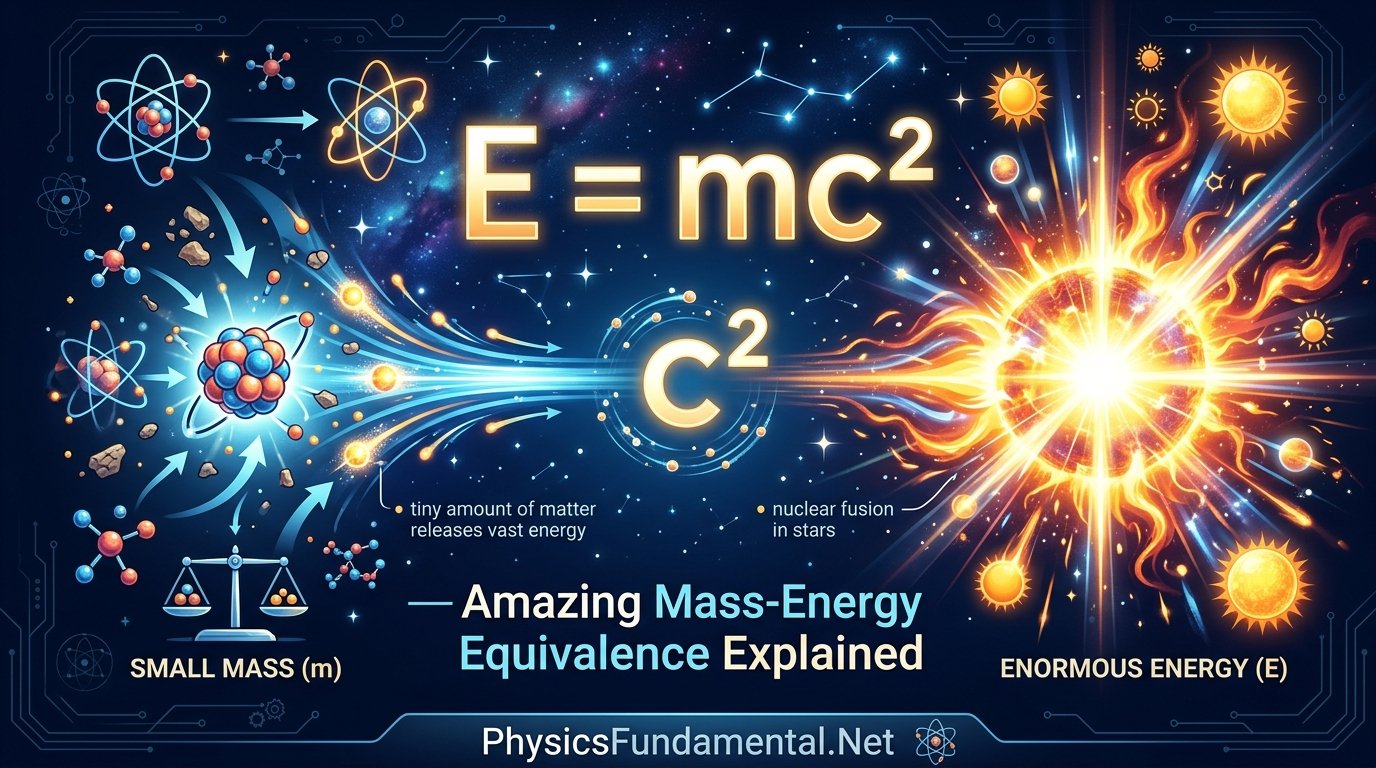
E = mc² is one of the most famous equations in physics. Introduced by Albert Einstein in the context of his theory of special relativity, this simple-looking equation reveals a profound connection between mass and energy.
The equation tells us that mass can be understood as a form of energy. Even an object sitting completely still contains an enormous amount of energy because its mass is multiplied by the square of the speed of light.
But what does E = mc² actually mean? Why does the speed of light appear in the equation? How can mass become energy? And how is this famous relationship derived?
In this guide, we’ll break down mass-energy equivalence, explain every part of the equation, explore its derivation, and look at its importance in nuclear physics, particle physics, and the universe.
What Does E = mc² Mean?
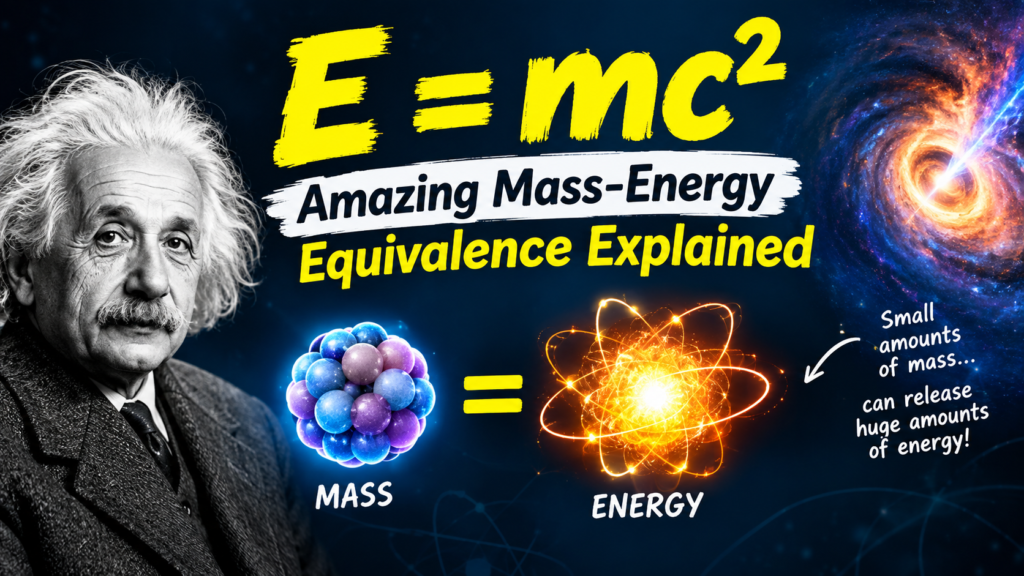
The equation is:
E = mc²
where:
- E = energy
- m = mass
- c = speed of light in vacuum
The speed of light is approximately:
c = 299,792,458 m/s
Because this number is extremely large, squaring it produces an enormous value.
That means even a small amount of mass corresponds to a very large amount of energy.
The key idea is called mass-energy equivalence.
Mass and energy are not completely separate quantities. Under the principles of relativity, they are different aspects of a deeper physical relationship.
What Is Mass-Energy Equivalence?
Mass-energy equivalence is the idea that mass and energy are related and can be converted into one another under appropriate physical processes.
An object with mass has what is called rest energy. The rest energy is given by:
E₀ = mc²
The subscript zero emphasizes that this is the energy associated with an object’s rest mass.
This does not mean that ordinary objects spontaneously turn all their mass into energy. Rather, it establishes the amount of energy equivalent to a given mass.
For example, in nuclear reactions, a small difference in mass between the initial and final systems can appear as released energy.
Breaking Down E = mc²
Let’s look at each part of the equation.
E — Energy
E represents energy, measured in joules (J) in the SI system.
Energy is the capacity associated with physical processes to produce change. It appears in many forms, including kinetic, potential, thermal, chemical, and nuclear energy.
In E = mc², E specifically represents the rest energy associated with mass when the equation is used in this form.
m — Mass
m represents mass, measured in kilograms (kg).
Mass describes an object’s inertia and also contributes to its gravitational effects.
In the mass-energy equation, even an object at rest has an associated energy because of its rest mass.
c — Speed of Light
c represents the speed of light in vacuum:
299,792,458 m/s
The value of c is fundamental to special relativity.
Because the equation contains c², a tiny amount of mass corresponds to a very large amount of energy.
Why Is the Speed of Light Squared?
This is one of the most interesting parts of E = mc².
The factor c² is not simply an arbitrary number inserted into the equation. It emerges naturally from the mathematical structure of special relativity.
The speed of light acts as a fundamental conversion factor between mass and energy.
Since:
c² ≈ 9 × 10¹⁶ m²/s²
even a small mass multiplied by this enormous factor represents a substantial amount of energy.
For example, if 1 kilogram of mass were completely converted into energy:
E = (1 kg)(299,792,458 m/s)²
which is approximately:
E ≈ 8.99 × 10¹⁶ joules
That is an enormous amount of energy.
Rest Energy vs Total Relativistic Energy
It is important to understand that E = mc² is specifically the rest-energy relationship.
For a particle moving relative to an observer, the more general relativistic energy equation is:
E² = p²c² + m²c⁴
where:
- E = total energy
- p = relativistic momentum
- m = invariant (rest) mass
- c = speed of light
When the particle is at rest, its momentum is zero:
p = 0
The equation becomes:
E² = m²c⁴
Taking the positive square root gives:
E = mc²
So the famous equation is a special case of the more general energy-momentum relationship.
How Was E = mc² Derived?
Einstein published his famous mass-energy relationship in 1905.
One way to understand the result is through special relativity and the relationship between energy and momentum.
A simple derivation can begin with relativistic energy and momentum.
For a particle, the total energy is related to momentum and rest mass by:
E² = p²c² + m²c⁴
For an object at rest:
p = 0
Therefore:
E² = m²c⁴
Taking the square root:
E = mc²
This shows why the rest energy of an object is proportional to its rest mass.
A More Physical Way to Understand the Equation
The mathematics gives us the relationship, but the physical meaning is even more important.
Imagine a particle that has no motion relative to an observer.
Classical physics might lead you to think that an object at rest has no kinetic energy. That is true: its kinetic energy is zero.
However, relativity says the particle still has rest energy.
That energy is:
E₀ = mc²
So an object does not need to be moving to possess energy.
Its mass itself is associated with energy.
Mass Defect and Nuclear Energy
One of the clearest applications of mass-energy equivalence occurs in nuclear physics.
When atomic nuclei undergo reactions, the total mass of the products can be slightly different from the total mass of the starting particles.
The difference is called the mass defect.
If the final system has less mass than the initial system, the missing mass corresponds to released energy:
ΔE = Δmc²
Even a tiny mass difference can produce a large amount of energy because of the factor c².
This principle is central to understanding nuclear fission and fusion.
E = mc² and Nuclear Fission
Nuclear fission occurs when a heavy atomic nucleus splits into smaller nuclei.
During the process, the total mass of the products can be slightly lower than the original mass.
That mass difference is converted into other forms of energy, including kinetic energy of the products and radiation.
This is one reason nuclear reactions can release much more energy per unit mass than ordinary chemical reactions.
E = mc² and Nuclear Fusion
Nuclear fusion involves combining light atomic nuclei to form a heavier nucleus.
Fusion can also result in a mass difference.
The resulting mass difference appears as energy according to:
ΔE = Δmc²
Fusion powers stars.
Inside stars, extremely high temperatures and pressures allow nuclear fusion reactions to occur. The energy produced eventually contributes to the radiation and heat emitted by the star.
E = mc² and the Sun
The Sun is one of the most spectacular examples of mass-energy conversion.
In the Sun’s core, hydrogen nuclei participate in nuclear fusion processes that ultimately produce helium.
The mass of the resulting products is slightly smaller than the mass of the initial reactants.
The difference is released as energy.
That energy travels outward through the Sun and is eventually emitted into space as radiation.
So when sunlight reaches Earth, it ultimately comes from nuclear processes governed by the principles of mass-energy equivalence.
Does E = mc² Mean Matter Is Pure Energy?
It is common to hear the phrase “matter is energy.”
While this can be useful as a simplified description, it needs some care.
Mass and energy are closely related physical quantities, but they are not simply interchangeable labels in every situation.
The equation says that a system with rest mass has an equivalent rest energy.
Mass can also change in physical processes when energy is transferred or released.
A better interpretation is that mass contributes to the total energy of a physical system and can be converted into other forms of energy under suitable circumstances.
Can Energy Create Mass?
Yes.
The relationship works in both directions.
Energy can contribute to the creation of massive particles when sufficient energy is available.
For example, in high-energy particle interactions, energy can be converted into particles with mass, provided the relevant conservation laws are satisfied.
This demonstrates that mass-energy equivalence is not simply about converting matter into energy.
It describes a deeper relationship between the two.
E = mc² and Particle Physics
Mass-energy equivalence is fundamental to particle physics.
Particle accelerators can provide enormous amounts of energy to particles. During collisions, that energy can produce new particles.
The mass of newly produced particles represents part of the energy budget of the collision.
Particle physicists therefore commonly express particle masses in units such as electronvolts (eV), particularly megaelectronvolts (MeV) and gigaelectronvolts (GeV), using the relationship between mass and energy.
Why Does E = mc² Matter?
The importance of E = mc² goes far beyond its popularity.
It changed our understanding of:
- Mass
- Energy
- Matter
- Nuclear reactions
- Particle physics
- Stars
- Relativity
- The structure of the universe
Before relativity, mass and energy were generally treated as separate conserved quantities in classical mechanics.
Relativity showed that they belong to a deeper framework.
Common Misconceptions About E = mc²
Does E = mc² Say That Everything Moves at the Speed of Light?
No.
The c in the equation is the speed of light and acts as a fundamental constant. It does not mean that a massive object is traveling at light speed.
In fact, an object with nonzero rest mass cannot be accelerated to the speed of light.
Does Mass Automatically Turn Into Energy?
No.
Mass-energy equivalence does not mean that everyday objects spontaneously convert their entire mass into energy.
Specific physical processes are required for significant conversion or release of energy.
Is E = mc² the Complete Relativity Equation?
No.
For a particle in motion, the more general relationship is:
E² = p²c² + m²c⁴
E = mc² describes the rest energy when the particle’s momentum is zero.
Is All Energy Caused by Mass?
No.
Energy exists in many forms. A system’s total energy can include rest energy, kinetic energy, potential energy, radiation, and other contributions.
Simple Example of E = mc²
Suppose a hypothetical process converts 0.001 kg of mass completely into energy.
Using:
E = mc²
we get:
E = 0.001 × (299,792,458)²
The result is approximately:
E ≈ 8.99 × 10¹³ joules
This illustrates how enormous the energy equivalent of even a small amount of mass can be.
However, complete conversion of ordinary matter into energy is not what happens in most real-world processes. Nuclear reactions convert only a fraction of the participating mass into released energy.
E = mc² in Everyday Life
You might wonder whether this equation has any relevance outside advanced physics.
It does.
Mass-energy equivalence helps explain technologies and natural processes involving nuclear physics.
Examples include:
Nuclear power: Energy released from nuclear reactions is related to changes in mass.
Medical imaging: Some medical technologies rely on particle and radiation physics where mass-energy relationships are important.
Particle accelerators: High-energy collisions can transform energy into new particles.
The Sun: Stellar energy production depends on nuclear fusion and mass differences.
Nuclear medicine: Radioactive decay and particle interactions involve relativistic energy relationships.
The Historical Importance of Einstein’s Equation
Albert Einstein developed special relativity in 1905.
That same year is often called Einstein’s annus mirabilis, or “miracle year,” because he published several groundbreaking papers that transformed physics.
The mass-energy relationship became one of the most recognizable results associated with special relativity.
Its influence extended far beyond theoretical physics, helping establish a new understanding of space, time, matter, and energy.
Frequently Asked Questions
What does E = mc² mean?
E = mc² states that an object’s rest mass corresponds to a specific amount of rest energy, with c being the speed of light.
Who discovered E = mc²?
Albert Einstein published the mass-energy relationship in 1905 as part of his work on special relativity.
What does the c stand for in E = mc²?
The letter c represents the speed of light in vacuum, exactly 299,792,458 meters per second.
Why is c squared?
The factor c² emerges from the mathematical structure of special relativity and serves as the conversion factor between mass and energy.
What is mass-energy equivalence?
Mass-energy equivalence describes the relationship between mass and energy, showing that rest mass corresponds to rest energy.
Can mass be converted into energy?
Yes. Nuclear reactions can convert a small amount of mass difference into energy according to ΔE = Δmc².
Can energy create matter?
Yes. Under suitable high-energy conditions, energy can contribute to the creation of massive particles while obeying conservation laws.
Is E = mc² used in nuclear physics?
Yes. It is essential for understanding the energy released or absorbed when nuclear systems have different masses.
Final Thoughts
E = mc² may contain only three symbols, but it represents one of the most profound ideas in modern physics. It reveals that mass and energy are connected and that an object’s rest mass corresponds to an enormous amount of rest energy.
The equation becomes especially powerful when studying nuclear reactions, particle physics, stars, and the structure of matter. The broader relativistic energy equation also shows that E = mc² is the rest-energy case of a more general relationship between energy, momentum, and mass.
Most importantly, E = mc² changed the way scientists think about the physical universe. It showed that mass is not completely separate from energy, opening the door to a deeper understanding of how matter and energy interact.