Wave Particle Duality Explained: Powerful Light & Matter Facts 2026
How can something behave like a wave in one experiment and like a particle in another? This surprising question is at the heart of modern quantum physics. Light can produce interference patterns like a wave, yet it can also arrive at a detector as individual packets of energy called photons.
The same strange behavior applies to matter. Electrons and other particles can behave like localized particles, but under the right conditions they can also produce diffraction and interference patterns. This idea is known as Wave Particle Duality.
Wave-particle duality changed how scientists understand nature at very small scales. Instead of thinking of light and matter as being exclusively waves or particles, quantum mechanics describes them using a framework in which wave-like and particle-like properties both appear depending on how a system is measured.
What Is Wave Particle Duality?
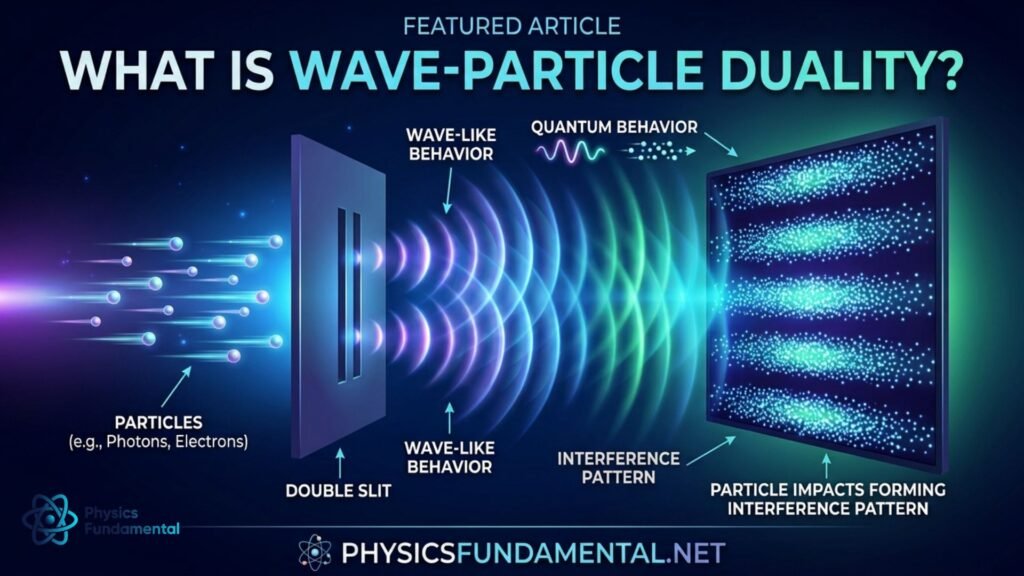
Wave-particle duality is the principle that quantum objects can display both wave-like and particle-like behavior.
Light is the classic example.
Light as a Wave
Light shows several properties associated with waves, including:
- Interference
- Diffraction
- Polarization
- Reflection and refraction
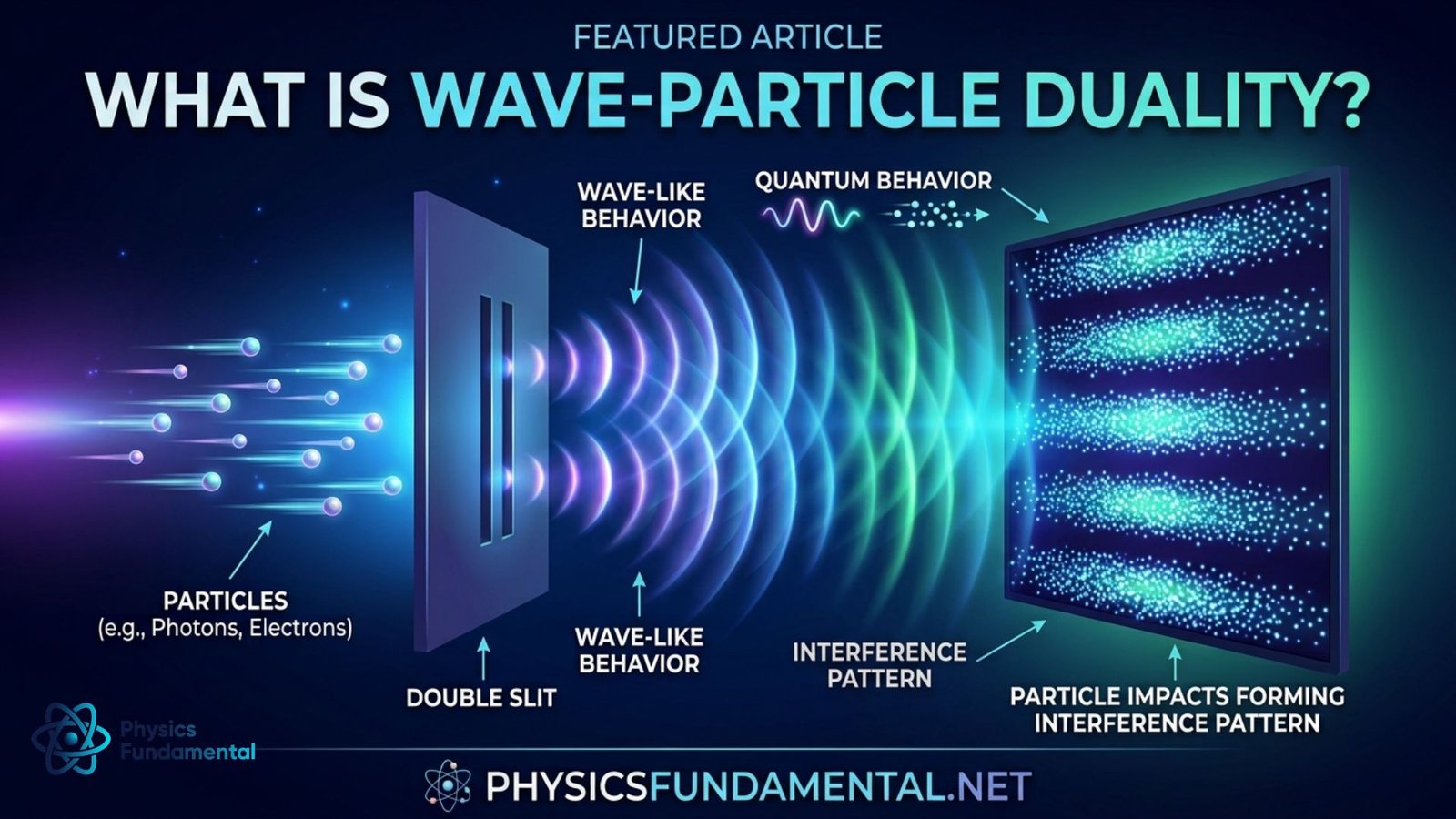
The double-slit experiment provides particularly strong evidence of light’s wave-like behavior. When light passes through two narrow slits, the resulting waves can interfere and produce bright and dark regions on a screen.
Light as a Particle
Light also behaves as though its energy is delivered in discrete packets called photons.
The energy of a photon is:
E = hf
where:
- E = photon energy
- h = Planck’s constant
- f = frequency
Since:
f = c/λ
the photon energy can also be written as:
E = hc/λ
This particle-like description helps explain phenomena such as the photoelectric effect.
Why Was Wave-Particle Duality Needed?
Classical physics traditionally separated waves and particles.
A wave could spread out, interfere, and diffract. A particle was treated as a localized object with properties such as momentum and position.
Experiments involving light and matter did not always fit neatly into either category.
For example, light clearly produces interference patterns, but the photoelectric effect shows that light transfers energy in discrete amounts. Electrons are detected as individual particles, yet beams of electrons can produce diffraction patterns.
These observations led to the development of quantum mechanics.
The Double-Slit Experiment
The double-slit experiment is one of the most important demonstrations of quantum behavior.
Imagine a source sending light toward a barrier containing two narrow openings. Behind the barrier is a screen.
If light behaved only as ordinary particles, we might expect two bright regions corresponding to the two slits.
Instead, when both slits are open, an interference pattern appears.
The pattern contains alternating bright and dark regions.
This is characteristic of wave interference.
Single-Particle Double-Slit Experiment
The experiment becomes even more remarkable when particles are sent through the apparatus one at a time.
Each photon or electron is detected at one particular location on the screen, showing particle-like detection.
However, after many individual detections, an interference pattern gradually builds up.
This demonstrates an important feature of quantum mechanics: individual detection events can be particle-like, while the overall probability distribution can show wave-like interference.
Wave-Particle Duality of Light
Light provides some of the earliest evidence for dual behavior.
Wave Properties of Light
Light behaves like an electromagnetic wave and can exhibit:
- Interference
- Diffraction
- Polarization
- Refraction
- Reflection
The wavelength of light is related to its frequency by:
c = fλ
where c is the speed of light in vacuum.
Particle Properties of Light
In quantum physics, electromagnetic radiation is quantized into photons.
Each photon has:
Energy: E = hf
and momentum:
p = h/λ
Therefore, increasing the frequency of light increases the energy of each photon.
Increasing the wavelength decreases photon momentum.
The Photoelectric Effect
The photoelectric effect helped establish the particle description of light.
When light of sufficient frequency shines on certain materials, electrons can be ejected from the surface.
The important observation is that increasing light intensity does not compensate for a frequency that is below the material’s threshold frequency.
Einstein explained this by treating light as photons.
Each photon carries energy:
E = hf
Some of that energy is required to remove an electron from the material. This minimum required energy is called the work function, represented by φ.
The remaining energy becomes the electron’s maximum kinetic energy:
Kₘₐₓ = hf − φ
This equation shows why photon frequency matters so strongly in the photoelectric effect.
Matter Waves
Wave-particle duality is not limited to light.
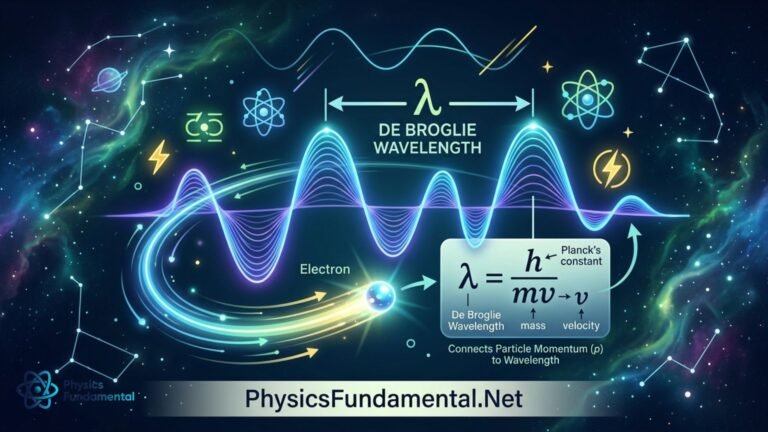
In 1924, Louis de Broglie proposed that particles of matter should also have wave-like properties.
He suggested that a particle with momentum p has a wavelength:
λ = h/p
This is called the de Broglie wavelength.
For a non-relativistic particle:
p = mv
so:
λ = h/mv
where:
- λ = matter-wave wavelength
- h = Planck’s constant
- m = particle mass
- v = particle velocity
This relationship means that every moving particle has an associated wavelength.
Worked Example: Electron Wavelength
Suppose an electron is moving with a speed of approximately:
v = 2.0 × 10⁶ m/s
The electron mass is approximately:
m = 9.11 × 10⁻³¹ kg
Using:
λ = h/mv
with:
h = 6.626 × 10⁻³⁴ J·s
we get approximately:
λ ≈ 3.64 × 10⁻¹⁰ m
This wavelength is comparable to atomic-scale distances, which helps explain why electrons can produce observable diffraction patterns.
Electron Diffraction
The wave nature of matter was experimentally demonstrated through electron diffraction.
When electrons pass through certain crystalline materials, they can produce diffraction patterns similar to those produced by waves.
This provides experimental support for de Broglie’s matter-wave hypothesis.
The result is significant because electrons are normally detected as individual localized particles, yet their motion can produce wave-like interference and diffraction.
Why Don’t We See Wave Behavior in Everyday Objects?
If every moving object has a wavelength, why don’t cars, baseballs, or people obviously behave like waves?
The answer is their extremely small de Broglie wavelengths.
Consider a baseball with a relatively large mass compared with an electron. Since:
λ = h/mv
a larger mass produces a much smaller wavelength for the same general speed.
For macroscopic objects, the wavelength is so tiny that observable diffraction and interference are effectively impossible under ordinary conditions.
For very small particles such as electrons, the wavelength can be comparable to atomic dimensions.
Worked Example: A Moving Particle
Consider a particle with:
m = 1.0 × 10⁻²⁶ kg
and:
v = 1.0 × 10³ m/s
Its momentum is:
p = mv
p = (1.0 × 10⁻²⁶)(1.0 × 10³)
p = 1.0 × 10⁻²³ kg·m/s
Now calculate its de Broglie wavelength:
λ = h/p
λ = 6.626 × 10⁻³⁴ / 1.0 × 10⁻²³
λ ≈ 6.63 × 10⁻¹¹ m
This is on the atomic scale, so wave behavior could potentially become experimentally relevant.
Wave and Particle Properties Compared
| Feature | Wave-Like Behavior | Particle-Like Behavior |
|---|---|---|
| Light | Interference and diffraction | Photons |
| Energy | Continuous-looking wave description | Quantized as E = hf |
| Momentum | Wave propagation | Photon momentum p = h/λ |
| Matter | Matter waves | Localized detections |
| Electrons | Diffraction and interference | Individual electron impacts |
| Main evidence | Double-slit and diffraction | Photoelectric effect and detection events |
This does not mean that quantum objects simply switch between being ordinary classical waves and ordinary classical particles. Their behavior is described by quantum theory, which is more fundamental than either classical picture.
Wave Function and Probability
Modern quantum mechanics uses a mathematical object called the wave function, usually represented by:
ψ
The wave function contains information about the possible states of a quantum system.
The quantity:
|ψ|²
is interpreted as a probability density for finding a particle in a particular location.
This gives a deeper interpretation of the double-slit experiment.
The wave-like behavior is associated with the evolution and interference of quantum probability amplitudes, while measurements produce individual outcomes.
Superposition and Interference
Quantum systems can exist in superpositions of possible states.
When two possible paths contribute to the same outcome, their probability amplitudes can interfere.
For two amplitudes:
ψ = ψ₁ + ψ₂
The probability is:
P = |ψ₁ + ψ₂|²
Expanding this gives:
P = |ψ₁|² + |ψ₂|² + 2Re(ψ₁*ψ₂)
The final term represents interference.
This is why quantum experiments can produce patterns that cannot be explained simply by adding classical particle probabilities.
You May Like to Read: Half Life Calculations Explained: Powerful Formula & Examples 2026
Complementarity
Niels Bohr developed the idea of complementarity to describe the relationship between wave and particle descriptions.
Different experimental arrangements can reveal different aspects of quantum systems.
For example, an experiment designed to determine which slit a particle passes through can affect whether an interference pattern appears.
The wave and particle descriptions are therefore not necessarily competing classical pictures. They can be complementary ways of describing observations from quantum systems.
Wave-Particle Duality and Uncertainty
Wave-particle duality is closely related to the uncertainty principle.
The uncertainty principle is commonly written as:
Δx Δp ≥ ℏ/2
where:
- Δx = uncertainty in position
- Δp = uncertainty in momentum
- ℏ = reduced Planck’s constant
A quantum particle cannot generally have perfectly defined position and momentum simultaneously.
The wave description naturally incorporates this uncertainty.
Photon Momentum
Although photons have zero rest mass, they carry momentum.
The photon momentum is:
p = E/c
Since:
E = hf
and:
c = fλ
we obtain:
p = h/λ
This momentum explains why light can exert radiation pressure.
Solar sails, for example, can use the momentum transferred by sunlight to generate a small but useful force.
Wave-Particle Duality and Quantum Mechanics
Wave-particle duality was one of the key developments that led to modern quantum mechanics.
Classical physics could not fully explain several observations involving atoms, electrons, and electromagnetic radiation.
Quantum mechanics introduced ideas such as:
- Quantized energy
- Probability amplitudes
- Superposition
- Wave functions
- Quantum measurement
- Matter waves
- Photon energy
Together, these concepts provide a framework for describing microscopic systems.
Applications of Wave-Particle Duality
Wave-particle duality is not merely a historical idea. It plays an important role in modern technology and scientific research.
Electron Microscopes
Electron microscopes use electrons whose wavelengths can be much smaller than visible-light wavelengths.
This allows scientists to investigate structures at extremely small scales.
Electron Diffraction
Electron diffraction is used to study crystal structures and the arrangement of atoms in materials.
Lasers
Lasers rely on quantum behavior of electromagnetic radiation and interactions between photons and matter.
Semiconductor Technology
Modern electronics depend on quantum behavior within semiconductor materials.
Transistors, integrated circuits, LEDs, and many other technologies require quantum physics for their underlying explanation.
Quantum Computing
Quantum computers use quantum states, superposition, interference, and measurement to process information in ways that differ from classical computers.
Electron and Neutron Microscopy
The wave properties of particles such as electrons and neutrons can be exploited to study materials and structures at microscopic scales.
Common Misconceptions About Wave-Particle Duality
Misconception 1: A Photon Is Literally a Tiny Classical Wave and Particle
Quantum objects do not necessarily behave like miniature versions of familiar classical objects.
Wave and particle language describes different observable aspects of quantum behavior.
Misconception 2: Electrons Are Sometimes Waves and Sometimes Particles in a Simple Switching Process
It is better to say that electrons have quantum properties that can produce particle-like detection events and wave-like interference or diffraction.
Misconception 3: Only Light Has Duality
Matter also has wave-like properties. De Broglie’s equation applies to particles with momentum.
Misconception 4: Large Objects Have No Wavelength
They do have de Broglie wavelengths, but those wavelengths are normally far too small to produce noticeable quantum interference or diffraction.
Misconception 5: Wave-Particle Duality Means Classical Physics Is Wrong Everywhere
Classical physics remains extremely useful for everyday-scale systems. Quantum mechanics becomes especially important when dealing with microscopic systems and situations where quantum effects are observable.
How to Solve Wave-Particle Duality Problems
When solving numerical problems, first identify whether the question involves a photon or a material particle.
For photons, commonly used equations include:
E = hf
E = hc/λ
p = h/λ
For matter particles:
p = mv
and:
λ = h/p
Therefore:
λ = h/mv
For photoelectric-effect problems:
Kₘₐₓ = hf − φ
For a threshold frequency:
f₀ = φ/h
Writing down the known values and units before choosing an equation helps prevent calculation errors.
Important Formulas
The key equations related to Wave Particle Duality include:
Photon energy:
E = hf
Photon energy using wavelength:
E = hc/λ
Photon momentum:
p = h/λ
Wave speed relationship:
c = fλ
de Broglie wavelength:
λ = h/p
Non-relativistic matter wavelength:
λ = h/mv
Photoelectric equation:
Kₘₐₓ = hf − φ
Threshold frequency:
f₀ = φ/h
Uncertainty principle:
ΔxΔp ≥ ℏ/2
These equations connect the wave and particle descriptions of light and matter.
Frequently Asked Questions
What is Wave Particle Duality?
Wave Particle Duality is the principle that quantum objects such as photons and electrons can display both wave-like and particle-like behavior.
What is the de Broglie wavelength?
The de Broglie wavelength is the wavelength associated with a moving particle and is given by λ = h/p.
Is light a wave or a particle?
Light has both wave-like and particle-like properties. Its observed behavior depends on the type of experiment and measurement being performed.
Do electrons have wave properties?
Yes. Electrons can produce interference and diffraction patterns, demonstrating their wave-like quantum behavior.
Why don’t large objects show obvious wave behavior?
Large objects have extremely small de Broglie wavelengths, making observable wave effects such as diffraction and interference impractical under ordinary conditions.
Conclusion
Wave-particle duality is one of the central ideas of quantum physics. Light can behave like a wave through interference and diffraction, while its energy and momentum can appear in discrete photon interactions. Matter shows the same deep connection: electrons and other particles can produce localized detection events while also displaying wave-like diffraction and interference.
The key equations make this connection clear. A photon has energy E = hf and momentum p = h/λ, while a moving particle has a de Broglie wavelength λ = h/p. These relationships helped transform physics from a purely classical description into the quantum framework used to understand atoms, particles, materials, and many modern technologies.
Wave-particle duality does not simply mean that quantum objects switch between being ordinary waves and ordinary particles. Instead, it reveals that microscopic nature cannot always be described using classical categories alone. Quantum mechanics provides the broader framework that explains why both wave-like and particle-like behavior appear in experiments.