
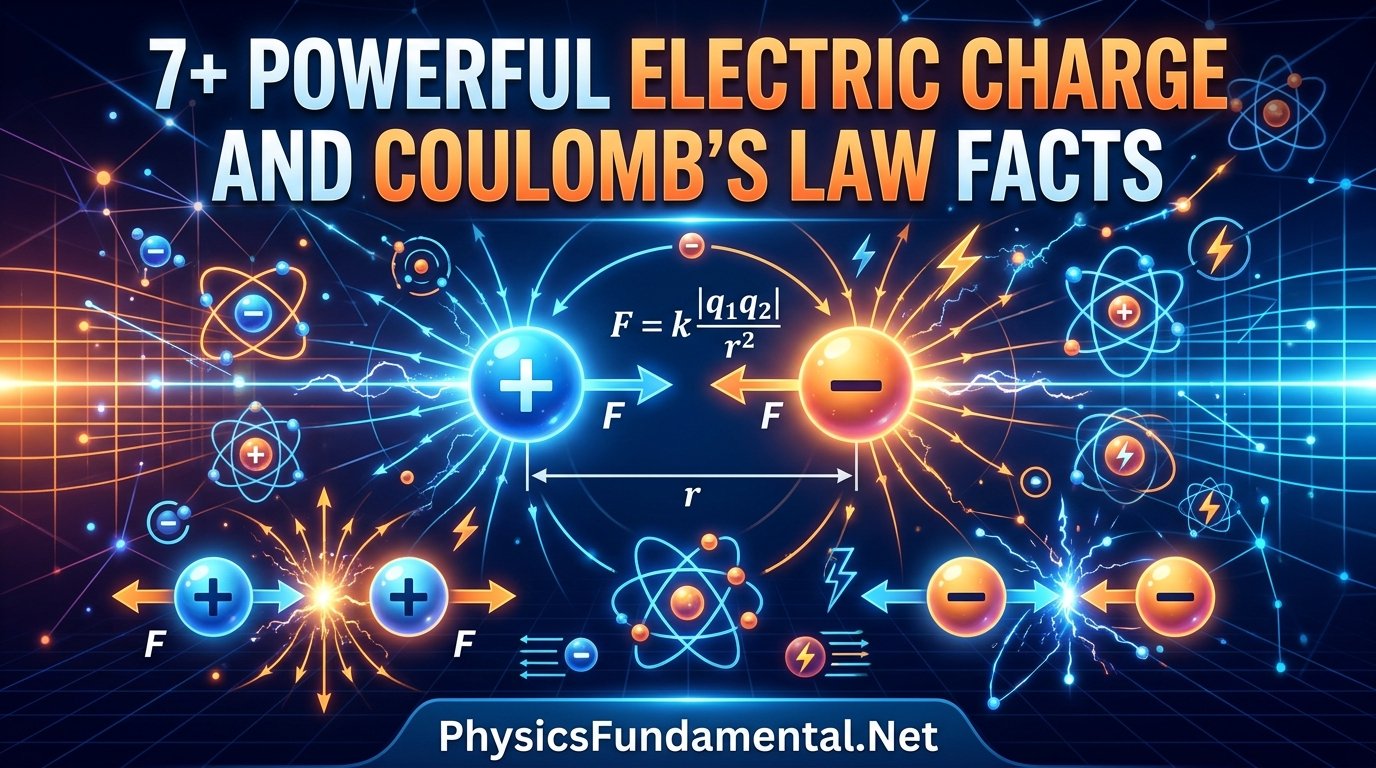
Electric Charge and Coulomb’s Law are fundamental concepts in electricity and magnetism. They help explain how charged objects interact with one another and why some charges attract while others repel.
Everything around us is made of atoms, and atoms contain electrically charged particles. Protons carry positive charge, electrons carry negative charge, and neutrons have no net electric charge. When objects gain or lose electrons, they can become electrically charged and begin to exert electric forces on other charged objects.
Coulomb’s Law describes the size of the electric force between two point charges. It shows that the force depends on the amount of charge and the distance between them. The basic formula is:
This equation is one of the most important formulas in electrostatics.
What Is Electric Charge?
Electric Charge is a physical property of matter that causes particles and objects to experience electric forces.
There are two types of electric charge:
- Positive charge
- Negative charge
Protons have positive charge, while electrons have negative charge.
Objects can become charged when electrons move from one object to another.
For example, if an object gains electrons, it becomes negatively charged. If it loses electrons, it becomes positively charged.
The SI unit of Electric Charge is the coulomb:
The charge of a proton is approximately:
The charge of an electron is approximately:
These values are equal in magnitude but opposite in sign.
Properties of Electric Charge
Electric Charge has several important properties that form the basis of electrostatics.
Like Charges Repel
Two positive charges repel each other, and two negative charges also repel each other.
This means:
and:
Unlike Charges Attract
A positive charge and a negative charge attract one another.
Therefore:
The direction of the electric force always depends on whether the interacting charges are alike or opposite.
Electric Charge Is Conserved
Electric charge cannot simply be created or destroyed in an isolated system.
It can, however, be transferred from one object to another.
For example, rubbing two materials together can cause electrons to move from one material to the other. The total charge of the complete isolated system remains conserved.
You May Like to Read: 7+ Powerful Projectile Motion Formulas You Need to Know
Electric Charge Is Quantized
Electric charge occurs in discrete amounts.
The elementary charge is:
The charge on an object can be written as:
where is an integer representing the number of elementary charges.
What Is Coulomb’s Law?
Coulomb’s Law describes the electrostatic force between two point charges.
The law states that the magnitude of the electric force is directly proportional to the product of the two charges and inversely proportional to the square of the distance between them.
The formula is:
where:
- is the magnitude of the electric force.
- is Coulomb’s constant.
- and are the charges.
- is the distance between the charges.
The absolute value is used when calculating magnitude. The signs of the charges are then used separately to determine whether the force is attractive or repulsive.
Coulomb’s Law Formula
The standard form of Coulomb’s Law is:
The Coulomb constant in vacuum or approximately in air is:
It is also related to the permittivity of free space:
where:
For many introductory problems, using:
is sufficient.
Understanding the Variables in Coulomb’s Law
Every part of Coulomb’s Law has a specific meaning.
Electric Force
The symbol represents the magnitude of the electric force between the two charges.
The SI unit of force is:
Charges and
These represent the values of the two electric charges.
Their SI unit is the coulomb:
The signs of the charges determine whether the interaction is attractive or repulsive.
Distance
The symbol represents the separation between the two point charges.
The distance must be measured in meters when using the standard SI value of Coulomb’s constant.
Coulomb’s Constant
The constant determines the strength of the electric interaction in vacuum or approximately in air.
Its value is approximately:
How Coulomb’s Law Depends on Charge
Coulomb’s Law tells us that the electric force is directly proportional to the product of the charges:
If one charge is doubled while everything else remains constant, the force doubles.
If both charges are doubled, then:
so the force becomes four times larger.
This shows that increasing the amount of charge increases the electrostatic force.
You May Like to Read: BN6922297R Samsung TV Code: Avoid This Common Mistake
How Coulomb’s Law Depends on Distance
Coulomb’s Law includes the square of the distance:
This means the electric force decreases rapidly as the charges move farther apart.
If the distance is doubled:
then:
So doubling the distance makes the electric force one-fourth as large.
If the distance is tripled, the force becomes one-ninth of its original value.
This is known as an inverse-square relationship.
Attraction and Repulsion in Coulomb’s Law
Coulomb’s Law gives the magnitude of the force, but the signs of the charges tell us the direction of the interaction.
If:
the charges have the same sign and repel.
If:
the charges have opposite signs and attract.
For example, two positive charges push away from one another.
A positive and a negative charge pull toward one another.
The electric forces on the two charges always have equal magnitude and opposite direction.
You May Like to Read: BrassSmile: 10+ Powerful Fixes and Hidden Causes
Example of Coulomb’s Law
Suppose two charges are:
and:
Their separation is:
Using:
we get:
First calculate the product of the charges:
Then:
Therefore, the magnitude of the electric force is:
Because both charges are positive, the force is repulsive.
Example With Opposite Charges
Suppose:
and:
with a separation of:
The magnitude is:
Therefore:
Because the charges have opposite signs, the force is attractive.
How to Calculate Coulomb’s Law Step by Step
A reliable method can make Coulomb’s Law problems much easier.
Step 1: Identify the Charges
Write down and , including their signs.
Step 2: Convert the Units
Make sure charge is expressed in coulombs and distance is expressed in meters.
For example:
Step 3: Identify the Distance
Use the separation between the centers of the charges.
Step 4: Substitute Into the Formula
Use:
Step 5: Determine the Direction
Like charges repel.
Unlike charges attract.
Step 6: Check the Units
The final force should be expressed in newtons.
Coulomb’s Law as a Vector Equation
Because electric force has both magnitude and direction, Coulomb’s Law can also be written in vector form.
For two point charges:
Here, is a unit vector that indicates the direction between the charges.
The vector equation is particularly useful when several charges are present because the individual force vectors can be added using vector addition.
You May Like to Read: Glorvix Com: 10+ Powerful Benefits and Hidden Risks
Principle of Superposition
When more than two charges are present, each pair of charges exerts an electric force.
The total force on a particular charge is the vector sum of all the individual forces.
This is called the principle of superposition.
Mathematically:
For example, if three charges are present, you calculate the force produced by each charge on the selected object and then add those force vectors.
The individual electric forces do not cancel automatically. Their directions must be considered.
Electric Charge and Electric Field
Electric Charge is closely connected to the concept of electric field.
An electric field describes the force that a positive test charge would experience at a particular location.
The electric field is defined as:
For a point charge:
where is the source charge.
The electric field points away from a positive source charge and toward a negative source charge.
Coulomb’s Law can therefore be used as the foundation for calculating electric fields produced by point charges.
Difference Between Electric Charge and Electric Force
Electric Charge is a property of matter, while electric force is an interaction between charges.
Charge is measured in coulombs:
Electric force is measured in newtons:
An object can possess charge even when there is no net force acting on it.
For example, a charged object in an arrangement of several other charges may experience forces from different directions that add up to zero.
Difference Between Coulomb’s Law and Newton’s Law of Gravitation
Coulomb’s Law and Newton’s law of universal gravitation have a similar mathematical structure.
Coulomb’s Law:
Gravitational force:
Both are inverse-square laws.
However, there is an important difference.
Gravitational force between ordinary masses is always attractive, while electric force can be attractive or repulsive depending on the signs of the charges.
Electric interactions can also be much stronger than gravitational interactions at the particle scale.
You May Like to Read: Snapjotz com: 10+ Powerful Benefits and Hidden Risks
Conductors and Electric Charge
Conductors are materials in which electric charges can move relatively freely.
Metals are common examples.
When a conductor becomes charged, the excess charge redistributes over its surface.
In electrostatic equilibrium, the electric field inside an ideal conductor is zero.
Electric charge therefore plays an important role in determining the behavior of conductors.
Insulators and Electric Charge
Insulators do not allow electric charges to move freely through the material.
Examples include glass, rubber, and many plastics.
When an insulator is charged, the excess charge tends to remain localized rather than spreading throughout the entire material.
This difference between conductors and insulators is important when studying electrostatic phenomena.
Charging by Friction
One familiar way to transfer Electric Charge is through friction.
When two different materials are rubbed together, electrons may move from one material to another.
One object gains electrons and becomes negatively charged, while the other loses electrons and becomes positively charged.
The total charge remains conserved.
This is why a balloon rubbed against hair can become electrically charged and then interact with other objects.
Charging by Conduction
Charging by conduction occurs when a charged object comes into direct contact with another object.
Electrons can move between the objects until the charge is redistributed according to the properties of the materials.
After contact, the objects can possess net charge.
This process demonstrates that Electric Charge can be transferred between objects.
You May Like to Read: Unblocked Games G+: 15+ Best Games You Shouldn’t Miss
Charging by Induction
Charging by induction allows an object to become charged without direct contact with the charged object.
A nearby charged object causes charges inside a conductor to redistribute.
With the appropriate grounding and separation steps, the conductor can be left with a net charge.
This method is another example of the movement and conservation of Electric Charge.
Coulomb’s Law in Different Media
The simple Coulomb’s Law equation with:
applies to vacuum and is approximately valid in air.
In a material medium, the force can differ because the electric interaction is affected by the medium’s permittivity.
A general expression is:
where is the permittivity of the medium.
For a medium with relative permittivity :
As the permittivity increases, the electric force between the charges becomes smaller.
When Coulomb’s Law Can Be Used
Coulomb’s Law works most directly for point charges or objects whose charge distributions can be treated as point-like because of symmetry or distance.
It is especially useful when:
- Charges are small compared with their separation.
- The charge distributions have suitable symmetry.
- The system is being analyzed electrostatically.
For extended charge distributions, more advanced methods such as integration may be required.
Common Mistakes in Coulomb’s Law Problems
One of the most common mistakes is forgetting to square the distance.
The correct formula is:
not:
Another common mistake is using the distance in centimeters instead of meters.
For example:
before substitution into the SI form of Coulomb’s Law.
Students may also forget to convert microcoulombs or nanocoulombs into coulombs.
For example:
and:
Another mistake is calculating the magnitude correctly but ignoring the direction of the force.
Remember:
- Like charges repel.
- Unlike charges attract.
Finally, when several charges are involved, individual forces must be added as vectors rather than simply adding their magnitudes.
Electric Charge and Coulomb’s Law Formula Summary
The most important formula is:
Coulomb’s constant is approximately:
The vector form is:
The electric field of a point charge is:
The relationship between electric field and force is:
The elementary charge is:
and charge quantization can be expressed as:
These equations form the foundation for many introductory electrostatics problems.
Frequently Asked Questions
What is Electric Charge?
Electric Charge is a physical property of matter responsible for electric interactions. It can be positive or negative and is measured in coulombs.
What is Coulomb’s Law?
Coulomb’s Law describes the electric force between two point charges. The force is proportional to the product of the charges and inversely proportional to the square of their separation.
What is the formula for Coulomb’s Law?
The formula is:
where is Coulomb’s constant.
Do like charges attract or repel?
Like charges repel each other. Positive charges repel positive charges, and negative charges repel negative charges.
Do unlike charges attract or repel?
Unlike charges attract each other. A positive charge and a negative charge experience an attractive electric force.
Conclusion
Electric Charge and Coulomb’s Law provide the foundation for understanding electrostatic interactions. Electric Charge is a fundamental property of matter, while Coulomb’s Law describes how charged objects exert forces on one another.
The central equation is:
The equation shows that the electric force becomes stronger when the charges increase and weaker as the distance between them increases. Because the force follows an inverse-square relationship, even a relatively small change in distance can produce a significant change in the force.
Understanding the difference between attraction and repulsion, correctly handling units, and treating electric force as a vector are essential for solving Coulomb’s Law problems.
Once the relationship between Electric Charge and Coulomb’s Law is clear, it becomes much easier to study electric fields, electric potential, capacitors, circuits, and other topics in electromagnetism.