
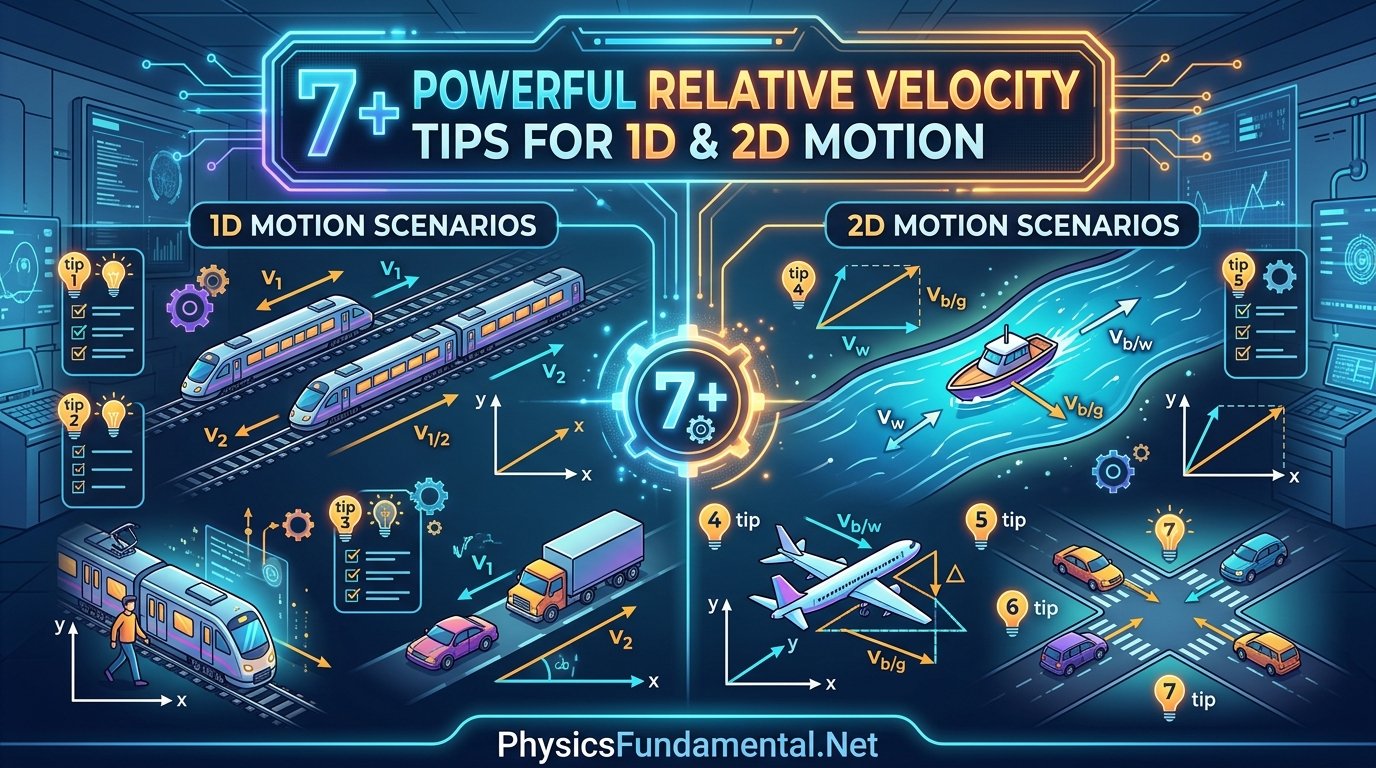
Relative Velocity is a fundamental concept in physics that describes how fast one object appears to move from the perspective of another object. Instead of measuring an object’s motion only relative to the ground, Relative Velocity helps us understand motion between two moving objects.
For example, imagine two cars traveling on the same straight road. One car may be moving at 80 km/h while the other is moving at 60 km/h. To a person standing beside the road, their speeds are 80 km/h and 60 km/h. However, to the driver of the slower car, the faster car appears to move at a different speed. This difference is explained using Relative Velocity.
Understanding Relative Velocity is especially important when studying objects moving in the same direction, opposite directions, or along different paths. The calculation becomes particularly useful in problems involving cars, trains, boats, airplanes, rivers, and moving objects in two-dimensional space.
In this article, we will explain how to calculate Relative Velocity in one dimension and two dimensions, including the formulas, equations, examples, and common mistakes to avoid.
What Is Relative Velocity?
Relative Velocity is the velocity of one object as observed from the reference frame of another object.
Suppose object A has velocity and object B has velocity . The velocity of A relative to B is written as:
Similarly, the velocity of B relative to A is:
The important point is that velocity is a vector quantity. This means both magnitude and direction must be considered when calculating Relative Velocity.
The equation can be understood simply as:
This formula works for both one-dimensional and two-dimensional motion, although the calculation becomes more involved when vectors point in different directions.
Relative Velocity Formula
The general Relative Velocity formula is:
Here:
- is the velocity of A relative to B.
- is the velocity of A relative to the chosen reference frame.
- is the velocity of B relative to the same reference frame.
Because velocity is a vector, subtraction must be performed using direction as well as magnitude.
The formula can also be rearranged:
This relationship is useful when the velocity of one object relative to another is known and the velocity of the reference object is given.
How to Calculate Relative Velocity in 1D
One-dimensional motion occurs along a single straight line. This makes Relative Velocity easier to calculate because we only need to assign positive and negative signs to indicate direction.
Choose one direction as positive. For example, motion toward the right can be positive, while motion toward the left can be negative.
Then use:
The signs of the velocities automatically account for their directions.
Objects Moving in the Same Direction
Consider two cars moving along the same straight road.
Suppose:
and
Both cars are moving in the same direction.
The velocity of A relative to B is:
Therefore, car A appears to move at 20 m/s relative to car B.
The velocity of B relative to A would be:
The negative sign indicates that B appears to move backward relative to A.
Objects Moving in Opposite Directions
Now consider two cars moving toward each other.
Suppose car A moves to the right at:
and car B moves to the left at:
The Relative Velocity of A relative to B is:
Thus, the cars approach each other with a Relative Velocity of 120 m/s.
When two objects move toward each other along the same line, their speeds often add when determining how quickly their separation changes.
Relative Velocity in 1D: Step-by-Step Method
A simple method can be used for almost every one-dimensional Relative Velocity problem.
Step 1: Identify the Two Objects
Determine which object is being observed and which object is acting as the reference frame.
You May Like to Read: Almawadahit .com Technology: 10+ Powerful Pros & Risks 2026
Step 2: Write Their Velocities
Record the velocity of each object using the same unit and reference direction.
Step 3: Assign Signs
Choose one direction as positive. Give velocity in the opposite direction a negative sign.
Step 4: Apply the Formula
Use:
Step 5: Interpret the Sign
A positive result means the relative motion is in the positive direction. A negative result means the relative motion is in the opposite direction.
Example of Relative Velocity in 1D
A train is traveling east at 25 m/s while another train is traveling east at 15 m/s. Find the velocity of the first train relative to the second train.
Take east as positive.
Using the Relative Velocity formula:
Therefore, the first train moves at 10 m/s relative to the second train.
How to Calculate Relative Velocity in 2D
Relative Velocity becomes more interesting in two-dimensional motion because objects can move in different directions.
In two dimensions, velocity is represented by components along the x-axis and y-axis.
The general equation remains:
However, instead of subtracting only one number, we subtract the corresponding components.
If:
and:
then:
The x-components are subtracted from each other, and the y-components are subtracted from each other.
Relative Velocity in 2D Using Components
Suppose object A has a velocity of:
m/s and object B has a velocity of:
m/s.
The Relative Velocity of A relative to B is:
Therefore:
The relative velocity vector has x-component 6 m/s and y-component 4 m/s.
To find its magnitude, use the Pythagorean theorem:
Thus, the magnitude of the Relative Velocity is approximately 7.21 m/s.
Finding the Direction of Relative Velocity
In two-dimensional problems, finding the magnitude is not enough. We may also need to determine the direction.
The direction can be calculated using:
Using the previous example:
and:
Therefore:
So the Relative Velocity points approximately 33.7° above the positive x-axis.
When using this method, always consider the signs of the x- and y-components because they determine the correct quadrant of the velocity vector.
You May Like to Read: Write for Aelftech.com: 10+ Powerful Guest Post Tips 2026
Relative Velocity Between Two Perpendicular Velocities
Sometimes two objects move at right angles to each other.
For example, suppose one object moves east at 12 m/s while another moves north at 5 m/s.
Take east as the x-direction and north as the y-direction.
Then:
and:
The Relative Velocity of A with respect to B is:
Its magnitude is:
Therefore, the magnitude of the Relative Velocity is 13 m/s.
This type of problem is common when studying motion involving perpendicular directions.
Relative Velocity of a Boat in a River
One of the most common applications of Relative Velocity is boat and river problems.
A boat may have a velocity relative to the water, while the water itself has a velocity relative to the ground.
The boat’s velocity relative to the ground can be found using vector addition:
where:
- is the boat velocity relative to the ground.
- is the boat velocity relative to the water.
- is the water velocity relative to the ground.
The same concept can be rearranged when finding the velocity of the water relative to the boat.
Example
Suppose a boat moves north at 8 m/s relative to the water, while the river flows east at 6 m/s.
The boat’s velocity relative to the ground is:
Its magnitude is:
The boat therefore moves at 10 m/s relative to the ground, in a direction between north and east.
Relative Velocity of an Airplane in Wind
Airplane and wind problems also use Relative Velocity.
An airplane may have a certain velocity relative to the air, while the air moves relative to the ground because of wind.
The aircraft’s ground velocity is:
Here, the airplane’s velocity relative to the ground depends on both its velocity through the air and the wind velocity.
This is why an airplane traveling directly north through the air may not travel directly north over the ground when a crosswind is present.
Pilots account for the wind by choosing an appropriate heading so the resulting ground velocity points toward the desired destination.
You May Like to Read: Voozon.com: 10+ Powerful Pros & Risks to Know in 2026
Difference Between Speed and Relative Velocity
Speed and velocity are related but are not the same quantity.
Speed tells us how quickly an object is moving and has only magnitude. Velocity includes both magnitude and direction.
Relative Velocity therefore provides more information than simply comparing two speeds.
For example, two cars may each have a speed of 50 m/s.
If they travel in the same direction, their Relative Velocity may be zero.
But if they travel in opposite directions, the magnitude of their Relative Velocity may be:
This demonstrates why direction must be considered.
Relative Velocity and Reference Frames
Relative Velocity depends on the observer or reference frame.
An object can have a certain velocity relative to the ground and a different velocity relative to another moving object.
For example, a passenger sitting inside a moving train is at rest relative to the train. However, the same passenger is moving relative to a person standing beside the railway track.
Neither description is necessarily wrong. They are velocities measured from different reference frames.
This idea is central to understanding motion in physics.
Why Relative Velocity Is Important
Relative Velocity has many practical and theoretical applications.
It is used to understand the motion of vehicles, aircraft, boats, spacecraft, projectiles, and other moving objects.
It also helps explain how an observer perceives motion. A person inside a moving vehicle can use the motion of surrounding objects to determine their relative movement.
Relative Velocity is particularly useful when two or more objects are moving simultaneously because it allows us to analyze their motion from one object’s point of view.
Common Mistakes When Calculating Relative Velocity
One of the most common mistakes is ignoring direction.
Velocity is a vector quantity, so simply subtracting two positive speeds may give an incorrect answer when the objects move in opposite directions.
Another common mistake is using inconsistent reference frames. Both velocities must be measured relative to the same reference frame before subtraction.
Students also sometimes confuse with . These two quantities have equal magnitudes but opposite directions:
A further mistake occurs in two-dimensional problems when students subtract the magnitudes before considering the components. In 2D motion, the x- and y-components should be handled separately.
Finally, always check the units. If one velocity is given in km/h and another in m/s, convert them to the same unit before performing the calculation.
Relative Velocity Examples
Example 1: Same Direction
A car moves east at 30 m/s while another car moves east at 20 m/s.
The first car moves at 10 m/s relative to the second car.
Example 2: Opposite Direction
A cyclist moves east at 12 m/s while another cyclist moves west at 8 m/s.
Take east as positive:
Therefore:
The cyclists approach one another with a Relative Velocity magnitude of 20 m/s.
Example 3: Two-Dimensional Motion
Object A moves with velocity:
m/s, while object B moves with:
m/s.
Then:
The magnitude is:
The direction is:
Therefore, the Relative Velocity has a magnitude of approximately 7.07 m/s at 45° above the positive x-axis.
Relative Velocity in Projectile and Motion Problems
Relative Velocity can also be useful when analyzing more complex motion.
For example, if an observer is moving while watching a projectile, the projectile’s measured velocity may differ from the velocity measured by an observer standing on the ground.
The velocity of the projectile relative to the moving observer can be obtained through:
This makes Relative Velocity useful in many mechanics problems where the observer is not stationary.
Relative Velocity Formula Summary
The most important equation to remember is:
For one-dimensional motion:
For two-dimensional motion:
The magnitude of a two-dimensional relative velocity is:
Its direction can be found from:
Frequently Asked Questions
What is Relative Velocity?
Relative Velocity is the velocity of one object as measured from the reference frame of another object. It is calculated by subtracting the observer’s velocity from the velocity of the object being observed.
What is the formula for Relative Velocity?
The basic formula is:
Both velocities must be measured relative to the same reference frame.
How do you calculate Relative Velocity in 1D?
For one-dimensional motion, assign signs to the velocities according to their directions and use:
How do you calculate Relative Velocity in 2D?
Break each velocity into x- and y-components, subtract the corresponding components, and then calculate the magnitude and direction of the resulting vector.
Why is Relative Velocity important?
Relative Velocity helps describe how one object appears to move from another object’s perspective. It is widely used in problems involving vehicles, trains, boats, airplanes, rivers, wind, and moving reference frames.
Conclusion
Relative Velocity provides a simple way to understand motion from the perspective of another moving object. The central idea is to compare two velocities using their directions as well as their magnitudes.
For one-dimensional motion, Relative Velocity can usually be calculated directly by subtracting one velocity from another. When objects move in opposite directions, their signed velocities must be handled carefully. In two-dimensional motion, the calculation requires vector components, followed by finding the magnitude and direction of the resulting velocity.
Once the basic formula
is understood, many motion problems become much easier to solve. Whether you are studying cars on a road, boats in a river, airplanes in wind, or objects moving in different directions, Relative Velocity is an essential tool for analyzing motion.