
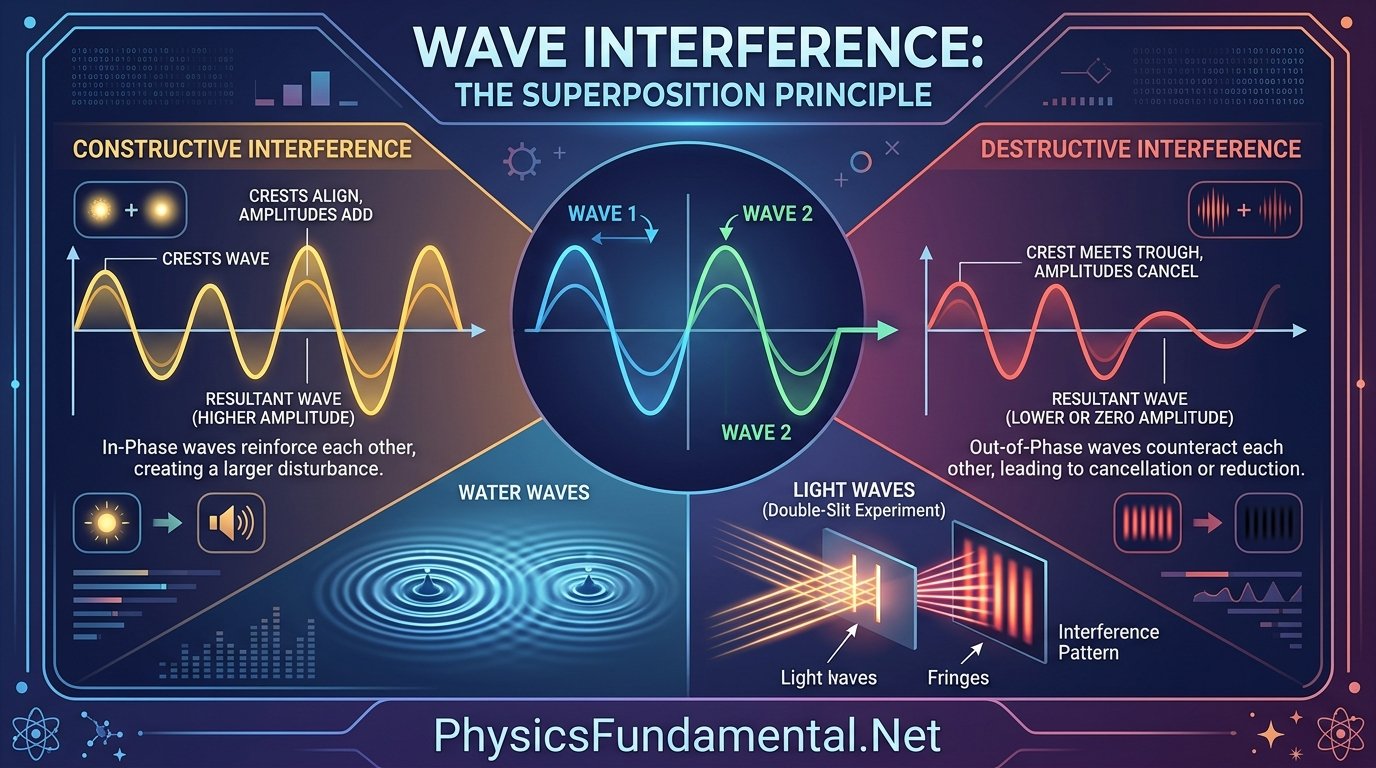
Wave interference is one of the most important concepts in physics used to explain how two or more waves interact when they meet. Instead of simply passing through each other without changing, waves can combine to produce a new wave pattern.
This phenomenon can make a wave stronger, weaker, or even cancel it out completely. You can observe interference in many areas of physics, including sound, light, water waves, radio signals, and electromagnetic waves.
Understanding wave interference also helps explain fascinating phenomena such as colorful patterns in thin films, noise-canceling headphones, diffraction effects, and the bright and dark bands produced in the famous double-slit experiment.
In this guide, we’ll explore what wave interference means, how it works, its main types, important formulas, examples, and practical applications.
What Is Wave Interference?
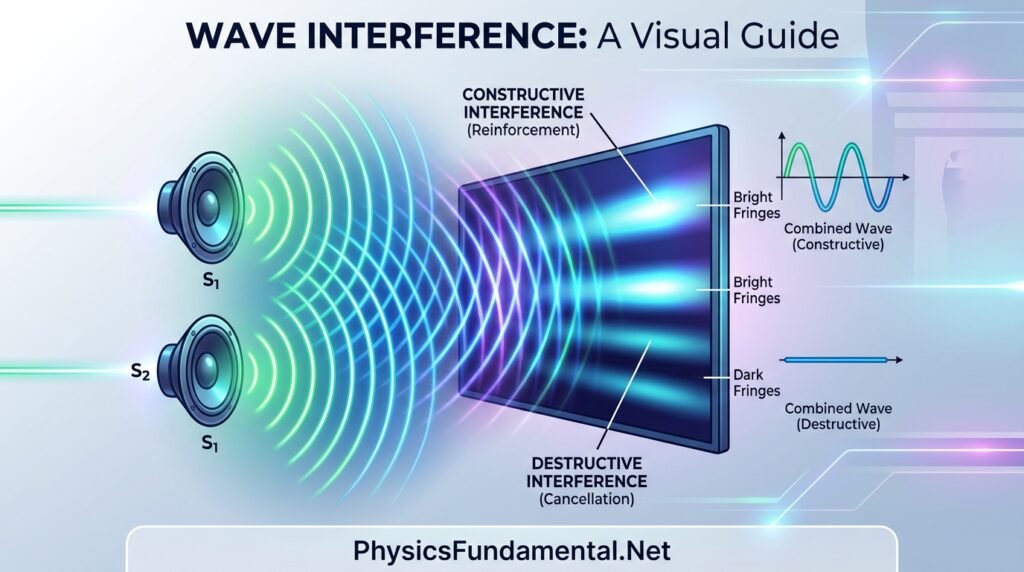
Wave interference occurs when two or more waves overlap in the same region of space at the same time. The waves combine according to the principle of superposition and produce a resultant wave.
The resulting wave depends on the amplitude, phase, frequency, and direction of the interacting waves.
When two waves meet, their displacements are added together. If their displacements reinforce one another, the resulting wave becomes larger. If they oppose each other, the resulting wave becomes smaller or may disappear.
A simple example is dropping two stones into a calm pond. Each stone creates circular water waves. When the expanding waves meet, they form regions where the water rises higher and regions where the waves partially or completely cancel.
This pattern is an example of wave interference.
Principle of Superposition
The principle of superposition is the foundation of wave interference.
It states that when multiple waves overlap, the resultant displacement at any point is equal to the algebraic sum of the individual displacements.
For two waves, the resultant displacement can be written as:
y = y₁ + y₂
Here:
- y = resultant displacement
- y₁ = displacement produced by the first wave
- y₂ = displacement produced by the second wave
This principle applies to many types of waves, including mechanical waves and electromagnetic waves.
Types of Wave Interference
Wave interference is mainly divided into two types:
- Constructive interference
- Destructive interference
The difference between them depends mainly on the phase relationship between the waves.
Constructive Interference
Constructive interference occurs when two waves meet in such a way that their displacements reinforce each other.
When two waves with similar amplitudes are perfectly in phase, the crest of one wave overlaps with the crest of another, while their troughs also overlap.
As a result, the amplitude of the resulting wave increases.
For two waves with amplitudes A₁ and A₂:
A = A₁ + A₂
If both waves have the same amplitude:
A = 2A₀
where A₀ is the amplitude of either individual wave.
Example of Constructive Interference
Imagine two water waves approaching the same location. If the crest of one wave arrives at the same time as the crest of the other, their heights combine.
The resulting wave has a larger amplitude than either original wave.
This is constructive interference.
Destructive Interference
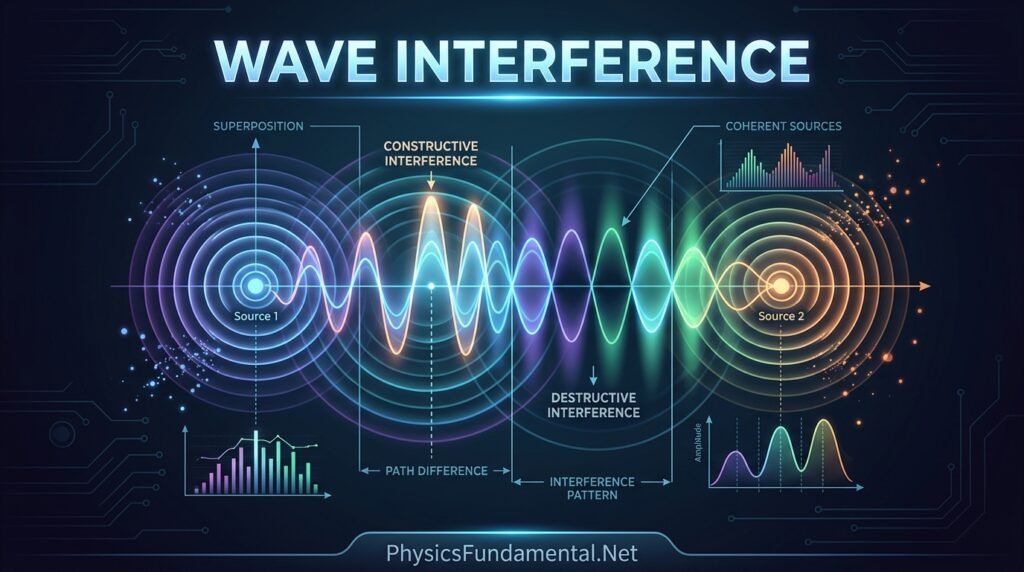
Destructive interference occurs when two waves meet out of phase and their displacements oppose one another.
For example, the crest of one wave may overlap with the trough of another.
If the two waves have equal amplitudes, they can completely cancel each other.
For two waves with amplitudes A₁ and A₂:
A = |A₁ − A₂|
If both waves have equal amplitude:
A = 0
This is called complete destructive interference.
Example of Destructive Interference
Suppose two identical waves travel toward one another. When the crest of one wave meets the trough of the other, the positive and negative displacements can cancel.
At that particular point, the resultant displacement becomes zero.
However, this does not mean the original waves permanently disappear. They continue traveling after interacting.
Conditions for Constructive Interference
For two coherent waves, constructive interference occurs when their path difference is:
Δx = nλ
where:
- Δx = path difference
- n = 0, 1, 2, 3…
- λ = wavelength
The corresponding phase difference is:
φ = 2nπ
This means the waves are in phase.
Conditions for Destructive Interference
Destructive interference occurs when the path difference is:
Δx = (n + 1/2)λ
The corresponding phase difference is:
φ = (2n + 1)π
This means the waves arrive out of phase.
Wave Interference Formula
For two sinusoidal waves having amplitudes A₁ and A₂ with a phase difference φ, the resultant amplitude can be expressed as:
A = √(A₁² + A₂² + 2A₁A₂ cosφ)
For two waves with equal amplitudes A₀:
A = 2A₀ cos(φ/2)
These equations show how the phase difference between waves affects their resultant amplitude.
When φ = 0, the waves are completely in phase and constructive interference occurs.
When φ = π, they are completely out of phase and destructive interference occurs.
What Is Phase Difference?
Phase difference describes how much one wave is shifted relative to another.
Two waves are in phase when their corresponding points, such as crests and troughs, occur together.
Two waves are out of phase when corresponding points are shifted relative to each other.
Phase difference is usually measured in degrees or radians.
For example:
0° → waves are in phase
180° → waves are completely out of phase
The phase difference plays an important role in determining whether interference will be constructive or destructive.
What Is Coherent Interference?
For a stable and clearly observable interference pattern, the interacting waves generally need to be coherent.
Coherent waves have:
- The same frequency
- A constant phase difference
- A stable relationship over time
Two independent light sources usually do not produce a stable interference pattern because their phase relationship changes randomly.
This is why controlled sources are important in many interference experiments.
Interference of Light Waves
Light behaves as a wave, so it can also undergo interference.
When coherent light waves overlap, they can produce alternating regions of high and low intensity.
These regions are often observed as:
- Bright fringes
- Dark fringes
One of the most famous demonstrations is the Young’s double-slit experiment.
In this experiment, light passes through two narrow slits and produces an interference pattern on a screen.
The pattern consists of alternating bright and dark bands.
Young’s Double-Slit Experiment
Young’s double-slit experiment provided strong evidence for the wave nature of light.
When monochromatic light passes through two closely spaced slits, the slits act as sources of waves.
The waves spread out and overlap on a screen.
At some points, the waves reinforce each other and create bright fringes.
At other points, they cancel each other and create dark fringes.
The fringe width is given by:
β = λD/d
where:
- β = fringe width
- λ = wavelength of light
- D = distance between the slits and screen
- d = separation between the two slits
This equation is useful for understanding how the interference pattern changes when experimental conditions change.
Interference in Sound Waves
Sound waves can also interfere with each other.
When two sound waves overlap, they may produce a louder or quieter sound depending on their phase relationship.
Constructive interference produces a stronger sound, while destructive interference reduces the sound intensity.
This principle is used in noise-canceling headphones.
Noise-canceling systems generate a sound wave designed to be opposite in phase to unwanted noise. When the two waves meet, destructive interference reduces the unwanted sound.
Interference of Water Waves
Water provides one of the easiest ways to visualize wave interference.
Imagine two sources producing circular waves on the surface of a water tank.
As the waves move outward, they overlap.
Some areas experience constructive interference and have larger oscillations.
Other areas experience destructive interference and have smaller oscillations.
The result is a visible interference pattern consisting of alternating regions of strong and weak disturbance.
Interference in Thin Films
Thin-film interference occurs when light reflects from the upper and lower surfaces of a thin transparent layer.
Some of the reflected light waves can interfere constructively, while others interfere destructively.
This can produce beautiful colors.
Thin-film interference helps explain the colors seen in:
- Soap bubbles
- Oil films on water
- Some coatings on lenses
- Thin transparent layers
The colors depend on factors such as the film’s thickness, refractive index, viewing angle, and wavelength of light.
Interference vs Diffraction
Interference and diffraction are closely related wave phenomena, but they are not exactly the same.
Interference usually refers to the superposition of waves from two or more coherent sources.
Diffraction describes the spreading and bending of waves when they pass through openings or around obstacles.
Both phenomena can create alternating regions of high and low intensity.
In many situations, diffraction itself can be understood using interference between different parts of a wavefront.
Real-Life Applications of Wave Interference
Wave interference is not simply a theoretical concept. It has many practical applications in modern science and technology.
Noise-Canceling Headphones
Noise-canceling headphones use destructive interference to reduce unwanted background sounds.
The system detects external sound and produces an opposing sound wave, reducing the perceived noise.
Radio and Communication Systems
Interference is important in radio and wireless communication.
Signals can sometimes combine constructively or destructively, affecting the strength and quality of communication.
Engineers study interference to improve wireless systems and reduce unwanted signal disruption.
Optical Coatings
Interference is used to create specialized coatings for optical equipment.
These coatings can reduce unwanted reflections from surfaces such as lenses.
Such technology is useful in cameras, microscopes, telescopes, and other optical instruments.
Scientific Measurements
Interference patterns can be used to make extremely precise measurements.
Scientists can use changes in interference fringes to determine quantities such as small distances, wavelength, or changes in optical path length.
Holography
Interference plays an important role in holography.
Holographic techniques record information related to the phase and amplitude of light, allowing three-dimensional visual information to be reconstructed.
Examples of Wave Interference
Here are some simple examples that demonstrate wave interference:
Example 1: Two water waves
Two water waves meet and produce larger waves at some locations and smaller waves at others.
Example 2: Noise-canceling headphones
Opposing sound waves reduce unwanted background noise through destructive interference.
Example 3: Soap bubbles
Different wavelengths of reflected light interfere differently, creating colorful patterns.
Example 4: Young’s double-slit experiment
Light passing through two slits produces alternating bright and dark fringes.
Example 5: Thin oil films
Light reflecting from different surfaces of an oil film can create colorful interference patterns.
Why Is Wave Interference Important?
Wave interference helps scientists understand how waves behave when they interact.
It is especially important because many natural and technological systems involve multiple waves traveling through the same region.
By studying interference, scientists can understand and control:
- Light
- Sound
- Radio waves
- Electromagnetic signals
- Water waves
- Optical systems
The concept also provides important evidence for the wave behavior of light and other physical systems.
Frequently Asked Questions About Wave Interference
What is wave interference in simple words?
Wave interference happens when two or more waves overlap and combine to produce a new resultant wave.
What are the two main types of wave interference?
The two main types are constructive interference, which strengthens waves, and destructive interference, which weakens or cancels them.
What causes constructive interference?
Constructive interference occurs when waves meet in phase, causing their amplitudes to reinforce each other.
What causes destructive interference?
Destructive interference occurs when waves meet out of phase, causing their displacements to oppose and reduce each other.
Can sound waves interfere?
Yes, sound waves can interfere and produce louder or quieter regions depending on their phase relationship.
Can light waves interfere?
Yes. Light waves can produce interference patterns when coherent light waves overlap.
What is the principle of superposition?
The principle of superposition states that the resultant displacement is the sum of the individual displacements of overlapping waves.
Is interference a property of waves?
Yes. Interference is a fundamental wave phenomenon and occurs when waves overlap and interact through superposition.
Final Thoughts
Wave interference explains what happens when waves meet and combine. Depending on their phase relationship, they can reinforce one another through constructive interference or reduce one another through destructive interference.
From water ripples and sound waves to light, radio communication, optical coatings, and noise-canceling headphones, interference appears throughout physics and modern technology.
Once you understand superposition, phase difference, constructive interference, and destructive interference, many seemingly complicated wave phenomena become much easier to understand.
Wave interference is therefore not just an important topic in physics textbooks—it is a fundamental principle that helps explain how waves behave in the real world.