What Is Electric Current? Powerful I = Q/t & Drift Velocity 2026
Electricity powers almost everything around us, from smartphones and computers to household appliances and electric vehicles. But what actually moves through a wire when an electrical device is operating? The answer begins with the flow of electric charge.
What Is Electric Current? Electric current is the rate at which electric charge passes through a given point in a circuit. It is represented by the symbol I and is measured in amperes (A). The basic relationship is I = Q/t, which connects current with the amount of charge flowing and the time taken.
Electric current becomes even more interesting at the microscopic level. In metal wires, electrons do not race through the wire at extremely high speeds. Instead, they have a slow average motion called drift velocity while the electric field establishes the conditions that make current flow through the circuit.
What Is Electric Current?

Electric current describes how quickly electric charge moves through a conductor or another electrical medium.
If a quantity of charge Q passes through a cross-section of a wire during a time interval t, the average current is:
I = Q/t
Where:
- I = electric current in amperes (A)
- Q = electric charge in coulombs (C)
- t = time in seconds (s)
In more general situations, where the current changes with time, the instantaneous current is written as:
I = dQ/dt
This means current is fundamentally a rate of charge flow.
For example, if 20 coulombs of charge pass through a wire in 5 seconds:
I = Q/t
I = 20/5 = 4 A
Therefore, the average current is 4 amperes.
The concept of current is central to electric current and charge flow, which describes the movement of electric charge through a medium.
The I = Q/t Formula Explained
The formula I = Q/t is one of the most important equations used to understand electric current.
It tells us that current increases when more charge passes through a point in a given amount of time.
For a constant current, the equation can also be rearranged:
Q = It
and
t = Q/I
These forms are useful when you need to calculate charge or time instead of current.
Example: Finding Current
Suppose 24 C of charge passes through a wire in 6 seconds.
Using:
I = Q/t
Substitute the values:
I = 24/6
I = 4 A
So, the current is 4 A.
Example: Finding Charge
A current of 3 A flows through a circuit for 5 minutes. How much charge passes through the circuit?
First convert minutes to seconds:
5 min = 5 × 60 = 300 s
Now use:
Q = It
Q = 3 × 300
Q = 900 C
Therefore, 900 coulombs of charge pass through the circuit.
SI Unit of Electric Current
The SI unit of electric current is the ampere, represented by A.
From the equation:
I = Q/t
one ampere means:
1 A = 1 C/s
So, a current of 1 ampere means that 1 coulomb of electric charge passes through a given point every second.
Common current values can vary greatly:
| Situation | Approximate Current |
|---|---|
| Small electronic signal | mA or μA |
| LED circuit | A few mA |
| USB-powered device | Around 1–3 A |
| Household appliance | Several A |
| Electric vehicle systems | Tens to hundreds of A |
The actual current depends on the particular device and operating conditions.
Conventional Current Direction
There is an important distinction between conventional current direction and the actual motion of electrons in a metal.
By convention, electric current is considered to flow from higher electric potential toward lower electric potential in an external circuit. In a simple battery circuit, this is commonly represented as current flowing from the positive terminal toward the negative terminal through the external circuit.
However, electrons in a metal have negative charge, so they drift in the opposite direction to conventional current.
This can seem confusing at first, but both descriptions are consistent because current direction is defined according to the movement of positive charge.
Conventional Current vs Electron Flow
| Feature | Conventional Current | Electron Flow |
|---|---|---|
| Direction in a metal wire | Positive to negative externally | Negative to positive externally |
| Charge considered | Positive-charge convention | Electrons |
| Used in circuit diagrams | Yes | Usually not |
| Direction relative to electron drift | Opposite | Actual electron drift direction |
Circuit diagrams and most electrical engineering calculations use conventional current.
What Is Drift Velocity?
Electrons inside a metal are already moving randomly because of their thermal energy. Without an applied electric field, these random motions do not produce a net electric current.
When an electric field is established inside the conductor, the electrons acquire a small average velocity in a particular direction. This average velocity is called drift velocity.
Drift velocity is represented by:
v_d
In a metal, electrons drift opposite to the direction of conventional current.
The drift velocity is usually quite small compared with the random microscopic speeds of electrons. This leads to an important question: if electrons drift slowly, how can a lamp respond almost immediately when a switch is closed?
The answer is that the electromagnetic field and electrical disturbance propagate through the circuit much faster than individual electrons drift. The electrons are already present throughout the wire, so they do not need to travel from the battery all the way to the lamp before the lamp responds.
Current and Drift Velocity Formula
The microscopic relationship between current and drift velocity is:
I = nqAv_d
Where:
- I = electric current
- n = number of mobile charge carriers per unit volume
- q = charge of each carrier
- A = cross-sectional area of the conductor
- v_d = drift velocity
This equation explains electric current from the microscopic perspective.
It shows that current depends on four main factors:
- The number of available charge carriers
- The amount of charge carried by each particle
- The cross-sectional area of the conductor
- The average drift velocity
For electrons, the magnitude of their charge is:
q = e = 1.602 × 10⁻¹⁹ C
The electron’s actual charge is negative, but the magnitude is often used when calculating the size of the current.
Deriving I = nqAv_d
Consider a wire with cross-sectional area A.
Suppose the charge carriers have:
- Number density = n
- Charge per carrier = q
- Drift velocity = v_d
During a time t, the carriers move an average distance:
d = v_d t
The volume of the section through which the carriers move is:
Volume = A v_d t
The number of charge carriers in that volume is:
N = nAv_dt
Since each carrier has charge q, the total charge is:
Q = nqAv_dt
Current is:
I = Q/t
Therefore:
I = nqAv_dt/t
So:
I = nqAv_d
This equation connects the macroscopic quantity of current with the microscopic motion of charge carriers.
Worked Example: Drift Velocity
Suppose a copper wire has:
- Charge-carrier density: n = 8.5 × 10²⁸ m⁻³
- Current: I = 2 A
- Cross-sectional area: A = 1 × 10⁻⁶ m²
- Electron charge magnitude: q = 1.6 × 10⁻¹⁹ C
Find the drift velocity.
Start with:
I = nqAv_d
Rearrange:
v_d = I/(nqA)
Substitute:
v_d = 2 / [(8.5 × 10²⁸)(1.6 × 10⁻¹⁹)(1 × 10⁻⁶)]
This gives approximately:
v_d ≈ 1.47 × 10⁻⁴ m/s
So the drift velocity is about:
0.000147 m/s
or approximately:
0.147 mm/s
This illustrates how slow the average electron drift can be in a metal wire even when a substantial current is flowing.
Why Is Drift Velocity So Small?
The small drift velocity does not mean that electricity travels slowly through a circuit.
Metal contains an enormous number of mobile electrons. Even a small average drift of these electrons can produce a measurable current because an enormous number of charge carriers contribute simultaneously.
When an electric field is established, electrons throughout the conducting path respond. The electrical effect can therefore reach a device much faster than an individual electron would travel from the power source to that device.
A useful analogy is a long pipe already filled with water. Pushing water at one end can cause water to move at the other end without the same individual water molecule having to travel the entire length of the pipe.
Current Density
Current density describes how much current flows through a unit area.
It is represented by J.
The basic formula is:
J = I/A
For a uniform conductor where charge carriers have a single average drift velocity:
J = nqv_d
The SI unit of current density is:
A/m²
Current density is especially useful when studying wires, semiconductor devices, electrical components, and materials carrying high currents.
A thin wire carrying a large current can have a much greater current density than a thick wire carrying the same current.
Electric Current in Different Materials
Electric current can occur in several types of materials and media, but the charge carriers are not always the same.
Current in Metals
In metals, the main mobile charge carriers are electrons.
When an electric field is applied, these electrons acquire a small average drift velocity, producing current.
Copper and aluminum are widely used because they conduct electricity effectively.
Current in Electrolytes
In liquids such as electrolytes, current can be carried by positive and negative ions.
For example, ions in a solution can move in opposite directions under an electric field.
Current in Semiconductors
Semiconductors can conduct current through both:
- Electrons
- Holes
Holes behave as effective positive charge carriers and are important in devices such as diodes and transistors.
Direct Current and Alternating Current
Electric current can be classified according to how its direction and magnitude change with time.
Direct Current (DC)
In direct current, the current maintains a constant direction.
A battery-powered circuit is a common example of a DC system.
The current may be approximately constant or may vary in magnitude while still maintaining the same direction.
You May Like to Read: Time Dilation, Length Contraction and E = mc²: Powerful Relativity 2026
Alternating Current (AC)
In alternating current, the current periodically changes direction.
The electricity supplied through conventional household power systems is generally alternating current.
A simple sinusoidal AC current can be represented as:
I = I₀ sin(ωt)
Where:
- I₀ = maximum current
- ω = angular frequency
- t = time
The distinction between AC and DC is important in power transmission, electrical equipment, motors, generators, and electronic systems.
Electric Current and Voltage
Current and voltage are related, but they are not the same physical quantity.
Voltage represents electric potential difference and provides the energy-per-charge difference that can drive charge through a circuit.
Current measures the rate at which charge flows.
For a resistor, the relationship between them is given by Ohm’s law:
V = IR
Therefore:
I = V/R
This shows that for a fixed resistance, increasing the voltage increases the current.
For example, if a resistor has a voltage of 12 V across it and a resistance of 6 Ω:
I = V/R
I = 12/6 = 2 A
The current is therefore 2 A.
Current in Series Circuits
In a simple series circuit, the same current flows through each component because there is only one continuous path for charge.
For example, if a series circuit carries:
I = 2 A
then the current through each series component is also 2 A, assuming an ideal steady-state circuit with no branching.
The voltage is divided among the components according to their resistances.
Current in Parallel Circuits
In a parallel circuit, current has multiple paths available.
The total current entering a junction equals the sum of the currents leaving it:
I_total = I₁ + I₂ + I₃ + …
For example, if two parallel branches carry 2 A and 3 A:
I_total = 2 + 3 = 5 A
The voltage across ideal parallel branches is the same, while the current through each branch depends on its resistance.
Current and Electrical Power
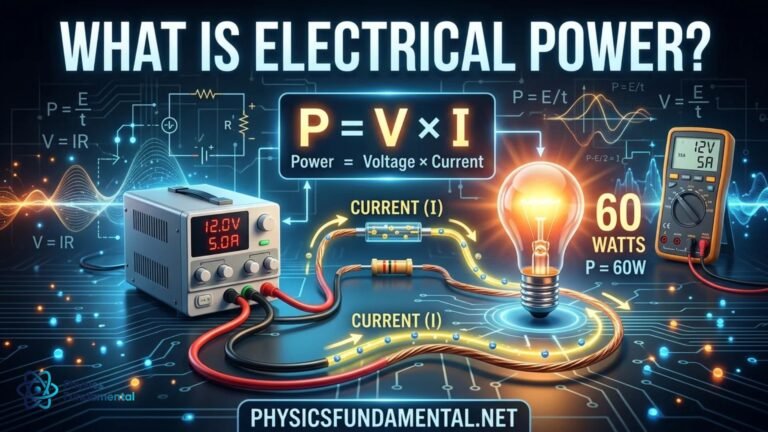
Electric current is also directly connected to electrical power.
The basic electrical power equation is:
P = VI
Where:
- P = power in watts
- V = voltage in volts
- I = current in amperes
Using Ohm’s law, other useful forms are:
P = I²R
and
P = V²/R
For example, a device operating at 120 V and drawing 2 A uses:
P = VI
P = 120 × 2 = 240 W
So its electrical power is 240 watts.
What Happens When a Switch Is Closed?
Imagine a simple circuit containing a battery, wires, a switch, and a lamp.
When the switch is open, the conducting path is broken and there is no continuous path for steady current through the complete circuit.
When the switch closes, an electric field is established throughout the circuit. The mobile charge carriers already present in the wires respond, allowing current to flow.
The electrons themselves move through the metal with a relatively small drift velocity, but the electromagnetic changes associated with the circuit propagate much more quickly.
This is why an electrical device can respond very soon after a circuit is completed.
Factors That Affect Electric Current
Several factors can influence the current in a circuit.
Voltage
For a fixed resistance, increasing voltage generally increases current according to:
I = V/R
Resistance
For a fixed voltage, increasing resistance reduces current.
I ∝ 1/R
Cross-Sectional Area
A larger conductor can accommodate a greater number of charge carriers across its cross-section. In the microscopic model:
I = nqAv_d
So increasing A, while other factors remain fixed, increases current.
Charge-Carrier Density
A material with more mobile charge carriers per unit volume can support greater current for the same carrier charge, area, and drift velocity.
Drift Velocity
For fixed carrier density, charge, and cross-sectional area, greater drift velocity corresponds to greater current.
Common Mistakes About Electric Current
Mistake 1: Thinking current is the same as charge
Charge and current are different quantities.
Charge is measured in coulombs, while current is the rate of charge flow and is measured in amperes.
Mistake 2: Forgetting the time in I = Q/t
Current cannot be calculated from charge alone.
You need to know how much charge passes through a point and how long it takes.
Mistake 3: Saying electrons move in the direction of conventional current
In metal wires, electrons drift opposite to conventional current.
Mistake 4: Assuming electrons travel extremely fast through the wire
The average drift velocity of electrons in ordinary conductors can be very small. The rapid electrical response of a circuit is associated with the electromagnetic field and propagation of electrical effects, not with individual electrons instantly traveling from the source to the device.
Mistake 5: Confusing voltage with current
Voltage is electric potential difference, while current is the rate of charge flow. They are related but represent different physical quantities.
Important Electric Current Formulas
Here is a quick summary of the most useful equations:
| Quantity | Formula |
|---|---|
| Average current | I = Q/t |
| Instantaneous current | I = dQ/dt |
| Charge | Q = It |
| Current from drift velocity | I = nqAv_d |
| Drift velocity | v_d = I/(nqA) |
| Current density | J = I/A |
| Microscopic current density | J = nqv_d |
| Ohm’s law | V = IR |
| Current using voltage and resistance | I = V/R |
| Electrical power | P = VI |
| Power using current | P = I²R |
| Power using voltage | P = V²/R |
Real-World Applications of Electric Current
Electric current is fundamental to modern technology.
It is used in:
- Household electrical systems
- Computers and smartphones
- Electric motors
- Generators
- Batteries
- Electric vehicles
- Telecommunication equipment
- Medical electronics
- Industrial machinery
- Semiconductor devices
- Lighting systems
- Power transmission networks
Understanding current also provides the foundation for studying resistance, capacitance, inductance, circuits, electromagnetism, and electronics.
Frequently Asked Questions
What Is Electric Current?
Electric current is the rate at which electric charge passes through a point in a circuit. It is measured in amperes.
What is the formula for electric current?
The basic formula is I = Q/t, where I is current, Q is charge, and t is time.
What is drift velocity?
Drift velocity is the average velocity acquired by charge carriers in a conductor because of an applied electric field.
What is the difference between current and drift velocity?
Current describes the overall rate of charge flow, while drift velocity describes the average directed motion of individual charge carriers.
Why do electrons move opposite to conventional current?
Electrons have negative charge, so their drift direction in a metal is opposite to the conventional direction defined for positive charge flow.
Conclusion
Electric current is one of the fundamental ideas in electricity. The simple equation I = Q/t shows that current is the rate at which electric charge passes through a point, while the microscopic equation I = nqAv_d explains how charge carriers produce that current.
In metal conductors, electrons move randomly and also acquire a small average drift velocity when an electric field is applied. Although this drift can be slow, electrical effects propagate through a circuit much more rapidly because the electromagnetic field establishes the response throughout the conducting system.
Understanding current, charge, drift velocity, current density, voltage, and resistance provides a strong foundation for studying electrical circuits and more advanced topics in physics and electronics.