What Is Capacitance? 7 Powerful C = Q/V Facts & Examples 2026
Have you ever wondered how a device can store electrical energy and release it when needed? A capacitor is one of the key components that makes this possible. It can store electric charge and energy, then release that stored energy into a circuit when required.
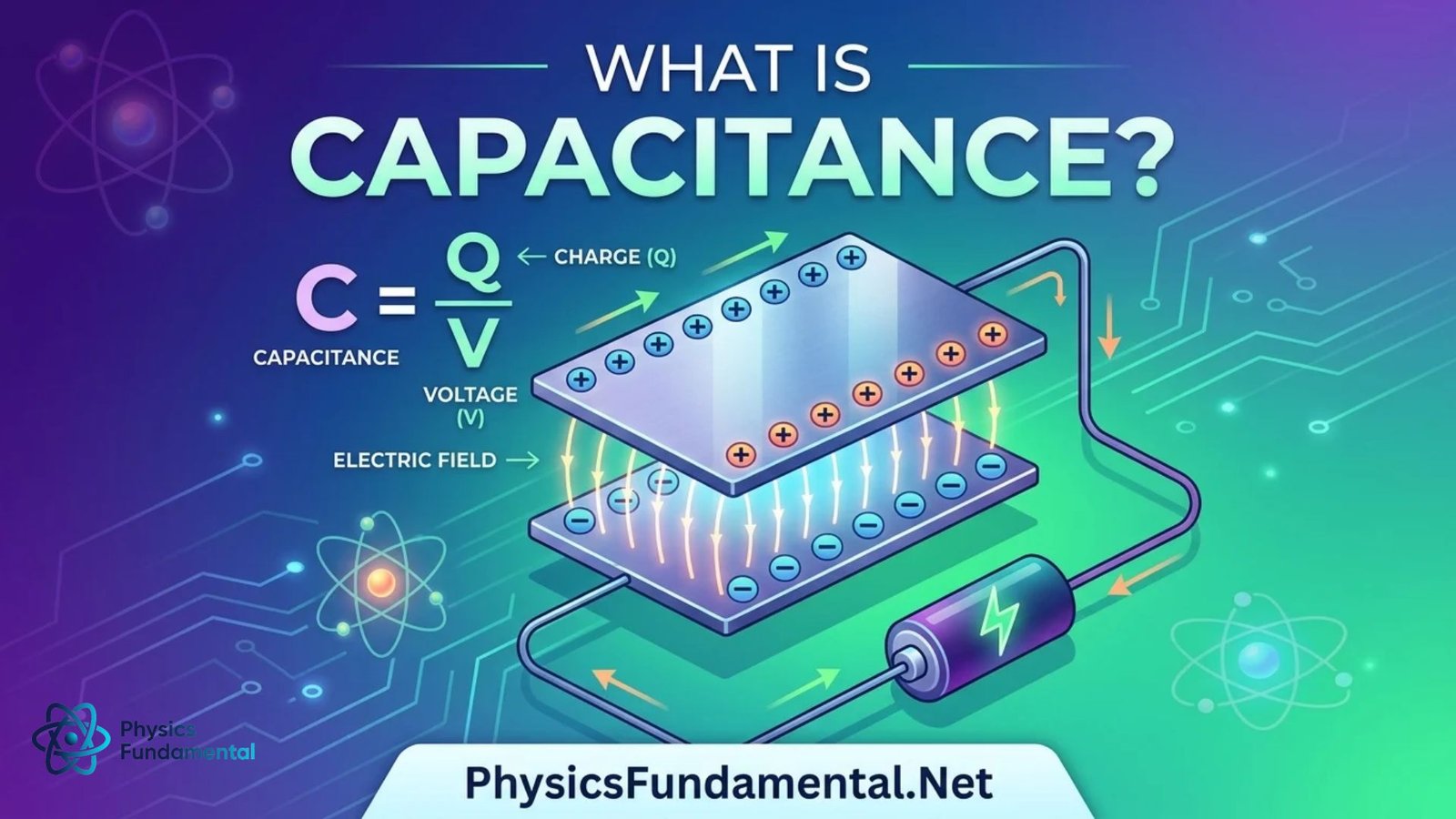
So, what is capacitance? Capacitance is the ability of a capacitor or electrical system to store electric charge for a given potential difference. The basic relationship is C = Q/V, which connects capacitance, charge, and voltage.
Capacitance is important in everything from camera flashes and power supplies to timing circuits, filters, sensors, and electronic devices. By understanding C = Q/V, capacitor energy storage, and the factors that affect capacitance, you can solve many common electricity and electronics problems.
What Is Capacitance?
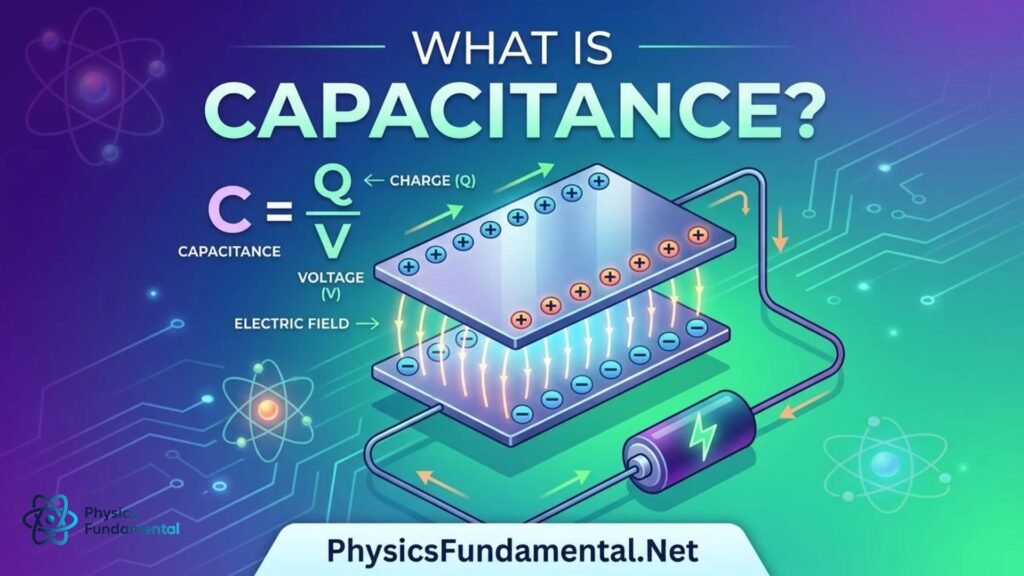
Capacitance measures how much electric charge a capacitor stores for each unit of potential difference across it.
The basic formula is:
C = Q/V
Where:
- C = capacitance
- Q = electric charge stored
- V = potential difference across the capacitor
The SI unit of capacitance is the farad (F).
One farad means that a capacitor stores one coulomb of charge when the potential difference across it is one volt:
1 F = 1 C/V
A farad is a relatively large unit for many practical electronic circuits, so capacitance is often expressed using smaller units.
Common units include:
- 1 millifarad (mF) = 10⁻³ F
- 1 microfarad (μF) = 10⁻⁶ F
- 1 nanofarad (nF) = 10⁻⁹ F
- 1 picofarad (pF) = 10⁻¹² F
What Is a Capacitor?
A capacitor is a device designed to store electrical energy in an electric field.
A simple capacitor consists of two conducting plates separated by an insulating material called a dielectric.
When connected to a voltage source, electrons are transferred from one plate to the other. One plate becomes relatively negative while the other becomes relatively positive.
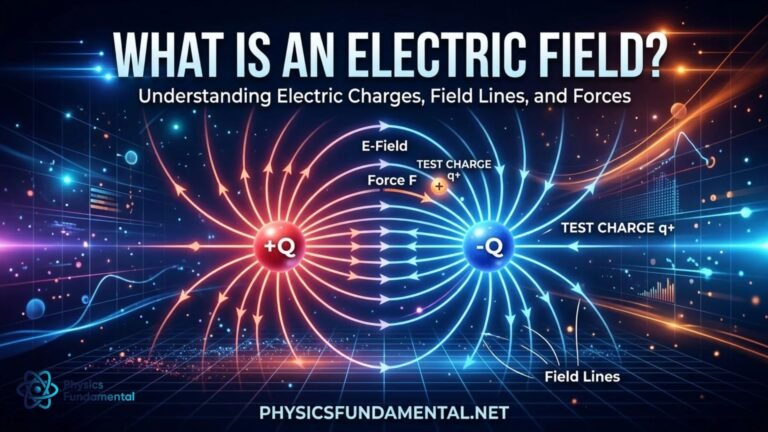
This separation of charge creates an electric field between the plates.
The capacitor therefore stores energy in the electric field rather than simply storing charge as an isolated quantity.
Understanding C = Q/V
The equation:
C = Q/V
can be rearranged into two other useful forms.
Finding Charge
Q = CV
If you know capacitance and voltage, multiply them to find the stored charge.
Finding Voltage
V = Q/C
If you know charge and capacitance, divide charge by capacitance to find voltage.
These relationships are useful for solving basic capacitor problems.
Worked Example 1: Calculate Capacitance
A capacitor stores 0.004 C of charge when connected across a 20 V potential difference. Find its capacitance.
Use:
C = Q/V
Substitute:
C = 0.004/20
C = 0.0002 F
Convert to microfarads:
0.0002 F = 200 μF
Answer
The capacitance is 200 μF.
Worked Example 2: Calculate Stored Charge
A 50 μF capacitor is connected to a 12 V source. How much charge does it store?
Use:
Q = CV
Convert capacitance:
50 μF = 50 × 10⁻⁶ F
Then:
Q = (50 × 10⁻⁶)(12)
Q = 600 × 10⁻⁶ C
Q = 6 × 10⁻⁴ C
Answer
The capacitor stores 0.0006 C, or 600 μC, of charge.
Worked Example 3: Calculate Voltage
A capacitor has a capacitance of 100 μF and stores 0.002 C of charge. What is the voltage across it?
Use:
V = Q/C
Convert capacitance:
100 μF = 100 × 10⁻⁶ F
Therefore:
V = 0.002/(100 × 10⁻⁶)
V = 20 V
Answer
The voltage across the capacitor is 20 V.
How Does a Capacitor Store Energy?
A capacitor stores energy in the electric field between its conductors.
When a capacitor is connected to a voltage source, work must be done to move additional charge onto one plate while removing charge from the other.
The energy stored is:
U = ½CV²
Where:
- U = stored electrical energy in joules
- C = capacitance in farads
- V = voltage in volts
This formula shows that stored energy increases with capacitance and with the square of voltage.
Because voltage is squared, doubling the voltage increases the stored energy by a factor of four if capacitance remains constant.
Other Capacitor Energy Formulas
Using:
Q = CV
the energy equation can also be written as:
U = ½QV
or:
U = Q²/(2C)
Therefore, the three useful forms are:
U = ½CV²
U = ½QV
U = Q²/(2C)
Choose the form that matches the information provided in the problem.
Worked Example 4: Calculate Energy Stored
A 100 μF capacitor is charged to 20 V. How much energy does it store?
Use:
U = ½CV²
Convert capacitance:
C = 100 × 10⁻⁶ F
Substitute:
U = ½(100 × 10⁻⁶)(20²)
U = ½(100 × 10⁻⁶)(400)
U = 0.02 J
Answer
The capacitor stores 0.02 J of electrical energy.
Factors Affecting Capacitance
For a simple parallel-plate capacitor, capacitance depends on the physical arrangement of the plates and the material between them.
The formula is:
C = εA/d
Where:
- C = capacitance
- ε = permittivity of the dielectric
- A = area of each plate
- d = separation between the plates
For a vacuum:
C = ε₀A/d
where ε₀ is the permittivity of free space.
If a dielectric material is inserted between the plates, the permittivity becomes:
ε = κ ε₀
where κ is the dielectric constant or relative permittivity.
Therefore:
C = κε₀A/d
Effect of Plate Area
From:
C = εA/d
capacitance is directly proportional to plate area.
If the plate area increases, capacitance increases.
For example, if the plate area is doubled while all other factors remain constant:
C’ = 2C
The capacitor can store twice as much charge at the same voltage.
Effect of Plate Separation
Capacitance is inversely proportional to the separation between the plates.
If the distance between the plates decreases, capacitance increases.
For example, if the separation is reduced by half:
C’ = 2C
assuming the dielectric and plate area remain unchanged.
This relationship is important in the design of practical capacitors.
Effect of a Dielectric
A dielectric is an insulating material placed between the conducting plates.
Examples include:
- Ceramic
- Plastic
- Glass
- Paper
- Mica
- Certain electrolytic materials
A dielectric increases capacitance because it changes the electric field and allows a greater amount of charge to be stored for a given voltage.
The basic relationship is:
C = κε₀A/d
A larger relative permittivity generally produces a larger capacitance for the same geometry.
The physics of capacitors and capacitance is closely connected to electric fields and energy storage.
Capacitors in Parallel
When capacitors are connected in parallel, their equivalent capacitance is the sum of their individual capacitances:
Cₑq = C₁ + C₂ + C₃ + …
Example
Suppose three capacitors have values:
- C₁ = 2 μF
- C₂ = 3 μF
- C₃ = 5 μF
Then:
Cₑq = 2 + 3 + 5
Cₑq = 10 μF
Answer
The equivalent capacitance is 10 μF.
Parallel capacitors effectively provide more plate area, increasing the total capacitance.
You May Like to Read: Alpha, Beta & Gamma Decay: 7 Powerful Facts About Half-Life 2026
Capacitors in Series
For capacitors connected in series:
1/Cₑq = 1/C₁ + 1/C₂ + 1/C₃ + …
For two capacitors:
Cₑq = C₁C₂/(C₁ + C₂)
Example
Two capacitors, 6 μF and 3 μF, are connected in series.
Use:
Cₑq = (6 × 3)/(6 + 3)
Cₑq = 18/9
Cₑq = 2 μF
Answer
The equivalent capacitance is 2 μF.
Notice that the equivalent capacitance of capacitors in series is smaller than the smallest individual capacitance.
Charge and Voltage in Capacitor Networks
The behavior of charge and voltage depends on how capacitors are connected.
Parallel Capacitors
In parallel:
V₁ = V₂ = V₃
The voltage across each capacitor is the same.
The total charge is:
Q_total = Q₁ + Q₂ + Q₃
Series Capacitors
In series, the magnitude of charge stored on each capacitor is the same in the ideal case:
Q₁ = Q₂ = Q₃
The total voltage is divided among the capacitors:
V_total = V₁ + V₂ + V₃
A capacitor with smaller capacitance generally has a larger voltage across it when series capacitors carry the same charge.
Capacitor Charging
When an uncharged capacitor is connected to a DC voltage source through a resistor, it does not normally charge instantaneously.
The voltage across the capacitor increases with time.
For an RC charging circuit:
V_C(t) = V₀(1 − e⁻ᵗ/ᴿᶜ)
Where:
- V_C(t) = capacitor voltage at time t
- V₀ = source voltage
- R = resistance
- C = capacitance
- t = time
The product:
τ = RC
is called the time constant.
After one time constant, the capacitor voltage reaches approximately 63.2% of its final value during charging.
Capacitor Discharging
When a charged capacitor is allowed to discharge through a resistor, its voltage decreases exponentially:
V_C(t) = V₀e⁻ᵗ/ᴿᶜ
After one time constant, the voltage falls to approximately 36.8% of its initial value.
The same time constant:
τ = RC
determines the characteristic speed of the charging or discharging process.
What Is the Difference Between Capacitance and Capacitor?
These two terms are related but not identical.
A capacitor is the physical electronic component.
Capacitance is the physical quantity that describes its ability to store charge per unit voltage.
For example, you might have a capacitor with a capacitance of:
100 μF
The component is the capacitor, while 100 μF is its capacitance.
Applications of Capacitors
Capacitors are used in many electrical and electronic systems.
Energy Storage
Capacitors can temporarily store and release electrical energy.
Filtering
They can reduce unwanted voltage variations in power supplies and electronic circuits.
Timing Circuits
Capacitors combined with resistors can create predictable charging and discharging times.
Signal Coupling
Capacitors can allow changing signals to pass while blocking steady DC components in suitable circuit configurations.
Motor Circuits
Certain capacitor configurations are used in AC motor applications.
Camera Flashes
A capacitor can accumulate electrical energy and release it rapidly to produce a bright flash.
Power Electronics
Capacitors are used for smoothing, filtering, decoupling, and energy management.
Common Mistakes When Solving Capacitance Problems
Forgetting Unit Conversion
A microfarad is not equal to one farad.
Remember:
1 μF = 10⁻⁶ F
Confusing Charge With Capacitance
Charge is measured in coulombs, while capacitance is measured in farads.
The relationship is:
Q = CV
Using the Wrong Energy Formula
If voltage and capacitance are known, use:
U = ½CV²
If charge and voltage are known, use:
U = ½QV
Forgetting That Voltage Is Squared
In:
U = ½CV²
voltage is squared.
Therefore, a small increase in voltage can produce a larger change in stored energy.
Mixing Up Series and Parallel Rules
For capacitors:
Parallel: Cₑq = C₁ + C₂ + …
Series: 1/Cₑq = 1/C₁ + 1/C₂ + …
These rules are opposite to the familiar rules for resistors.
Important Capacitance Formulas
| Quantity | Formula | Unit |
|---|---|---|
| Capacitance | C = Q/V | Farad (F) |
| Charge | Q = CV | Coulomb (C) |
| Voltage | V = Q/C | Volt (V) |
| Stored energy | U = ½CV² | Joule (J) |
| Stored energy | U = ½QV | Joule (J) |
| Stored energy | U = Q²/(2C) | Joule (J) |
| Parallel-plate capacitance | C = εA/d | Farad (F) |
| Parallel capacitors | Cₑq = C₁ + C₂ + … | Farad (F) |
| Series capacitors | 1/Cₑq = 1/C₁ + 1/C₂ + … | Farad (F) |
| RC time constant | τ = RC | Second (s) |
Frequently Asked Questions
What is capacitance?
Capacitance is the ability of a capacitor to store electric charge per unit potential difference. It is given by C = Q/V.
What is the SI unit of capacitance?
The SI unit is the farad (F). One farad equals one coulomb per volt.
How does a capacitor store energy?
A capacitor stores electrical energy in the electric field between its conducting plates.
What is the formula for energy stored in a capacitor?
The main formula is U = ½CV². Equivalent forms include U = ½QV and U = Q²/(2C).
What factors increase capacitance?
For a parallel-plate capacitor, increasing plate area, decreasing plate separation, or using a dielectric with greater relative permittivity increases capacitance.
Conclusion
What is capacitance? It is a measure of how much electric charge a capacitor can store for a given voltage. The fundamental relationship C = Q/V connects capacitance, charge, and potential difference, making it one of the most important formulas in basic electricity.
Capacitors store energy in electric fields, with the stored energy given by U = ½CV². Their capacitance depends on factors such as plate area, plate separation, and dielectric material. Capacitors can also be combined in series or parallel to obtain different equivalent capacitances.
From power supplies and filters to timing circuits and energy-storage systems, capacitance plays an important role throughout electrical engineering and modern electronics.