
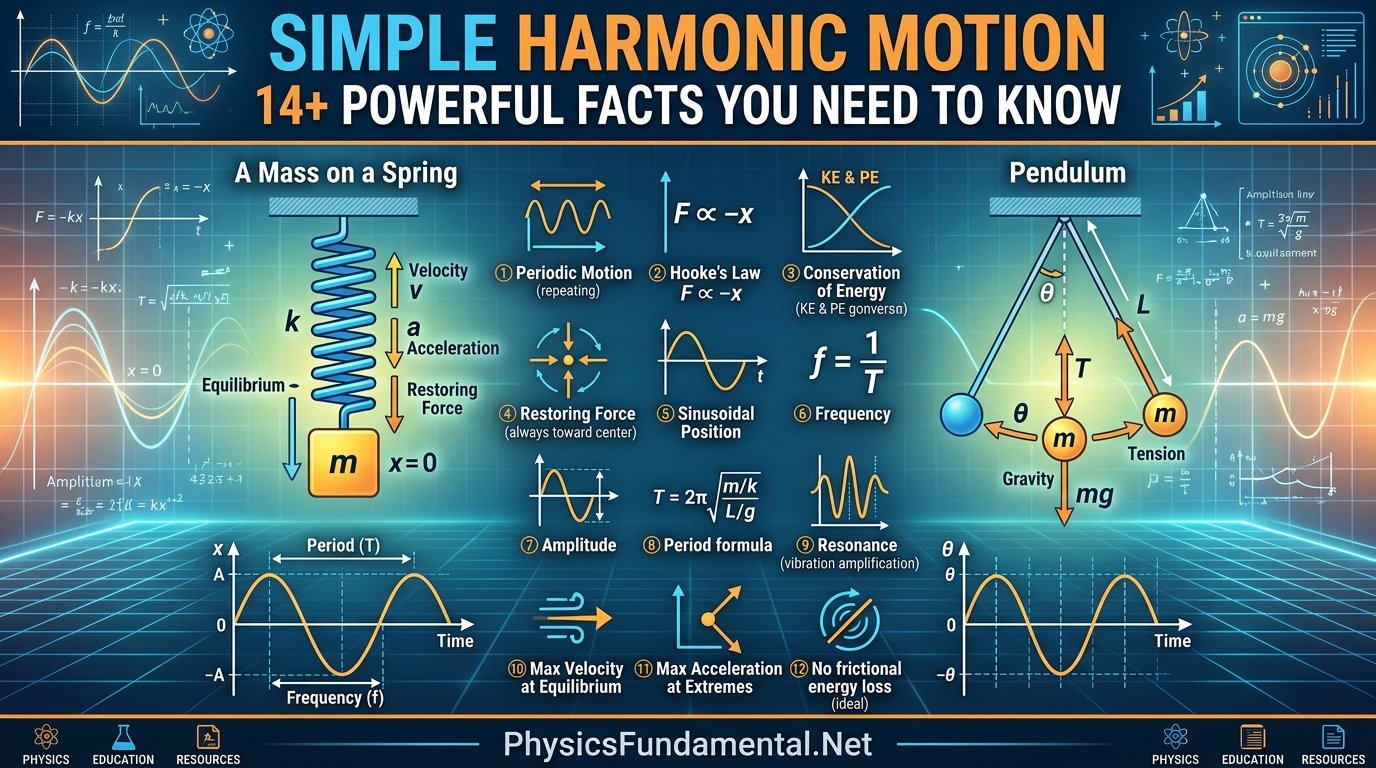
Have you ever watched a pendulum swing back and forth or seen a mass attached to a spring move repeatedly from one side to another? These are common examples of Simple Harmonic Motion, a type of periodic motion that appears throughout physics.
Simple harmonic motion occurs when an object moves repeatedly around an equilibrium position and experiences a restoring force that is proportional to its displacement from that position. The motion follows a predictable pattern, making it one of the most important models used to understand oscillations and waves.
A common equation used to describe this motion is:
x = A cos(ωt)
This equation tells us how the position of an oscillating object changes with time. By understanding amplitude, angular frequency, period, and phase, we can describe the motion mathematically and physically.
What Is Simple Harmonic Motion?
Simple Harmonic Motion is a special type of periodic motion in which the restoring force or acceleration is directly proportional to the displacement from the equilibrium position and directed toward that equilibrium position.
The basic condition for simple harmonic motion is:
F ∝ −x
Or:
F = −kx
Where:
- F = restoring force
- k = proportionality constant
- x = displacement from equilibrium
The negative sign indicates that the force acts in the direction opposite to the displacement.
If an object moves to the right of its equilibrium position, the restoring force acts toward the left. If it moves to the left, the restoring force acts toward the right.
Simple Harmonic Motion Formula
The position of an object undergoing simple harmonic motion can be written as:
x = A cos(ωt + φ)
For a simple case where the initial phase is zero:
x = A cos(ωt)
Where:
- x = displacement at time t
- A = amplitude
- ω = angular frequency
- t = time
- φ = phase constant
The equation allows us to determine the position of the object at any particular time.
For example, when t = 0 and the phase is zero:
x = A cos(0)
Since:
cos(0) = 1
we get:
x = A
This means the object starts at its maximum positive displacement.
What Is Amplitude?
Amplitude is the maximum displacement of an oscillating object from its equilibrium position.
It is represented by:
A
For example, if a spring moves 0.2 meters to either side of its equilibrium position, its amplitude is:
A = 0.2 m
Amplitude determines how far the object moves from its equilibrium position.
In ideal simple harmonic motion, changing the amplitude does not change the period or frequency of the motion for systems such as an ideal mass-spring oscillator.
What Is Angular Frequency?
Angular frequency describes how quickly the phase of an oscillation changes.
It is represented by:
ω
The relationship between angular frequency and frequency is:
ω = 2πf
Where:
- ω = angular frequency in rad/s
- f = frequency in Hz
Angular frequency can also be related to the period:
ω = 2π/T
Where T is the period.
A larger angular frequency means the object completes its oscillations more quickly.
What Is the Period?
The period is the amount of time required for an object to complete one complete cycle of motion.
It is represented by:
T
The relationship between period and frequency is:
T = 1/f
For simple harmonic motion, the period can also be related to angular frequency:
T = 2π/ω
For example, if an oscillator has a frequency of 2 Hz:
T = 1/2
T = 0.5 s
So, the oscillator completes one full cycle every 0.5 seconds.
You May Like to Read: Impulse and Momentum: 12+ Powerful Facts You Need to Know
What Is Frequency?
Frequency is the number of complete oscillations an object makes per unit of time.
It is represented by:
f
The SI unit of frequency is the hertz:
1 Hz = 1 cycle per second
Frequency and period are related by:
f = 1/T
If an object completes 5 oscillations every second, its frequency is:
f = 5 Hz
Its period is:
T = 1/5 = 0.2 s
How Does Simple Harmonic Motion Work?
To understand Simple Harmonic Motion, imagine a block attached to a spring on a frictionless surface.
When the block is pulled away from its equilibrium position and released, the spring produces a restoring force.
The restoring force is described by Hooke’s law:
F = −kx
As the block moves toward equilibrium, the restoring force pulls it back.
When the block reaches equilibrium, its displacement is zero, but its speed is at its maximum.
The block continues moving past equilibrium because of its inertia. The spring then pulls it back toward the opposite side.
This process repeats continuously, producing simple harmonic motion.
Simple Harmonic Motion and Restoring Force
The restoring force is one of the most important features of simple harmonic motion.
For simple harmonic motion:
F = −kx
The force is proportional to displacement.
If the displacement doubles, the magnitude of the restoring force also doubles.
The negative sign shows that the force always acts toward the equilibrium position.
This restoring force is what causes the object to oscillate instead of continuing indefinitely in one direction.
Acceleration in Simple Harmonic Motion
Since Newton’s second law states:
F = ma
and the restoring force is:
F = −kx
we can write:
ma = −kx
Therefore:
a = −(k/m)x
This shows that acceleration is directly proportional to displacement and points in the opposite direction.
The general condition for simple harmonic motion can therefore be written as:
a = −ω²x
This equation is fundamental to the mathematical description of simple harmonic motion.
Velocity in Simple Harmonic Motion
The velocity of an object undergoing simple harmonic motion changes continuously throughout its cycle.
If:
x = A cos(ωt)
then the velocity is obtained by differentiating the position with respect to time:
v = −Aω sin(ωt)
The velocity is zero at the extreme positions because the object momentarily stops before reversing direction.
The velocity is greatest when the object passes through its equilibrium position.
The maximum velocity is:
vₘₐₓ = Aω
Therefore, increasing either the amplitude or angular frequency increases the maximum speed of the oscillator.
Acceleration in Simple Harmonic Motion
The acceleration can be found by differentiating the velocity:
v = −Aω sin(ωt)
This gives:
a = −Aω² cos(ωt)
Since:
x = A cos(ωt)
we can also write:
a = −ω²x
This equation shows that acceleration is greatest at the extreme positions and zero at the equilibrium position.
At maximum positive displacement, acceleration is directed toward the negative direction.
At maximum negative displacement, acceleration is directed toward the positive direction.
Position, Velocity, and Acceleration
An object in simple harmonic motion has different values of position, velocity, and acceleration throughout its cycle.
At maximum displacement:
- Position is maximum
- Velocity is zero
- Acceleration is maximum toward equilibrium
At equilibrium:
- Position is zero
- Velocity is maximum
- Acceleration is zero
This relationship helps explain why the object continuously moves back and forth.
Energy in Simple Harmonic Motion
Energy continuously changes between kinetic and potential forms during simple harmonic motion.
At the extreme positions, the object’s velocity is zero. Therefore, its kinetic energy is zero, while its potential energy is maximum.
At the equilibrium position, the object’s speed is maximum. Therefore, its kinetic energy is maximum, while its spring potential energy is minimum.
For an ideal oscillator with no friction, the total mechanical energy remains constant.
For a spring system:
E = 1/2 kA²
Where:
- E = total mechanical energy
- k = spring constant
- A = amplitude
The energy moves between kinetic and potential energy as the object oscillates.
You May Like to Read: B = μ₀I/2πr — The Magnetic Field Around a Current-Carrying Wire
Simple Harmonic Motion of a Spring
A mass attached to an ideal spring is one of the most common examples of simple harmonic motion.
The restoring force follows:
F = −kx
Using Newton’s second law:
ma = −kx
The angular frequency is:
ω = √(k/m)
The period is:
T = 2π√(m/k)
This tells us that a stiffer spring, with a larger value of k, produces faster oscillations.
A larger mass produces slower oscillations and therefore a longer period.
Simple Harmonic Motion of a Pendulum
A simple pendulum can also perform approximately simple harmonic motion when its angular displacement is small.
The period of a simple pendulum is:
T = 2π√(L/g)
Where:
- T = period
- L = length of the pendulum
- g = acceleration due to gravity
For small oscillations, the period does not depend significantly on the mass of the pendulum bob.
The simple pendulum is an important example because it demonstrates how periodic motion can arise from a restoring effect.
For larger angles, the motion is not exactly simple harmonic, and the small-angle approximation becomes less accurate.
Examples of Simple Harmonic Motion
Several physical systems can exhibit simple harmonic motion under appropriate conditions.
Common examples include:
- A mass attached to an ideal spring
- A simple pendulum at small angles
- Vibrations of certain mechanical systems
- Molecular vibrations
- Certain electrical oscillations
Many real systems are more complicated than the ideal simple harmonic model, but simple harmonic motion provides a useful approximation for understanding their behavior.
Graph of Simple Harmonic Motion
The position of an object undergoing simple harmonic motion follows a sinusoidal pattern.
For:
x = A cos(ωt)
the position starts at +A when time is zero if the phase is zero.
As time increases, the position decreases toward zero, reaches −A, returns to zero, and eventually reaches +A again.
One complete cycle consists of:
+A → 0 → −A → 0 → +A
This repeating pattern is characteristic of harmonic oscillations.
Simple Harmonic Motion and Circular Motion
There is a useful connection between simple harmonic motion and uniform circular motion.
Imagine a point moving around a circle at constant angular speed. If you look at the point’s projection onto one diameter of the circle, that projection moves back and forth in simple harmonic motion.
This provides a geometric way to understand why sine and cosine functions appear in the equations of simple harmonic motion.
The position can be represented as:
x = A cos(ωt)
while the corresponding motion in the perpendicular direction can involve a sine function.
Phase in Simple Harmonic Motion
Phase describes the position of an oscillator within its cycle.
The more general equation is:
x = A cos(ωt + φ)
Here, φ is the phase constant.
Different values of the phase constant mean that the oscillator starts its motion at different points in its cycle.
For example, if:
φ = 0
the object begins at maximum positive displacement.
If the phase is different, the object may begin at the equilibrium position or somewhere between equilibrium and maximum displacement.
You May Like to Read: 10+ Powerful Friction Force Explained Formulas & Examples
Simple Harmonic Motion Example
Suppose an object performs simple harmonic motion with:
A = 0.5 m
and:
ω = 4 rad/s
Its position is:
x = 0.5 cos(4t)
At t = 0:
x = 0.5 cos(0)
x = 0.5 m
At a later time, the cosine function determines the object’s position.
The maximum velocity is:
vₘₐₓ = Aω
vₘₐₓ = 0.5 × 4
vₘₐₓ = 2 m/s
So, the object’s maximum speed is 2 m/s.
The maximum acceleration is:
aₘₐₓ = Aω²
aₘₐₓ = 0.5 × 4²
aₘₐₓ = 8 m/s²
This example shows how amplitude and angular frequency determine important properties of the motion.
Why Is Simple Harmonic Motion Important?
Simple harmonic motion is important because it provides one of the simplest mathematical models for periodic motion.
Many complicated oscillating systems can behave approximately like simple harmonic oscillators when the displacement is small.
The concepts developed through simple harmonic motion are also useful when studying:
- Waves
- Sound
- Vibrations
- Mechanical systems
- Electrical circuits
- Quantum physics
Understanding harmonic motion therefore provides a foundation for many other areas of physics.
Frequently Asked Questions
What is Simple Harmonic Motion?
Simple Harmonic Motion is periodic motion in which the restoring force or acceleration is proportional to displacement and directed toward the equilibrium position.
What is the formula for Simple Harmonic Motion?
A common position equation is x = A cos(ωt + φ). When the phase constant is zero, it becomes x = A cos(ωt).
What happens to velocity at maximum displacement?
The velocity becomes zero at the maximum displacement because the object momentarily stops before changing direction.
Where is velocity maximum in Simple Harmonic Motion?
Velocity is maximum when the object passes through its equilibrium position.
What is the difference between amplitude and frequency?
Amplitude is the maximum displacement from equilibrium, while frequency is the number of complete oscillations made per second.
Conclusion
Simple Harmonic Motion is one of the most important models for understanding oscillations in physics. It describes periodic motion in which the restoring force is proportional to displacement and directed toward the equilibrium position.
The equation:
x = A cos(ωt)
describes the position of an oscillator as it changes with time under a particular starting condition. Other important relationships include a = −ω²x, vₘₐₓ = Aω, and T = 2π/ω.
From springs and pendulums to vibrations and waves, simple harmonic motion provides a powerful way to understand repeating motion. Once you understand amplitude, period, frequency, angular frequency, velocity, and acceleration, the behavior of an ideal oscillator becomes much easier to analyze.