
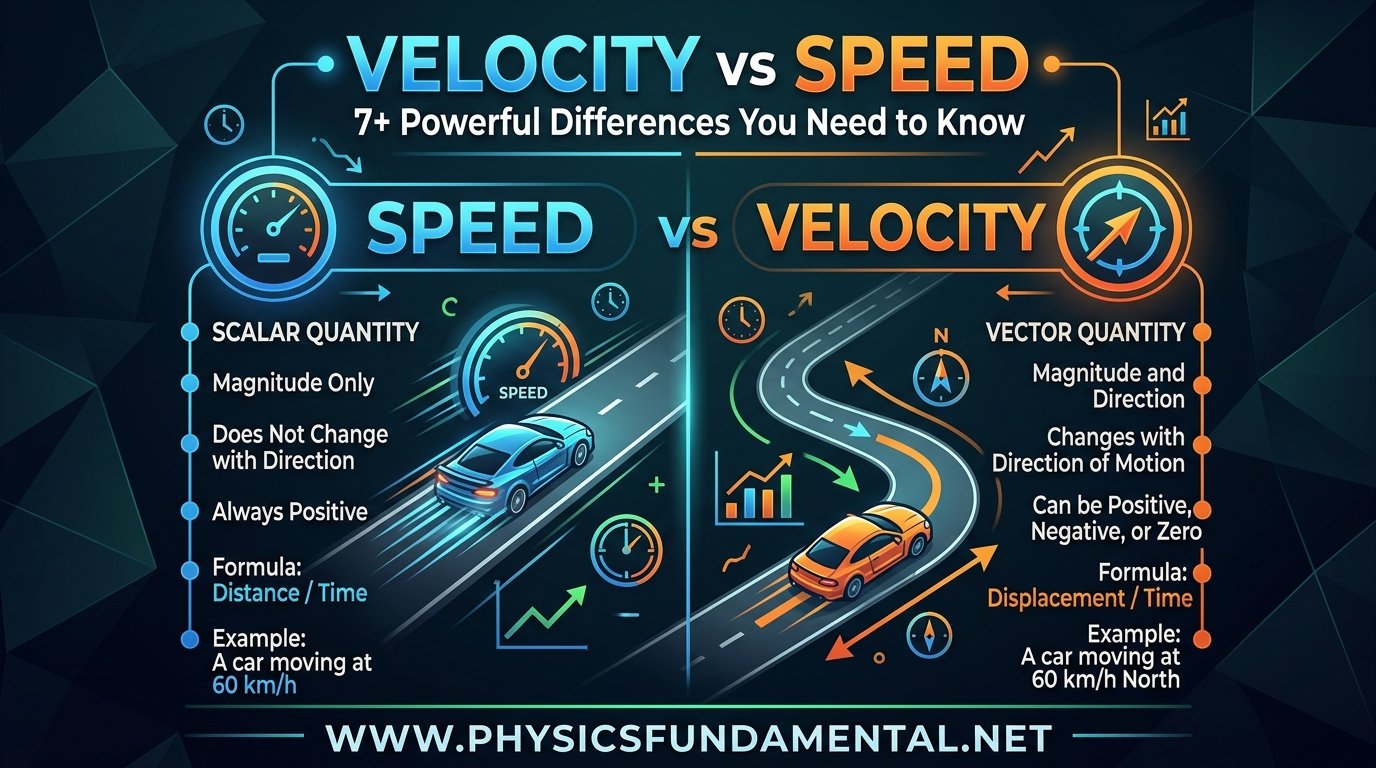
Have you ever wondered why velocity and speed are treated as two different concepts when both seem to describe how fast something is moving? The difference is simple but important: speed tells you how quickly an object moves, while velocity tells you how quickly it moves in a particular direction.
Both speed and velocity are fundamental concepts in physics and are commonly used to describe motion. Although they are closely related, they are not interchangeable. Speed is a scalar quantity, while velocity is a vector quantity, which means velocity includes both magnitude and direction.
Understanding velocity vs speed becomes much easier when you look at their formulas, units, examples, and real-life applications. In this article, we will explain the difference clearly and show how to calculate each one.
What Is Speed?
Speed is the rate at which an object covers distance. In simple terms, it tells us how fast something is moving without considering the direction in which it moves.
For example, if a car travels 100 kilometers in 2 hours, its average speed is 50 kilometers per hour.
The formula for speed is:
Speed = Distance ÷ Time
Mathematically:
v = d/t
Where:
- v = speed
- d = distance traveled
- t = time taken
Speed only tells us the magnitude of motion. It does not tell us whether the object is moving north, south, east, west, or in any other direction.
Example of Speed
Suppose a cyclist travels 30 kilometers in 2 hours.
Using the speed formula:
Speed = Distance ÷ Time
Speed = 30 km ÷ 2 h
Speed = 15 km/h
Therefore, the cyclist’s average speed is 15 km/h.
The direction of the cyclist does not matter when calculating speed.
What Is Velocity?
Velocity is the rate at which an object’s displacement changes with time. Unlike speed, velocity includes both the magnitude of motion and its direction.
The formula for average velocity is:
Velocity = Displacement ÷ Time
Mathematically:
v = Δx/Δt
Where:
- v = average velocity
- Δx = displacement
- Δt = change in time
Because velocity includes direction, it is a vector quantity.
For example, saying that a car is traveling at 60 km/h north gives information about its velocity. The value tells us the magnitude, while “north” provides the direction.
Example of Velocity
Imagine a person walks 100 meters east in 20 seconds.
The average velocity is:
Velocity = Displacement ÷ Time
Velocity = 100 m ÷ 20 s
Velocity = 5 m/s east
So, the person’s average velocity is 5 m/s east.
The direction is essential because velocity depends on displacement rather than simply the total distance traveled.
Velocity vs Speed: What Is the Main Difference?
The main difference between velocity and speed is that speed measures distance traveled per unit of time, while velocity measures displacement per unit of time in a specific direction.
Speed is a scalar quantity, so it has magnitude only. Velocity is a vector quantity, so it has both magnitude and direction.
For example, if a car travels at 80 km/h, you know its speed. If you say the car travels at 80 km/h toward the west, you are describing its velocity.
This distinction becomes especially important when an object changes direction.
You May Like to Read: Gaming PlayMyWorld 2026: 7+ Powerful Pros & Risky Cons
Speed Is a Scalar Quantity
Speed is classified as a scalar quantity because it has magnitude but no direction.
Other examples of scalar quantities include:
- Distance
- Time
- Mass
- Temperature
- Energy
If someone says a runner is moving at 10 m/s, this describes the runner’s speed. There is no directional information included.
The speed can remain the same even when the direction of motion changes.
Velocity Is a Vector Quantity
Velocity is a vector quantity because it has both magnitude and direction.
Other examples of vector quantities include:
- Displacement
- Acceleration
- Force
- Momentum
If a car is moving at 70 km/h north, its velocity is 70 km/h north.
If the car turns around and moves at 70 km/h south, its speed may remain 70 km/h, but its velocity has changed because its direction has changed.
Difference Between Distance and Displacement
To fully understand velocity vs speed, you also need to understand the difference between distance and displacement.
Distance is the total path traveled by an object. It does not consider direction.
Displacement is the shortest straight-line change from an object’s initial position to its final position and includes direction.
For example, imagine walking 5 meters east and then 5 meters west.
The total distance traveled is:
5 m + 5 m = 10 m
But your final position is the same as your starting position, so your displacement is:
0 m
This creates an important difference:
Distance → used to calculate speed
Displacement → used to calculate velocity
Velocity vs Speed Formula
The formulas for speed and velocity look similar, but they use different measurements.
The formula for speed is:
Speed = Distance ÷ Time
The formula for average velocity is:
Velocity = Displacement ÷ Time
The important difference is distance versus displacement.
If you know the total path traveled, you can calculate average speed. If you know the object’s change in position and direction, you can calculate average velocity.
Average Speed
Average speed is calculated by dividing the total distance traveled by the total time taken.
The formula is:
Average Speed = Total Distance ÷ Total Time
For example, suppose a car travels 200 kilometers in 4 hours.
Average Speed = 200 km ÷ 4 h
Average Speed = 50 km/h
The car’s average speed is therefore 50 km/h.
Average speed does not require the car to travel at a constant rate throughout the journey.
Average Velocity
Average velocity is calculated using total displacement and total time.
The formula is:
Average Velocity = Total Displacement ÷ Total Time
Suppose a person walks 100 meters east and then returns 40 meters west.
The person’s displacement is:
100 m east − 40 m west = 60 m east
If the entire trip takes 20 seconds:
Average Velocity = 60 m ÷ 20 s
Average Velocity = 3 m/s east
Therefore, the average velocity is 3 m/s east.
Notice that the total distance traveled is 140 meters, but the displacement is only 60 meters.
Instantaneous Speed
Instantaneous speed is the speed of an object at a particular moment.
For example, when you look at the speedometer of a car, the number displayed represents the car’s instantaneous speed at that moment.
A car may have an instantaneous speed of 40 km/h at one moment and 70 km/h a few seconds later.
Instantaneous speed can change continuously as an object accelerates or slows down.
You May Like to Read: Hypackle: What It Is, Hypackel Games, Safety & Complete Guide
Instantaneous Velocity
Instantaneous velocity is the velocity of an object at a particular moment, including its direction.
For motion along a straight line, instantaneous velocity can be described using the object’s speed and direction at that exact moment.
For example, a train moving at 90 km/h toward the north has an instantaneous velocity of 90 km/h north at that moment.
If the train changes direction, its velocity changes even if its speed remains constant.
Can Speed Be Negative?
In basic physics, speed cannot be negative.
Speed describes how much distance an object covers per unit of time, and distance is not negative.
Therefore, speed is always:
Speed ≥ 0
For example, an object can have a speed of 20 m/s, but saying that its speed is −20 m/s is generally not meaningful.
Direction is handled separately in velocity.
Can Velocity Be Negative?
Yes. Velocity can be positive, negative, or zero depending on the chosen coordinate system and direction.
For example, suppose east is defined as the positive direction.
An object moving east at 10 m/s can have:
Velocity = +10 m/s
An object moving west at 10 m/s can have:
Velocity = −10 m/s
The negative sign does not mean the object is moving “slower.” It indicates that the object is moving in the opposite direction from the positive direction that was chosen.
When Are Speed and Velocity Equal?
Speed and velocity can have the same numerical value when an object moves in a straight line without changing direction.
For example, suppose a car travels straight north at 60 km/h.
Its speed is:
60 km/h
Its velocity is:
60 km/h north
The magnitude of the velocity is equal to the speed.
However, the quantities are still conceptually different because velocity includes direction.
When Are Speed and Velocity Different?
Speed and velocity become different in important ways when an object changes direction.
Consider a runner completing one full lap around a circular track and returning to the starting point.
The runner has traveled a certain distance, so the average speed is greater than zero.
However, the runner’s final position is the same as the starting position. Therefore, the total displacement is zero.
So:
Average speed > 0
Average velocity = 0
This is one of the clearest examples of the difference between speed and velocity.
You May Like to Read: Skibidi Meaning 2026: 10+ Powerful Facts You Need to Know
Example of Velocity vs Speed in Circular Motion
Imagine a car driving around a circular track at a constant speed of 50 km/h.
The car’s speed can remain constant throughout the trip.
However, its velocity changes continuously because the direction of motion is constantly changing.
At one point, the car may be moving north. A few seconds later, it may be moving east. Later, it may be moving south.
Therefore:
Constant speed does not necessarily mean constant velocity.
This is an important concept in physics.
Units of Speed and Velocity
Speed and velocity have the same basic SI unit because both represent a distance or displacement divided by time.
The SI unit for both is:
meter per second (m/s)
Other commonly used units include:
- kilometers per hour (km/h)
- miles per hour (mph)
- centimeters per second (cm/s)
For example:
36 km/h = 10 m/s
To convert kilometers per hour into meters per second, multiply by 5/18.
To convert meters per second into kilometers per hour, multiply by 18/5.
Velocity vs Speed in Everyday Life
The difference between velocity and speed appears in many everyday situations.
When a car’s dashboard shows 80 km/h, it is generally displaying the car’s speed.
If you describe the same car as moving at 80 km/h toward the east, you are describing its velocity.
Navigation systems also rely heavily on directional information. Knowing only how fast a vehicle is moving is not enough to determine its exact motion.
Frequently Asked Questions
What is the main difference between velocity and speed?
Speed measures distance traveled per unit of time, while velocity measures displacement per unit of time and includes direction.
Is velocity a scalar or vector quantity?
Velocity is a vector quantity because it has both magnitude and direction.
Is speed always positive?
Speed is normally zero or positive because it measures the rate of covering distance and does not include direction.
Can velocity be zero while speed is not zero?
Yes. An object can travel a distance and return to its starting point, giving it zero average velocity while its average speed remains greater than zero.
Do speed and velocity have the same units?
Yes. Both speed and velocity have the SI unit of meters per second (m/s).
Conclusion
Understanding velocity vs speed is essential for studying motion in physics. Although both describe how an object moves, they use different ideas. Speed tells us how quickly an object covers distance, while velocity tells us how quickly its position changes in a particular direction.
Speed is a scalar quantity and has magnitude only. Velocity is a vector quantity and has both magnitude and direction. This is why an object can maintain a constant speed while its velocity changes, such as when moving around a circular track.
The easiest way to remember the difference is simple: speed uses distance, while velocity uses displacement and direction. Once you understand this distinction, many problems involving motion, acceleration, and displacement become much easier to solve.