Vectors and Scalars Explained: Powerful Differences, Examples & Rules 2026
Physics uses quantities to describe everything from motion and forces to energy and temperature. Some quantities need only a numerical value, while others also require a direction. This is the key difference between Vectors and Scalars.
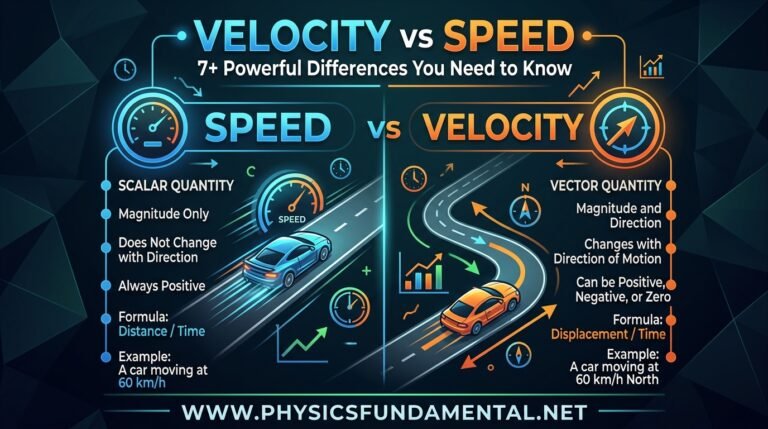
A scalar has magnitude only, while a vector has both magnitude and direction. Speed is a scalar, for example, while velocity is a vector. Similarly, distance is scalar, whereas displacement is vector.
Understanding the difference between vectors and scalars is essential because many physics problems involve adding vectors, resolving them into components, or finding their magnitude and direction.
What Are Scalars?
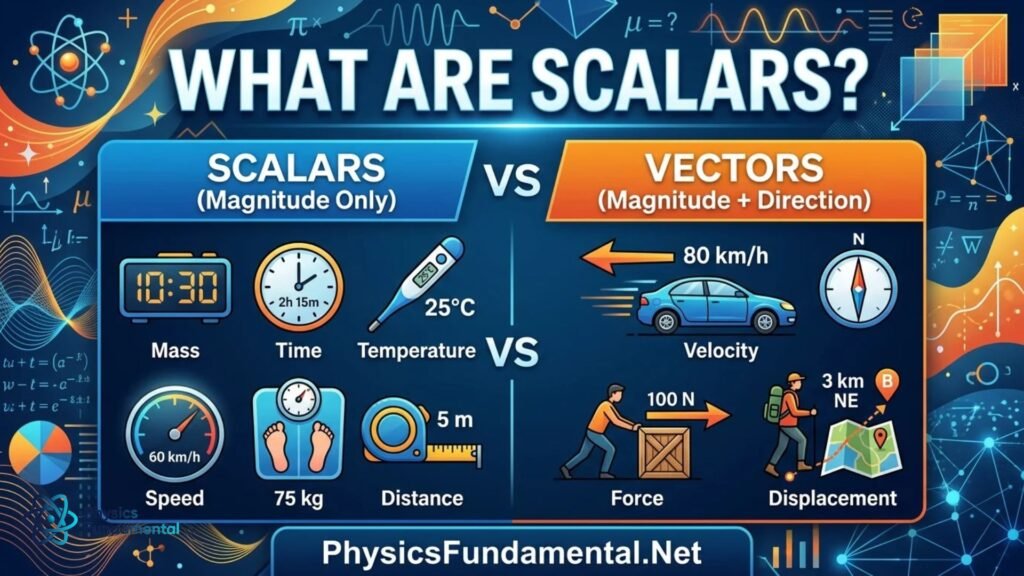
A scalar is a physical quantity described completely by its magnitude and unit.
Scalars do not have a direction.
Examples include:
- Mass
- Time
- Temperature
- Distance
- Speed
- Energy
- Work
- Power
- Volume
- Density
For example, saying that an object has a mass of 5 kg completely describes its mass.
Similarly, a temperature of 25°C does not require a direction.
What Are Vectors?
A vector is a physical quantity that has both magnitude and direction.
Examples include:
- Displacement
- Velocity
- Acceleration
- Force
- Momentum
- Electric field
- Gravitational field
For example:
20 m/s east
contains both:
- Magnitude = 20 m/s
- Direction = east
The direction is essential because changing it changes the vector.
Vectors and scalars in physics
Vectors and Scalars: The Main Difference
The simplest distinction is:
Scalar = magnitude only
Vector = magnitude + direction
Consider these examples:
| Quantity | Type | Example |
|---|---|---|
| Mass | Scalar | 5 kg |
| Time | Scalar | 10 s |
| Temperature | Scalar | 30°C |
| Speed | Scalar | 20 m/s |
| Energy | Scalar | 500 J |
| Displacement | Vector | 20 m east |
| Velocity | Vector | 20 m/s east |
| Force | Vector | 50 N upward |
| Acceleration | Vector | 9.8 m/s² downward |
| Momentum | Vector | 10 kg·m/s west |
Scalar Examples
Mass
Mass measures the amount of matter in an object.
For example:
m = 10 kg
It does not have a direction.
Time
Time is scalar.
For example:
t = 30 s
There is no direction associated with the quantity itself.
Temperature
Temperature is also scalar.
For example:
T = 25°C
Speed
Speed tells us how quickly an object moves but does not specify its direction.
For example:
60 km/h
is a scalar.
Energy
Energy is a scalar quantity.
For example:
E = 500 J
Energy has magnitude but no direction.
Vector Examples
Displacement
Displacement describes the change in position from one point to another and includes direction.
For example:
10 m north
Velocity
Velocity is speed with a specified direction.
For example:
15 m/s west
Force
A force has both magnitude and direction.
For example:
40 N upward
Acceleration
Acceleration describes the rate of change of velocity and has a direction.
For example:
9.8 m/s² downward
Momentum
Momentum is given by:
p = mv
Because velocity is a vector, momentum is also a vector.
Distance vs Displacement
This is one of the most important scalar-versus-vector comparisons.
Distance is scalar.
Displacement is vector.
Suppose a person walks 5 m east and then 5 m west.
Total distance:
5 + 5 = 10 m
But the final position is the same as the starting position.
Therefore:
Displacement = 0 m
So:
Distance = 10 m
Displacement = 0 m
This example demonstrates why distance and displacement should not be treated as the same quantity.
Speed vs Velocity
Speed is scalar, while velocity is vector.
Suppose a car travels at:
80 km/h
Its speed is:
80 km/h
But if it travels north:
Velocity = 80 km/h north
The magnitude may be identical, but velocity additionally specifies direction.
How Are Vectors Represented?
Vectors are often represented using arrows.
The:
- Length of the arrow represents magnitude.
- Arrowhead represents direction.
For example:
A -------------------->

The arrow points to the right.
Its length represents the magnitude.
A longer arrow can represent a larger vector if the same scale is being used.
Vectors can also be written using bold symbols or arrow notation:
A
or:
A⃗
Vector Magnitude
The magnitude of a vector is its size.
For a vector:
A = (Aₓ, Aᵧ)
its magnitude is:
|A| = √(Aₓ² + Aᵧ²)
This comes from the Pythagorean theorem.
Example
Suppose:
Aₓ = 3 m
and:
Aᵧ = 4 m
Then:
|A| = √(3² + 4²)
|A| = √25
|A| = 5 m
The vector has a magnitude of 5 m.
Vector Addition
Vectors cannot always be added in the same way as ordinary scalar quantities because direction matters.
If two vectors point in the same direction, their magnitudes can be added directly.
For example:
5 N east + 3 N east = 8 N east
But if they point in opposite directions:
5 N east + 3 N west = 2 N east
The directions must therefore be considered.
Adding Vectors in the Same Direction
Suppose two forces act toward the right:
F₁ = 10 N
F₂ = 15 N
The resultant is:
F_R = F₁ + F₂
F_R = 10 + 15
F_R = 25 N
So the resultant force is:
25 N to the right
Adding Opposite Vectors
Suppose:
F₁ = 20 N east
and:
F₂ = 8 N west
Choose east as positive.
Then:
F₁ = +20 N
F₂ = −8 N
Therefore:
F_R = 20 − 8
F_R = 12 N
The resultant is:
12 N east
You May Like to Read: De Broglie Wavelength Explained: Powerful λ = h/mv Formula & Facts 2026
Vector Addition Using Components
For two-dimensional vectors, it is often easier to break each vector into horizontal and vertical components.
Suppose:
A = (Aₓ, Aᵧ)
and:
B = (Bₓ, Bᵧ)
Then their resultant is:
R = A + B
with:
Rₓ = Aₓ + Bₓ
and:
Rᵧ = Aᵧ + Bᵧ
The magnitude is:
R = √(Rₓ² + Rᵧ²)
Worked Example: Adding Two Perpendicular Vectors
Suppose one vector is:
A = 3 m east
and another is:
B = 4 m north
These vectors are perpendicular.
The resultant magnitude is:
R = √(3² + 4²)
R = 5 m
To find the direction:
θ = tan⁻¹(4/3)
Therefore:
θ ≈ 53.1°
So the resultant is approximately:
5 m at 53.1° north of east
The Triangle Method of Vector Addition
Vectors can also be added graphically.
Place the tail of the second vector at the head of the first vector.
Then draw the resultant from the tail of the first vector to the head of the second.
This is called the head-to-tail method.
A -------->

           \
            \
             \ B
              \
               ↓

Resultant runs from the starting point to the final point.
The exact diagram depends on the directions of the vectors.
The Parallelogram Method
Another graphical method is the parallelogram method.
Place two vectors so that they begin at the same point.
Complete the parallelogram.
The diagonal from the common starting point represents the resultant vector.
This method is particularly useful for visualizing the addition of two vectors at an angle.
Vector Subtraction
Vector subtraction can be treated as vector addition with the opposite vector.
For example:
A − B = A + (−B)
The vector −B has the same magnitude as B but points in the opposite direction.
If:
B = 5 N east
then:
−B = 5 N west
Therefore:
A − B = A + (−B)
Scalar Addition
Scalar quantities are simpler because direction is not involved.
For example:
5 kg + 3 kg = 8 kg
Similarly:
10 s + 5 s = 15 s
There is no need to account for orientation or direction.
Can Scalars Be Negative?
Yes.
A scalar can have a negative value when the quantity’s definition or chosen reference makes that appropriate.
For example, temperature can be:
−10°C
Potential energy can also be negative depending on the chosen reference level.
The important point is that having a negative value does not automatically make a quantity a vector.
Direction is what distinguishes vectors from scalars.
Can Vectors Be Negative?
Yes.
A negative vector component indicates direction relative to the chosen coordinate system.
For example:
vₓ = −10 m/s
could mean that the velocity points in the negative x-direction.
The negative sign is not itself the complete description of direction; it depends on how the coordinate system has been defined.
Vector Components
A vector can be resolved into perpendicular components.
For a vector of magnitude A making an angle θ with the positive x-axis:
Aₓ = A cosθ
Aᵧ = A sinθ
The original vector can then be reconstructed from these components.
Its magnitude is:
A = √(Aₓ² + Aᵧ²)
and its direction is:
θ = tan⁻¹(Aᵧ/Aₓ)
The correct quadrant must be considered when determining the angle.
Why Vector Components Are Useful
Breaking a vector into components makes complicated problems easier.
For example, a force acting at an angle can be divided into:
- Horizontal force
- Vertical force
This approach is widely used in:
- Projectile motion
- Forces and equilibrium
- Circular motion
- Electricity and magnetism
- Engineering
- Mechanics
Vectors in Projectile Motion
Projectile motion provides a useful example of vector analysis.
An initial velocity can be separated into horizontal and vertical components:
uₓ = u cosθ
uᵧ = u sinθ
Ignoring air resistance:
Horizontal acceleration = 0
Vertical acceleration = −g
The horizontal and vertical components can then be analyzed independently.
This is why vectors are essential for understanding projectile motion.
Vectors in Forces
Forces are vectors because their effects depend on both magnitude and direction.
Suppose two people push a box in the same direction.
If:
F₁ = 50 N
and:
F₂ = 30 N
then:
F_R = 80 N
But if they push in opposite directions:
F_R = 50 − 30
F_R = 20 N
The direction of the resultant is toward the larger force.
Resultant Vector
The resultant vector is the single vector that has the same overall effect as two or more vectors acting together.
For vectors:
A
and:
B
the resultant is:
R = A + B
Finding the resultant is one of the most important applications of vector addition.
Zero Vector
A zero vector has zero magnitude.
It can result when two equal vectors point in opposite directions.
For example:
5 N east + 5 N west = 0 N
The resultant is the zero vector.
The zero vector has no defined direction in the usual sense because its magnitude is zero.
Scalar and Vector Quantities in Physics
Some common quantities can be classified as follows:
Scalars
- Mass
- Time
- Temperature
- Distance
- Speed
- Energy
- Work
- Power
- Volume
- Density
- Electric charge
Vectors
- Displacement
- Velocity
- Acceleration
- Force
- Momentum
- Electric field
- Gravitational field
Knowing this classification helps determine which mathematical methods are appropriate.
Common Mistakes With Vectors and Scalars
Mistake 1: Saying Speed Is a Vector
Speed has magnitude only, so it is scalar.
Velocity is the vector quantity.
Mistake 2: Treating Distance and Displacement as the Same
Distance measures total path length. Displacement describes the change in position and has direction.
Mistake 3: Adding Vector Magnitudes Without Considering Direction
Two vectors cannot always be added by simply adding their numerical values.
Mistake 4: Forgetting Components
For vectors at an angle, resolving them into perpendicular components often makes the calculation much easier.
Mistake 5: Assuming Negative Means Vector
Scalars can also be negative. Directional behavior, not simply the presence of a minus sign, determines whether a physical quantity is a vector.
Vectors and Scalars Formula Summary
Important vector equations include:
A = √(Aₓ² + Aᵧ²)
Aₓ = A cosθ
Aᵧ = A sinθ
Rₓ = Aₓ + Bₓ
Rᵧ = Aᵧ + Bᵧ
R = √(Rₓ² + Rᵧ²)
θ = tan⁻¹(Rᵧ/Rₓ)
For vector subtraction:
A − B = A + (−B)
These relationships form the basis of many vector calculations in physics.
Frequently Asked Questions
What is the difference between a vector and a scalar?
A scalar has magnitude only, while a vector has both magnitude and direction.
Is speed a vector or scalar?
Speed is a scalar because it describes how fast something moves without specifying direction.
Is velocity a vector?
Yes. Velocity has both magnitude and direction, making it a vector quantity.
How do you add vectors?
Vectors can be added graphically using the head-to-tail or parallelogram method, or mathematically by adding their components.
Is distance a scalar or vector?
Distance is a scalar because it describes the total path length without direction. Displacement is the corresponding vector quantity.
Conclusion
Understanding Vectors and Scalars is fundamental to physics. Scalars such as mass, time, temperature, speed, and energy require only magnitude, while vectors such as displacement, velocity, acceleration, force, and momentum require both magnitude and direction.
Vector addition becomes especially important when multiple forces, velocities, or displacements act at different angles. By resolving vectors into components, calculating their resultant, and determining the final magnitude and direction, complicated problems can be reduced to manageable steps.
Once the distinction between scalar and vector quantities becomes familiar, many areas of physics—including mechanics, projectile motion, forces, and electromagnetism—become much easier to analyze.