Electric Field and Potential — Formulas and Worked Examples 2026
Electric charges can influence objects around them without physically touching them. A charged particle can push or pull another charge from a distance, and this interaction is described using two important concepts in electrostatics: electric field and electric potential.
The electric field describes the force that a charge would experience at a particular location, while electric potential describes the electric potential energy available per unit charge at that location. Although the two quantities are closely related, they are not the same. Electric field is a vector, while electric potential is a scalar.
Understanding electric field and potential is essential for studying capacitors, circuits, charged particles, electric forces, and many other topics in physics. Their formulas also provide a powerful way to solve problems involving point charges and electric energy.
What Is an Electric Field?

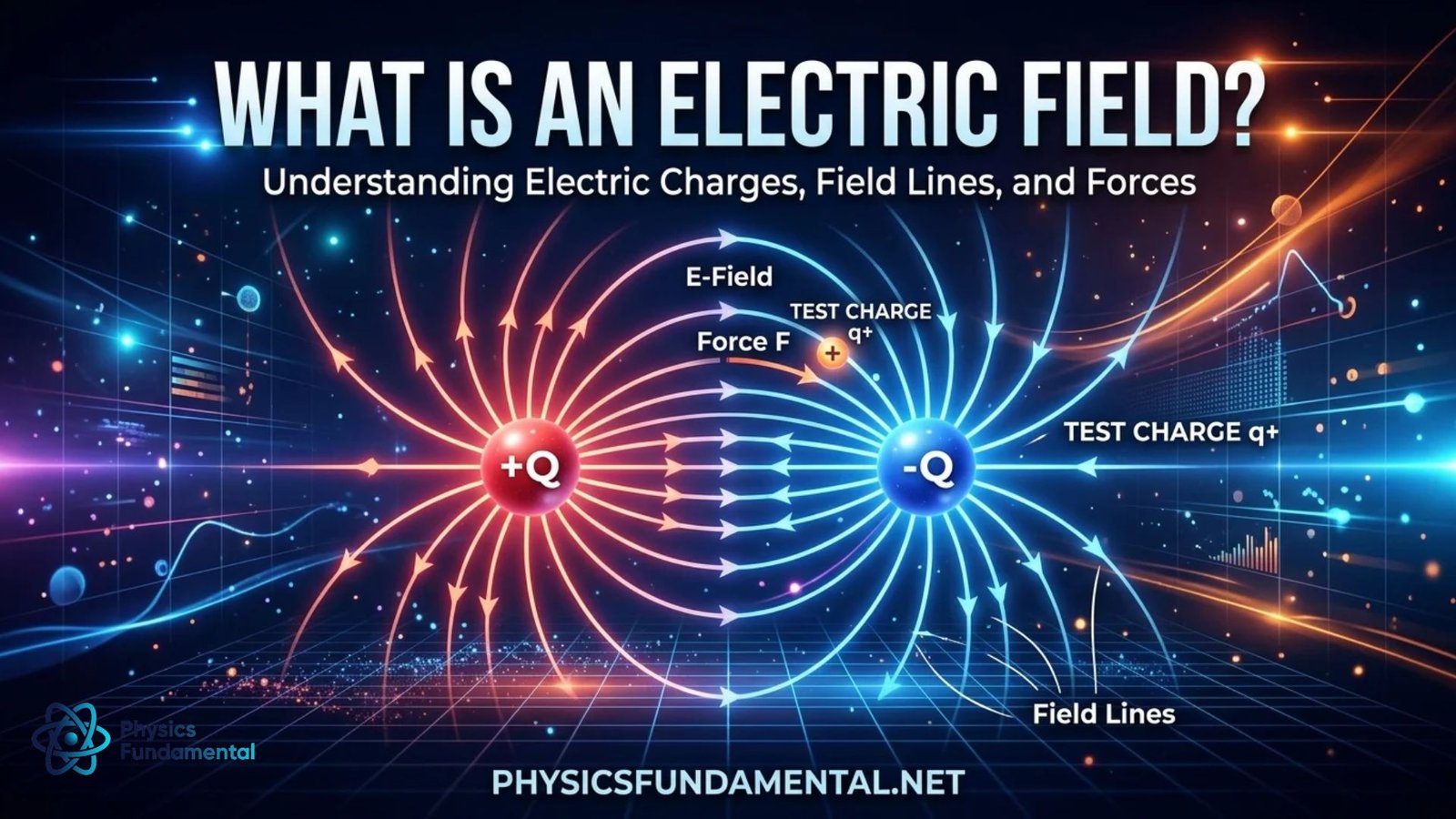
An electric field is a region around an electric charge where another charged object would experience an electric force.
The electric field at a point is defined as the electric force per unit positive test charge:
E = F/q
where:
- E = electric field
- F = electric force
- q = test charge
The SI unit of electric field is newton per coulomb (N/C).
It can also be expressed in volts per meter:
1 N/C = 1 V/m
The electric field allows us to describe the influence of a source charge without having to place another charge at every point to measure the force.
Electric Field Due to a Point Charge
For a point charge Q, the magnitude of the electric field at a distance r is:
E = kQ/r²
where:
- E = electric field strength
- Q = source charge
- r = distance from the charge
- k = Coulomb’s constant
The value of Coulomb’s constant is approximately:
k = 8.99 × 10⁹ N·m²/C²
The electric field gets weaker as the distance from the charge increases.
Because the distance is squared, doubling the distance reduces the electric field to one-fourth of its original value.
Direction of an Electric Field
The direction of an electric field is defined as the direction of the force on a positive test charge.
For a positive source charge:
Electric field points away from the charge.
For a negative source charge:
Electric field points toward the charge.
Electric field lines are commonly used to visualize the field.
Some important rules for electric field lines are:
- They point away from positive charges.
- They point toward negative charges.
- The closer the lines are together, the stronger the field is represented.
- Electric field lines never cross.
- The field direction at a point is tangent to the field line at that point.
What Is Electric Potential?
Electric potential is the electric potential energy per unit charge at a particular point.
It is defined as:
V = U/q
where:
- V = electric potential
- U = electric potential energy
- q = charge
The SI unit of electric potential is the volt (V).
One volt is equal to one joule per coulomb:
1 V = 1 J/C
Electric potential is a scalar quantity, meaning it has magnitude but no direction.
This makes electric potential especially useful when dealing with several charges because scalar quantities can be added algebraically.
Electric Potential Due to a Point Charge
For a point charge Q, the electric potential at a distance r is:
V = kQ/r
where:
- V = electric potential
- k = Coulomb’s constant
- Q = source charge
- r = distance from the charge
Unlike electric field, electric potential varies with 1/r, not 1/r².
This difference is important when solving electrostatic problems.
Electric Potential Energy
Electric potential and electric potential energy are closely related.
For a charge q placed at a location with electric potential V:
U = qV
where:
- U = electric potential energy
- q = charge
- V = electric potential
For two point charges, the electric potential energy is:
U = kQq/r
Here, Q is the source charge and q is the charge being placed in its electric field.
Electric Field vs Electric Potential
Electric field and electric potential describe related aspects of an electric environment, but they have important differences.
| Property | Electric Field | Electric Potential |
|---|---|---|
| Symbol | E | V |
| Meaning | Force per unit charge | Energy per unit charge |
| Type | Vector | Scalar |
| SI unit | N/C or V/m | Volt |
| Point-charge formula | E = kQ/r² | V = kQ/r |
| Depends on direction? | Yes | No |
A useful way to remember the difference is:
Electric field tells you about force.
Electric potential tells you about energy per unit charge.
Relationship Between Electric Field and Potential
Electric field and electric potential are directly related.
In a one-dimensional situation:
E = −ΔV/Δx
More generally, the electric field is related to the negative gradient of electric potential:
E = −∇V
The negative sign is important. It means the electric field points in the direction in which electric potential decreases most rapidly.
For a uniform electric field:
ΔV = −Ed
when the displacement is along the direction of the field.
The potential difference between two points can therefore be used to determine the work associated with moving a charge.
Why Is There a Negative Sign?
The negative sign in the electric field-potential relationship indicates that the electric field points from higher electric potential toward lower electric potential.
For example, if a positive charge moves naturally in the direction of the electric field, its electric potential energy decreases.
The electric field does positive work on the charge during such a displacement.
This relationship between electric field and potential is an important part of electrostatics and electric potential.
Worked Example 1: Electric Field of a Point Charge
A point charge of 2 × 10⁻⁶ C is located in empty space. Find the electric field at a point 0.5 m away.
Use:
E = kQ/r²
Substitute:
E = (8.99 × 10⁹)(2 × 10⁻⁶)/(0.5)²
Since:
(0.5)² = 0.25
we get:
E ≈ 7.19 × 10⁴ N/C
Therefore, the electric field has a magnitude of approximately:
7.2 × 10⁴ N/C
Because the source charge is positive, the field points away from the charge.
Worked Example 2: Electric Potential of a Point Charge
A point charge of 3 × 10⁻⁶ C produces an electric potential at a distance of 2 m. Find the potential.
Use:
V = kQ/r
Substitute:
V = (8.99 × 10⁹)(3 × 10⁻⁶)/2
V ≈ 1.35 × 10⁴ V
Therefore:
V ≈ 13,485 V
The potential is positive because the source charge is positive, assuming the reference potential at infinity is zero.
Worked Example 3: Electric Potential Energy
A charge of 2 × 10⁻⁶ C is placed at a point where the electric potential is 500 V. Find its electric potential energy.
Use:
U = qV
Substitute:
U = (2 × 10⁻⁶)(500)
U = 1 × 10⁻³ J
Therefore:
U = 0.001 J
Worked Example 4: Potential Difference in a Uniform Electric Field
A uniform electric field has a magnitude of 200 N/C. Two points are separated by 0.5 m along the direction of the field. Find the potential difference.
Use:
ΔV = −Ed
Substitute:
ΔV = −(200)(0.5)
ΔV = −100 V
The potential decreases by 100 V when moving in the direction of the electric field.
You May Like to Read: Mechanical Energy Explained: 7 Powerful KE + PE Facts & Examples 2026
Electric Potential From Multiple Charges
When several point charges are present, the total electric potential is found by adding the individual potentials.
Because electric potential is a scalar:
Vₜₒₜₐₗ = V₁ + V₂ + V₃ + …
For several point charges:
Vₜₒₜₐₗ = k(Q₁/r₁ + Q₂/r₂ + Q₃/r₃ + …)
Positive and negative charges contribute positive and negative potential values, respectively.
This is often easier than calculating the electric field because electric fields must be added as vectors.
Electric Field From Multiple Charges
Electric fields also obey the principle of superposition.
The total electric field is the vector sum of the individual fields:
Eₜₒₜₐₗ = E₁ + E₂ + E₃ + …
Because electric field has both magnitude and direction, the direction of each individual field must be considered.
For charges arranged along a straight line, you can choose a positive direction and assign signs to the individual field contributions.
For charges arranged in two or three dimensions, vector components may be needed.
Equipotential Surfaces
An equipotential surface is a region where the electric potential is the same at every point.
Moving a charge along an equipotential surface requires no net work by the electric field because:
ΔV = 0
and therefore:
W = qΔV = 0
Electric field lines are always perpendicular to equipotential surfaces.
Equipotential surfaces are useful for visualizing electric potential around charged objects.
For a single isolated point charge, equipotential surfaces form concentric spheres centered on the charge.
Work Done and Electric Potential
Electric potential difference is closely related to work.
The relationship is:
ΔV = ΔU/q
Since electric potential energy changes when a charge moves, the work done by the electric field can be expressed as:
Wₑ = −ΔU
Therefore:
Wₑ = −qΔV
If a positive charge moves from higher potential to lower potential, the electric field does positive work on the charge.
Electric Field Inside a Conductor
In electrostatic equilibrium, the electric field inside an ideal conductor is zero.
This happens because free charges within the conductor redistribute themselves until the internal electric field is canceled.
Some important properties of a conductor in electrostatic equilibrium are:
- Electric field inside the conducting material is zero.
- Excess charge resides on the conductor’s surface.
- The electric field just outside the surface is perpendicular to the surface.
- The conductor is an equipotential region.
These properties are important in electrostatic shielding and many electrical applications.
Electric Field and Potential of a Charged Sphere
For a conducting spherical object, the electric field outside the sphere behaves like the field of a point charge located at its center.
Outside the sphere:
E = kQ/r²
and:
V = kQ/r
Inside an ideal conducting sphere in electrostatic equilibrium:
E = 0
The electric potential inside remains constant and is equal to the potential at the surface.
Electric Field Between Parallel Plates
Two large, oppositely charged parallel plates can produce an approximately uniform electric field between them.
For a uniform field:
E = V/d
where:
- E = electric field strength
- V = potential difference
- d = separation between the plates
Rearranging:
V = Ed
This approximation is particularly useful when studying capacitors.
The electric field between sufficiently large parallel plates is approximately constant except near the edges.
Electric Potential and Voltage
The terms electric potential and voltage are closely related but can be used in slightly different contexts.
Electric potential describes the potential at a particular location relative to a reference.
Voltage usually refers to the difference in electric potential between two points.
For example, a battery may provide a potential difference of 9 V between its terminals.
This means that the potential difference between the two terminals is 9 joules per coulomb.
Common Applications
Electric field and potential concepts are used in many areas of science and technology.
Capacitors
Capacitors store electrical energy using separated charges and an electric field.
The relationship between charge and potential difference is:
Q = CV
where:
- Q = charge
- C = capacitance
- V = potential difference
Particle Accelerators
Charged particles can gain kinetic energy when they move through a potential difference.
The energy change is related to:
ΔU = qΔV
Charged particles can therefore be accelerated using carefully controlled electric fields.
Electrostatic Precipitators
These devices use electric fields to remove particles from gases.
They can be used in industrial systems to reduce particulate emissions.
Inkjet Printers
Electric fields can help control charged ink droplets in certain printing technologies.
Sensors and Electronic Devices
Electric fields and potential differences are fundamental to the operation of many electronic components and sensors.
Common Mistakes
Confusing electric field with electric potential
Electric field measures force per unit charge, while electric potential measures energy per unit charge.
Forgetting the square in the electric field formula
For a point charge:
E = kQ/r²
The distance must be squared.
For electric potential:
V = kQ/r
The distance is not squared.
Ignoring direction for electric field
Electric field is a vector, so direction matters.
Electric potential is scalar, so its values can be added algebraically.
Using the wrong charge
When calculating the electric field produced by a source charge, use the source charge Q.
When calculating force on a test charge, the test charge is also relevant:
F = qE
Forgetting units
Electric field is commonly measured in N/C or V/m.
Electric potential is measured in volts.
Electric potential energy is measured in joules.
Key Formulas
Here are the most important formulas to remember:
Electric field definition:
E = F/q
Electric field of a point charge:
E = kQ/r²
Electric potential:
V = U/q
Electric potential of a point charge:
V = kQ/r
Electric potential energy:
U = qV
Potential energy of two point charges:
U = kQq/r
Electric field-potential relationship:
E = −ΔV/Δx
Uniform electric field:
E = V/d
These equations form the foundation for many electrostatics problems.
Frequently Asked Questions
What is an electric field?
An electric field is a region where a charged object experiences an electric force. It is defined as force per unit positive test charge.
What is electric potential?
Electric potential is electric potential energy per unit charge. It is measured in volts and is a scalar quantity.
What is the difference between electric field and electric potential?
Electric field describes force per unit charge and has direction, while electric potential describes energy per unit charge and has no direction.
What is the formula for electric field?
For a point charge, the electric field is E = kQ/r², where Q is the source charge and r is the distance from it.
What is the formula for electric potential?
For a point charge, electric potential is V = kQ/r. It represents the potential energy per unit charge at that location.
Conclusion
Electric field and electric potential are two fundamental concepts used to describe the effects of electric charges. The electric field tells us how much force a charge would experience at a particular point, while electric potential tells us how much electric potential energy exists per unit charge.
For a point charge, the key formulas are E = kQ/r² for electric field and V = kQ/r for electric potential. Their different dependence on distance is an important feature to remember. Electric field is a vector quantity, while electric potential is a scalar, making potential calculations especially convenient for systems containing multiple charges.
These concepts provide the foundation for understanding capacitors, voltage, electric forces, particle acceleration, electrostatic shielding, and many electronic technologies. Once the relationship between electric field, potential, force, and energy is clear, many electrostatics problems become much easier to analyze.