
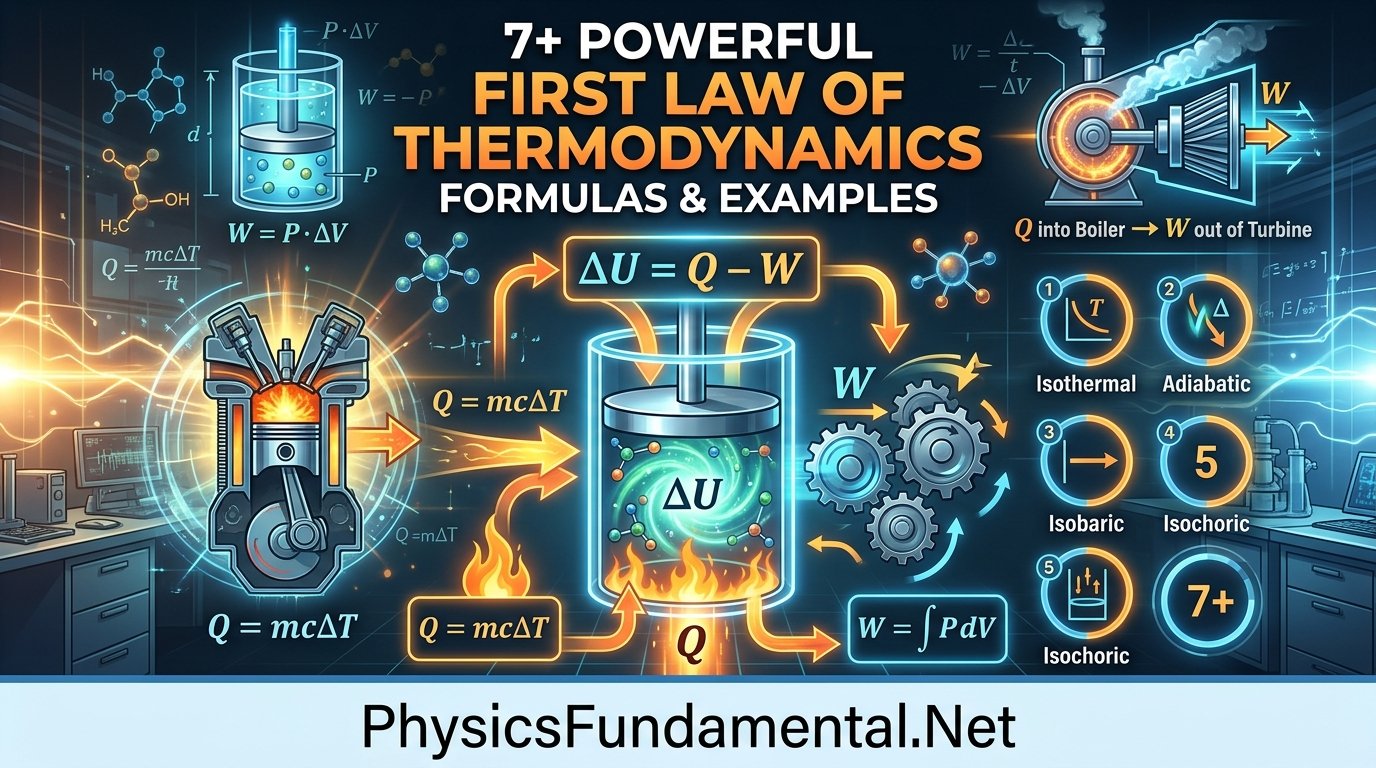
The First Law of Thermodynamics is one of the most important principles in physics because it explains how energy is transferred and transformed in a system. From engines and refrigerators to gases, heat, and everyday machines, this law helps us understand what happens when energy enters or leaves a physical system.
At its simplest, the First Law of Thermodynamics says that energy cannot be created or destroyed. It can only be transferred from one form to another or moved from one system to another. When heat is supplied to a system, that energy can increase the system’s internal energy, cause the system to do work, or both.
This idea is known as the law of conservation of energy applied to thermodynamic systems. It provides a simple mathematical relationship between heat, work, and internal energy.
In this article, we will explain the First Law of Thermodynamics in simple terms, explore its formula, understand the sign convention, and look at important processes such as isochoric, isobaric, isothermal, and adiabatic changes. We will also solve examples and discuss common applications of the law.
What Is the First Law of Thermodynamics?
The First Law of Thermodynamics states that the change in the internal energy of a system is equal to the heat supplied to the system minus the work done by the system.
The standard equation is:
where:
- is the change in internal energy.
- is the heat added to the system.
- is the work done by the system.
This equation is based on the conservation of energy.
For example, imagine heating a gas inside a cylinder with a movable piston. Some of the heat supplied to the gas may increase the energy of its molecules, while some of the energy may be used to push the piston upward.
Therefore, the heat supplied does not necessarily remain completely inside the gas.
First Law of Thermodynamics Formula
The most commonly used formula is:
This can also be written as:
Both equations express the same energy relationship.
The first form emphasizes the change in internal energy, while the second form emphasizes where the supplied heat goes.
If the system receives heat and does work, the added heat is divided between increasing internal energy and performing work.
Understanding Internal Energy
Internal energy is the total microscopic energy contained within a system.
It includes the energy associated with the random motion and interactions of the particles making up the system.
For an ideal gas, internal energy depends mainly on temperature. When the temperature of an ideal gas increases, its internal energy generally increases. When the temperature decreases, its internal energy generally decreases.
Internal energy is represented by:
and its change is:
where is the final internal energy and is the initial internal energy.
An important point is that internal energy is a state function. This means its change depends only on the initial and final states, not on the particular path taken between them.
You May Like to Read: Hypackle: What It Is, Hypackel Games, Safety & Complete Guide
Understanding Heat
Heat is energy transferred between systems because of a temperature difference.
It is represented by:
When heat enters a system:
When heat leaves a system:
Heat is not something that a system simply “contains.” Instead, it is energy transferred because of a temperature difference.
For example, when a hot object is placed in contact with a colder object, thermal energy flows from the hotter object to the colder one.
Understanding Work in Thermodynamics
In thermodynamics, work often occurs when a gas expands or contracts.
For a gas expanding against an external pressure, the work done by the gas can be written as:
For constant pressure, this becomes:
where:
If the gas expands, , so the work done by the gas is positive under the convention used in:
If the gas is compressed, , meaning work is done on the gas.
Sign Convention of the First Law
Understanding signs is one of the most important parts of using the First Law of Thermodynamics correctly.
Using the convention:
we have:
Heat Added to the System
If heat enters the system:
Heat Removed from the System
If heat leaves the system:
Work Done by the System
If the system does work on its surroundings:
Work Done on the System
If the surroundings do work on the system, the work done by the system is negative:
The most important thing is to use one sign convention consistently throughout a problem.
Simple Example of the First Law of Thermodynamics
Suppose 500 J of heat is supplied to a gas, and the gas does 200 J of work on its surroundings.
Using:
we get:
Therefore, the internal energy of the gas increases by 300 J.
The other 200 J of energy has been transferred to the surroundings as work.
You May Like to Read: 7+ Powerful Nuclear Binding Energy Formulas & Examples
Another Example
Suppose a system receives 800 J of heat while 300 J of work is done on the system.
Using the convention that represents work done by the system, the work done on the system means:
Therefore:
So the internal energy increases by 1100 J.
This example shows why the sign of work must be handled carefully.
First Law of Thermodynamics for Different Processes
The First Law of Thermodynamics applies to every thermodynamic process, but the relationship between heat, work, and internal energy changes depending on the conditions.
Some of the most important processes are:
- Isochoric process
- Isobaric process
- Isothermal process
- Adiabatic process
Understanding how the First Law behaves in each process makes thermodynamics much easier.
Isochoric Process
An isochoric process occurs at constant volume.
Since the volume does not change:
Therefore, the work done by the system is:
The First Law becomes:
This means all the heat supplied to the system changes its internal energy.
For an ideal gas, supplying heat at constant volume increases the temperature and therefore increases the internal energy.
Isobaric Process
An isobaric process occurs at constant pressure.
In this case, the gas may expand or contract while pressure remains constant.
The work is:
The First Law is:
Therefore:
Some of the supplied heat increases the internal energy, while the rest is used to perform expansion work.
Isothermal Process
An isothermal process occurs at constant temperature.
For an ideal gas, internal energy depends only on temperature. Therefore, when temperature remains constant:
The First Law becomes:
So:
This means that heat supplied to the gas is converted entirely into work, under the ideal-gas isothermal model.
Similarly, if the gas is compressed isothermally, work is done on the gas and heat must leave the system to maintain constant temperature.
You May Like to Read: Naro0326: Shocking Facts, Benefits & Risks in 2026
Adiabatic Process
An adiabatic process occurs when no heat enters or leaves the system.
Therefore:
The First Law becomes:
This means that if the gas does positive work during adiabatic expansion, its internal energy decreases.
For an ideal gas, this usually causes its temperature to fall.
During adiabatic compression, work is done on the gas, causing its internal energy and temperature to increase.
Cyclic Process
A cyclic process occurs when a system returns to its original state after undergoing a series of changes.
Because internal energy is a state function, returning to the initial state means:
Applying the First Law:
Therefore:
For a complete cycle, the net heat supplied equals the net work done by the system.
Heat engines operate using cycles, so this result is particularly important in understanding how engines convert thermal energy into mechanical work.
First Law of Thermodynamics and Heat Engines
A heat engine takes energy from a high-temperature source, converts part of it into work, and releases the remaining energy to a lower-temperature sink.
According to the First Law, energy must be conserved.
If:
- is heat absorbed from the hot reservoir,
- is heat rejected to the cold reservoir,
- is the work produced,
then:
This equation is an application of the First Law of Thermodynamics to a complete cycle.
The engine cannot convert more energy into work than the amount of energy it receives.
First Law of Thermodynamics and Refrigerators
A refrigerator works in the opposite general direction from a heat engine.
It uses external work to transfer thermal energy from a colder region to a warmer region.
For a refrigerator:
where is the heat removed from the cold region, is the work supplied to the refrigerator, and is the heat delivered to the warmer surroundings.
This again demonstrates conservation of energy.
First Law of Thermodynamics and the Human Body
The First Law is not limited to engines and gases. It also helps explain energy changes in living systems.
The human body receives energy through food and uses that energy for many purposes, including maintaining body functions, movement, growth, and releasing heat to the surroundings.
Although biological systems are much more complex than simple textbook thermodynamic systems, the basic principle of energy conservation still applies.
Energy can change forms, but the total energy must be accounted for.
First Law of Thermodynamics in Everyday Life
The First Law can be observed in many familiar situations.
When you heat water on a stove, energy is transferred into the water. This increases its internal energy and can eventually cause the water to change state.
When air inside a bicycle pump is compressed, work is done on the air. The internal energy of the air increases, causing the pump and compressed air to become warmer.
When compressed gas expands, it can do work on its surroundings, and its internal energy can decrease.
These examples show that the First Law of Thermodynamics applies to ordinary physical processes as well as advanced engineering systems.
Why the First Law of Thermodynamics Is Important
The First Law of Thermodynamics provides the foundation for analyzing energy changes in thermodynamic systems.
It tells us that every energy transfer must be accounted for. If heat enters a system, that energy must either remain as increased internal energy, leave as work, or be redistributed through other forms of energy transfer.
The law is important in physics, mechanical engineering, chemical engineering, meteorology, power generation, refrigeration, and many other fields.
It also provides a basic framework for understanding how machines use energy.
You May Like to Read: 18003234459: Who Called Me? Scam Warning & Facts 2026
Limitations of the First Law of Thermodynamics
Although the First Law is fundamental, it does not tell us everything about a thermodynamic process.
The law explains energy conservation, but by itself it does not determine whether a process can occur naturally in a particular direction.
For example, the First Law allows energy conservation in many hypothetical processes, but real processes are also constrained by the Second Law of Thermodynamics.
The First Law therefore answers an important question:
“How much energy is conserved?”
The Second Law addresses questions related to direction, entropy, and the efficiency limits of real processes.
Common Mistakes When Using the First Law
One common mistake is forgetting the sign convention.
Using:
means that represents work done by the system.
Another common mistake is assuming that all heat supplied to a system increases its internal energy. Some of the energy may be used to perform work.
Students also sometimes confuse heat with temperature. Heat is energy transferred because of a temperature difference, while temperature describes the thermal state of a system.
A further mistake is using:
for every process without checking whether pressure is constant. For a changing pressure, the more general expression is:
Finally, always check the units. Heat, work, and internal energy are all forms of energy, so they should be expressed in compatible units, usually joules.
First Law of Thermodynamics Formula Summary
The central equation is:
Other useful relationships include:
For constant pressure:
For an isochoric process:
so:
For an isothermal ideal-gas process:
so:
For an adiabatic process:
so:
For a complete cycle:
so:
Frequently Asked Questions
What is the First Law of Thermodynamics?
The First Law of Thermodynamics states that energy cannot be created or destroyed. For a thermodynamic system, the change in internal energy equals the heat added to the system minus the work done by the system.
What is the formula for the First Law of Thermodynamics?
The standard formula is:
where is the change in internal energy, is heat added, and is work done by the system.
What happens when no work is done?
If:
then:
This means the heat supplied directly changes the internal energy of the system.
What happens during an adiabatic process?
In an adiabatic process, no heat is transferred:
Therefore:
The internal energy changes because of work.
Why is the First Law of Thermodynamics important?
The First Law of Thermodynamics is important because it applies the conservation of energy to thermal systems. It helps explain engines, refrigerators, gases, heating processes, and many other physical systems.
Conclusion
The First Law of Thermodynamics is fundamentally a statement of energy conservation. It explains that energy transferred to a system as heat can increase its internal energy, be converted into work, or be distributed between both.
The most important equation to remember is:
By understanding the meanings and signs of heat, work, and internal energy, you can apply the law to a wide range of thermodynamic problems. Whether a gas is expanding, being compressed, heated at constant volume, or undergoing a complete cycle, the First Law provides the energy balance needed to analyze the process.
Once this basic principle is understood, topics such as heat engines, refrigerators, thermodynamic cycles, and the Second Law of Thermodynamics become much easier to study.