
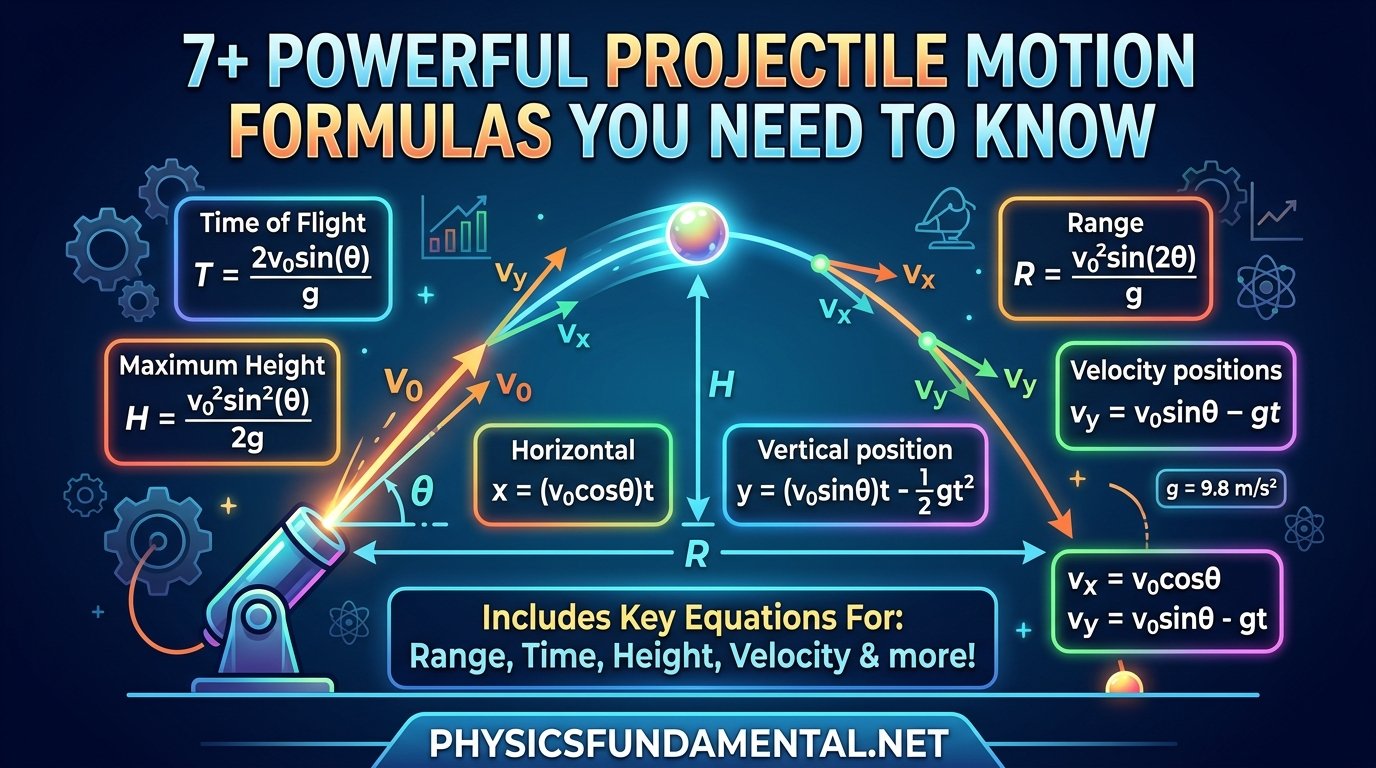
Projectile Motion is a fundamental topic in physics that describes the motion of an object launched into the air and then moving under the influence of gravity. A thrown ball, a kicked football, a stone launched from the ground, and an object dropped from a moving vehicle can all involve Projectile Motion.
What makes Projectile Motion interesting is that the motion takes place in two directions at the same time. The object moves horizontally while gravity causes it to accelerate vertically downward. Although these two motions happen simultaneously, they can be analyzed separately.
This makes Projectile Motion an important application of the equations of motion and vectors. Once horizontal and vertical motion are understood individually, it becomes much easier to calculate the flight time, maximum height, horizontal range, velocity, and position of a projectile.
What Is Projectile Motion?
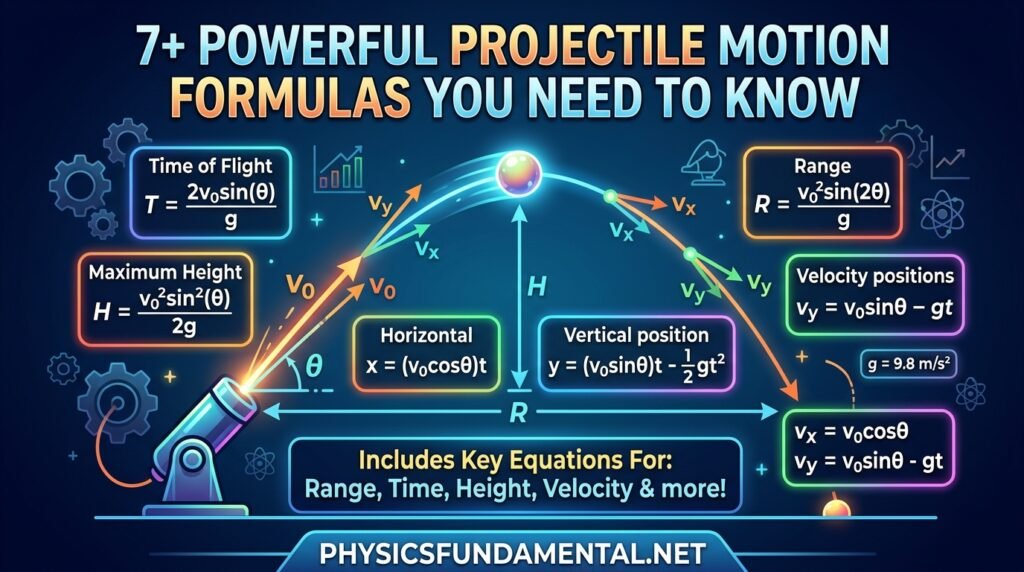
Projectile Motion is the motion of an object that is launched into the air and then moves under the action of gravity, assuming air resistance is negligible.
A projectile can be launched at an angle, horizontally, or in special cases vertically. After launch, gravity acts downward throughout the motion.
The path followed by the projectile is usually a curved path called a parabola.
For example, when a ball is kicked at an angle, it initially moves upward and forward. Its upward velocity gradually decreases because gravity acts downward. The ball eventually reaches its highest point and then begins to fall while continuing to move forward.
The horizontal and vertical motions are connected because they occur during the same time interval, but the horizontal motion is treated independently from the vertical motion.
How Does Projectile Motion Work?
Projectile Motion can be understood by separating it into two components:
- Horizontal motion
- Vertical motion
In the ideal case, there is no horizontal acceleration because gravity acts vertically downward.
Therefore:
The horizontal velocity remains constant:
In the vertical direction, the projectile experiences gravitational acceleration:
where is approximately:
Thus, the horizontal motion is uniform while the vertical motion is uniformly accelerated.
This combination produces the curved path associated with Projectile Motion.
Projectile Motion Formula
The formulas used in Projectile Motion depend on how the object is launched and what quantity needs to be calculated.
For a projectile launched with initial speed at an angle :
Horizontal component of initial velocity:
Vertical component of initial velocity:
Horizontal position after time :
Vertical position after time :
Vertical velocity after time :
Horizontal velocity remains:
when air resistance is ignored.
You May Like to Read: Helen’s Place Marathahalli Menu 2026: Prices & Best Dishes
Resolving the Initial Velocity
When a projectile is launched at an angle, its initial velocity has both horizontal and vertical components.
Suppose the initial speed is and the launch angle is .
The horizontal component is:
The vertical component is:
These two components are perpendicular to each other.
The original velocity can therefore be represented as the vector sum of the horizontal and vertical components.
Using components makes Projectile Motion much easier to analyze because the two directions can then be handled separately.
Horizontal Motion of a Projectile
In ideal Projectile Motion, gravity does not produce horizontal acceleration.
Therefore:
The horizontal velocity stays constant:
The horizontal displacement is:
Therefore:
This means horizontal distance increases uniformly with time.
For example, if a projectile has a constant horizontal velocity of 20 m/s, it travels:
every second in the horizontal direction.
Vertical Motion of a Projectile
Vertical motion is affected by gravity.
The vertical acceleration is:
The vertical velocity after time is:
or:
The vertical displacement is:
The negative sign before the term appears because gravity acts downward when upward is chosen as the positive direction.
Time of Flight
Time of flight is the total time a projectile remains in the air.
For a projectile launched and landing at the same height, the total time of flight is:
This formula assumes:
- Air resistance is ignored.
- The projectile lands at the same vertical level from which it was launched.
- The acceleration due to gravity is constant.
The time of flight increases when the initial vertical velocity increases.
You May Like to Read: Bawarchi Restaurant New Nallakunta Menu 2026: Prices & Best Dishes
Example: Finding Time of Flight
A ball is launched with an initial speed of:
at an angle of:
to the horizontal.
Using:
we get:
Since:
then:
Therefore, the projectile remains in the air for approximately 2.04 seconds.
Maximum Height
Maximum height is the greatest vertical distance reached by the projectile above its launch point.
At the highest point of Projectile Motion, the vertical velocity becomes zero:
Using:
we can find the time to reach maximum height:
Therefore:
The maximum height is:
This formula gives the maximum height relative to the launch point when the projectile lands at the same level.
Example: Finding Maximum Height
A projectile is launched at:
at an angle of:
Using:
we have:
Therefore, the projectile reaches a maximum height of approximately 5.1 m above its launch point.
Horizontal Range
The horizontal range is the total horizontal distance traveled by a projectile before it returns to the launch height.
For a projectile launched and landing at the same height:
The range depends on:
- Initial speed
- Launch angle
- Gravitational acceleration
The range is greatest when:
for ideal Projectile Motion on level ground.
At 45°:
so the maximum range is:
Example: Finding Horizontal Range
A projectile is launched at:
at:
Using:
we get:
Since:
then:
Therefore, the projectile travels approximately 40.8 m horizontally.
Why 45 Degrees Gives the Maximum Range
For ideal Projectile Motion on level ground:
The sine function has a maximum value of 1.
Therefore, the range reaches its largest value when:
so:
This result applies only under the usual ideal assumptions, such as equal launch and landing heights and negligible air resistance.
In the real world, air resistance can change the angle that produces the greatest range.
You May Like to Read: Pihu Baug Menu 2026: Prices, Best Dishes & Reviews
Equation of the Trajectory
The trajectory is the path followed by the projectile.
For ideal Projectile Motion, the trajectory can be written as:
This equation shows why the path is parabolic.
The first term:
represents the upward effect of the initial launch angle, while the second term represents the downward effect of gravity.
Because the equation contains , the trajectory has a parabolic shape.
Velocity of a Projectile at Any Time
The velocity of a projectile has both horizontal and vertical components.
The horizontal component is:
The vertical component changes with time:
The magnitude of the velocity is:
The direction of the velocity relative to the horizontal can be found using:
Thus, both the speed and direction of the projectile change throughout its flight.
Velocity at the Highest Point
At the highest point of Projectile Motion:
However, the horizontal velocity is still present:
Therefore, the projectile is still moving horizontally at its maximum height.
Its speed at that point is:
This is an important point because the total velocity is not necessarily zero at maximum height.
Only the vertical component becomes zero.
Horizontal Projectile Motion
A special case occurs when an object is launched horizontally from a height.
In this case:
Therefore:
and:
The object has no initial vertical velocity, but gravity immediately causes it to accelerate downward.
The horizontal displacement is:
The vertical displacement is:
when downward is taken as positive from the launch point.
Example: Horizontal Projectile
Suppose a ball rolls horizontally from a cliff at:
and the cliff is:
high.
To find the time taken to reach the ground, use:
Therefore:
Now calculate horizontal distance:
So the ball lands approximately 20.2 m from the base of the cliff.
Projectile Launched From an Elevated Position
Not every projectile starts and ends at the same height.
For example, a ball may be thrown from the top of a building and land on the ground.
In such cases, the standard range and time-of-flight formulas for equal heights should not be used directly.
Instead, use the general motion equation:
Choose the appropriate coordinate system and solve for the time when the projectile reaches the target height.
Once the flight time is known, the horizontal distance can be found using:
This method works for a wide range of Projectile Motion problems.
You May Like to Read: Phurr Menu 2026: Best Dishes, Prices & What to Order
Projectile Motion and Symmetry
Projectile Motion has a useful symmetry when the projectile lands at the same height at which it was launched and air resistance is ignored.
The time taken to reach maximum height is half of the total flight time:
The projectile also has the same speed at equal heights on the way up and down, although the direction of the vertical velocity is opposite.
For example, if the projectile is moving upward through a particular height with a vertical velocity of m/s, it will pass through the same height on the way down with:
This symmetry can simplify many calculations.
Projectile Motion and Acceleration
The acceleration of a projectile is constant throughout its flight, assuming air resistance is ignored.
The acceleration is:
This means:
and:
Even at the highest point, the acceleration is still:
downward.
A common misunderstanding is that acceleration becomes zero at maximum height. It does not. The vertical velocity becomes zero momentarily, but gravity continues to accelerate the projectile downward.
Effect of Launch Angle
The launch angle strongly affects the shape and distance of Projectile Motion.
A small angle gives a relatively low trajectory and a longer horizontal component of initial velocity.
A large angle gives a higher trajectory but a smaller horizontal component.
For equal launch and landing heights and a fixed launch speed, angles that add up to produce the same ideal range.
For example:
and:
have the same ideal range because:
in the range formula’s term.
However, the 60° launch produces a greater maximum height and a longer flight time than the 30° launch.
Projectile Motion and Gravity
Gravity is the main force responsible for the vertical part of ideal Projectile Motion.
Near Earth’s surface:
directed downward.
A projectile launched upward slows down because its upward velocity opposes gravity.
As it rises:
At the highest point:
During the downward part of the motion, gravity causes the magnitude of the downward velocity to increase.
The horizontal velocity remains unchanged in the ideal model.
You May Like to Read: 10+ Powerful Potential Energy Formulas & Examples
Effect of Air Resistance
The standard equations for Projectile Motion usually assume that air resistance is negligible.
In reality, air resistance can have a significant effect.
Air resistance depends on factors such as:
- Speed
- Shape of the object
- Size and area
- Air density
- Surface properties
When air resistance is considered, the horizontal velocity is no longer constant, the trajectory is not an ideal parabola, and the angle that produces maximum range may differ from 45°.
For introductory physics calculations, however, neglecting air resistance makes the motion much easier to analyze.
Applications of Projectile Motion
Projectile Motion has many applications in physics and everyday life.
Sports provide several examples. A basketball shot, soccer kick, baseball throw, and golf shot all involve projectile-like trajectories.
Projectile Motion is also important in engineering and military physics, where the motion of launched objects must be predicted.
Water streams from fountains and hoses can show approximate projectile paths.
Space and planetary science also involve the study of objects moving under gravity, although more advanced models are often needed outside the simple near-Earth case.
Common Mistakes in Projectile Motion
One of the most common mistakes is treating horizontal and vertical motion as the same kind of motion.
In ideal Projectile Motion:
while:
Another common mistake is using the wrong trigonometric component. For an angle measured from the horizontal:
and:
Students also sometimes assume that the acceleration is zero at the highest point. Only the vertical velocity is zero there; acceleration due to gravity continues to act downward.
Another mistake is using the range formula:
when the launch and landing heights are different. That formula assumes equal heights.
Finally, forgetting units can lead to incorrect answers. Use a consistent unit system throughout the calculation.
Worked Example: Complete Projectile Motion Problem
A ball is launched from the ground with an initial speed of:
at an angle of:
Find:
- The horizontal component of velocity
- The vertical component of velocity
- The time of flight
- The maximum height
- The horizontal range
Take:
Step 1: Horizontal Component
Step 2: Vertical Component
Step 3: Time of Flight
Step 4: Maximum Height
Step 5: Horizontal Range
Therefore, the ball has:
Projectile Motion Formula Summary
The main equations for Projectile Motion are:
Horizontal velocity:
Vertical initial velocity:
Horizontal displacement:
Vertical displacement:
Vertical velocity:
Time to maximum height:
Maximum height:
Time of flight for equal launch and landing heights:
Range for equal launch and landing heights:
Trajectory equation:
These equations form the foundation for most introductory Projectile Motion problems.
Frequently Asked Questions
What is Projectile Motion?
Projectile Motion is the motion of an object launched into the air that moves under the influence of gravity, assuming air resistance is negligible.
What are the two components of Projectile Motion?
Projectile Motion is divided into horizontal and vertical components. Horizontal velocity remains constant in the ideal case, while vertical motion is affected by gravity.
What is the formula for the range of a projectile?
For equal launch and landing heights:
At what angle is the range maximum?
For ideal Projectile Motion on level ground, the maximum range occurs at a launch angle of:
Is acceleration zero at the highest point?
No. At the highest point, the vertical velocity is zero, but gravitational acceleration is still approximately downward.
Conclusion
Projectile Motion describes the motion of an object launched into the air and affected by gravity. The key to solving Projectile Motion problems is to separate the motion into horizontal and vertical components.
The horizontal component has constant velocity when air resistance is ignored, while the vertical component has constant downward acceleration due to gravity. By combining these two independent motions, we can calculate important quantities such as time of flight, maximum height, horizontal range, velocity, and position.
The most important formulas include:
and, for equal launch and landing heights:
Once the horizontal and vertical motions are understood separately, Projectile Motion becomes much easier to analyze. These principles provide a strong foundation for more advanced topics involving vectors, forces, motion, and mechanics.