
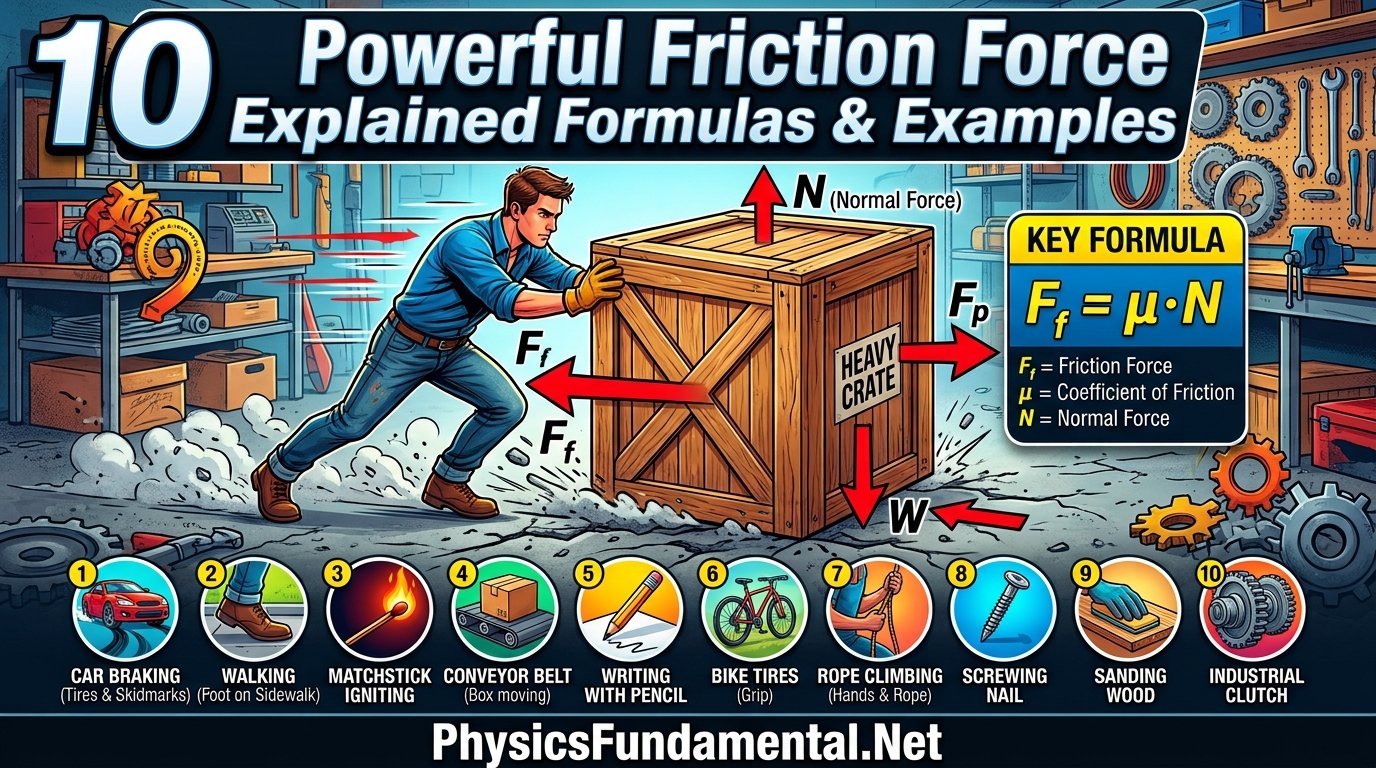
Friction Force Explained is an important topic in physics because friction affects almost every type of motion we experience in daily life. Walking, driving a car, stopping a bicycle, writing with a pencil, and even holding an object all depend on friction.
Whenever two surfaces come into contact, they interact in ways that can resist relative motion between them. This resistance is called friction. Friction does not always mean that an object is already moving. It can also prevent an object from starting to move.
For example, when you push a heavy box across the floor, friction acts against the motion of the box. When you walk, friction between your shoes and the ground helps prevent your feet from slipping backward. When a car brakes, friction between the tires and the road helps reduce the car’s speed.
Friction is therefore both useful and sometimes undesirable. It allows us to control motion, but it can also cause energy loss, heating, and wear of machine parts.
What Is Friction Force?
Friction Force is a force that opposes relative motion or the tendency of relative motion between two surfaces in contact.
It acts along the surfaces of contact.
The direction of friction is opposite to the relative motion, or opposite to the direction in which the surfaces would tend to move relative to one another.
For example, if a box is sliding to the right across a floor, the friction force acting on the box points to the left.
Friction is a contact force because the surfaces must interact for the friction force to occur.
The SI unit of friction force is the newton:
Friction is affected by factors such as the nature of the surfaces, the force pressing the surfaces together, and whether the surfaces are sliding or not.
Why Does Friction Occur?
At first, two surfaces may appear smooth, but at a microscopic level they contain irregularities.
When surfaces touch, these tiny irregularities can interact. There can also be electromagnetic interactions between atoms and molecules at the contact areas.
As a result, some force is required to make one surface move relative to the other.
This interaction produces friction.
For idealized physics problems, we usually do not need to study the microscopic details. Instead, we use simple models involving coefficients of friction and the normal force.
You May Like to Read: 7+ Powerful Electric Charge and Coulomb’s Law Facts
Friction Force Formula
For many basic physics problems, the friction force is related to the normal force.
The general relationship is:
where:
- is the friction force.
- is the coefficient of friction.
- is the normal force.
However, this formula must be used carefully because static and kinetic friction behave differently.
For kinetic friction:
For static friction:
The coefficient of static friction is usually greater than the coefficient of kinetic friction:
under the usual simple friction model.
What Is Normal Force?
To understand friction, it is important to understand the normal force.
The normal force is the force a surface exerts perpendicular to an object in contact with it.
For an object resting on a horizontal surface with no other vertical forces:
where:
- is the mass of the object.
- is gravitational acceleration.
In this simple situation, kinetic friction can therefore be written as:
But the normal force is not always equal to .
For example, if an object is placed on an inclined surface or pulled upward at an angle, the normal force changes.
That is why it is better to calculate first rather than automatically using .
Static Friction
Static friction acts when two surfaces are not sliding relative to each other.
Its purpose is to prevent relative motion up to a maximum possible value.
The static friction force is:
The maximum possible static friction is:
This does not mean that static friction is always equal to .
Instead, static friction adjusts to match the applied force until it reaches its maximum value.
For example, suppose you push a box with a force of 20 N, but the box does not move.
The static friction force may be:
in the opposite direction.
If you increase your push to 50 N and the box still does not move, static friction may increase to:
provided the maximum static friction has not been exceeded.
You May Like to Read: JoinCRS com: 10+ Powerful Features, Benefits & Hidden Problems in 2026
Kinetic Friction
Kinetic friction acts when two surfaces are sliding relative to each other.
It is commonly modeled as:
Unlike static friction, kinetic friction is generally treated as having a roughly constant magnitude for a given pair of surfaces under a simple model.
Suppose a box is sliding across a horizontal floor.
If:
and:
then:
Therefore, the kinetic friction force is 30 N opposite the direction of sliding.
Difference Between Static and Kinetic Friction
Static and kinetic friction both oppose relative motion, but they apply in different situations.
Static friction acts when surfaces are not sliding relative to one another.
Kinetic friction acts when the surfaces are already sliding.
The maximum static friction is:
while kinetic friction is:
Usually:
This explains why it can be harder to start moving a heavy object than to keep it sliding once it has started moving.
Rolling Friction
Rolling friction occurs when an object rolls over a surface.
Examples include:
- A bicycle wheel moving along a road
- A ball rolling across the floor
- A car tire rolling along a highway
Rolling resistance is often smaller than sliding friction, which is one reason wheels make it easier to move heavy objects.
However, real rolling resistance is influenced by factors such as deformation of the wheel and surface, tire pressure, and material properties.
Fluid Friction
Friction can also occur when an object moves through a fluid such as air or water.
This is often called fluid friction or drag.
For example:
- Air resistance acting on a falling object
- Water resistance acting on a swimmer
- Drag acting on an airplane
Unlike simple dry friction, fluid resistance often depends strongly on speed.
At higher speeds, drag can become much larger.
Limiting Friction
When an object is at rest and an applied force is gradually increased, static friction also increases until it reaches a maximum value.
This maximum value is called limiting friction.
It is given by:
If the applied force becomes greater than this value, the object starts sliding.
For example, suppose:
and:
Then:
An applied force below 100 N may be insufficient to start motion in this model, while an applied force greater than 100 N can cause the object to begin sliding.
Coefficient of Friction
The coefficient of friction is represented by:
It is a dimensionless quantity, meaning it has no SI unit.
It describes how strongly two surfaces resist relative motion.
There are usually two coefficients:
for static friction, and:
for kinetic friction.
Different materials and surface conditions have different coefficients of friction.
A rough surface generally provides greater resistance to sliding than a very smooth surface, although the actual behavior depends on the materials and conditions involved.
You May Like to Read: www FeedBuzzard Com Review 2026: Powerful Trend Hub or Risky Information Source?
Factors Affecting Friction
Several factors can affect friction in real situations.
Nature of the Surfaces
Different materials interact differently.
Rubber and dry pavement can produce substantial friction, which is useful for vehicle traction.
Normal Force
In the simple friction model:
A larger normal force generally produces a larger friction force.
Surface Condition
Oil, water, dust, temperature, and surface finish can change friction significantly.
Lubricants are often used to reduce unwanted friction between machine components.
Type of Motion
Static, kinetic, rolling, and fluid friction behave differently and require different models.
Example: Friction on a Horizontal Surface
A 10 kg box slides across a horizontal floor. The coefficient of kinetic friction is:
Find the kinetic friction force.
First calculate the normal force:
Now use:
Therefore:
The friction force acts opposite the direction of motion.
Example: Static Friction
A 20 kg box rests on a horizontal surface. The coefficient of static friction is:
Find the maximum static friction.
First calculate the normal force:
Then:
Therefore, the maximum static friction is:
Any applied horizontal force smaller than this can be balanced by static friction, assuming the simple model applies.
Example: Finding Whether an Object Moves
Suppose a 15 kg box is on a horizontal floor.
The coefficient of static friction is:
A horizontal force of:
is applied.
First:
Maximum static friction is:
The applied force is:
Since:
the box does not move.
Static friction simply becomes:
opposite the applied force.
Friction on an Inclined Plane
Friction problems become more interesting when an object is placed on an incline.
Suppose a block rests on a slope at angle .
The gravitational force can be divided into components:
Parallel to the slope:
Perpendicular to the slope:
For a simple incline with no other perpendicular forces:
The maximum static friction is then:
The friction force acts along the slope and opposes the tendency of the block to slide.
You May Like to Read: Voomixi com Review 2026: Safe Platform or Dangerous Scam? Truth Revealed
Example: Friction on an Incline
A 5 kg block rests on a 30° incline. The coefficient of static friction is:
The normal force is:
Maximum static friction:
The component of gravity down the slope is:
Because the downward gravitational component is greater than the maximum static friction:
the block cannot remain at rest under this simple model. It will begin sliding downward.
Friction and Newton’s Laws
Friction is commonly used together with Newton’s laws of motion.
Newton’s second law states:
Suppose a box is pulled to the right by an applied force , while friction acts to the left.
Then the net horizontal force is:
Therefore:
This equation can be used to find acceleration.
If the applied force is greater than kinetic friction, the object accelerates in the direction of the applied force.
Example: Finding Acceleration With Friction
A 10 kg box is pulled horizontally with a force of:
The coefficient of kinetic friction is:
The normal force is:
Kinetic friction:
Net force:
Using:
we get:
Therefore, the box accelerates at:
Friction and Energy
Friction plays an important role in energy transfer.
When an object slides over a rough surface, friction does negative work on the object.
The work done by kinetic friction can be written as:
when the friction force is constant and opposite the displacement.
Here:
- is the work done by friction.
- is the kinetic friction force.
- is the distance traveled.
The negative sign indicates that friction removes mechanical energy from the object-system.
That energy is commonly transformed into thermal energy.
Friction and Heat
You can observe the heating effect of friction in everyday life.
Rub your hands together and they become warmer.
The mechanical energy involved in the motion is partly converted into thermal energy through friction.
Similarly, brakes become hot when a moving vehicle slows down because friction converts some of the vehicle’s kinetic energy into thermal energy.
This does not mean energy disappears. Instead, the energy is transferred into forms that are less useful for mechanical motion.
You May Like to Read: WallPostMedia Com Review 2026: Powerful Benefits, Hidden Risks & The Truth
Friction in Everyday Life
Friction is essential in many everyday activities.
Walking
When you walk, your foot pushes backward against the ground. Static friction from the ground helps provide a forward force on your foot.
Driving
Friction between the tires and road provides traction, allowing vehicles to accelerate, turn, and brake.
Writing
Friction between a pencil or pen and paper helps transfer material and control the writing motion.
Braking
Brake systems use friction to reduce the rotational motion of wheels and convert mechanical energy into thermal energy.
Holding Objects
Friction between your hands and an object helps prevent the object from slipping.
Without sufficient friction, many ordinary activities would become difficult or impossible.
Advantages of Friction
Friction has many useful effects.
It allows people to walk safely.
It helps vehicles move and stop.
It makes writing and drawing possible.
It helps screws, nails, and many mechanical connections stay in place.
It provides grip between surfaces.
Without friction, many objects would continue sliding rather than remaining where they are placed.
Disadvantages of Friction
Friction can also create problems.
It causes wear in machine components.
It produces unwanted heat.
It reduces the efficiency of moving machines.
It can increase the energy required to move an object.
For this reason, engineers often try to control friction rather than simply maximize or eliminate it.
How Friction Can Be Reduced
Several methods can reduce unwanted friction.
Lubrication
Oil and other lubricants can reduce direct interaction between moving surfaces.
Using Wheels
Rolling can reduce resistance compared with sliding in many situations.
Using Ball Bearings
Ball bearings allow components to rotate with relatively low rolling resistance.
Smoothing Surfaces
Changing surface texture can reduce or alter friction in suitable applications.
However, reducing friction is not always desirable. Machines such as brakes and clutches depend on substantial friction to operate.
How Friction Can Be Increased
Sometimes more friction is necessary.
Tread patterns on tires increase traction under appropriate conditions.
Shoe soles are designed to provide grip with the ground.
Materials used in brake pads are selected to produce suitable friction.
Rougher surfaces can also increase resistance to slipping in many everyday situations.
The goal is usually to produce the appropriate amount of friction for the application.
Friction and Mechanical Efficiency
Friction often reduces the useful mechanical efficiency of a system because some energy is converted into thermal energy.
For machines, reducing unnecessary friction can lower energy consumption and reduce wear.
However, a machine cannot always operate with zero friction. Some systems require friction for controlled motion and force transmission.
Engineers therefore design systems to manage friction rather than simply eliminate it.
Common Mistakes About Friction Force
One common mistake is assuming that friction always has a fixed value.
Static friction can vary from zero up to its maximum value:
Another mistake is assuming that friction always equals:
That relationship is commonly used directly for kinetic friction, while static friction has a maximum value.
Students also sometimes assume:
in every situation.
This is only true in certain simple cases, such as an object on a horizontal surface with no other vertical forces.
Another common mistake is forgetting the direction of friction. Friction opposes relative motion or the tendency of relative motion between the surfaces.
Finally, friction is not always undesirable. It is essential for walking, driving, braking, gripping, and many other activities.
Friction Force Formula Summary
The basic kinetic friction formula is:
The maximum static friction is:
Static friction satisfies:
For an object on a horizontal surface with no additional vertical forces:
For an object on a simple inclined surface:
The work done by constant kinetic friction is:
Newton’s second law can be used with friction:
These equations cover many introductory friction problems.
Frequently Asked Questions
What is friction force?
Friction force is a contact force that opposes relative motion or the tendency of relative motion between two surfaces in contact.
What is the formula for friction force?
For kinetic friction:
For static friction, the force can vary up to:
What is the difference between static and kinetic friction?
Static friction acts when surfaces are not sliding relative to one another, while kinetic friction acts when the surfaces are sliding.
Does friction always oppose motion?
Friction opposes relative motion between contacting surfaces or the tendency of such motion. Its direction depends on the relative motion at the contact.
Why is friction useful?
Friction provides traction for walking and driving, helps vehicles stop, allows us to hold objects, and makes activities such as writing possible.
Conclusion
Friction Force Explained becomes much easier once you understand that friction is a contact force that opposes relative motion or the tendency of relative motion between surfaces.
The two most important forms in basic physics are static friction and kinetic friction. Static friction prevents an object from beginning to slide and can vary up to a maximum value:
Kinetic friction acts when surfaces are already sliding:
Friction is closely connected to Newton’s laws, energy, and work. It can slow objects down and convert mechanical energy into thermal energy, but it is also essential for everyday activities such as walking, driving, braking, and gripping.
By correctly identifying the type of friction, calculating the normal force, and applying the appropriate equation, you can solve a wide range of physics problems involving friction with confidence.