Ceslie-Ann Kamakawiwo’ole: The Remarkable Story (2026)
Ceslie-Ann Kamakawiwo’ole is known publicly as the daughter of Israel Kamakawiwo’ole, the beloved Hawaiian singer whose gentle voice carried Hawaiian music to audiences around the world. While her father became internationally recognized for his unforgettable rendition of “Somewhere Over the Rainbow/What a Wonderful World,” information about his daughter’s own life remains limited.
A contemporary Honolulu Star-Bulletin report published on June 26, 1997, identified Israel’s wife as Marlene and his daughter as Ceslieanne “Wehi,” who was 14 at the time of his death. This provides an important historical starting point for understanding the Kamakawiwo’ole family and the connection between Ceslie-Ann and one of Hawaii’s most celebrated musical figures.
People searching for Ceslie-Ann Kamakawiwo’ole’s biography, family background or personal life often encounter incomplete information and conflicting claims. The clearest approach is to separate documented family history from speculation while explaining why her father’s musical legacy continues to draw public attention to his family.
Who Is Ceslie-Ann Kamakawiwo’ole?
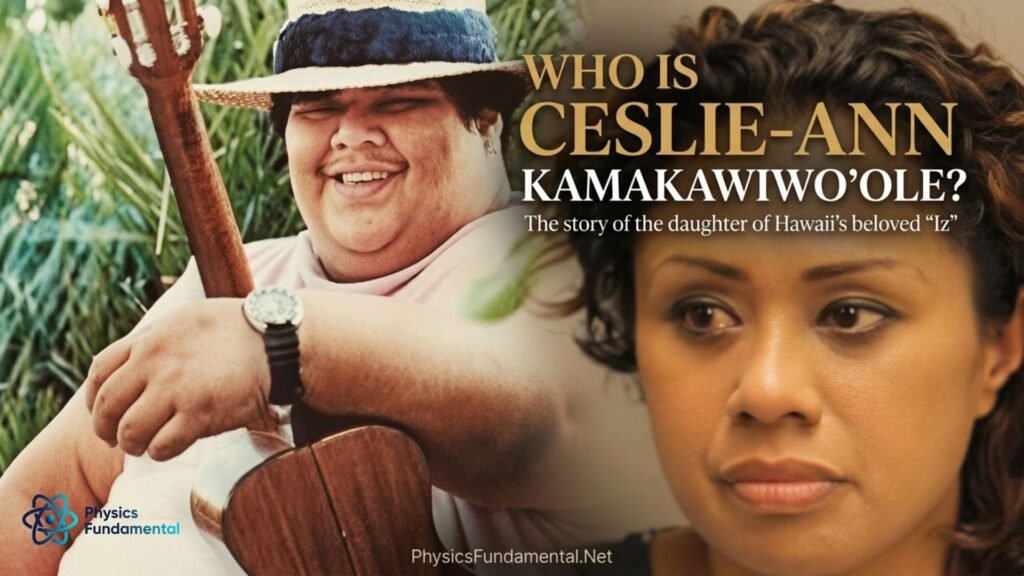
Ceslie-Ann Kamakawiwo’ole is publicly known primarily as the daughter of Israel Kamakawiwo’ole, also affectionately called “Iz” or “Bruddah Iz.” Her father was a Hawaiian singer, songwriter and musician whose work combined a recognizable voice, ukulele-based arrangements and a strong connection to Hawaiian musical traditions.
Unlike her father, Ceslie-Ann has not established a widely documented public career as a recording artist or entertainer. Much of the available information about her identity comes from historical reporting about Israel and his family rather than extensive interviews, official biographies or a sustained public presence of her own.
The distinction matters. A search for who Ceslie-Ann Kamakawiwo’ole is can produce pages that promise a complete account of her life, including details about her current occupation, relationships, children, age and finances. However, those details should not automatically be accepted simply because they appear on multiple websites.
A reliable biography begins with information that can be traced to credible reporting. The 1997 Honolulu Star-Bulletin article is particularly useful because it was published when Israel died at age 38 and directly identified his surviving wife and daughter.
That report establishes the immediate family connection without requiring assumptions about Ceslie-Ann’s later choices. It does not provide a complete account of her adult life, and it should not be treated as one.
What historical reporting confirms
The strongest publicly documented facts about Ceslie-Ann Kamakawiwo’ole concern her relationship with Israel and Marlene Kamakawiwo’ole. The contemporary newspaper report confirms that she was their daughter and was 14 when her father died in June 1997.
The same newspaper’s later coverage of Israel’s funeral again identified Ceslieanne as his daughter. These reports are useful historical records because they establish the family connection close to the events being described.
However, they do not establish her present-day circumstances, precise adult biography, educational history, career or financial position. Those details require separate evidence.
Why her name appears in different forms
Readers may encounter several variations, including Ceslie-Ann Kamakawiwo’ole, Ceslieanne Kamakawiwo’ole and Ceslieanne “Wehi.” A later newspaper report also used the spelling “Wehe.”
These differences create uncertainty when readers search for Ceslieanne Kamakawiwo’ole or Wehi Kamakawiwo’ole. The safest approach is to preserve the spelling used by each source when describing that source and to retain Ceslie-Ann Kamakawiwo’ole as the primary search term for this article.
The available reporting does not justify treating every spelling variation as a separate person, nor does it establish that every version represents her complete legal name.
A Family Name With Deep Meaning
The Kamakawiwo’ole family name carries considerable recognition because of Israel’s influence on Hawaiian music. For listeners who grew up hearing his songs, his name represents more than a successful recording career. It is associated with a distinctive voice, a recognizable musical style and a connection to Hawaii’s cultural identity.
Israel grew up in Hawaii and became involved in music during his youth. He and his brother Skippy were associated with the Makaha Sons of Ni’ihau, a group that became important in the development and popularity of contemporary Hawaiian music. Israel later continued his career as a solo performer.
His family connection gives readers a reason to search for Ceslie-Ann Kamakawiwo’ole’s family history. Yet a famous surname should not be mistaken for a complete description of the person who carries it.
For relatives of widely recognized artists, public attention can continue long after the original performer has died. The musician’s work remains available, new audiences discover the recordings, and interest in the artist’s background generates questions about family members.
That pattern explains much of the search interest surrounding Israel Kamakawiwo’ole’s daughter. It does not mean that she has chosen to live publicly or that every personal detail about her is available for others to examine.
The family name can be an entry point into an important musical history, but Ceslie-Ann’s own identity should not be reduced to her father’s professional achievements.
The Burden of Being a Legend’s Child
Growing up in the family of a celebrated musician can create a complicated relationship with public attention. Fans may develop a deep emotional connection to an artist through songs, concerts and memories. Over time, they may also become curious about the artist’s spouse, children and other relatives.
For the relatives, however, that relationship is different. The audience knows the music and public image, while the family relationship belongs to a more personal part of life.
This is a useful way to understand the public interest in Israel Kamakawiwo’ole’s daughter. His fans encounter his voice through recordings, films and shared memories. They may search for his family because learning about the people closest to an artist can make the artist’s history feel more complete.
But it would be inappropriate to assume that Ceslie-Ann necessarily experienced her father’s fame in a particular way. Without reliable statements from her, claims about her emotional life, ambitions or feelings toward the public should remain interpretations rather than biographical facts.
The same caution applies to questions about whether she became a singer. Being the daughter of a respected musician does not establish that someone inherited the same profession, has a musical career or wants to follow a parent’s path.
A useful biography can explain the pressures that sometimes accompany a famous family name without claiming that those general experiences describe one individual’s private life.
It can also acknowledge that family members deserve their own identities. Their value does not depend on becoming performers, preserving a public image or satisfying the expectations of an audience.
Israel Kamakawiwo’ole’s Legacy
Israel Kamakawiwo’ole’s musical legacy is the central reason his daughter’s name attracts attention. His recordings continue to reach listeners who discover him long after his death, and his most famous medley has become closely associated with peaceful, emotional and reflective moments.
The story behind “Somewhere Over the Rainbow/What a Wonderful World”
Israel’s rendition of “Somewhere Over the Rainbow/What a Wonderful World” combines songs originally written by different composers into a distinctive performance accompanied by his voice and ukulele.
The recording became widely recognized beyond Hawaii. Its continuing popularity introduced many listeners to his work and prompted some to explore his other recordings, his background and the Hawaiian music scene that shaped his career.
The Library of Congress selected the 1993 recording for the National Recording Registry in 2020. That recognition reflects its cultural and historical significance in recorded sound. It also helps explain why interest in Israel remains strong decades after he died.
For readers exploring the musical career of Israel Kamakawiwo’ole, his legacy extends beyond a single song. His work reflects a longer involvement in Hawaiian music, including his years with the Makaha Sons of Ni’ihau and his later solo recordings.
Facing Future and the lasting influence of Bruddah Iz
Released in 1993, Facing Future became one of Israel’s best-known albums. It included the medley that introduced many international listeners to his voice, while the wider collection reflected his musical roots and distinctive approach.
Mountain Apple Company, which released his recordings, has described Facing Future as the world’s top-selling Hawaiian music album. That description reflects the album’s exceptional reach within Hawaiian music and its continuing visibility beyond the islands.
Israel’s contribution was not limited to commercial recognition. His recordings helped bring Hawaiian musical expression to people who might otherwise have had little exposure to the genre. His voice also became associated with a particular sense of warmth and familiarity, which helped the music endure.
The phrase Bruddah Iz’s legacy therefore refers to more than a famous recording. It includes his work as a Hawaiian singer-songwriter, his connection to local musical traditions and the lasting audience for his songs.
Ceslie-Ann’s connection to that history is a family connection, not evidence that she has a public musical career of her own. Keeping that distinction clear allows the article to honor Israel’s achievements without inventing a parallel professional story for his daughter.
The Name “Wehi” in Public Memory
The name “Wehi” appears in historical coverage of Israel Kamakawiwo’ole’s death. The Honolulu Star-Bulletin identified his daughter as Ceslieanne “Wehi” in its June 1997 report. Another article published around the time of his funeral used the spelling “Wehe.”
For readers searching for Ceslieanne “Wehi” Kamakawiwo’ole, these references provide useful context. They show that the name was associated with Israel’s daughter in contemporary reporting.
They do not, by themselves, establish the name’s exact meaning, full cultural significance or preferred spelling today. Those questions should not be answered with confident claims unless a reliable source directly supports them.
Names can carry personal, cultural and family significance, but an outsider should not assign a particular meaning to someone’s nickname without evidence. The same care is necessary when discussing Hawaiian names and cultural terminology more broadly.
The historical references are therefore valuable, but their purpose is limited: they help explain why different spellings appear in searches and biographies.
For a trustworthy account of Ceslie-Ann Kamakawiwo’ole’s background, accurate attribution is more useful than presenting uncertain name details as settled fact.
A Private Life Near a Public Song
There is an interesting contrast between the worldwide recognition of Israel’s music and the limited verified information available about his daughter. His recording continues to attract listeners, yet the public record does not provide a similarly comprehensive picture of Ceslie-Ann’s life.
That contrast can lead to searches such as Ceslie-Ann Kamakawiwo’ole now, where is Ceslie-Ann Kamakawiwo’ole now, and what is her career. These are understandable questions, but search interest alone does not create reliable answers.
No sufficiently strong evidence establishes her current occupation, present location, relationship status, children or net worth. It would be misleading to present a guessed age or financial estimate as a fact, especially when multiple biography pages may repeat the same unsupported claim.
Likewise, there is not enough reliable public information to state that she followed her father into the music industry or built a career as a singer. A responsible biography should not fill this gap with imagined events or conclusions based on her family name.
Her father’s recordings also create a special form of public memory. Every time a listener discovers “Somewhere Over the Rainbow/What a Wonderful World,” Israel’s name may become relevant again. The listener might then search for his biography, wife, daughter or family history.
This cycle helps explain the continuing visibility of the Kamakawiwo’ole family in search results. It does not prove that every family member has chosen a public role.
A person can remain connected to a public figure’s legacy without becoming a public figure in their own right. That distinction is essential when discussing a relative whose life has not been extensively documented through direct interviews or verified public statements.
You May Like to Read: Jalynn Elordi: Fascinating Facts About Jacob’s Sister (2026)
Why Privacy Matters in This Story

Privacy is particularly important when writing about Ceslie-Ann Kamakawiwo’ole’s personal life because much of the available information concerns her father rather than her own activities.
A search engine can make a person’s name highly visible, but visibility is not the same as public consent. Nor does a famous family connection make every personal detail relevant to readers.
Biographical websites sometimes publish estimated ages, supposed occupations, relationship details or net worth figures without explaining where the information came from. Repetition can make these claims look authoritative even when an independent source is missing.
A careful article should distinguish three categories: documented facts, claims attributed to specific reporting, and details that remain unverified.
For example, the 1997 newspaper report provides historical evidence of Ceslie-Ann’s family relationship and age at that time. It does not establish her current age, professional activities or financial circumstances.
Similarly, public reporting about a past incident can be acknowledged without turning it into a complete biography. Context matters, and the limits of a report should remain clear.
Respect for privacy does not mean that every public question must be avoided. It means that the answer should be proportionate to the evidence and should not turn uncertainty into a dramatic story.
For anyone researching Ceslie-Ann Kamakawiwo’ole’s verified facts, the most useful standard is straightforward: prefer original reporting, check whether a claim has independent support, and leave unsupported personal details out of the finished biography.
When Public Attention Turns Hard
Not all public attention surrounding the Kamakawiwo’ole name has focused on music. In 2016, KHON2 News published a segment titled “Hawaii’s Most Wanted: Ceslieanne Kamakawiwoole.” The description refers to a previous arrest in 2015 in connection with police surveillance involving a stolen Mercedes.
This is a distinct part of the public reporting associated with Ceslieanne Kamakawiwo’ole, but it should be handled carefully. A media report about an arrest or wanted-list appearance is not a complete account of a person’s life, and it should not be used to infer character, motives or unrelated conduct.
The information available in that segment is also not enough to establish the final disposition of any associated case. A responsible article should not invent a conviction, sentence, financial penalty or later legal outcome without reliable supporting records.
Readers searching for Ceslie-Ann Kamakawiwo’ole legal case, public records or news coverage deserve a factual distinction between what was reported and what has been independently established. Sensational wording may attract attention, but it does not make a biography more accurate.
The incident should remain proportionate to the article’s purpose. The central subject is a family connection to a major Hawaiian musical figure, not an attempt to define someone through one item of news coverage.
A fair account can acknowledge the existence of public reporting while avoiding speculation about her private circumstances. This makes the article more useful for readers and more responsible in how it treats a real person.
What Her Story Teaches About Legacy
The story of Ceslie-Ann Kamakawiwo’ole illustrates how the legacy of a famous musician can continue to influence public interest in a family long after the performer has died.
Israel Kamakawiwo’ole’s legacy lives through his recordings, his influence on Hawaiian music and the audiences who continue to discover his work. His daughter’s public recognition, meanwhile, comes largely from the historical family connection documented in contemporary reporting.
These are related stories, but they are not identical. Israel’s musical career is well documented, while much of Ceslie-Ann’s adult life remains outside the publicly verified record.
The distinction is worth preserving. A famous person’s legacy includes the work they created, the cultural history they contributed to and the memories their audience carries. It does not give strangers a complete account of the private lives of their relatives.
For readers researching Israel Kamakawiwo’ole’s family, a strong article should answer the basic biographical questions, explain the significance of the music and be open about what cannot be confirmed.
This approach is also useful for understanding other families connected to public figures. A person’s identity should not be reduced to a surname, a public incident or a presumed relationship with fame.
Ceslie-Ann does not need an invented musical career or a speculative personal history for her place in the family story to be understandable. The documented connection is meaningful on its own, particularly when considered alongside the enduring recognition of her father’s work.
Frequently Asked Questions
Who is Ceslie-Ann Kamakawiwo’ole?
Ceslie-Ann Kamakawiwo’ole is publicly known as the daughter of Hawaiian singer Israel Kamakawiwo’ole and his wife, Marlene.
Who were Ceslie-Ann Kamakawiwo’ole’s parents?
Historical newspaper reporting identifies her parents as Israel Kamakawiwo’ole and Marlene Kamakawiwo’ole.
What does the nickname “Wehi” refer to?
A 1997 Honolulu Star-Bulletin report identified Israel’s daughter as Ceslieanne “Wehi,” although another contemporary report used a different spelling.
Did Ceslie-Ann Kamakawiwo’ole become a musician?
There is not enough reliable public information to establish that she pursued a professional music career like her father.
What is publicly known about Ceslie-Ann Kamakawiwo’ole today?
Her historical family connection is documented, but reliable details about her current occupation, location and personal circumstances remain limited.
Why is information about her private life limited?
Most established reporting concerns her father and family background, rather than a separate public career or extensive direct interviews with her.
Conclusion
Ceslie-Ann Kamakawiwo’ole is an important part of the family history surrounding Israel Kamakawiwo’ole, the Hawaiian singer whose music continues to reach audiences around the world. Contemporary reporting establishes her relationship to Israel and Marlene, while the Library of Congress’s recognition of his 1993 medley demonstrates the lasting importance of his musical legacy.
Beyond those documented details, caution is necessary. Her current occupation, relationships, finances and other private circumstances should not be presented as facts without reliable evidence.
The most trustworthy account of Ceslie-Ann Kamakawiwo’ole is therefore one that explains her family connection, honors her father’s place in Hawaiian music history and recognizes the limits of the public record. His legacy can be celebrated without turning his daughter’s private life into speculation.