
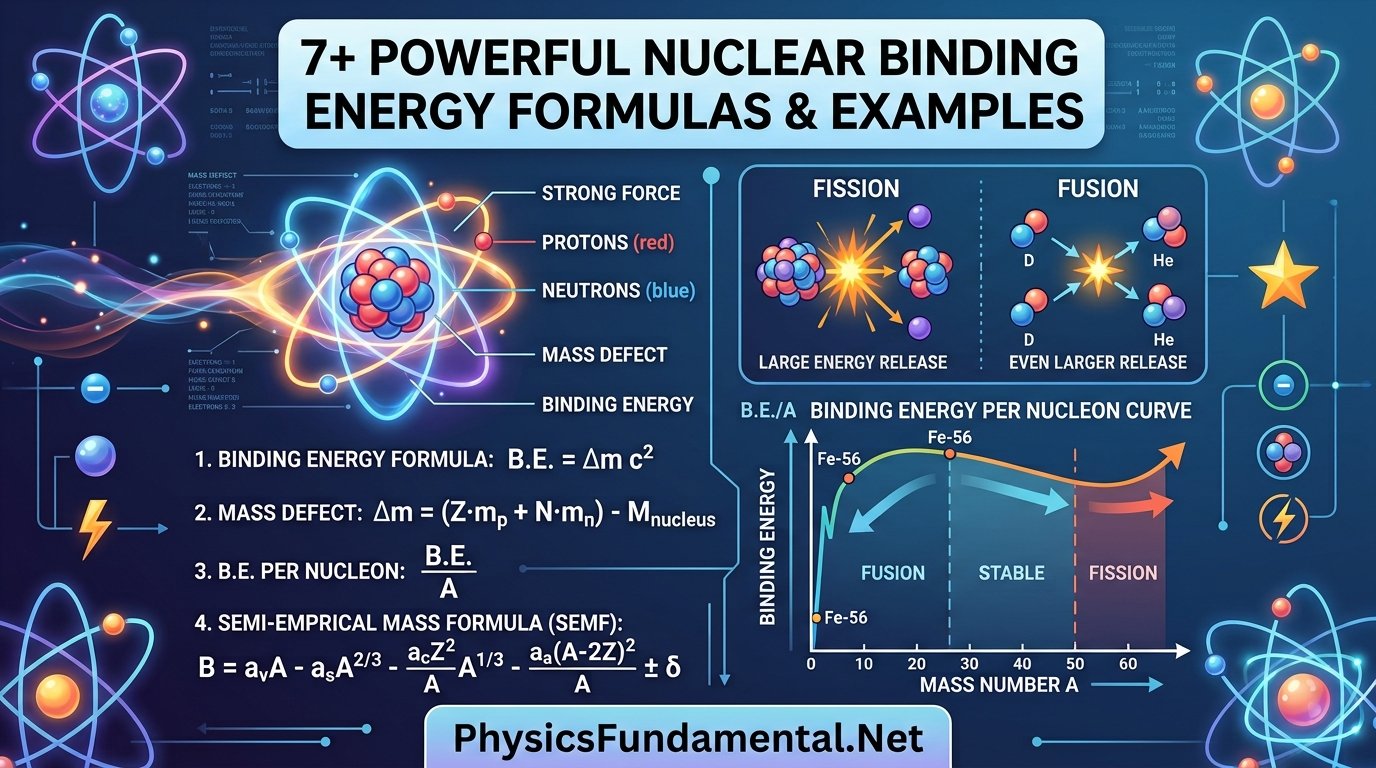
Nuclear Binding Energy is one of the most important concepts in nuclear physics because it explains why an atomic nucleus stays together and how much energy is involved when nuclei form, split, or change. Although protons carry positive electric charges and naturally repel one another, the nucleus can remain stable because of the strong nuclear force acting over very short distances.
The amount of energy required to separate a nucleus completely into its individual protons and neutrons is called Nuclear Binding Energy. A nucleus with greater binding energy per nucleon is generally more tightly bound and tends to be more stable than a nucleus with lower binding energy per nucleon.
This concept is closely connected to mass defect and Einstein’s famous mass-energy relationship. When free protons and neutrons combine to form a nucleus, the mass of the resulting nucleus is slightly less than the total mass of the separate particles. The missing mass is converted into energy and appears as Nuclear Binding Energy.
In this article, we will explain Nuclear Binding Energy, mass defect, the binding energy per nucleon, and the nuclear stability curve. We will also look at how these ideas explain nuclear fusion, nuclear fission, and the stability of different atomic nuclei.
What Is Nuclear Binding Energy?
Nuclear Binding Energy is the minimum amount of energy needed to completely separate an atomic nucleus into its individual protons and neutrons.
The same idea can be described in reverse. When separate protons and neutrons combine to form a nucleus, energy is released. The amount of energy released during this formation is equal to the Nuclear Binding Energy of the nucleus.
The nucleus contains two types of particles:
- Protons
- Neutrons
These particles are collectively called nucleons.
The strong nuclear force attracts nucleons to one another and helps hold the nucleus together. At the same time, the positively charged protons repel each other through the electrostatic force.
The balance between these forces determines whether a nucleus is stable.
A high Nuclear Binding Energy generally indicates that a nucleus is strongly bound. However, when comparing different nuclei, the more useful quantity is often the binding energy per nucleon.
Why Does a Nucleus Need Binding Energy?
You may wonder why energy is needed to pull a nucleus apart if its protons and neutrons already exist as separate particles.
When nucleons come together, the strong nuclear force lowers the total energy of the system. A bound nucleus therefore has less total energy than the same nucleons when they are separated far apart.
Because the bound system has lower energy, energy must be supplied to separate the nucleons again.
This required energy is the Nuclear Binding Energy.
The stronger the binding between the nucleons, the greater the energy needed to separate them.
What Is Mass Defect?
Mass defect is the difference between the total mass of the individual protons and neutrons and the actual mass of the nucleus they form.
Suppose a nucleus contains protons and neutrons.
The total mass of the separate nucleons would be:
But the actual mass of the nucleus is slightly smaller.
The mass difference is called the mass defect:
This missing mass is not actually destroyed. It has been converted into energy.
According to Einstein’s mass-energy equation:
the Nuclear Binding Energy is:
This is why even a very small mass defect can correspond to a large amount of energy.
You May Like to Read: 7+ Powerful Relative Velocity Tips for 1D & 2D Motion
How Mass Defect Produces Nuclear Binding Energy
The connection between mass defect and Nuclear Binding Energy is one of the clearest examples of mass-energy equivalence.
Imagine a group of free nucleons with a total mass of atomic mass units. After the nucleons form a nucleus, suppose the nucleus has a mass of only atomic mass units.
The mass defect is:
That missing u corresponds to the energy released when the nucleus formed.
A useful conversion is:
Therefore:
So:
Thus, a mass defect of u corresponds to approximately 93.15 MeV of Nuclear Binding Energy.
Nuclear Binding Energy Formula
The basic Nuclear Binding Energy formula is:
If mass defect is measured in atomic mass units, it is convenient to use:
where:
- is the Nuclear Binding Energy.
- is the mass defect.
- is the speed of light.
- corresponds to approximately MeV of energy.
The result is commonly expressed in megaelectronvolts (MeV).
How to Calculate Nuclear Binding Energy
Calculating Nuclear Binding Energy usually involves several steps.
First, determine the number of protons and neutrons in the nucleus.
If the atomic number is and the mass number is , then:
where is the number of neutrons.
Next, calculate the total mass of the separate nucleons.
Then subtract the actual nuclear mass to find the mass defect.
Finally, convert the mass defect into energy using:
or:
Example of Nuclear Binding Energy Calculation
Consider a hypothetical nucleus containing 2 protons and 2 neutrons.
Suppose the total mass of the four separate nucleons is:
and the measured nuclear mass is:
The mass defect is:
Now use:
Therefore, the nucleus has a Nuclear Binding Energy of approximately 28.3 MeV.
You May Like to Read: GrammarVista.com: 10+ Proven Ways to Improve Grammar 2026
Binding Energy Per Nucleon
Total Nuclear Binding Energy tells us how strongly the entire nucleus is bound, but it does not always provide the best way to compare different nuclei.
For that purpose, physicists use binding energy per nucleon.
The formula is:
where is the total number of nucleons.
For example, suppose a nucleus has:
and:
Then:
This value gives a useful indication of how tightly the nucleons are bound on average.
Why Binding Energy Per Nucleon Matters
A larger nucleus naturally contains more nucleons, so its total Nuclear Binding Energy may be larger simply because it has more particles.
Binding energy per nucleon removes much of this size effect.
A nucleus with a high binding energy per nucleon has, on average, a stronger binding of its nucleons.
This is why binding energy per nucleon is especially useful when comparing light, medium, and heavy nuclei.
The binding energy per nucleon does not remain constant for all elements. It changes significantly as the atomic mass increases.
This changing pattern produces the famous nuclear stability curve.
What Is the Nuclear Stability Curve?
The nuclear stability curve, often called the binding energy per nucleon curve, shows how the average Nuclear Binding Energy changes with mass number.
The curve rises sharply for light nuclei, reaches a maximum around medium-mass nuclei, and then gradually decreases for very heavy nuclei.
This shape is extremely important because it explains why both nuclear fusion and nuclear fission can release energy.
Nuclei near the middle of the curve are among the most tightly bound nuclei and are therefore generally the most stable.
Iron and nearby nuclei are close to the maximum binding energy per nucleon.
Understanding the Stability Curve
The nuclear stability curve can be divided into three broad regions.
Light Nuclei
For very light nuclei, the binding energy per nucleon increases rapidly as the number of nucleons increases.
This means combining light nuclei can produce a nucleus with a greater binding energy per nucleon.
The process can therefore release energy.
This is the basic principle behind nuclear fusion.
Medium-Mass Nuclei
For medium-mass nuclei, the binding energy per nucleon reaches its highest values.
Nuclei in this region are generally very strongly bound.
Iron is often used as a reference point because nuclei around iron have among the highest binding energies per nucleon.
Heavy Nuclei
For very heavy nuclei, the binding energy per nucleon begins to decrease.
Although these nuclei are still bound together, the average binding per nucleon is lower than it is for medium-mass nuclei.
This makes nuclear fission energetically possible.
Nuclear Fusion and Nuclear Binding Energy
Nuclear fusion occurs when two or more light nuclei combine to form a heavier nucleus.
If the product nucleus has a higher binding energy per nucleon than the original nuclei, the reaction can release energy.
This happens because the final nucleus is more tightly bound.
A common example is the fusion of hydrogen isotopes to form helium.
The total mass of the products is slightly smaller than the total mass of the original nuclei. The mass difference is converted into energy according to:
Stars generate enormous amounts of energy through nuclear fusion processes.
The Sun, for example, converts hydrogen into helium through a series of nuclear reactions. The resulting mass difference is released as energy.
You May Like to Read: Classroom 15x: Best Unblocked Games, Features & Safe Play
Nuclear Fission and Nuclear Binding Energy
Nuclear fission is the process in which a heavy nucleus splits into two or more smaller nuclei.
The products are usually closer to the middle of the stability curve than the original heavy nucleus.
As a result, the products can have a higher binding energy per nucleon.
The increase in total binding corresponds to released energy.
A well-known example is the fission of uranium-235.
When a uranium-235 nucleus undergoes fission, it can produce smaller nuclei, free neutrons, and a large amount of energy.
The energy comes from the decrease in total mass and the corresponding increase in binding energy.
Why Fusion and Fission Both Release Energy
At first, it may seem strange that both combining nuclei and splitting nuclei can release energy.
The stability curve explains this.
Very light nuclei can release energy by moving toward the high-binding-energy region through fusion.
Very heavy nuclei can release energy by moving toward the same region through fission.
In both cases, the final products are more tightly bound per nucleon than the original nuclei.
The key idea is not simply whether a nucleus gets bigger or smaller. The important factor is whether the process moves the nuclear system toward a state of greater binding.
Factors Affecting Nuclear Stability
Several factors influence whether a nucleus is stable.
Strong Nuclear Force
The strong nuclear force is attractive at very short distances and holds nucleons together.
It is responsible for much of the binding within the nucleus.
Electrostatic Repulsion
Protons repel one another because they all carry positive electric charge.
As the number of protons increases, this repulsion becomes increasingly important.
This helps explain why very heavy nuclei have lower binding energy per nucleon and can become unstable.
Neutron-to-Proton Ratio
Stable nuclei generally require an appropriate balance between neutrons and protons.
For light nuclei, stable nuclei often have roughly similar numbers of neutrons and protons.
For heavier nuclei, additional neutrons are generally needed to help offset the increasing proton-proton repulsion without adding more electric charge.
If the neutron-to-proton ratio becomes unsuitable, the nucleus may undergo radioactive decay.
Difference Between Mass Defect and Binding Energy
Mass defect and Nuclear Binding Energy are directly related, but they are not the same physical quantity.
Mass defect is a difference in mass.
Nuclear Binding Energy is the energy corresponding to that mass difference.
The relationship is:
Therefore:
- Mass defect is usually expressed in atomic mass units or kilograms.
- Nuclear Binding Energy is commonly expressed in joules or MeV.
A larger mass defect generally corresponds to a larger total binding energy.
Difference Between Binding Energy and Binding Energy Per Nucleon
These two terms are often confused.
Nuclear Binding Energy is the total energy required to separate the entire nucleus into its individual nucleons.
Binding energy per nucleon is the total Nuclear Binding Energy divided by the number of nucleons.
The equations are:
and:
The first describes the whole nucleus, while the second is useful for comparing nuclei of different sizes.
Relationship Between Nuclear Binding Energy and Radioactivity
A nucleus tends to move toward a more energetically favorable configuration.
When a nucleus has an unstable combination of protons and neutrons, it may undergo radioactive decay.
Different types of decay can change the proton and neutron numbers and move the nucleus toward greater stability.
Alpha decay, beta decay, and other nuclear processes can therefore be understood partly in terms of changes in nuclear energy and stability.
A more stable nucleus generally has a lower total energy state relative to the available alternatives.
Why Heavy Nuclei Become Less Stable
The strong nuclear force is short-ranged, meaning each nucleon interacts strongly with nearby nucleons rather than equally with every nucleon in a large nucleus.
Electric repulsion between protons, however, acts over longer distances.
As a nucleus becomes very large, proton-proton repulsion becomes increasingly significant.
This contributes to the decline in binding energy per nucleon for heavy nuclei.
Eventually, some heavy nuclei become unstable and can undergo alpha decay, spontaneous fission, or other radioactive processes.
Applications of Nuclear Binding Energy
Nuclear Binding Energy is important in many areas of science and technology.
It helps physicists understand how stars produce energy and how nuclear reactions release energy.
It is also essential in nuclear power generation, where fission reactions release energy from heavy nuclei.
In nuclear physics, binding energy calculations are used to compare nuclear stability, analyze reaction energetics, and study isotopes.
The same principles are also important in understanding the formation of elements inside stars and during energetic cosmic events.
You May Like to Read: E = mc² — Amazing Mass-Energy Equivalence Explained
Common Mistakes in Nuclear Binding Energy Calculations
One common mistake is confusing atomic mass with nuclear mass.
Atomic masses can include electrons, while nuclear mass refers only to the nucleus. The chosen formula must be consistent with the masses being used.
Another mistake is forgetting that the mass defect must be converted into energy.
The mass difference itself is not the Nuclear Binding Energy.
The correct relationship is:
Students also sometimes confuse total binding energy with binding energy per nucleon.
A nucleus may have a large total binding energy simply because it contains many nucleons. For stability comparisons, the binding energy per nucleon is usually more informative.
Units are another common source of errors. When mass defect is given in atomic mass units and the answer is required in MeV, the conversion factor of approximately 931.5 MeV per atomic mass unit should be used.
Frequently Asked Questions
What is Nuclear Binding Energy?
Nuclear Binding Energy is the energy required to completely separate a nucleus into its individual protons and neutrons. It is related to the mass defect through .
What is the formula for Nuclear Binding Energy?
The main formula is:
When mass defect is measured in atomic mass units, the energy can be calculated using:
What is mass defect?
Mass defect is the difference between the total mass of the separate protons and neutrons and the actual mass of the nucleus.
Why is binding energy per nucleon important?
Binding energy per nucleon allows scientists to compare how tightly different nuclei are bound regardless of their total size. Nuclei around the iron region have some of the highest values.
How does Nuclear Binding Energy explain fusion and fission?
Light nuclei can release energy through fusion as they move toward higher binding energy per nucleon, while heavy nuclei can release energy through fission for the same general reason.
Conclusion
Nuclear Binding Energy explains why atomic nuclei remain together and provides a powerful way to understand nuclear stability and nuclear reactions. It comes from the mass defect that occurs when individual protons and neutrons combine to form a bound nucleus.
The relationship is given by Einstein’s equation:
The concept becomes even more useful when we examine binding energy per nucleon. The nuclear stability curve shows that medium-mass nuclei have the greatest average binding, while very light and very heavy nuclei have lower values.
This explains why nuclear fusion can release energy from light nuclei and why nuclear fission can release energy from heavy nuclei. Understanding Nuclear Binding Energy therefore provides a foundation for studying nuclear reactions, radioactive stability, stars, and nuclear power.