Half Life Calculations Explained: Powerful Formula & Examples 2026
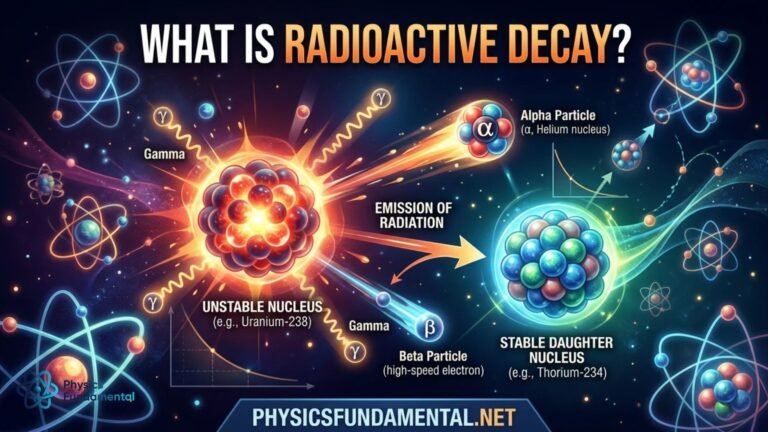
Radioactive materials do not disappear all at once. Instead, unstable nuclei gradually transform into more stable forms, and the rate of this process can be described using half-life. This makes Half Life Calculations an important part of nuclear physics, chemistry, medicine, archaeology, and environmental science.
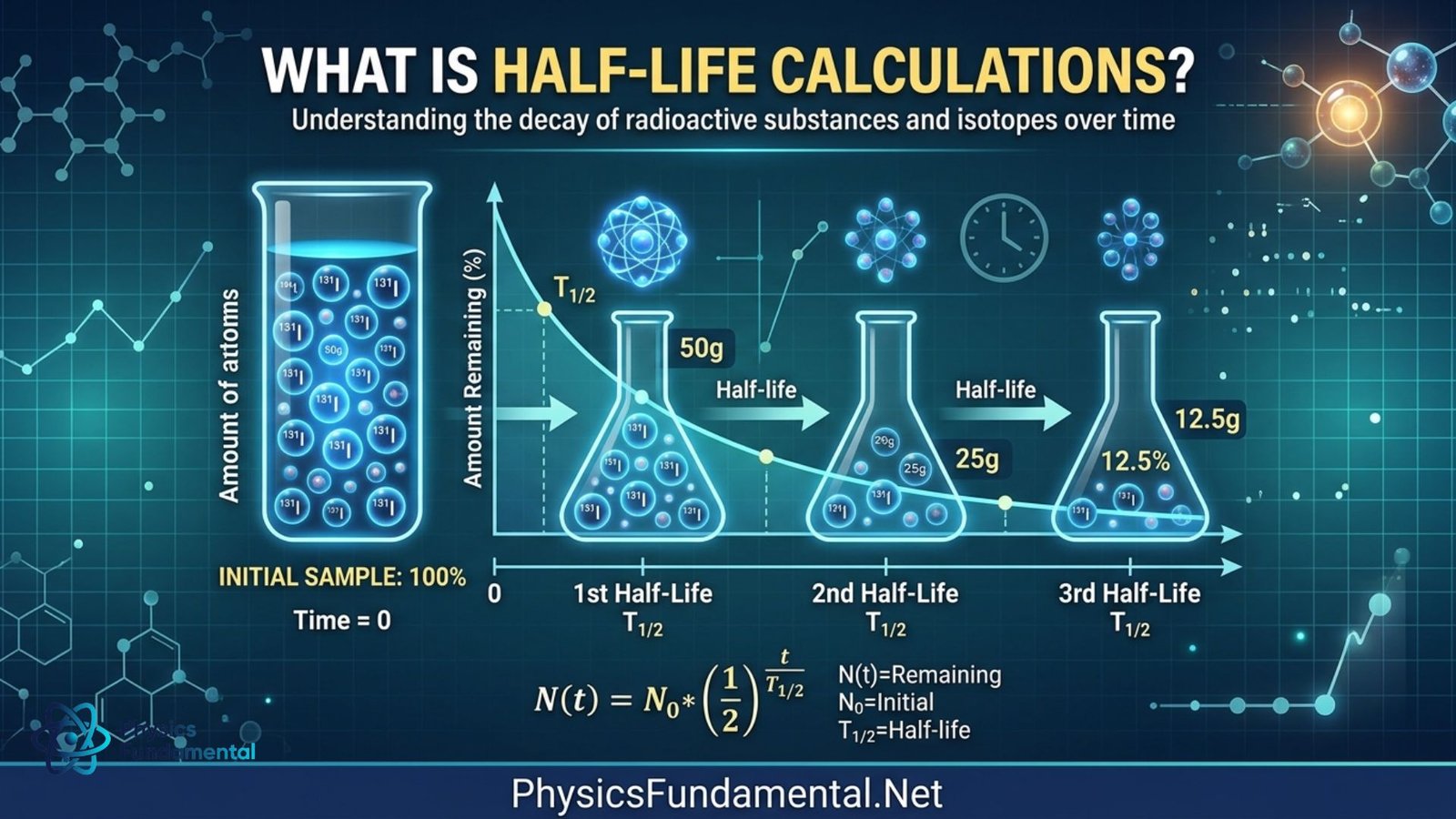
Half-life tells us how long it takes for half of a radioactive sample to decay. For example, if a sample begins with 100 grams of a radioactive substance and its half-life is 10 years, only 50 grams remains after 10 years, 25 grams after 20 years, and 12.5 grams after 30 years.
Understanding half-life calculations becomes much easier once you know the basic half-life formula and how to identify the number of elapsed half-lives. From there, you can calculate the remaining quantity, determine the age of a sample, or find the decay constant.
What Is Half Life Calculations?

Half-life is the time required for half of the radioactive nuclei in a sample to decay.
It is usually represented by the symbol:
T₁/₂
The exact half-life depends on the radioactive isotope. Some isotopes decay in fractions of a second, while others take thousands or millions of years.
Radioactive decay is a statistical process involving unstable atomic nuclei. The concept of radioactive decay and half-life is therefore central to understanding how radioactive substances change with time.
For a radioactive sample, the amount does not decrease by the same number of atoms during every equal time interval. Instead, it decreases by the same fraction during each half-life.
Caffeine Half Life Calculator
A caffeine half-life calculator helps you estimate how much caffeine remains in your body after drinking coffee, tea, energy drinks, or other caffeinated beverages. Caffeine doesn’t disappear immediately after consumption. Instead, your body gradually breaks it down over time.
For example, if you consume 200 mg of caffeine and its half-life is five hours, approximately 100 mg remains after five hours. After another five hours, about 50 mg remains.
To estimate your remaining caffeine, enter the amount consumed, the time elapsed, and your estimated caffeine half-life into a calculator. Many adults have a caffeine half-life of around four to six hours, although individual results vary depending on factors such as medications, pregnancy, smoking habits, and liver metabolism.
How to Calculate Half Life
To calculate half-life, you need to know the original amount of a substance and how much remains after a certain period. Half-life is the time required for a substance to decrease to half its original amount.
The formula is:
Half-life = (Elapsed Time × ln(2)) ÷ ln(Initial Amount ÷ Remaining Amount)
Where:
- Elapsed time: The total time that has passed.
- Initial amount: The quantity at the beginning.
- Remaining amount: The quantity left after the elapsed time.
- ln: The natural logarithm.
For example, suppose you start with 200 mg of caffeine and have 100 mg remaining after five hours. The caffeine half-life is five hours because the amount has decreased by half.
How to Calculate Half Life
You can calculate half-life using a simple mathematical formula or by observing how quickly a substance decreases over time.
For caffeine, use this formula:
Remaining Caffeine = Initial Caffeine × (1/2)^(Elapsed Time ÷ Half-Life)
For example, imagine you drink coffee containing 160 mg of caffeine and assume a half-life of five hours.
- After 5 hours: approximately 80 mg remains.
- After 10 hours: approximately 40 mg remains.
- After 15 hours: approximately 20 mg remains.
- After 20 hours: approximately 10 mg remains.
These are estimates, not exact measurements of caffeine in your bloodstream. Your actual caffeine clearance may be faster or slower.
To get a useful estimate, record your caffeine intake, note when you consumed it, and use a reasonable half-life assumption. Remember that caffeine can remain in your body for many hours, so drinking coffee late in the day may affect your sleep.
The Basic Half-Life Formula
The simplest formula for half-life calculations is:
N = N₀(1/2)ⁿ
Where:
- N = amount remaining
- N₀ = initial amount
- n = number of half-lives that have passed
The number of half-lives can be calculated using:
n = t/T₁/₂
Therefore, the complete equation can also be written as:
N = N₀(1/2)^(t/T₁/₂)
Where:
- t = elapsed time
- T₁/₂ = half-life
This equation is useful when you know the initial quantity, half-life, and elapsed time.
How Half-Life Works
Suppose a radioactive material has a half-life of 5 years and starts with 80 grams.
After one half-life:
80 ÷ 2 = 40 g
After two half-lives:
40 ÷ 2 = 20 g
After three half-lives:
20 ÷ 2 = 10 g
After four half-lives:
10 ÷ 2 = 5 g
The pattern is:
| Half-Lives Passed | Amount Remaining |
|---|---|
| 0 | 100% |
| 1 | 50% |
| 2 | 25% |
| 3 | 12.5% |
| 4 | 6.25% |
| 5 | 3.125% |
Step-by-Step Method for Half Life Calculations
Most basic problems can be solved using the same process.
Step 1: Identify the Initial Amount
Find the starting quantity, represented by N₀.
This might be given in grams, kilograms, atoms, or activity units such as becquerels.
Step 2: Find the Half-Life
Identify T₁/₂, the time required for half of the material to decay.
Step 3: Find the Elapsed Time
Determine how much time has passed, represented by t.
Step 4: Calculate the Number of Half-Lives
Use:
n = t/T₁/₂
Step 5: Calculate the Remaining Amount
Use:
N = N₀(1/2)ⁿ
This gives the amount remaining after the specified time.
Worked Example 1: Finding the Remaining Amount
A radioactive sample has an initial mass of 160 grams and a half-life of 4 years. How much remains after 12 years?
First, calculate the number of half-lives:
n = 12/4 = 3
Three half-lives have passed.
Now apply the formula:
N = 160(1/2)³
N = 160 × 1/8
N = 20 g
Therefore, 20 grams remain after 12 years.
Worked Example 2: Finding the Remaining Percentage
A radioactive isotope has a half-life of 6 hours. What percentage remains after 24 hours?
Calculate the number of half-lives:
n = 24/6 = 4
After four half-lives:
N/N₀ = (1/2)⁴
N/N₀ = 1/16
Convert this to a percentage:
1/16 × 100 = 6.25%
Therefore, 6.25% of the original material remains.
Worked Example 3: Finding the Initial Amount
A radioactive sample contains 15 grams after three half-lives. What was its original mass?
After three half-lives:
N = N₀(1/2)³
So:
15 = N₀/8
Therefore:
N₀ = 15 × 8
N₀ = 120 g
The original sample contained 120 grams.
Worked Example 4: Finding the Half-Life
A radioactive substance decreases from 200 grams to 25 grams in 18 years. What is its half-life?
Start with:
200 → 100 → 50 → 25
The sample has undergone three half-lives.
Therefore:
3T₁/₂ = 18 years
So:
T₁/₂ = 18/3
T₁/₂ = 6 years
The half-life is 6 years.
The Exponential Decay Formula
For more advanced Half Life Calculations, radioactive decay can be described using an exponential equation:
N = N₀e^(-λt)
Where:
- N = amount remaining
- N₀ = initial amount
- e = Euler’s number
- λ = decay constant
- t = elapsed time
The decay constant tells us how quickly a radioactive substance decays.
The relationship between the decay constant and half-life is:
T₁/₂ = ln(2)/λ
Since:
ln(2) ≈ 0.693
we can write:
T₁/₂ = 0.693/λ
The decay constant can therefore be found using:
λ = 0.693/T₁/₂
Worked Example 5: Finding the Decay Constant
An isotope has a half-life of 10 years. Find its decay constant.
Use:
λ = 0.693/T₁/₂
Therefore:
λ = 0.693/10
λ = 0.0693 year⁻¹
The decay constant is approximately:
0.0693 year⁻¹
Half-Life and Radioactive Activity
Half-life can also describe the decrease in radioactive activity.
Activity is the number of nuclear decays occurring per unit of time and is measured in becquerels (Bq).
The same half-life relationship applies:
A = A₀(1/2)^(t/T₁/₂)
Where:
- A = activity after time t
- A₀ = initial activity
- T₁/₂ = half-life
For example, if a sample has an initial activity of 800 Bq and its half-life is 5 hours, after 10 hours:
n = 10/5 = 2
So:
A = 800(1/2)²
A = 800/4
A = 200 Bq
The activity decreases from 800 Bq to 200 Bq.
Finding Time From Half-Life
Sometimes the question gives the initial and final quantities and asks how long the decay took.
Starting with:
N = N₀(1/2)^(t/T₁/₂)
we can rearrange the equation:
t = T₁/₂ × log₂(N₀/N)
This is useful when the amount remaining is not an exact power of one-half.
Example
A sample starts with 500 grams and decreases to 62.5 grams. Its half-life is 3 years. How long did the decay take?
The decay sequence is:
500 → 250 → 125 → 62.5
That represents three half-lives.
Therefore:
t = 3 × 3
t = 9 years
The decay took 9 years.
Half-Life When the Remaining Amount Is Not an Exact Fraction
Not every problem gives a convenient value such as 50%, 25%, or 12.5%.
For example, suppose only 30% of a radioactive sample remains.
Use:
N/N₀ = (1/2)^(t/T₁/₂)
Taking logarithms:
t/T₁/₂ = ln(N/N₀)/ln(1/2)
Therefore:
t = T₁/₂ × ln(N/N₀)/ln(1/2)
This method allows you to calculate the elapsed time for any remaining fraction.
You May Like to Read: Photoelectric Effect Explained: Powerful Einstein Theory & Key Facts 2026
Half-Life Graph
Radioactive decay produces an exponential curve.
At the beginning, the quantity is relatively large. It then falls quickly before gradually approaching zero.
A typical decay sequence looks like:
100% → 50% → 25% → 12.5% → 6.25%
The time between each percentage reduction is the same half-life.
For example, if the half-life is 10 seconds:
- 0 s → 100%
- 10 s → 50%
- 20 s → 25%
- 30 s → 12.5%
- 40 s → 6.25%
The graph is not a straight line because radioactive decay is exponential rather than linear.
Half-Life vs Decay Constant
Half-life and decay constant describe the same radioactive process from different perspectives.
| Quantity | Meaning | Formula |
|---|---|---|
| Half-life | Time for half the sample to decay | T₁/₂ = 0.693/λ |
| Decay constant | Probability of decay per unit time | λ = 0.693/T₁/₂ |
| Remaining amount | Quantity left after time t | N = N₀e^(-λt) |
A short half-life generally corresponds to a larger decay constant, meaning the substance decays more rapidly.
Half-Life in Carbon Dating
Half-life calculations are especially important in radiometric dating.
One famous example is carbon-14 dating. Carbon-14 is radioactive and decays over time. Scientists can compare the amount of carbon-14 remaining in an organic sample with the amount expected in a living organism to estimate when the organism stopped exchanging carbon with its environment.
The calculation relies on radioactive decay equations rather than simply counting whole half-lives when the remaining amount falls between standard fractions.
Half-Life in Medicine
Radioactive isotopes are used in medical diagnosis and treatment.
A radioactive tracer can be introduced into the body and detected as it decays. The isotope’s half-life is important because it affects how long the material remains radioactive.
Medical imaging techniques can therefore depend on careful knowledge of radioactive decay, activity, and half-life.
Half-Life in Nuclear Physics
Half-life calculations help scientists understand unstable nuclei and predict how radioactive materials change over time.
They are useful for:
- Nuclear decay studies
- Radiation measurements
- Nuclear medicine
- Radiometric dating
- Environmental monitoring
- Radioactive waste management
- Scientific research
Half-Life Is Not the Time for Everything to Decay
A common misunderstanding is that a radioactive sample completely disappears after one half-life.
That is incorrect.
After one half-life, 50% remains.
After two half-lives, 25% remains.
After three half-lives, 12.5% remains.
After ten half-lives:
(1/2)¹⁰ ≈ 0.000977
So about 0.098% remains.
The quantity gets extremely small, but mathematical radioactive decay does not normally reach exactly zero.
Does Half-Life Depend on the Amount of Material?
For a particular radioactive isotope under ordinary conditions, the half-life is essentially independent of how much material is present.
A large sample and a small sample of the same isotope have the same characteristic half-life.
However, a larger sample contains more radioactive nuclei, so its total activity is generally greater.
Common Mistakes in Half Life Calculations
Mistake 1: Subtracting the Same Amount Each Time
Radioactive decay is not usually a linear process.
You should divide the amount by two after each half-life rather than subtracting a fixed number.
Mistake 2: Confusing Half-Life With Full Decay Time
One half-life leaves 50% of the original material, not zero.
Mistake 3: Using the Wrong Number of Half-Lives
Always calculate:
n = t/T₁/₂
before applying the simple half-life equation.
Mistake 4: Mixing Units
If the half-life is measured in hours, the elapsed time must also be expressed in hours.
For example, do not divide 12 minutes by a half-life of 2 hours without converting the units first.
Mistake 5: Confusing Mass With Activity
Mass and radioactive activity are different quantities. Both can decrease according to the same decay relationship, but they represent different physical measurements.
How to Solve Half-Life Problems Quickly
For most basic questions, use this checklist:
- Write down the initial amount.
- Identify the half-life.
- Convert all times into the same units.
- Calculate the number of half-lives.
- Divide the original quantity by 2 for each half-life.
- Or use N = N₀(1/2)^(t/T₁/₂).
- Check whether the final value makes physical sense.
For advanced questions involving non-integer numbers of half-lives, use the exponential decay equation or logarithms.
Half-Life Formula Summary
The most important equations are:
Number of half-lives:
n = t/T₁/₂
Basic decay equation:
N = N₀(1/2)ⁿ
Time-dependent half-life equation:
N = N₀(1/2)^(t/T₁/₂)
Exponential decay equation:
N = N₀e^(-λt)
Half-life and decay constant:
T₁/₂ = 0.693/λ
Decay constant:
λ = 0.693/T₁/₂
Time from remaining quantity:
t = T₁/₂ × ln(N/N₀)/ln(1/2)
These equations cover most standard Half Life Calculations encountered in introductory physics and chemistry.
Frequently Asked Questions
What is the formula for half-life?
The basic formula is N = N₀(1/2)^(t/T₁/₂), where N is the remaining amount and T₁/₂ is the half-life.
How do you calculate the number of half-lives?
Divide the elapsed time by the half-life: n = t/T₁/₂.
What remains after three half-lives?
After three half-lives, 12.5% of the original sample remains.
What is the relationship between half-life and decay constant?
They are related by T₁/₂ = 0.693/λ.
Does a radioactive sample ever completely disappear?
Mathematically, exponential decay approaches zero but does not reach exactly zero. In practice, the amount can eventually become extremely small.
Conclusion
Half-life provides a simple way to describe how radioactive substances decrease over time. The key idea is that the sample loses half of its remaining amount during every half-life, rather than half of its original amount each time.
For basic Half Life Calculations, the most useful equation is N = N₀(1/2)^(t/T₁/₂). For more advanced problems, the exponential decay equation N = N₀e^(-λt) connects half-life with the decay constant and allows calculations for any elapsed time.
Once you understand the number of half-lives, the calculations become much easier. These principles are widely used in nuclear physics, medicine, radiometric dating, environmental science, and many other areas where radioactive decay needs to be measured and predicted.