De Broglie Wavelength Explained: Powerful λ = h/mv Formula & Facts 2026
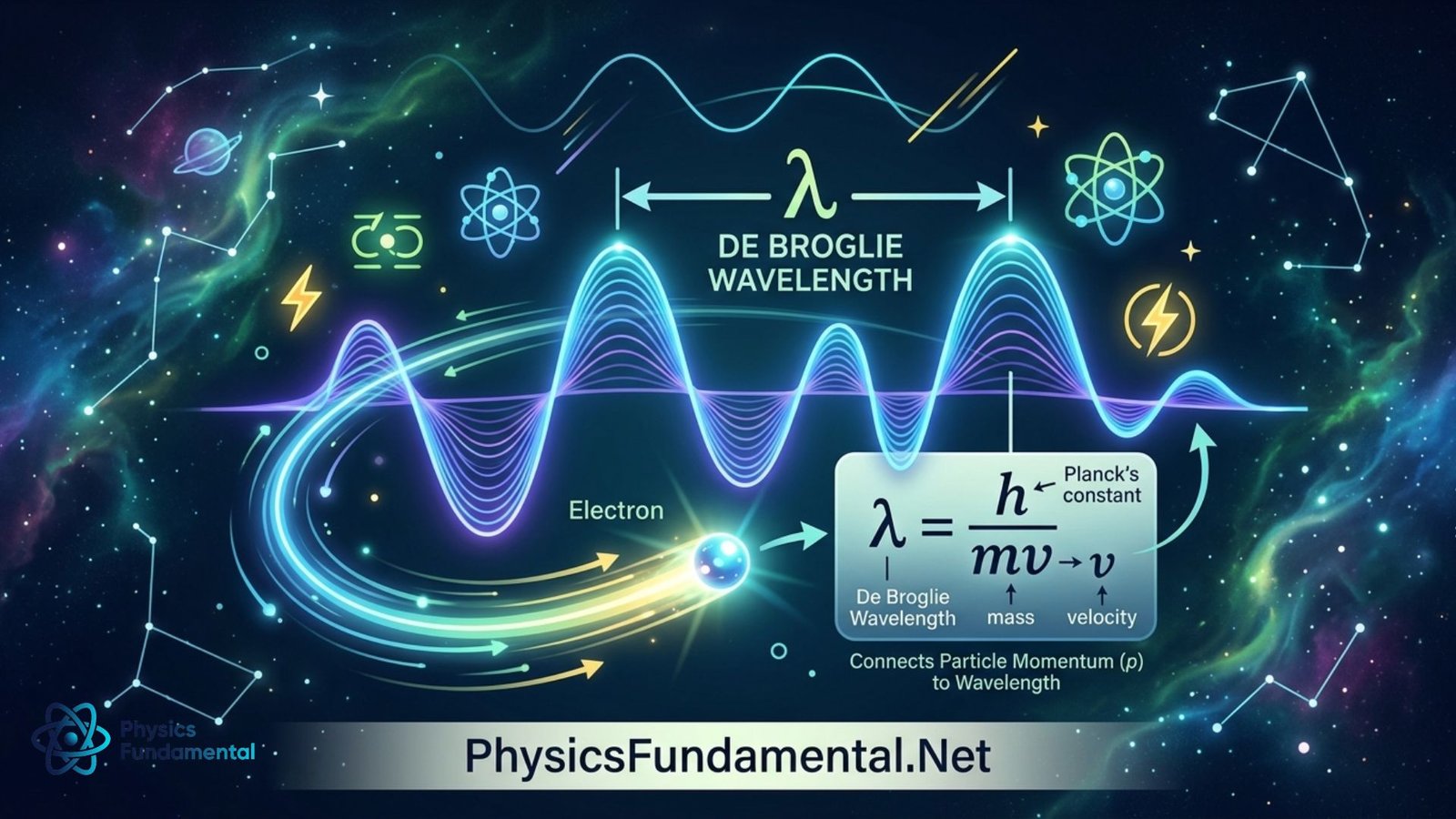
What if matter could behave like a wave? That surprising idea became one of the foundations of quantum mechanics when French physicist Louis de Broglie proposed that particles have wave-like properties. The De Broglie Wavelength connects the wavelength of a particle with its momentum through the famous equation λ = h/mv.
The idea applies to electrons, protons, neutrons, atoms, and other particles. For everyday objects, the wavelength is usually so incredibly small that wave behavior is impossible to notice directly. At microscopic scales, however, matter-wave effects become important and help explain phenomena such as electron diffraction.
The De Broglie relationship also provides an important connection between two seemingly different descriptions of nature: particles and waves. It helped establish the idea of wave-particle duality, a central concept in modern physics.
What Is the De Broglie Wavelength?

The De Broglie Wavelength is the wavelength associated with a moving particle.
According to de Broglie’s hypothesis, every moving particle has wave-like properties. Its wavelength is related to its momentum by:
λ = h/p
where:
- λ = De Broglie wavelength
- h = Planck’s constant
- p = momentum
For a non-relativistic particle:
p = mv
Therefore:
λ = h/mv
where:
- m = particle mass
- v = particle velocity
The equation shows that a particle with greater momentum has a shorter wavelength.
De Broglie wavelength and matter waves
What Is Matter-Wave Duality?
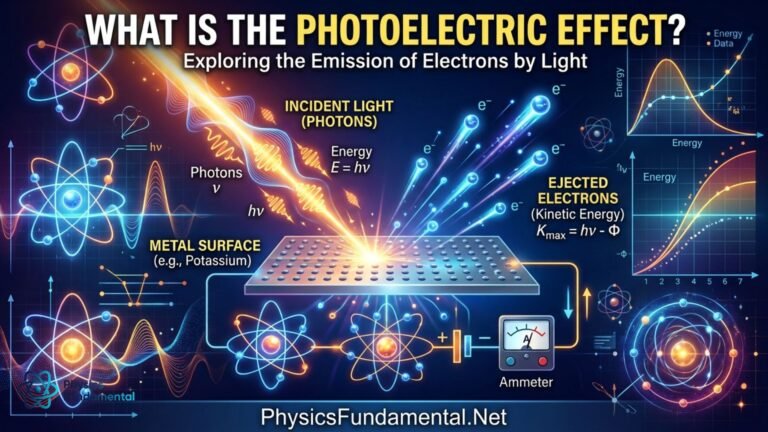
Before de Broglie’s proposal, scientists had already discovered that light, traditionally considered a wave, can also behave like particles.
Photons have energy:
E = hf
where f is frequency.
De Broglie extended this idea to matter. He suggested that particles traditionally considered particles could also exhibit wave-like behavior.
This became known as matter-wave or wave-particle duality.
Experiments later demonstrated that particles such as electrons can produce diffraction and interference patterns, providing evidence for their wave-like nature.
The De Broglie Formula
The fundamental equation is:
λ = h/p
For a particle moving at ordinary, non-relativistic speeds:
p = mv
Therefore:
λ = h/mv
Planck’s constant is:
h = 6.626 × 10⁻³⁴ J·s
Because h is extremely small, the wavelength of ordinary macroscopic objects is usually extremely small.
Deriving the De Broglie Wavelength
The De Broglie relationship can be motivated by combining the properties of photons with Einstein’s relation between energy and momentum.
For a photon:
E = hf
The speed of light is:
c = fλ
Therefore:
f = c/λ
Substitute into the energy equation:
E = hc/λ
For a photon, the relativistic energy-momentum relationship gives:
E = pc
Therefore:
pc = hc/λ
Cancel c:
p = h/λ
Rearranging:
λ = h/p
De Broglie proposed that this relationship should also apply to matter.
For a non-relativistic particle:
p = mv
So:
λ = h/mv
This is the standard De Broglie wavelength equation.
What Does λ = h/mv Tell Us?
The equation reveals several important relationships.
Greater Mass Means Smaller Wavelength
If velocity stays constant:
λ ∝ 1/m
A heavier particle has a shorter wavelength.
Greater Velocity Means Smaller Wavelength
If mass remains constant:
λ ∝ 1/v
A faster particle has a shorter wavelength.
Greater Momentum Means Smaller Wavelength
The most general form is:
λ = h/p
Therefore:
λ ∝ 1/p
Increasing momentum decreases the wavelength.
Worked Example: Electron De Broglie Wavelength
Suppose an electron moves at:
v = 1.0 × 10⁶ m/s
The electron’s mass is approximately:
m = 9.11 × 10⁻³¹ kg
Using:
λ = h/mv
Substitute:
λ = (6.626 × 10⁻³⁴) / [(9.11 × 10⁻³¹)(1.0 × 10⁶)]
The denominator is approximately:
9.11 × 10⁻²⁵
Therefore:
λ ≈ 7.27 × 10⁻¹⁰ m
So the electron’s wavelength is approximately:
0.727 nm
This is comparable to atomic-scale distances, which helps explain why electron wave behavior can be observed in diffraction experiments.
Worked Example: A Larger Object
Consider a 1 kg object moving at 10 m/s.
Its momentum is:
p = mv
p = 1 × 10
p = 10 kg·m/s
Therefore:
λ = h/p
λ = 6.626 × 10⁻³⁴ / 10
λ = 6.626 × 10⁻³⁵ m
This wavelength is extraordinarily small.
That is why we do not normally observe obvious wave behavior for everyday objects.
Why Are Matter Waves Hard to Observe Macroscopically?
The De Broglie equation explains this directly.
For a microscopic particle, mass can be extremely small, so its wavelength can be comparable to atomic distances.
For a macroscopic object, mass is much larger. Even at moderate speeds, its momentum becomes large, causing the wavelength to become incredibly small.
For example:
λ = h/mv
As m increases, λ decreases.
This does not mean macroscopic objects lack a De Broglie wavelength. Rather, their wavelengths are generally too small for ordinary experiments to reveal easily.
De Broglie Wavelength and Momentum
Momentum is the most fundamental quantity in the De Broglie relationship:
λ = h/p
This form is especially useful because it also works when the simple classical expression p = mv is not sufficient.
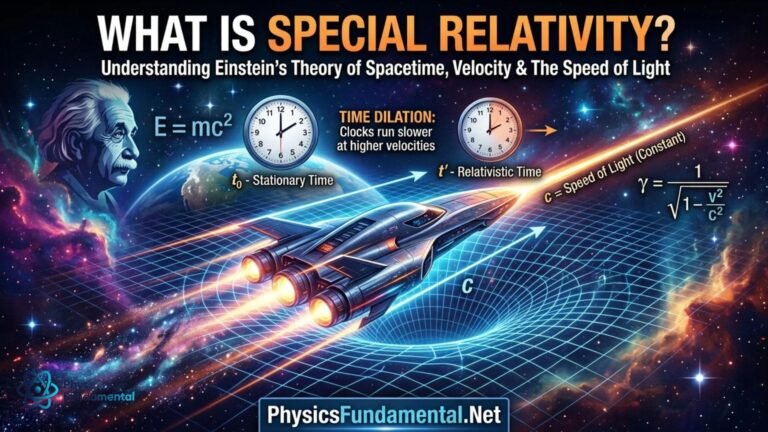
For particles moving close to the speed of light, relativistic momentum must be considered.
The relativistic momentum is:
p = γmv
where:
γ = 1/√(1 − v²/c²)
Therefore, for high-speed particles:
λ = h/(γmv)
At ordinary speeds, the classical approximation:
λ = h/mv
is usually sufficient.
De Broglie Wavelength and Electron Diffraction
One of the important experimental confirmations of matter waves came from electron diffraction.
When electrons interact with crystal structures, they can produce diffraction patterns similar to those produced by waves.
This behavior is difficult to explain using a purely classical particle model.
The diffraction results support the idea that electrons have a wavelength associated with their momentum.
Electron diffraction is therefore an important demonstration of wave-particle duality.
De Broglie Wavelength and the Double-Slit Experiment
The double-slit experiment is another famous demonstration of quantum wave behavior.
When particles such as electrons pass through two possible paths under suitable experimental conditions, an interference pattern can develop when many detection events are accumulated.
This suggests that quantum particles cannot always be described as classical particles following a single ordinary trajectory.
The De Broglie wavelength provides the wavelength associated with the particle’s momentum and helps explain the scale of the resulting interference effects.
De Broglie Wavelength and Quantum Mechanics
The De Broglie hypothesis played a major role in the development of quantum mechanics.
It suggested that particles have wave-like properties and helped lead to the development of wave mechanics.
In modern quantum mechanics, particles are described using quantum states and wavefunctions rather than simply assigning them a classical path.
The De Broglie relationship remains an important connection between a particle’s momentum and its associated wavelength.
You May Like to Read: SUVAT Equations Explained: Powerful Motion Formulas & Examples 2026
De Broglie Wavelength and the Bohr Model
The De Broglie wavelength also provides an interesting interpretation of the quantized orbits in the old Bohr model.
For an electron moving around the nucleus, a standing-wave condition can be written approximately as:
2πr = nλ
where:
- r = orbit radius
- n = positive integer
- λ = De Broglie wavelength
Substitute:
λ = h/mv
Then:
2πr = n(h/mv)
Multiplying by mv:
2πrmv = nh
Since angular momentum is:
L = mvr
we obtain:
L = nh/2π
or:
L = nℏ
where:
ℏ = h/2π
This provides a wave-based interpretation of the quantization condition used in the Bohr model.
Why Does the De Broglie Wavelength Matter?
The De Broglie wavelength is important because it explains why quantum objects can display wave-like effects.
It helps scientists understand:
- Electron diffraction
- Particle interference
- Quantum confinement
- Electron microscopy
- Atomic-scale behavior
- Wave-particle duality
- Quantum mechanics
The relationship is particularly important whenever the particle’s wavelength is comparable to the dimensions of the system it is interacting with.
De Broglie Wavelength in Electron Microscopes
Electron microscopes take advantage of the short wavelengths associated with high-momentum electrons.
The resolution of a microscope is related to the wavelength used. Shorter wavelengths can allow much smaller structures to be resolved.
Electrons can have much shorter wavelengths than visible light under suitable conditions, making electron microscopy useful for investigating structures at very small scales.
De Broglie Wavelength and Uncertainty
The De Broglie wavelength is also connected conceptually with the uncertainty principle.
The wavelength describes a particle’s momentum:
p = h/λ
The uncertainty principle states:
ΔxΔp ≥ ℏ/2
Therefore, a particle’s wave-like description is closely related to the uncertainty in its position and momentum.
Quantum mechanics does not simply treat particles as tiny classical objects with precisely defined trajectories at all times.
De Broglie Wavelength and Energy
For a non-relativistic particle:
K = ½mv²
Momentum is:
p = mv
Therefore:
K = p²/2m
So:
p = √(2mK)
Substitute this into:
λ = h/p
giving:
λ = h/√(2mK)
This form is useful when a particle’s kinetic energy is known instead of its velocity.
Worked Example Using Kinetic Energy
Suppose an electron has kinetic energy:
K = 100 eV
The De Broglie wavelength can be calculated using:
λ = h/√(2mK)
The energy must first be converted into joules:
100 eV ≈ 1.602 × 10⁻¹⁷ J
Using the electron mass and Planck’s constant gives a wavelength of approximately:
λ ≈ 1.23 × 10⁻¹⁰ m
or:
λ ≈ 0.123 nm
This is on the scale of atomic distances, making electron diffraction possible.
Common Mistakes With the De Broglie Formula
Forgetting Momentum
The most general equation is:
λ = h/p
The equation:
λ = h/mv
is the non-relativistic form obtained from p = mv.
Using the Wrong Mass
Make sure the particle mass is in kilograms when using SI units.
Mixing Energy Units
If using the kinetic-energy version of the equation, energy must be converted consistently.
For example:
1 eV = 1.602 × 10⁻¹⁹ J
Forgetting the Meaning of Wavelength
The De Broglie wavelength is not necessarily a physical wave with particles moving up and down like a rope. It is associated with the quantum wave nature of the particle.
Applying Classical Momentum at Relativistic Speeds
For particles moving close to the speed of light, relativistic momentum should be used.
De Broglie Wavelength Formula Summary
The most important equations are:
λ = h/p
For non-relativistic particles:
λ = h/mv
Momentum:
p = mv
For a particle with kinetic energy K:
λ = h/√(2mK)
Planck’s constant:
h = 6.626 × 10⁻³⁴ J·s
Reduced Planck’s constant:
ℏ = h/2π
These equations provide the foundation for many basic matter-wave calculations.
Frequently Asked Questions
What is the De Broglie wavelength?
The De Broglie wavelength is the wavelength associated with a particle’s wave-like quantum behavior. It is given by λ = h/p.
What is the formula for the De Broglie wavelength?
For a non-relativistic particle, the formula is λ = h/mv, where h is Planck’s constant, m is mass, and v is velocity.
Do all particles have a De Broglie wavelength?
According to the de Broglie hypothesis, matter has wave-like properties. However, the wavelength of macroscopic objects is usually far too small to observe directly.
Does a faster particle have a longer wavelength?
No. For a fixed mass, increasing velocity increases momentum and therefore decreases the De Broglie wavelength.
Why is the De Broglie wavelength important?
It helps explain the wave-like behavior of matter, including electron diffraction and interference, and is a fundamental part of quantum mechanics.
Conclusion
The De Broglie Wavelength reveals one of the most surprising ideas in modern physics: matter can exhibit wave-like behavior. The central relationship is:
λ = h/p
and for a non-relativistic particle:
λ = h/mv
The equation shows that wavelength decreases as momentum increases. Microscopic particles can therefore have wavelengths comparable to atomic dimensions, allowing observable quantum effects such as diffraction and interference.
De Broglie’s idea helped establish wave-particle duality and played an important role in the development of quantum mechanics. From electrons in atoms to modern electron microscopes, the concept remains essential for understanding physics at microscopic scales.