Centre of Gravity Explained: Powerful Stability, Balance & Mass Facts 2026
Why can a tall object easily fall over while a low, wide object remains stable? The answer is closely related to where its Centre of Gravity is located. This point helps us understand how objects balance, rotate, tip, and respond to gravitational forces.
The Centre of Gravity is the point where the entire weight of an object can be considered to act. For many objects near Earth’s surface, it provides a convenient way to analyze balance and stability without having to consider gravity acting separately on every small part of the object.
The centre of gravity is closely related to the centre of mass, but the two concepts are not always identical. Understanding the difference is important in mechanics, engineering, sports, architecture, and everyday situations involving balance.
What Is Centre of Gravity?
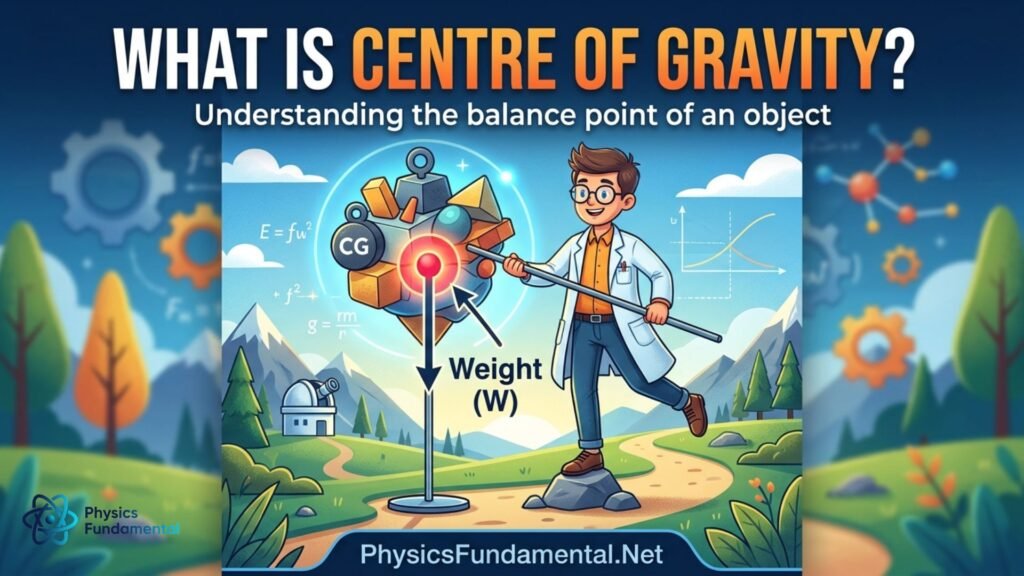
The centre of gravity is the point at which the total gravitational force acting on an object can be considered to act.
In a uniform gravitational field, the centre of gravity and centre of mass are at the same location.
For a simple symmetrical object, finding the centre of gravity can be relatively easy. For example, the centre of gravity of a uniform rectangular block is located at its geometric centre.
The centre of gravity does not necessarily have to lie inside the physical object. For some shapes, such as a ring or hollow structure, the centre of gravity can be located in an empty region.
Centre of Gravity Formula
For a system of discrete masses in a uniform gravitational field, the position of the centre of gravity can be calculated using a weighted average.
For the x-coordinate:
x_cg = Σmᵢxᵢ / Σmᵢ
Similarly:
y_cg = Σmᵢyᵢ / Σmᵢ
Where:
- mᵢ = mass of each part
- xᵢ = x-coordinate of each mass
- yᵢ = y-coordinate of each mass
- Σmᵢ = total mass
Because gravity is assumed to be uniform, this gives the same location as the centre of mass.
For a continuous object, the corresponding expression can be written using integration:
x_c = ∫x dm / ∫dm
The same approach can be used for the y- and z-coordinates.
Centre of Gravity and Weight
Weight is the gravitational force acting on an object.
The basic formula is:
W = mg
Where:
- W = weight
- m = mass
- g = acceleration due to gravity
The total weight of an object can be treated as acting through its centre of gravity.
This makes the analysis of forces and moments much easier, particularly when studying equilibrium and stability.
The broader idea of centre of gravity and centre of mass in mechanics is fundamental to analyzing the motion and balance of physical systems.
Centre of Gravity vs Centre of Mass
Centre of gravity and centre of mass are closely connected but describe different ideas.
Centre of Mass
The centre of mass is the point representing the average position of the mass of an object or system.
It depends on how mass is distributed.
Centre of Gravity
The centre of gravity is the point through which the resultant gravitational force acts.
It depends on the gravitational field as well as the object’s mass distribution.
When Are They the Same?
In a uniform gravitational field, the centre of gravity and centre of mass coincide.
Near Earth’s surface, the gravitational field is approximately uniform for many ordinary-sized objects. Therefore, in most elementary physics problems, the two locations can be treated as the same.
How to Find the Centre of Gravity of a Symmetrical Object
Symmetry can make finding the centre of gravity much easier.
For a uniform object:
- A straight rod → centre
- A rectangular block → geometric centre
- A circular disk → geometric centre
- A sphere → geometric centre
- A uniform ring → geometric centre
The centre of gravity lies on an object’s axis or plane of symmetry.
If an object has more than one symmetry axis, their intersection often identifies the centre of gravity.
Centre of Gravity of an Irregular Object
Finding the centre of gravity becomes more difficult when an object has an irregular shape.
One practical method is to suspend the object from different points.
When an object hangs freely, its centre of gravity lies vertically below the suspension point.
If the object is suspended from a second point, another vertical line can be drawn.
The intersection of these vertical lines identifies the centre of gravity.
This method can be demonstrated using a flat, irregular piece of cardboard.
Suspension Method
- Make a small hole near one edge of the object.
- Suspend the object from that point.
- Allow it to come to rest.
- Draw a vertical line downward from the suspension point.
- Suspend the object from another point.
- Draw another vertical line.
- The intersection of the two lines gives the approximate centre of gravity.
This is a useful experimental technique for irregular flat objects.
Centre of Gravity and Stability
The position of the centre of gravity has a major effect on an object’s stability.
An object is generally more stable when:
- its centre of gravity is low,
- its base is wide,
- the vertical projection of its centre of gravity remains inside its base.
A high centre of gravity and narrow base generally make an object easier to tip.
For example, a sports car typically has a relatively low centre of gravity, which helps reduce the tendency to tip during sharp turns.
Base of Support
The base of support is the area enclosed by the points where an object contacts the ground or supporting surface.
For an object to remain stable under ordinary static conditions, the vertical line through its centre of gravity should fall within its base of support.
If the line moves outside the base, the gravitational torque can cause the object to tip.
This is why standing with your feet spread apart generally gives you greater stability than standing with your feet together.
Worked Example: Stability
Imagine a box standing on a horizontal floor.
Its centre of gravity is located directly above the middle of its base.
The vertical line through the centre of gravity falls inside the base.
Therefore, the box can remain stable.
Now imagine tilting the box until the vertical line through its centre of gravity passes beyond the edge of its base.
At that point, the weight produces a turning effect that tends to rotate the box further.
The box will tip unless another force or support prevents the rotation.
Why a Low Centre of Gravity Improves Stability
A lower centre of gravity generally makes an object more difficult to tip.
Suppose two objects have the same base but different centre-of-gravity heights.
The object with the lower centre of gravity requires a greater tilt before the vertical line through its centre of gravity reaches the edge of the base.
Therefore, it can tolerate a larger angular displacement before tipping.
This principle is used in:
- racing vehicles,
- buses and trucks,
- robotics,
- sports equipment,
- furniture,
- construction machinery.
Centre of Gravity in Vehicles
Vehicle designers pay close attention to the centre of gravity.
A vehicle with a lower centre of gravity generally has improved resistance to tipping during turning and sudden changes in motion.
The position of the centre of gravity also affects:
- handling,
- weight distribution,
- braking behavior,
- cornering,
- rollover tendency.
For example, a tall truck has its centre of gravity higher than many low passenger cars. This is one factor that must be considered when analyzing vehicle stability.
Centre of Gravity in Sports
Athletes use body position to control their centre of gravity and improve balance.
A gymnast, wrestler, skier, or martial artist may lower their body position to increase stability.
A sprinter changes body position during acceleration, while a high jumper deliberately moves their body relative to the bar.
In many sports, controlling the centre of gravity helps athletes maintain balance while producing or resisting forces.
Centre of Gravity in Human Balance
The human body is not a simple rigid object because it contains many moving parts.
The body’s centre of mass changes as the positions of the arms, legs, torso, and head change.
When standing, the body adjusts its posture so that the vertical projection of its centre of mass remains within the area of support provided by the feet.
If the projection moves beyond that area without corrective movement, a person may lose balance.
This is why balance involves continuous adjustments by the nervous system and muscles.
Centre of Gravity in Buildings
Engineers consider centre of gravity when designing buildings and structures.
A structure must be able to resist forces that could cause it to overturn.
Wind, earthquakes, moving loads, and uneven weight distribution can all affect stability.
A broad foundation and suitable mass distribution can help keep the effective centre of gravity and resultant forces within a stable configuration.
Tall structures require particularly careful analysis because their height and exposure to lateral forces can create significant turning moments.
Centre of Gravity and Torque
The weight of an object acts through its centre of gravity.
The resulting turning effect depends on the force and the perpendicular distance from the pivot.
Torque can be expressed as:
τ = rF sinθ
For gravitational torque, the force is the object’s weight:
F = mg
Therefore:
τ = rmg sinθ
Where r is the distance from the pivot to the centre of gravity.
If the line of action of the weight passes directly through the pivot, the gravitational torque is zero.
If it does not, the weight can produce a turning effect.
You May Like to Read: Acceleration in Physics Explained: Powerful Δv/Δt Formula & Examples 2026
Centre of Gravity and Equilibrium
An object is in equilibrium when the net force and net torque acting on it are both zero.
For translational equilibrium:
ΣF = 0
For rotational equilibrium:
Στ = 0
The centre of gravity is particularly useful when calculating gravitational torques.
For example, when analyzing a beam supported at two points, the beam’s entire weight can be treated as acting downward through its centre of gravity.
This simplifies the torque equations.
Worked Example: Centre of Gravity of Two Masses
Two masses are placed along a straight line.
- Mass 1 = 2 kg at x = 0 m
- Mass 2 = 4 kg at x = 3 m
The centre of mass, and therefore the centre of gravity in a uniform gravitational field, is:
x_cg = (m₁x₁ + m₂x₂)/(m₁ + m₂)
Substitute:
x_cg = [(2)(0) + (4)(3)]/(2 + 4)
x_cg = 12/6
x_cg = 2 m
Therefore, the centre of gravity is located 2 m from the first mass.
Notice that the centre is closer to the larger mass because the larger mass contributes more to the weighted average.
Can the Centre of Gravity Be Outside an Object?
Yes.
The centre of gravity does not have to be located inside the material of an object.
For example, a uniform ring has its centre of gravity at its geometric centre, even though there is no material at that central point.
Similarly, certain curved or hollow structures can have a centre of gravity located in an empty region.
This does not mean the object has weight concentrated at an empty point. It is simply a convenient point through which the resultant gravitational force can be considered to act.
Centre of Gravity of a Uniform Rod
For a uniform rod with length L, the centre of gravity is at its midpoint.
Therefore:
x_cg = L/2
For example, if a uniform rod is 4 m long and one end is at x = 0:
x_cg = 4/2 = 2 m
The centre of gravity is therefore 2 m from either end.
Centre of Gravity of a Uniform Rectangle
For a uniform rectangular plate with width w and height h, the centre of gravity lies at its geometric centre.
Its coordinates are:
x_cg = w/2
y_cg = h/2
This occurs because the mass is distributed symmetrically around the centre.
Factors Affecting Stability
Several factors can influence the stability of an object.
Height of Centre of Gravity
A lower centre of gravity generally increases stability.
Width of Base
A wider base makes it harder for the centre-of-gravity projection to move beyond the support area.
Object Shape
The shape determines how far the centre of gravity moves as the object tilts.
Mass Distribution
Moving heavy components can significantly change the centre of gravity.
External Forces
Wind, acceleration, impacts, and other forces can create torques that affect stability.
Common Mistakes About Centre of Gravity
Thinking It Is Always at the Geometric Centre
The centre of gravity is at the geometric centre only for certain symmetrical objects with appropriate uniform mass distribution.
Assuming It Must Be Inside the Object
It can be outside the material of an object.
Confusing Mass With Weight
Mass is measured in kilograms, while weight is a force measured in newtons.
Thinking Lower Is Always Better
A lower centre of gravity often improves stability, but overall stability also depends on the base of support, shape, forces, and motion.
Ignoring Direction of Forces
Stability depends not only on the size of a force but also on its line of action and the torque it produces.
Centre of Gravity vs Centre of Mass: Quick Comparison
| Feature | Centre of Gravity | Centre of Mass |
|---|---|---|
| Meaning | Point where resultant gravitational force acts | Weighted average position of mass |
| Depends on mass distribution | Yes | Yes |
| Depends on gravitational field | Yes | No |
| Same in uniform gravity? | Yes | Yes |
| Used for stability analysis | Very useful | Also useful |
| Can lie outside object | Yes | Yes |
Applications of Centre of Gravity
The concept is used in many areas of science and engineering.
Vehicle design: Engineers analyze centre of gravity to improve handling and reduce rollover risk.
Architecture: Structural designers consider mass distribution and stability when designing buildings.
Aerospace: Aircraft and spacecraft require careful control of their mass distribution for stable operation.
Sports: Athletes manipulate body position to maintain balance and control motion.
Robotics: Robots need appropriate mass distribution to remain stable while walking or moving.
Mechanical engineering: Machines and components are designed with centre-of-gravity calculations to prevent unwanted tipping or vibration.
Everyday objects: Furniture, ladders, bicycles, and tools all rely on principles of balance and stability.
Formula Summary
The most useful formulas related to centre of gravity and balance include:
Centre of gravity in one dimension:
x_cg = Σmᵢxᵢ / Σmᵢ
Centre of gravity in two dimensions:
y_cg = Σmᵢyᵢ / Σmᵢ
Weight:
W = mg
Torque:
τ = rF sinθ
Gravitational torque:
τ = rmg sinθ
Equilibrium:
ΣF = 0
Στ = 0
For a uniform gravitational field, the centre of gravity and centre of mass are at the same location.
Frequently Asked Questions
What is Centre of Gravity?
Centre of Gravity is the point where the entire weight of an object can be considered to act.
What is the difference between centre of gravity and centre of mass?
Centre of mass depends on mass distribution, while centre of gravity depends on how gravity acts on the object. They coincide in a uniform gravitational field.
Why is a low centre of gravity more stable?
A lower centre of gravity usually allows an object to tilt farther before the vertical line through its centre of gravity moves outside its base of support.
Can the centre of gravity be outside an object?
Yes. Hollow and irregular objects can have a centre of gravity located in a region where there is no material.
How do you find the centre of gravity of an irregular object?
A common experimental method is to suspend the object from different points and draw vertical lines downward from each suspension point. Their intersection gives the centre of gravity.
Conclusion
The Centre of Gravity is an essential concept for understanding balance, stability, and rotational motion. It represents the point through which the resultant weight of an object can be considered to act.
For objects in a uniform gravitational field, the centre of gravity coincides with the centre of mass. Its location depends on how mass is distributed, and it can even lie outside the physical material of an object.
From vehicles and buildings to athletes and machines, the centre of gravity plays an important role in determining whether an object remains balanced or tips over. Understanding its relationship with the base of support, torque, and equilibrium makes many real-world stability problems much easier to analyze.