Acceleration in Physics Explained: Powerful Δv/Δt Formula & Examples 2026
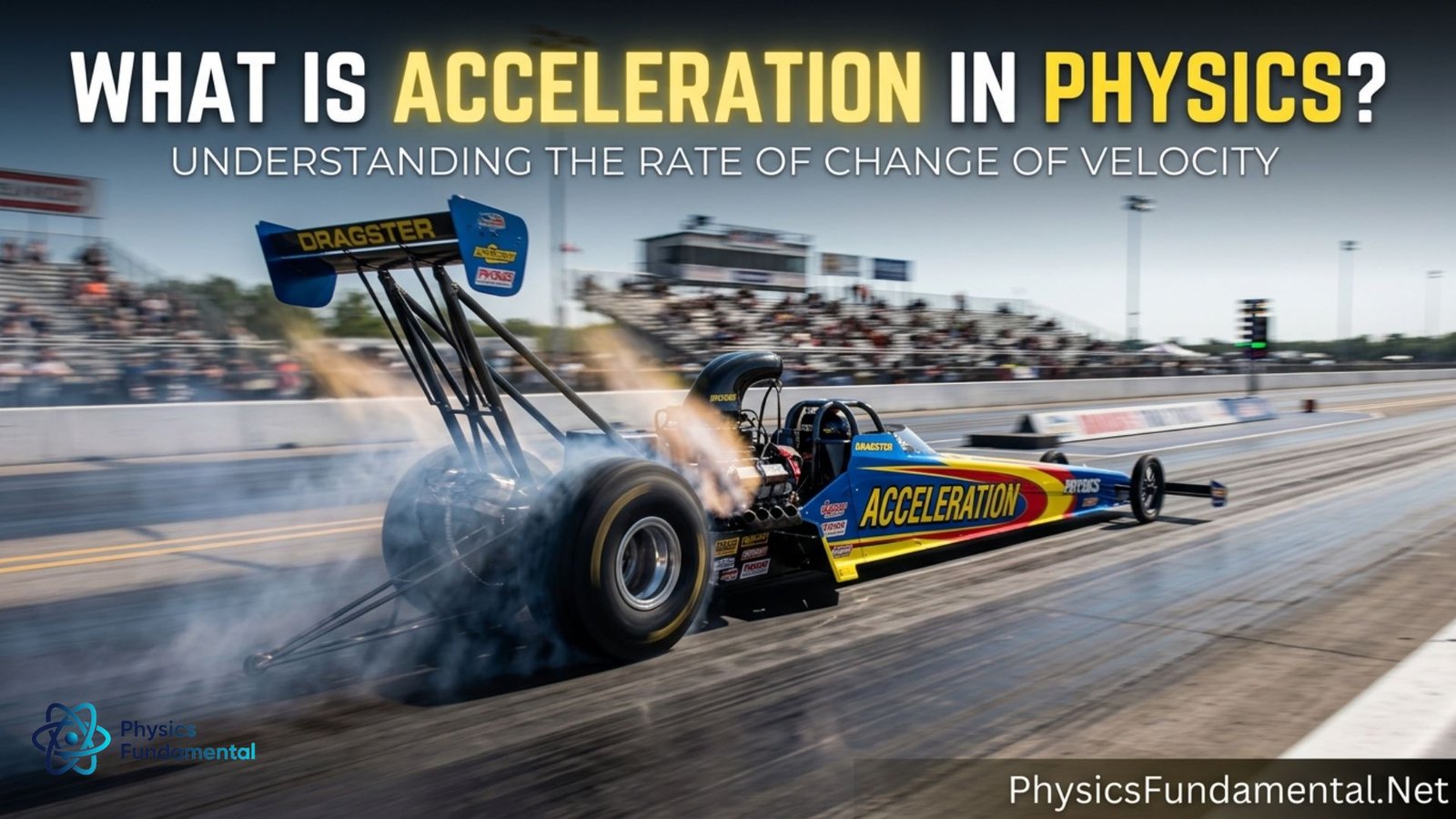
A car does not need to speed up to be accelerating. If it changes speed, slows down, or changes direction, its velocity is changing, and that means acceleration is involved. This simple idea makes acceleration one of the most important concepts in mechanics.
Acceleration in Physics describes how quickly an object’s velocity changes with time. The basic formula is a = Δv/Δt, where acceleration depends on the change in velocity and the time taken for that change.
Understanding acceleration helps explain everything from a falling object and a moving car to planets orbiting stars and athletes sprinting from a starting position. Once the relationship between velocity and time is clear, many motion problems become much easier to solve.
What Is Acceleration in Physics?
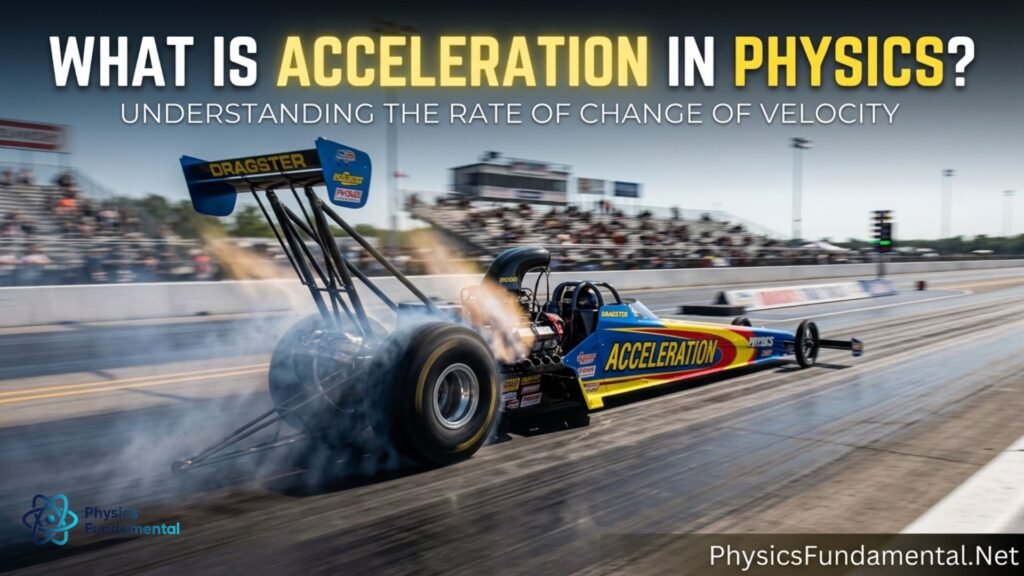
Acceleration is the rate of change of velocity with respect to time. It tells us how rapidly an object’s velocity is changing.
The average acceleration is given by:
a = Δv/Δt
Where:
- a = acceleration
- Δv = change in velocity
- Δt = change in time
The change in velocity can be written as:
Δv = v − u
Therefore:
a = (v − u)/t
Here:
- u = initial velocity
- v = final velocity
- t = time interval
Acceleration is a vector quantity, meaning it has both magnitude and direction.
The concept of acceleration in classical mechanics is closely connected to velocity, displacement, force, and Newton’s laws of motion.
SI Unit of Acceleration
The SI unit of acceleration is:
meter per second squared (m/s²)
An acceleration of 1 m/s² means that an object’s velocity changes by 1 m/s every second, assuming the acceleration remains constant.
For example, if a car has an acceleration of 3 m/s², its velocity increases by 3 m/s every second.
| Time | Velocity |
|---|---|
| 0 s | 0 m/s |
| 1 s | 3 m/s |
| 2 s | 6 m/s |
| 3 s | 9 m/s |
| 4 s | 12 m/s |
This assumes the object starts from rest and maintains constant acceleration.
The Acceleration Formula: a = Δv/Δt
The most important acceleration formula is:
a = Δv/Δt
Since:
Δv = v − u
we can also write:
a = (v − u)/t
This formula is useful when the initial velocity, final velocity, and time interval are known.
Worked Example 1: Finding Acceleration
A car increases its velocity from 10 m/s to 30 m/s in 5 seconds. Find its acceleration.
Given:
u = 10 m/s
v = 30 m/s
t = 5 s
Use:
a = (v − u)/t
a = (30 − 10)/5
a = 20/5
a = 4 m/s²
Therefore, the car’s acceleration is 4 m/s².
Positive Acceleration
Positive acceleration generally means that velocity is changing in the positive direction of the chosen coordinate system.
For an object moving in the positive direction, positive acceleration usually means it is speeding up.
For example, if a car’s velocity changes from 5 m/s to 15 m/s:
a = (15 − 5)/t
The acceleration is positive.
However, it is important to remember that positive acceleration does not always mean speeding up. Whether an object speeds up or slows down depends on the relationship between velocity and acceleration directions.
Negative Acceleration
Negative acceleration means acceleration points in the negative direction of the chosen coordinate system.
It is often called deceleration when an object is slowing down, but negative acceleration and deceleration are not exactly the same thing.
For example, an object moving at +20 m/s with an acceleration of −5 m/s² is slowing down.
But an object moving at −20 m/s with an acceleration of −5 m/s² is actually speeding up in the negative direction.
So, the safest approach is to consider both velocity and acceleration signs.
Constant Acceleration
An object has constant acceleration when its velocity changes by the same amount during equal time intervals.
For example:
2 m/s → 4 m/s → 6 m/s → 8 m/s
If each change happens during one second, the acceleration is constant:
a = 2 m/s²
Constant acceleration makes motion calculations particularly simple because several standard kinematic equations can be used.
Variable Acceleration
Acceleration is variable when it changes with time.
For example, a car may:
- accelerate strongly after starting,
- maintain nearly constant speed,
- accelerate again,
- brake suddenly.
In this situation, acceleration is not the same throughout the entire motion.
For changing acceleration, instantaneous acceleration is defined as:
a = dv/dt
This is the derivative of velocity with respect to time.
Average Acceleration vs Instantaneous Acceleration
These two ideas are related but not identical.
Average Acceleration
Average acceleration measures the overall velocity change during a time interval:
a_avg = Δv/Δt
For example, if velocity changes from 10 m/s to 50 m/s in 8 seconds:
a_avg = (50 − 10)/8
a_avg = 5 m/s²
Instantaneous Acceleration
Instantaneous acceleration tells us the acceleration at a particular instant:
a = dv/dt
For an object whose acceleration changes continuously, instantaneous acceleration can be different at different moments.
Acceleration Due to Gravity
One of the most familiar examples of acceleration is the acceleration caused by Earth’s gravity.
Near Earth’s surface:
g ≈ 9.8 m/s²
This means that, ignoring air resistance, the velocity of a freely falling object changes by approximately 9.8 m/s every second.
For an object falling from rest:
u = 0
After 1 second:
v ≈ 9.8 m/s
After 2 seconds:
v ≈ 19.6 m/s
After 3 seconds:
v ≈ 29.4 m/s
The exact direction and sign depend on which direction is chosen as positive.
Worked Example 2: Falling Object
An object is dropped from rest and falls freely for 3 seconds. Find its velocity, ignoring air resistance.
Use:
v = u + at
Since the object starts from rest:
u = 0
Taking downward as positive:
a = 9.8 m/s²
t = 3 s
Therefore:
v = 0 + (9.8)(3)
v = 29.4 m/s
The object’s velocity after 3 seconds is approximately 29.4 m/s downward.
Kinematic Equations for Constant Acceleration
When acceleration is constant, several equations can be used to solve motion problems.
First Equation
v = u + at
This connects initial velocity, final velocity, acceleration, and time.
Second Equation
s = ut + ½at²
This calculates displacement when initial velocity, acceleration, and time are known.
Third Equation
v² = u² + 2as
This is useful when time is not given.
Fourth Equation
s = [(u + v)/2]t
This uses the average velocity for constant acceleration.
These equations are commonly called the kinematic equations.
Worked Example 3: Using a Kinematic Equation
A motorcycle starts at 5 m/s and accelerates at 3 m/s² for 4 seconds. Find its final velocity.
Use:
v = u + at
Substitute:
v = 5 + (3)(4)
v = 17 m/s
Therefore, the final velocity is 17 m/s.
Acceleration and Velocity
Velocity and acceleration are closely related, but they are not the same quantity.
Velocity tells us how quickly an object’s position changes and in which direction.
Acceleration tells us how quickly its velocity changes.
An object can have:
- velocity without acceleration,
- acceleration while its speed increases,
- acceleration while its speed decreases,
- acceleration while its direction changes.
For example, a car traveling at a constant velocity on a straight road has velocity but zero acceleration.
Can an Object Accelerate at Constant Speed?
Yes.
This is one of the most important ideas about acceleration.
An object moving around a circular path at constant speed is continuously changing its direction. Since velocity includes direction, its velocity changes.
Therefore, the object is accelerating even though its speed remains constant.
This acceleration is called centripetal acceleration.
Its magnitude is:
a_c = v²/r
Where:
- a_c = centripetal acceleration
- v = speed
- r = radius of the circular path
The acceleration points toward the center of the circular path.
Acceleration in Circular Motion
Consider a car traveling around a circular track at constant speed.
Although its speed remains unchanged, its direction changes continuously.
Because:
velocity = speed + direction
the changing direction means the velocity changes.
Therefore:
acceleration ≠ 0
The centripetal acceleration is:
a_c = v²/r
Increasing the speed increases centripetal acceleration, while increasing the radius decreases it for the same speed.
You May Like to Read: Power in Physics Explained: Powerful Formulas, Units & Examples 2026
Acceleration and Newton’s Second Law
Acceleration is also directly connected to force.
Newton’s second law can be written as:
F = ma
Therefore:
a = F/m
This shows that, for a given mass, increasing the net force increases acceleration.
For a given net force, increasing the mass decreases acceleration.
For example, pushing an empty shopping cart and a heavily loaded cart with the same net force will generally produce different accelerations because their masses are different.
Worked Example 4: Force and Acceleration
A net force of 20 N acts on an object with a mass of 5 kg. Find its acceleration.
Use:
a = F/m
Substitute:
a = 20/5
a = 4 m/s²
Therefore, the object’s acceleration is 4 m/s².
Acceleration Graphs
Acceleration can be represented using graphs.
Velocity-Time Graph
On a velocity-time graph, acceleration is the slope.
a = Δv/Δt
Therefore:
- positive slope → positive acceleration
- negative slope → negative acceleration
- zero slope → zero acceleration
A steeper velocity-time graph represents a greater magnitude of acceleration.
Acceleration-Time Graph
An acceleration-time graph shows how acceleration changes with time.
If the graph is a horizontal line above zero, the object has constant positive acceleration.
If it is below zero, the acceleration is negative.
The area under an acceleration-time graph represents the change in velocity:
Δv = ∫a dt
For constant acceleration:
Δv = at
Types of Acceleration
Acceleration can be classified in several useful ways.
Uniform Acceleration
Uniform acceleration occurs when acceleration remains constant.
Example:
An object increases its velocity by 5 m/s every second.
Non-Uniform Acceleration
Non-uniform acceleration changes with time.
Example:
A vehicle accelerating differently as traffic conditions change.
Positive Acceleration
The acceleration points in the positive direction of the chosen coordinate system.
Negative Acceleration
The acceleration points in the negative direction of the chosen coordinate system.
Centripetal Acceleration
This occurs when an object follows a curved path and is directed toward the center of curvature.
Tangential Acceleration
Tangential acceleration changes the speed of an object moving along a curved path.
For rotational motion:
a_t = rα
where r is the radius and α is angular acceleration.
An object in circular motion can have both tangential and centripetal acceleration.
Acceleration and Deceleration
The words acceleration and deceleration can sometimes cause confusion.
Acceleration simply means a change in velocity.
Deceleration is commonly used when an object’s speed decreases.
An object can have negative acceleration while speeding up if it is already moving in the negative direction.
For example:
v = −10 m/s
a = −2 m/s²
The velocity becomes increasingly negative, so the object’s speed increases.
This is why signs should always be interpreted relative to the chosen coordinate system.
Common Real-World Examples of Acceleration
Acceleration appears throughout everyday life.
Cars
A car accelerates when its velocity changes as it moves away from a stop.
Bicycles
A cyclist accelerates when pedaling harder and changes speed.
Airplanes
An airplane accelerates during takeoff and can also accelerate or decelerate during flight.
Elevators
An elevator experiences acceleration when it starts moving, changes speed, or stops.
Falling Objects
Objects falling under gravity experience downward acceleration when air resistance is negligible.
Roller Coasters
Roller coasters experience acceleration as they speed up, slow down, and change direction.
Sports
A runner accelerates when leaving the starting line or changing speed during a race.
Common Mistakes When Calculating Acceleration
Several mistakes occur frequently in acceleration problems.
Confusing Speed With Velocity
Speed has magnitude only, while velocity includes direction.
Because acceleration depends on velocity, direction matters.
Forgetting the Initial Velocity
The formula is:
a = (v − u)/t
Do not automatically assume u = 0 unless the object starts from rest.
Mixing Units
Make sure velocity is expressed consistently, usually in m/s, and time in seconds.
Assuming Negative Acceleration Means Slowing Down
Negative acceleration only describes direction relative to the selected coordinate system.
Using the Wrong Time Interval
Acceleration is calculated over the specific time interval during which the velocity changes.
Ignoring Direction
An object can accelerate even when its speed remains constant if its direction changes.
How to Solve Acceleration Problems
A simple process can make most acceleration problems easier.
Step 1: Write down the known quantities.
Step 2: Identify the initial velocity, final velocity, and time.
Step 3: Choose the appropriate formula.
For average acceleration:
a = (v − u)/t
Step 4: Convert units if necessary.
Step 5: Substitute the values.
Step 6: Calculate the result.
Step 7: Include the correct unit and direction.
For more complicated constant-acceleration problems, determine which kinematic equation contains the quantities you know and the quantity you need.
Acceleration Formula Summary
| Quantity | Formula |
|---|---|
| Average acceleration | a = Δv/Δt |
| Change in velocity | Δv = v − u |
| Acceleration | a = (v − u)/t |
| Instantaneous acceleration | a = dv/dt |
| Newton’s second law | a = F/m |
| Final velocity | v = u + at |
| Displacement | s = ut + ½at² |
| Velocity without time | v² = u² + 2as |
| Average-velocity form | s = [(u + v)/2]t |
| Centripetal acceleration | a_c = v²/r |
| Tangential acceleration | a_t = rα |
Applications of Acceleration
The study of acceleration is important in many areas of science and engineering.
In automotive engineering, acceleration helps engineers analyze vehicle performance, braking, handling, and safety.
In aerospace engineering, acceleration is important when studying aircraft, rockets, spacecraft, and the forces experienced during launch and flight.
In sports science, acceleration helps measure how quickly athletes can increase their velocity.
In robotics, acceleration is used to control how machines move their joints and components.
In transportation systems, acceleration measurements help improve passenger comfort, vehicle control, and safety.
Acceleration is also fundamental to the study of gravity, orbital motion, collisions, and mechanical systems.
Frequently Asked Questions
What is the basic formula for acceleration?
The basic formula is a = Δv/Δt, meaning acceleration equals the change in velocity divided by the time taken.
What is the SI unit of acceleration?
The SI unit is meter per second squared (m/s²).
Is acceleration the same as speed?
No. Speed describes how fast an object moves, while acceleration describes how quickly its velocity changes.
Can an object accelerate without changing speed?
Yes. An object moving in a circular path at constant speed is accelerating because its direction of velocity changes.
What is acceleration due to gravity?
Near Earth’s surface, gravitational acceleration is approximately 9.8 m/s² downward when air resistance is neglected.
Conclusion
Acceleration describes how quickly an object’s velocity changes with time. The fundamental relationship a = Δv/Δt provides a simple way to calculate average acceleration from a change in velocity and the time taken.
Acceleration can be positive or negative, constant or variable, and it can occur even when an object’s speed remains constant if its direction changes. Concepts such as gravitational acceleration, centripetal acceleration, and Newton’s second law show how broadly acceleration is used in physics.
Once you understand the relationship between velocity, time, force, and acceleration, you can solve a wide range of motion problems and better understand how moving objects behave in the real world.