V = IR — Ohm’s Law: 7 Powerful Circuit Examples & Facts 2026
Why does a light bulb glow brighter when you increase the voltage? Why does a circuit draw more current when its resistance is reduced? These questions can be answered with one of the most important relationships in basic electricity: V = IR.
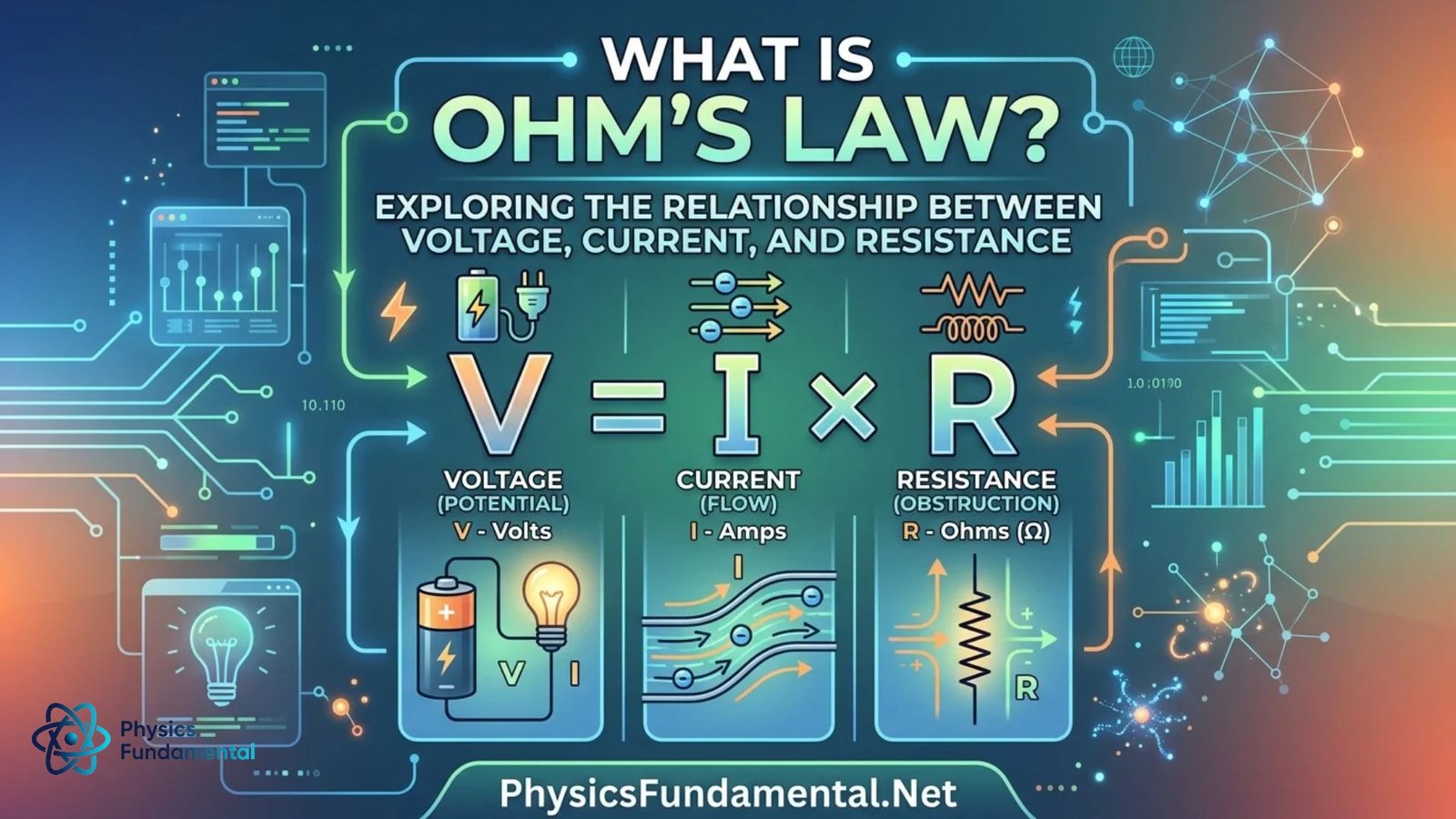
Known as Ohm’s Law, the equation connects three fundamental electrical quantities: voltage, current, and resistance. If you know any two of these values, you can calculate the third. This makes V = IR useful for understanding simple circuits, selecting resistors, troubleshooting electrical systems, and solving physics problems.
The relationship is simple, but understanding what each quantity means is important. Voltage provides the electrical potential difference, current describes the movement of electric charge, and resistance determines how strongly a material or component opposes that movement. Together, these ideas form the foundation of basic circuit analysis and electrical circuit theory.
What Is Ohm’s Law?

Ohm’s Law states that the current through a conductor is directly proportional to the voltage across it, provided physical conditions such as temperature remain constant.
The standard equation is:
V = IR
Where:
- V = voltage in volts (V)
- I = current in amperes (A)
- R = resistance in ohms (Ω)
The equation can be rearranged depending on what you need to calculate.
Finding Voltage
V = IR
Multiply current by resistance to find voltage.
Finding Current
I = V/R
Divide voltage by resistance to find current.
Finding Resistance
R = V/I
Divide voltage by current to find resistance.
These three versions are mathematically equivalent.
Understanding Voltage, Current, and Resistance
To use Ohm’s Law correctly, you need to understand what the three quantities represent.
Voltage
Voltage is the electrical potential difference between two points. It provides the energy-per-unit-charge difference that can drive charge through a circuit.
Voltage is measured in volts (V).
For example, a 12 V battery creates a potential difference of 12 volts between its terminals.
Current
Electric current represents the rate at which electric charge flows through a circuit.
It is measured in amperes (A).
One ampere corresponds to one coulomb of charge passing a point each second:
1 A = 1 C/s
A higher current means more electric charge is passing through a point per unit time.
Resistance
Resistance describes how strongly a component or material opposes electric current.
It is measured in ohms (Ω).
A larger resistance generally means less current for the same applied voltage.
For example, if a circuit has a fixed voltage and its resistance doubles, its current becomes half as large, assuming Ohm’s Law conditions remain valid.
The V = IR Triangle
A useful way to remember Ohm’s Law is the V-I-R triangle:
V
I × R
Cover the quantity you want to calculate:
- Cover V → I × R
- Cover I → V/R
- Cover R → V/I
This is particularly useful when solving introductory circuit problems.
How V = IR Works in a Circuit
Consider a simple circuit containing a battery and resistor.
The battery provides a voltage. That voltage creates an electric field within the circuit, which drives charge through the resistor. The resistor opposes the current.
For an ideal resistor, the relationship is:
I = V/R
This tells us two important things:
- Increasing voltage increases current if resistance stays constant.
- Increasing resistance decreases current if voltage stays constant.
For example, suppose a 12 V battery is connected to a 6 Ω resistor.
Using Ohm’s Law:
I = V/R
I = 12/6
I = 2 A
The circuit therefore carries a current of 2 amperes, assuming the resistor behaves according to Ohm’s Law.
Worked Example 1: Calculate Current
A resistor has a resistance of 10 Ω and is connected to a 20 V source. What current flows through it?
Use:
I = V/R
Substitute the values:
I = 20 V / 10 Ω
I = 2 A
Answer
The current is 2 A.
Worked Example 2: Calculate Voltage
A circuit carries a current of 3 A through a 4 Ω resistor. Find the voltage across the resistor.
Use:
V = IR
Substitute:
V = 3 A × 4 Ω
V = 12 V
Answer
The voltage is 12 V.
Worked Example 3: Calculate Resistance
A device operates at 24 V and draws 2 A of current. What is its resistance?
Use:
R = V/I
Substitute:
R = 24 V / 2 A
R = 12 Ω
Answer
The resistance is 12 Ω.
Worked Example 4: A Realistic Circuit Calculation
Suppose a small electronic circuit is connected to a 9 V battery and contains a 330 Ω resistor.
Find the current.
Using:
I = V/R
I = 9/330
I ≈ 0.0273 A
Convert amperes to milliamperes:
0.0273 A × 1000 ≈ 27.3 mA
Answer
The current is approximately 27.3 mA.
This type of calculation is commonly used when designing circuits with LEDs and current-limiting resistors.
Ohm’s Law Circuit Diagram
A basic series circuit can be represented conceptually as:
Battery → Resistor → Current Flow → Battery
For a circuit containing a voltage source V and resistor R, the current is:
I = V/R
The current is the same throughout a simple series circuit because there is only one path for charge to travel.
Ohm’s Law in Series Circuits
In a series circuit, components are connected along a single path.
The total resistance is:
R_total = R₁ + R₂ + R₃ + …
Once the total resistance is known, the circuit current can be calculated using:
I = V/R_total
Example
Three resistors have values:
- R₁ = 2 Ω
- R₂ = 3 Ω
- R₃ = 5 Ω
The total resistance is:
R_total = 2 + 3 + 5 = 10 Ω
If the supply voltage is 20 V:
I = 20/10 = 2 A
Therefore, the circuit current is 2 A.
Ohm’s Law in Parallel Circuits
Parallel circuits provide multiple paths for current.
For resistors connected in parallel:
1/R_total = 1/R₁ + 1/R₂ + 1/R₃ + …
In a parallel circuit, the voltage across each branch is the same, while the current can differ between branches.
Example
Two resistors, 6 Ω and 3 Ω, are connected in parallel to a 12 V source.
Their equivalent resistance is:
1/R_total = 1/6 + 1/3
1/R_total = 1/6 + 2/6
1/R_total = 3/6 = 1/2
Therefore:
R_total = 2 Ω
Now calculate total current:
I = V/R
I = 12/2
I = 6 A
The total current supplied by the source is therefore 6 A.
You May Like to Read: Snell’s Law Explained: 7 Powerful Formulas, Examples & Facts 2026
Ohm’s Law and Electrical Power
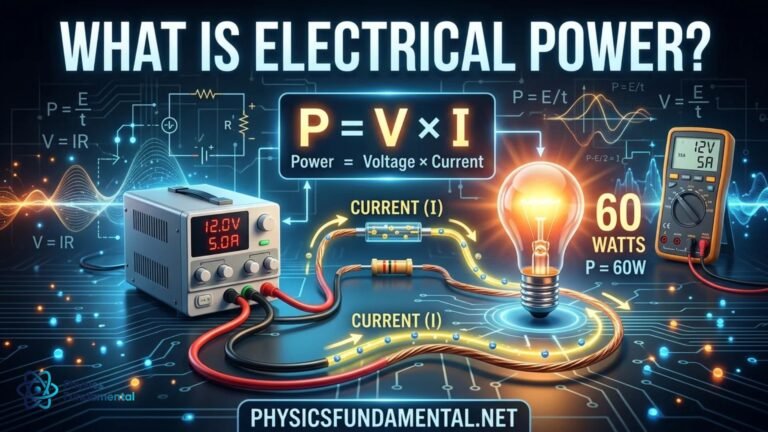
Ohm’s Law is closely connected to electrical power.
The basic power equation is:
P = VI
Where:
- P = power in watts (W)
- V = voltage in volts
- I = current in amperes
By combining this equation with V = IR, we can obtain two additional useful formulas.
Power in Terms of Current and Resistance
Since:
V = IR
Substitute into P = VI:
P = I²R
Power in Terms of Voltage and Resistance
Since:
I = V/R
Substitute into P = VI:
P = V²/R
Therefore, the three common power formulas are:
P = VI
P = I²R
P = V²/R
These formulas are useful when determining how much electrical energy a resistor or other component converts into heat or other forms of energy.
Worked Example 5: Calculate Electrical Power
A 10 Ω resistor carries a current of 2 A. How much power does it dissipate?
Use:
P = I²R
P = (2)² × 10
P = 4 × 10
P = 40 W
Answer
The resistor dissipates 40 watts of power.
This is also why a resistor must have an appropriate power rating. A resistor that continuously dissipates more power than it is designed to handle can become excessively hot or fail.
V-I Graph for an Ohmic Resistor
Ohm’s Law can also be represented using a graph.
If voltage is plotted on the vertical axis and current on the horizontal axis, an ideal ohmic resistor produces a straight line through the origin.
The relationship is:
V = IR
Comparing this with the equation of a straight line:
y = mx
the slope of a V-versus-I graph is the resistance:
Slope = R
A larger slope means a larger resistance.
If current is plotted against voltage instead, the relationship becomes:
I = V/R
In that case, the slope is:
Slope = 1/R
What Is an Ohmic Conductor?
A component is described as ohmic when it follows Ohm’s Law over the relevant operating range.
For an ohmic component:
V/I = constant
Therefore, its resistance remains approximately constant under the specified conditions.
A common example is a conventional resistor operating within its rated conditions.
Non-Ohmic Components
Not every electrical component follows a constant V = IR relationship.
Some components are non-ohmic, meaning their resistance changes with voltage, current, temperature, or other conditions.
Examples include:
- Diodes
- LEDs
- Filament lamps
- Thermistors
- Transistors
For these components, the ratio V/I may change as the operating point changes.
For example, the resistance of a filament lamp changes significantly as its filament heats up. Therefore, it does not behave like an ideal constant-resistance component.
Factors That Affect Resistance
For a uniform conductor, resistance can be related to its material and physical dimensions using:
R = ρL/A
Where:
- R = resistance
- ρ = resistivity of the material
- L = length of the conductor
- A = cross-sectional area
This equation shows that resistance increases with length and decreases with cross-sectional area, assuming the material and temperature remain constant.
A long, thin wire therefore generally has greater resistance than a short, thick wire made from the same material.
Resistance and Temperature
Temperature can affect resistance.
For many metallic conductors, resistance increases as temperature rises. This happens because increased thermal motion makes it more difficult for electrons to move through the material.
For some other materials, the relationship can be different.
This is important because Ohm’s Law is generally applied under conditions where the relevant physical properties remain sufficiently constant.
Why Is Ohm’s Law Important?
Ohm’s Law is one of the basic tools used in electrical and electronic calculations.
It helps with:
- Calculating circuit current
- Finding voltage drops
- Determining resistance
- Selecting resistor values
- Estimating power dissipation
- Designing simple circuits
- Troubleshooting electrical systems
- Understanding sensor circuits
- Analyzing series and parallel networks
Although real electrical systems can be more complicated, V = IR provides a foundation for understanding many basic circuit relationships.
Common Mistakes When Using V = IR
Mixing Up the Variables
Remember:
V = IR
Voltage equals current multiplied by resistance.
Forgetting Unit Conversions
Make sure units are compatible.
For example:
1 kΩ = 1000 Ω
and
1 mA = 0.001 A
Incorrect unit conversions can produce answers that are off by factors of 1000.
Confusing Current With Voltage
Voltage and current are different quantities.
Voltage is a potential difference, while current is the rate of charge flow.
Assuming Every Component Is Ohmic
V = IR can describe an ideal resistor or an ohmic component under suitable conditions. Non-ohmic components may not have a constant resistance.
Ignoring Power Ratings
Finding the current and voltage is not always enough. A resistor also needs to be able to safely handle the resulting power.
Important Ohm’s Law Formulas
Here is a quick summary:
| Quantity | Formula | Unit |
|---|---|---|
| Voltage | V = IR | Volt (V) |
| Current | I = V/R | Ampere (A) |
| Resistance | R = V/I | Ohm (Ω) |
| Power | P = VI | Watt (W) |
| Power | P = I²R | Watt (W) |
| Power | P = V²/R | Watt (W) |
| Resistance of a conductor | R = ρL/A | Ohm (Ω) |
Frequently Asked Questions
What does V = IR mean?
V = IR means voltage equals current multiplied by resistance. It describes the relationship between these three quantities in an ohmic component.
What is Ohm’s Law used for?
Ohm’s Law is used to calculate voltage, current, or resistance when the other two values are known.
What are the units of V, I, and R?
Voltage is measured in volts, current in amperes, and resistance in ohms.
Does Ohm’s Law apply to every electrical component?
No. It applies directly to ohmic components under suitable conditions. Many components, such as diodes and filament lamps, are non-ohmic.
How is Ohm’s Law related to electrical power?
Ohm’s Law can be combined with P = VI to produce P = I²R and P = V²/R, which are useful for calculating power.
Conclusion
V = IR is one of the most useful equations for understanding basic electricity. It connects voltage, current, and resistance and allows you to calculate one quantity when the other two are known.
The same relationship can be applied to simple resistors, series circuits, parallel circuits, and many practical electronic calculations. When combined with electrical power equations, it also helps determine how much energy components dissipate.
The key formulas to remember are V = IR, I = V/R, and R = V/I. Understanding what these quantities mean, checking your units, and knowing when a component is non-ohmic will help you solve circuit problems accurately.