Time Dilation, Length Contraction and E = mc²: Powerful Relativity 2026
Imagine traveling through space at a speed incredibly close to the speed of light. Your watch still seems to tick normally to you, your spacecraft still feels ordinary, and you can measure its length just as you always have. But an observer watching you from Earth can measure a different passage of time and a different length along your direction of motion.
This surprising behavior is explained by Time Dilation, Length Contraction and E = mc², three important consequences and ideas associated with Einstein’s special theory of relativity. At everyday speeds, these effects are so small that we do not notice them. As an object’s speed approaches the speed of light, however, relativistic effects become increasingly important.
Special relativity changed the way physicists understand space, time, motion, and energy. It is based on two fundamental postulates: the laws of physics are the same in all inertial reference frames, and the speed of light in vacuum is the same for all inertial observers. These principles lead to results that seem strange from a classical perspective but have been experimentally tested.
What Is Special Relativity?
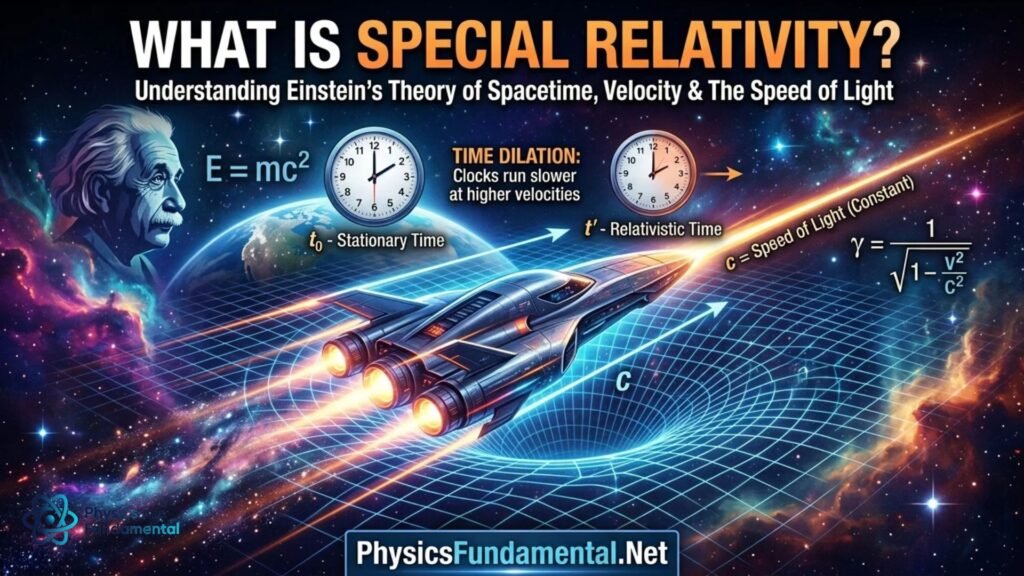
Special relativity is Einstein’s theory describing how measurements of space and time behave for observers moving at constant velocity relative to one another.
It applies specifically to inertial reference frames, meaning reference frames that are not accelerating.
The theory is built on two main postulates.
First Postulate: Laws of Physics Are the Same
The laws of physics have the same form in every inertial reference frame.
For example, an observer inside a smoothly moving spacecraft and an observer in another inertial frame can both use the same fundamental physical laws.
Second Postulate: The Speed of Light Is Constant
The speed of light in vacuum has the same value for every inertial observer:
c = 3.00 × 10⁸ m/s
This is true regardless of the motion of the source or the observer.
This second postulate is particularly important because it means that ordinary Newtonian ideas about adding velocities cannot completely describe objects moving at relativistic speeds.
Why Does Relativity Change Time and Length?
In classical physics, time is usually treated as universal. If two people have synchronized clocks, Newtonian physics suggests that they should agree about the passage of time.
Special relativity shows that this assumption does not hold for observers moving relative to one another.
The reason is connected to the constant speed of light.
If all inertial observers must measure the same speed of light, they cannot all measure the same time interval and distance in the same way. Instead, measurements of space and time adjust between reference frames.
This produces several important effects:
- Time dilation
- Length contraction
- Relativity of simultaneity
- Relativistic momentum
- Mass-energy equivalence
The first two are especially important for understanding motion near the speed of light.
The Lorentz Factor
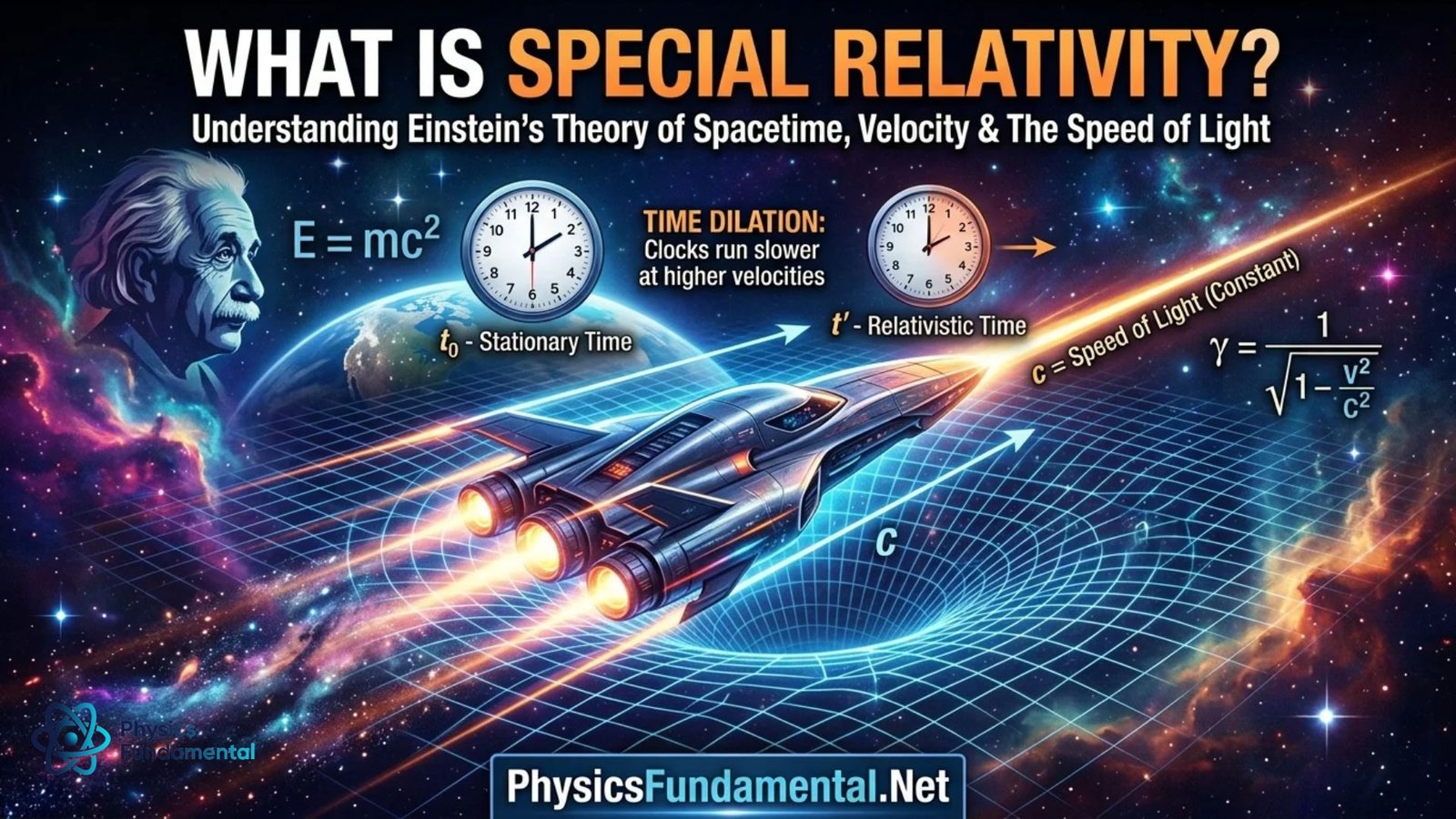
The central mathematical quantity used in many special-relativity equations is the Lorentz factor, represented by the Greek letter gamma:
γ = 1 / √(1 − v²/c²)
where:
- γ = Lorentz factor
- v = relative velocity between observers
- c = speed of light
As long as v is much smaller than c, gamma is very close to 1.
For example, at ordinary speeds such as 100 m/s, the difference from classical physics is extremely small.
As v approaches c, however, gamma becomes much larger.
For example:
v = 0.5c
gives approximately:
γ ≈ 1.155
At:
v = 0.9c
the factor becomes approximately:
γ ≈ 2.294
At:
v = 0.99c
it becomes approximately:
γ ≈ 7.089
This rapid increase explains why relativistic effects become significant at extremely high speeds.
What Is Time Dilation?
Time dilation is the phenomenon in which different inertial observers can measure different elapsed times between events.
For an object moving relative to an observer, the moving clock is measured to run more slowly than a clock at rest relative to that observer.
The equation is:
Δt = γΔt₀
where:
- Δt = time interval measured by the observer who sees the clock moving
- Δt₀ = proper time measured in the frame where the two events occur at the same location
- γ = Lorentz factor
Because γ is always greater than or equal to 1:
Δt ≥ Δt₀
The proper time is therefore the shortest time interval between the same two events.
OpenStax gives the same relationship and explains time dilation using a light-clock thought experiment.
Understanding Time Dilation With a Simple Example
Suppose a spacecraft travels at:
v = 0.8c
At this speed:
γ = 1 / √(1 − 0.8²)
γ = 1 / √(1 − 0.64)
γ = 1 / √0.36
γ = 1/0.6
γ ≈ 1.667
Suppose astronauts experience:
Δt₀ = 3 years
An observer on Earth would calculate:
Δt = γΔt₀
Δt = 1.667 × 3
Δt ≈ 5 years
So approximately 3 years could pass for the astronauts while about 5 years pass for the Earth observer, assuming the relevant relative motion remains constant.
The astronauts themselves would not feel their own time slowing down. Their clocks and biological processes would appear normal in their own reference frame.
What Is Proper Time?
Proper time is the time interval measured by a clock that is present at the same location for both events being considered.
It is represented by:
Δt₀
For example, imagine a passenger presses a button and then presses it again while remaining in the same spacecraft. The time measured by a clock traveling with that passenger can be the proper time.
Another observer watching the spacecraft move may measure a longer interval between those same events.
Proper time is therefore extremely important when applying the time-dilation equation.
What Is Length Contraction?
Length contraction is the shortening of an object’s measured length along the direction of its relative motion.
The equation is:
L = L₀/γ
or:
L = L₀√(1 − v²/c²)
where:
- L₀ = proper length
- L = contracted length measured by an observer who sees the object moving
- γ = Lorentz factor
Proper length is the length measured in the reference frame where the object is at rest.
The contraction occurs only along the direction of motion. Dimensions perpendicular to the motion are not contracted in this basic treatment.
Worked Example of Length Contraction
Suppose a spacecraft has a proper length of:
L₀ = 100 m
It travels at:
v = 0.8c
We already know:
γ ≈ 1.667
Therefore:
L = L₀/γ
L = 100/1.667
L ≈ 60 m
An observer who sees the spacecraft moving at 0.8c measures its length along the direction of motion as approximately 60 m.
The astronauts inside the spacecraft do not measure their spacecraft as being 60 m long. In their own rest frame, it remains 100 m long.
Time Dilation and Length Contraction Are Connected
Time dilation and length contraction are not independent tricks added to physics. They arise from the same relativistic structure.
Suppose two observers measure the same moving object.
If they disagree about elapsed time but must agree about the speed of light, their measurements of distance must also adjust.
Since:
speed = distance/time
a change in the measured time interval is connected to a corresponding change in measured distance.
This is why the Lorentz factor appears in both equations:
Δt = γΔt₀
and:
L = L₀/γ
One effect involves time intervals, while the other involves spatial lengths.
The Relativity of Simultaneity
Another important consequence of special relativity is that two events that are simultaneous in one reference frame may not be simultaneous in another.
In everyday life, we usually assume that if two events happen at exactly the same time, everyone agrees that they are simultaneous.
At relativistic speeds, that assumption fails.
This idea is closely connected to time dilation and length contraction. It is also one reason why space and time are treated together as spacetime.
What Does E = mc² Mean?
Einstein’s famous equation is:
E = mc²
It describes the relationship between mass and rest energy.
Here:
- E = rest energy
- m = rest mass
- c = speed of light
Because the speed of light is extremely large, even a small amount of mass corresponds to a very large amount of energy.
The equation is more precisely written as:
E₀ = mc²
when referring specifically to an object’s rest energy.
The broader relativistic energy equation is:
E = γmc²
for a particle of rest mass m moving at speed v.
At rest:
v = 0
so:
γ = 1
and therefore:
E = mc²
OpenStax identifies E₀ = mc² as the rest-energy form of Einstein’s famous relation.
Why Is c² So Important?
The number c² is enormous.
Since:
c ≈ 3.00 × 10⁸ m/s
then:
c² ≈ 9.00 × 10¹⁶ m²/s²
Therefore, even a small mass corresponds to a very large rest-energy equivalent.
For example, consider:
m = 1 gram
Convert it into kilograms:
m = 0.001 kg
Then:
E = mc²
E = (0.001)(3.00 × 10⁸)²
E = 9.00 × 10¹³ J
So one gram of mass corresponds to a rest-energy equivalent of approximately:
9 × 10¹³ joules
This does not mean that ordinary matter automatically releases all of this energy. Converting mass into energy depends on the physical process involved.
Mass-Energy Equivalence
The equation E = mc² shows that mass contributes to the energy content of a system.
This principle is particularly important in nuclear physics.
In nuclear reactions, the total mass of the products can differ slightly from the total mass of the initial particles. The mass difference corresponds to an energy difference according to:
ΔE = Δmc²
Even a tiny mass difference can correspond to a substantial amount of energy because c² is so large.
This relationship helps explain energy released in nuclear reactions and the energy associated with nuclear binding.
Stanford’s Einstein and Gravity Probe B educational material also describes the relationship between mass and energy through E = mc².
A Natural Wikipedia Reference for Special Relativity
For additional background on the broader theory behind these effects, you can explore special relativity and spacetime.
Special relativity provides the framework connecting measurements of space, time, motion, and energy between inertial observers.
Worked Example: Calculating Rest Energy
Suppose an object has a mass of:
m = 2 kg
Its rest energy is:
E = mc²
Substitute:
E = 2(3.00 × 10⁸)²
E = 2(9.00 × 10¹⁶)
E = 1.80 × 10¹⁷ J
Therefore, the object’s rest-energy equivalent is:
1.8 × 10¹⁷ J
Again, this represents the mass-energy equivalence, not necessarily an amount of energy that can be extracted from an ordinary object through a simple process.
Relativistic Energy at High Speed
For a moving object, the total relativistic energy is:
E = γmc²
At rest:
γ = 1
so:
E₀ = mc²
As velocity increases, gamma increases, and the total energy increases.
The relativistic kinetic energy is:
K = E − E₀
Therefore:
K = (γ − 1)mc²
At low speeds, this expression approaches the familiar classical result:
K ≈ ½mv²
This shows how classical mechanics emerges as an approximation of relativity at speeds much smaller than the speed of light.
Why Can’t a Massive Object Reach the Speed of Light?
As an object’s speed approaches c:
γ → ∞
The relativistic energy:
E = γmc²
therefore grows without bound in the limit.
For an object with nonzero rest mass, reaching the speed of light would require an unlimited amount of energy according to special relativity.
This is why massive objects cannot be accelerated to exactly the speed of light.
Light itself travels at c in vacuum because photons have zero rest mass and are described differently from massive particles.
Does Time Actually Slow Down?
The phrase “time slows down” is useful, but it should be understood carefully.
A person traveling with a spacecraft does not experience their own clock as running slowly. Their heartbeat, watch, thoughts, and physical processes all proceed normally in their own rest frame.
The difference appears when measurements made in different inertial reference frames are compared.
This is a fundamental feature of relativity rather than a mechanical malfunction of clocks.
Experimental and technological applications rely on these relativistic effects. For example, relativistic corrections are relevant to satellite-based timing systems such as GPS.
Does an Object Really Shrink?
Length contraction also depends on the reference frame.
An observer who sees an object moving at relativistic speed measures a shorter length along the direction of motion.
An observer traveling with the object measures its proper length.
So it is not correct to imagine that an object is physically being squeezed in its own rest frame.
The measured length depends on the observer’s reference frame.
Everyday Speeds vs Relativistic Speeds
Why do we not notice time dilation or length contraction while driving a car?
The answer is that ordinary speeds are extremely small compared with the speed of light.
Suppose:
v = 30 m/s
compared with:
c = 3.00 × 10⁸ m/s
Then:
v/c ≈ 1 × 10⁻⁷
The quantity v²/c² is therefore extraordinarily small.
As a result:
γ ≈ 1
and relativistic corrections are negligible for most everyday purposes.
At speeds such as 0.9c, however, the effects are dramatic.
Applications of Special Relativity
Special relativity is not only a theoretical idea. Its principles are important across modern physics and technology.
Particle Accelerators
Particles are routinely accelerated to speeds extremely close to the speed of light. Their energies and momenta must therefore be treated relativistically.
Nuclear Physics
The relationship:
E = mc²
helps physicists relate mass differences to energy differences in nuclear reactions.
GPS Technology
Precise satellite timing requires relativistic corrections because satellite clocks and clocks on Earth’s surface experience different relativistic conditions.
High-Energy Astrophysics
Relativistic effects are essential when studying cosmic rays, rapidly moving particles, and energetic astronomical objects.
Space Travel
Special relativity places fundamental constraints on travel at speeds approaching the speed of light and helps scientists calculate how time and distance measurements differ between spacecraft and Earth.
Common Misconceptions
“Time stops at normal high speeds.”
No. Relativistic time dilation becomes significant only when speeds are a substantial fraction of the speed of light.
“Astronauts feel time slowing down.”
Not in their own reference frame. Their clocks and biological processes appear normal to them.
“Length contraction happens in every direction.”
No. In the standard treatment, contraction occurs along the direction of relative motion.
“E = mc² means all matter can instantly become energy.”
No. The equation describes mass-energy equivalence. A particular physical process is required to convert mass into other forms of energy.
“Mass increases with speed.”
Modern treatments generally keep rest mass invariant and describe the increase in total energy and relativistic momentum using the Lorentz factor. The older concept of “relativistic mass” is generally avoided in contemporary introductory physics.
“Nothing can travel faster than light.”
Special relativity states that massive objects cannot be accelerated through the speed of light in vacuum. The speed of light also serves as the invariant limiting speed for causal signals in special relativity.
Important Special Relativity Formulas
Speed of Light
c = 3.00 × 10⁸ m/s
Lorentz Factor
γ = 1/√(1 − v²/c²)
Time Dilation
Δt = γΔt₀
Length Contraction
L = L₀/γ
Relativistic Momentum
p = γmv
Total Relativistic Energy
E = γmc²
Rest Energy
E₀ = mc²
Relativistic Kinetic Energy
K = (γ − 1)mc²
Mass-Energy Change
ΔE = Δmc²
Frequently Asked Questions
What is time dilation?
Time dilation is the relativistic effect in which different inertial observers can measure different elapsed times between the same events.
What is length contraction?
Length contraction is the reduction in measured length along the direction of relative motion for an observer who sees an object moving at relativistic speed.
What does E = mc² mean?
E = mc² expresses the relationship between an object’s rest mass and its rest energy, showing that mass corresponds to a large amount of energy.
Why does time dilation happen?
Time dilation follows from the requirement that all inertial observers measure the same speed of light in vacuum.
Can a massive object reach the speed of light?
No. As a massive object’s speed approaches the speed of light, the required relativistic energy increases without bound.
Conclusion
Time Dilation, Length Contraction and E = mc² are among the most important ideas introduced by special relativity. They show that measurements of time and distance depend on the relative motion of observers and that mass is directly connected to energy.
The Lorentz factor provides the mathematical foundation for these effects:
γ = 1/√(1 − v²/c²)
From it, we obtain time dilation:
Δt = γΔt₀
and length contraction:
L = L₀/γ
The famous equation:
E = mc²
then connects rest mass with rest energy, providing a fundamental relationship used throughout modern physics.
At everyday speeds, these effects are almost impossible to notice. Near the speed of light, however, they become essential. Together, they demonstrate that space, time, motion, mass, and energy are deeply connected parts of the same physical framework.