Alpha, Beta & Gamma Decay: 7 Powerful Facts About Half-Life 2026
What happens inside an unstable atomic nucleus when it tries to become more stable? The answer is radioactive decay, a natural process in which an unstable nucleus changes by releasing particles or electromagnetic radiation. Three of the most important forms are alpha, beta, and gamma decay.
These three types of radioactive decay behave differently. Alpha decay releases an alpha particle, beta decay changes the nucleus through the emission of a beta particle, and gamma decay releases high-energy electromagnetic radiation. Each process changes the nucleus in a different way and can affect the atomic number, mass number, or both.
Radioactive decay is also closely connected to half-life, which tells us how long it takes for half of a radioactive sample’s unstable nuclei to decay. Understanding alpha, beta, and gamma decay helps explain nuclear physics, radiation detection, medical treatments, nuclear energy, and the natural decay of radioactive elements.
What Is Radioactive Decay?

Radioactive decay is the spontaneous transformation of an unstable atomic nucleus into a more stable configuration.
An atomic nucleus contains protons and neutrons. The number of protons determines the element, while the total number of protons and neutrons determines the mass number.
Some combinations of protons and neutrons are unstable. Such nuclei can transform by releasing energy and particles.
The original nucleus is called the parent nucleus, while the resulting nucleus is called the daughter nucleus.
A radioactive decay can be represented generally as:
Parent nucleus → Daughter nucleus + emitted radiation
The type of radiation depends on the nuclear transformation involved.
Why Do Unstable Nuclei Decay?
The nucleus is held together primarily by the strong nuclear force, while positively charged protons electrically repel one another.
A stable nucleus requires a suitable balance between these effects and the neutron-to-proton ratio. When a particular nuclear arrangement is unstable, the nucleus can move toward a more stable state through radioactive decay.
The exact reason for instability depends on the nucleus. Very heavy nuclei, for example, can become unstable because the increasing electrical repulsion between many protons becomes significant.
Radioactive decay is fundamentally a quantum process. We cannot normally predict exactly when a particular unstable nucleus will decay. Instead, we describe decay statistically using a decay constant and probability.
The Three Main Types of Radioactive Decay
The three common types discussed in introductory nuclear physics are:
- Alpha decay
- Beta decay
- Gamma decay
They differ in what is emitted and how the nucleus changes.
| Type | What is emitted? | Atomic number | Mass number |
|---|---|---|---|
| Alpha | ⁴₂He nucleus | Decreases by 2 | Decreases by 4 |
| Beta-minus | Electron | Increases by 1 | Unchanged |
| Beta-plus | Positron | Decreases by 1 | Unchanged |
| Gamma | Photon | Unchanged | Unchanged |
Let’s examine each process in detail.
What Is Alpha Decay?
Alpha decay occurs when an unstable nucleus emits an alpha particle.
An alpha particle consists of:
- 2 protons
- 2 neutrons
It is therefore identical to the nucleus of a helium-4 atom.
The notation is:
⁴₂He
or simply:
α
Because an alpha particle contains two protons and two neutrons, alpha decay changes the parent nucleus according to:
A → A − 4
Z → Z − 2
where:
- A = mass number
- Z = atomic number
General Alpha Decay Equation
The process can be written as:
ᴬ_ZX → ᴬ⁻⁴_Z⁻²Y + ⁴₂He
The daughter nucleus has four fewer nucleons and two fewer protons.
Alpha Decay Example
Consider uranium-238:
²³⁸₉₂U → ²³⁴₉₀Th + ⁴₂He
Uranium-238 emits an alpha particle and becomes thorium-234.
Check the conservation rules:
Mass number:
238 = 234 + 4
Atomic number:
92 = 90 + 2
Both are conserved.
Properties of Alpha Radiation
Alpha particles are relatively massive and carry a charge of +2e.
They have:
- High ionizing power
- Relatively low penetrating ability
- Positive electric charge
- A short range in air compared with beta and gamma radiation
A sheet of paper or the outer layer of skin can stop alpha particles. However, alpha-emitting substances can be dangerous if radioactive material enters the body through inhalation, ingestion, or another internal route.
What Is Beta Decay?
Beta decay occurs when an unstable nucleus changes its neutron-to-proton balance.
There are two important forms:
- Beta-minus (β⁻) decay
- Beta-plus (β⁺) decay
Beta decay involves the weak nuclear interaction and can change one type of nucleon into another.
Beta-Minus Decay
In beta-minus decay, a neutron changes into a proton while emitting an electron and an electron antineutrino.
The nuclear process is:
n → p + e⁻ + ν̄ₑ
Here:
- n = neutron
- p = proton
- e⁻ = electron
- ν̄ₑ = electron antineutrino
Because a neutron becomes a proton, the atomic number increases by 1.
However, the total number of nucleons remains unchanged.
Therefore:
A → A
Z → Z + 1
General Beta-Minus Equation
ᴬ_ZX → ᴬ_Z+1Y + e⁻ + ν̄ₑ
Beta-Minus Decay Example
Carbon-14 undergoes beta-minus decay:
¹⁴₆C → ¹⁴₇N + e⁻ + ν̄ₑ
Carbon-14 has:
- 6 protons
- 8 neutrons
A neutron changes into a proton, producing nitrogen-14.
The mass number remains 14, while the atomic number increases from 6 to 7.
This decay is important in radiocarbon dating, which uses the radioactive decay of carbon-14 to estimate the age of once-living materials within appropriate dating ranges.
Beta-Plus Decay
In beta-plus decay, a proton changes into a neutron while emitting a positron and an electron neutrino.
The process is:
p → n + e⁺ + νₑ
A positron is the antimatter counterpart of an electron. It has the same mass as an electron but carries a positive electric charge.
Because a proton becomes a neutron:
A → A
Z → Z − 1
General Beta-Plus Equation
ᴬ_ZX → ᴬ_Z−1Y + e⁺ + νₑ
Beta-plus decay occurs in certain proton-rich nuclei.
What Is Gamma Decay?
Gamma decay is different from alpha and beta decay because the nucleus does not change its number of protons or neutrons.
Instead, an excited nucleus releases excess energy as a gamma photon.
The process can be represented as:
X → X + γ*
The symbol X* represents an excited nuclear state.
The atomic number remains unchanged:
Z → Z
The mass number also remains unchanged:
A → A
Gamma radiation is therefore electromagnetic radiation rather than a stream of massive charged particles.
Properties of Gamma Radiation
Gamma rays are high-energy electromagnetic photons.
They have:
- No electric charge
- No rest mass
- Very high penetrating ability
- Strong ability to travel through matter
- Electromagnetic behavior
Because gamma radiation can penetrate deeply into materials, shielding often requires dense materials such as lead or substantial thicknesses of concrete, depending on the energy and application.
Alpha vs Beta vs Gamma Decay
The differences become clearer when the three types are compared.
| Property | Alpha | Beta | Gamma |
|---|---|---|---|
| Emission | Helium nucleus | Electron or positron | Photon |
| Charge | +2 | −1 or +1 | 0 |
| Rest mass | Relatively large | Very small | 0 |
| Atomic number | Changes by 2 | Changes by 1 | No change |
| Mass number | Decreases by 4 | No change | No change |
| Ionizing ability | High | Moderate | Lower per interaction, but highly penetrating |
| Penetration | Low | Moderate | High |
| Deflection by electric/magnetic fields | Yes | Yes | No |
The exact penetration and ionization behavior depends on the radiation energy and the material it passes through.
What Is Half-Life?
One of the most important ideas in radioactive decay is half-life.
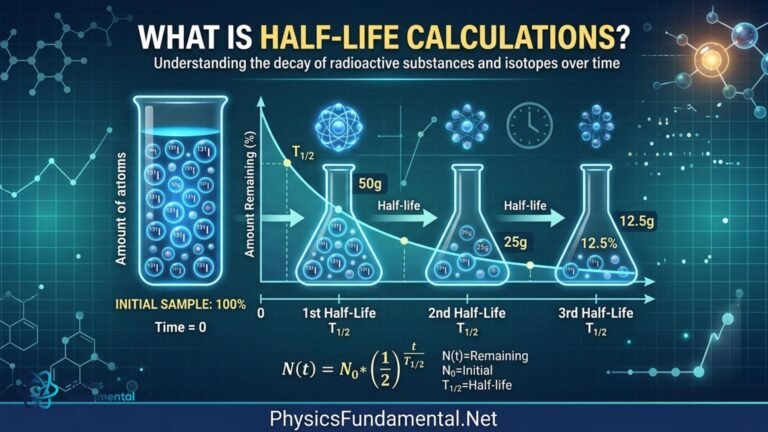
The half-life, written as T₁/₂, is the time required for half of the radioactive nuclei in a sample to decay.
For example, imagine a radioactive sample initially contains:
1000 unstable nuclei
After one half-life:
500 remain
After two half-lives:
250 remain
After three half-lives:
125 remain
After four half-lives:
62.5 remain on average
The number decreases exponentially rather than by the same fixed amount each time.
You May Like to Read: Centripetal vs Centrifugal Force: 7 Powerful Facts & Differences 2026
Radioactive Decay Equation
Radioactive decay can be described using:
N = N₀e⁻λt
Where:
- N = number of undecayed nuclei after time t
- N₀ = initial number of nuclei
- λ = decay constant
- t = elapsed time
- e = mathematical constant approximately equal to 2.718
The activity of a radioactive sample is:
A = λN
where A is measured in becquerels (Bq).
One becquerel corresponds to one nuclear decay per second.
Relationship Between Half-Life and Decay Constant
Half-life and the decay constant are related by:
T₁/₂ = ln(2)/λ
or approximately:
T₁/₂ = 0.693/λ
This means a larger decay constant corresponds to a shorter half-life.
A smaller decay constant corresponds to a longer half-life.
Worked Example: Half-Life
Suppose a radioactive isotope has a half-life of 10 years. If a sample initially contains 800 g of the radioactive isotope, how much remains after 30 years?
First determine the number of half-lives:
30/10 = 3
After one half-life:
800/2 = 400 g
After two:
400/2 = 200 g
After three:
200/2 = 100 g
Answer
After 30 years, approximately 100 g remains.
This assumes the stated mass represents the radioactive isotope and ignores changes in chemical form or other practical considerations.
A Useful Half-Life Formula
The remaining amount can also be calculated using:
N = N₀(1/2)ⁿ
where n is the number of elapsed half-lives.
Since:
n = t/T₁/₂
we can write:
N = N₀(1/2)^(t/T₁/₂)
This is especially useful for solving half-life problems quickly.
Worked Example: Finding the Remaining Activity
A radioactive source has an initial activity of 1600 Bq and a half-life of 5 hours. What is its activity after 15 hours?
Number of half-lives:
n = 15/5 = 3
Now:
A = 1600(1/2)³
A = 1600/8
A = 200 Bq
Answer
The activity after 15 hours is 200 Bq.
Why Is Radioactive Decay Random?
Radioactive decay is fundamentally probabilistic.
For a large collection of radioactive nuclei, we can accurately predict how many will decay over a period of time. But we cannot normally predict the exact moment when a particular unstable nucleus will decay.
This is why radioactive decay follows an exponential law.
A sample with a short half-life does not mean that every nucleus will decay exactly at the half-life. Instead, the half-life describes the statistical behavior of the population.
Penetrating Power of Alpha, Beta, and Gamma Radiation
The three forms differ significantly in their ability to pass through matter.
Alpha
Alpha particles have relatively low penetration. Paper and the outer layer of skin can stop them.
Beta
Beta particles penetrate farther than alpha particles but can often be reduced or stopped by relatively light shielding, depending on their energy.
Gamma
Gamma rays are highly penetrating. More substantial shielding may be required to reduce exposure significantly.
It is important not to confuse penetrating power with danger. A type of radiation that is difficult to penetrate may still pose significant biological risks if the radioactive material enters the body.
How Are Alpha, Beta, and Gamma Radiation Detected?
Radiation can be detected using specialized instruments.
Examples include:
- Geiger-Müller counters
- Scintillation detectors
- Semiconductor detectors
- Ionization chambers
Different detectors are suitable for different types and energies of radiation.
A Geiger counter, for example, can detect ionizing radiation and is widely used for radiation measurements, but it does not automatically tell you everything about the type or energy of the radiation present.
Applications of Radioactive Decay
Radioactive decay has many practical applications.
Medical Imaging
Radioactive isotopes can be used as tracers in nuclear medicine. Certain imaging techniques detect radiation emitted by substances introduced into the body.
Cancer Treatment
Some radioactive sources or radionuclides are used to deliver radiation to cancerous tissue.
Radiocarbon Dating
Carbon-14 decay is used to estimate the age of suitable organic materials.
Nuclear Energy
Radioactive processes and nuclear reactions are central to nuclear energy technologies.
Industrial Applications
Radioactive sources can be used for measurements, inspection, thickness monitoring, and other industrial processes.
Scientific Research
Radioactive isotopes are useful as tracers and tools for studying biological, chemical, geological, and physical processes.
Conservation Laws in Radioactive Decay
Nuclear decay must obey important conservation laws.
These include conservation of:
- Electric charge
- Energy
- Momentum
- Angular momentum
- Relevant quantum numbers
For example, in beta-minus decay, the electron and antineutrino are essential to satisfying the conservation laws of the process.
The neutrino was introduced into beta-decay theory in part to account for conservation of energy and momentum in the observed decay process.
Why Does Beta Decay Produce a Spectrum of Energies?
One interesting feature of beta decay is that emitted electrons or positrons can have a continuous range of kinetic energies rather than always leaving the nucleus with one fixed energy.
The missing energy is carried away by the corresponding neutrino or antineutrino.
This is an important example of how conservation laws and quantum physics shape radioactive processes.
Common Misconceptions About Radioactive Decay
“Radioactive Atoms All Decay at the Same Time”
They do not. Individual decay events occur randomly.
“Half-Life Means Half the Atoms Immediately Disappear”
No. Half-life describes the time required for half of a large population of radioactive nuclei to decay.
“Gamma Decay Changes the Element”
Gamma decay does not change the atomic number. It generally represents a transition from an excited nuclear state to a lower-energy state.
“Beta Decay Always Emits an Electron”
Beta decay can involve either an electron in beta-minus decay or a positron in beta-plus decay.
“Alpha Radiation Is Always Harmless”
Alpha particles have low penetration, but alpha-emitting radioactive material can be hazardous if it enters the body.
Key Formulas to Remember
Alpha Decay
ᴬ_ZX → ᴬ⁻⁴_Z⁻²Y + ⁴₂He
Beta-Minus Decay
ᴬ_ZX → ᴬ_Z+1Y + e⁻ + ν̄ₑ
Beta-Plus Decay
ᴬ_ZX → ᴬ_Z−1Y + e⁺ + νₑ
Gamma Decay
X → X + γ*
Radioactive Decay Law
N = N₀e⁻λt
Half-Life
T₁/₂ = 0.693/λ
Remaining Amount Using Half-Life
N = N₀(1/2)^(t/T₁/₂)
Activity
A = λN
Frequently Asked Questions
What are alpha, beta, and gamma decay?
They are three forms of radioactive decay. Alpha emits a helium nucleus, beta involves an electron or positron, and gamma emits a high-energy photon.
Which type of radioactive decay changes the atomic number?
Alpha decay decreases the atomic number by 2. Beta-minus increases it by 1, while beta-plus decreases it by 1. Gamma decay does not change it.
What is half-life in radioactive decay?
Half-life is the time required for half of the radioactive nuclei in a sample to decay.
Which radiation has the greatest penetrating power?
Gamma radiation generally has the greatest penetrating ability of the three, although penetration depends on radiation energy and the material involved.
Is radioactive decay predictable?
The exact decay time of an individual nucleus is generally unpredictable, but the statistical behavior of a large sample can be described accurately using the radioactive decay law and half-life.
Conclusion
Alpha, beta, and gamma decay are fundamental processes through which unstable atomic nuclei transform and release energy or particles. Alpha decay emits a helium nucleus and reduces both the mass number and atomic number. Beta decay changes the balance between protons and neutrons, while gamma decay releases excess nuclear energy without changing the identity of the element.
The concept of half-life provides a practical way to describe how radioactive samples change over time. Although individual nuclear decays are random, large populations follow a predictable exponential pattern.
Together, radioactive decay, half-life, and the different forms of nuclear radiation provide a foundation for understanding applications ranging from medical imaging and cancer treatment to radiocarbon dating, industrial measurement, and nuclear science.