Snell’s Law Explained: 7 Powerful Formulas, Examples & Facts 2026
Why does a straw appear bent when placed in a glass of water? Why does a swimming pool look shallower than it really is? These effects happen because light changes direction when it moves from one transparent medium into another. This phenomenon is called refraction, and one of the most important equations used to describe it is Snell’s Law.
Snell’s Law is written as n₁sinθ₁ = n₂sinθ₂. It relates the refractive indices of two media to the angles at which light enters and leaves the boundary between them. The law makes it possible to calculate how much a light ray bends when moving between materials such as air, water, glass, or plastic.
The equation is fundamental to optics and is used in lenses, cameras, eyeglasses, microscopes, fiber-optic communication, and many other technologies. Understanding how Snell’s Law works also provides a clear foundation for studying total internal reflection and critical angles.
What Is Snell’s Law?
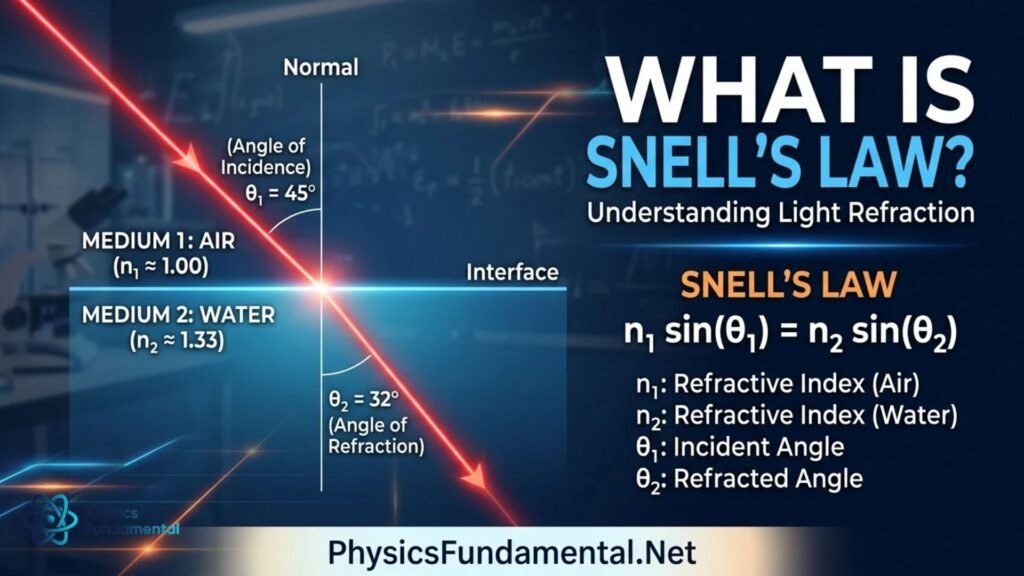
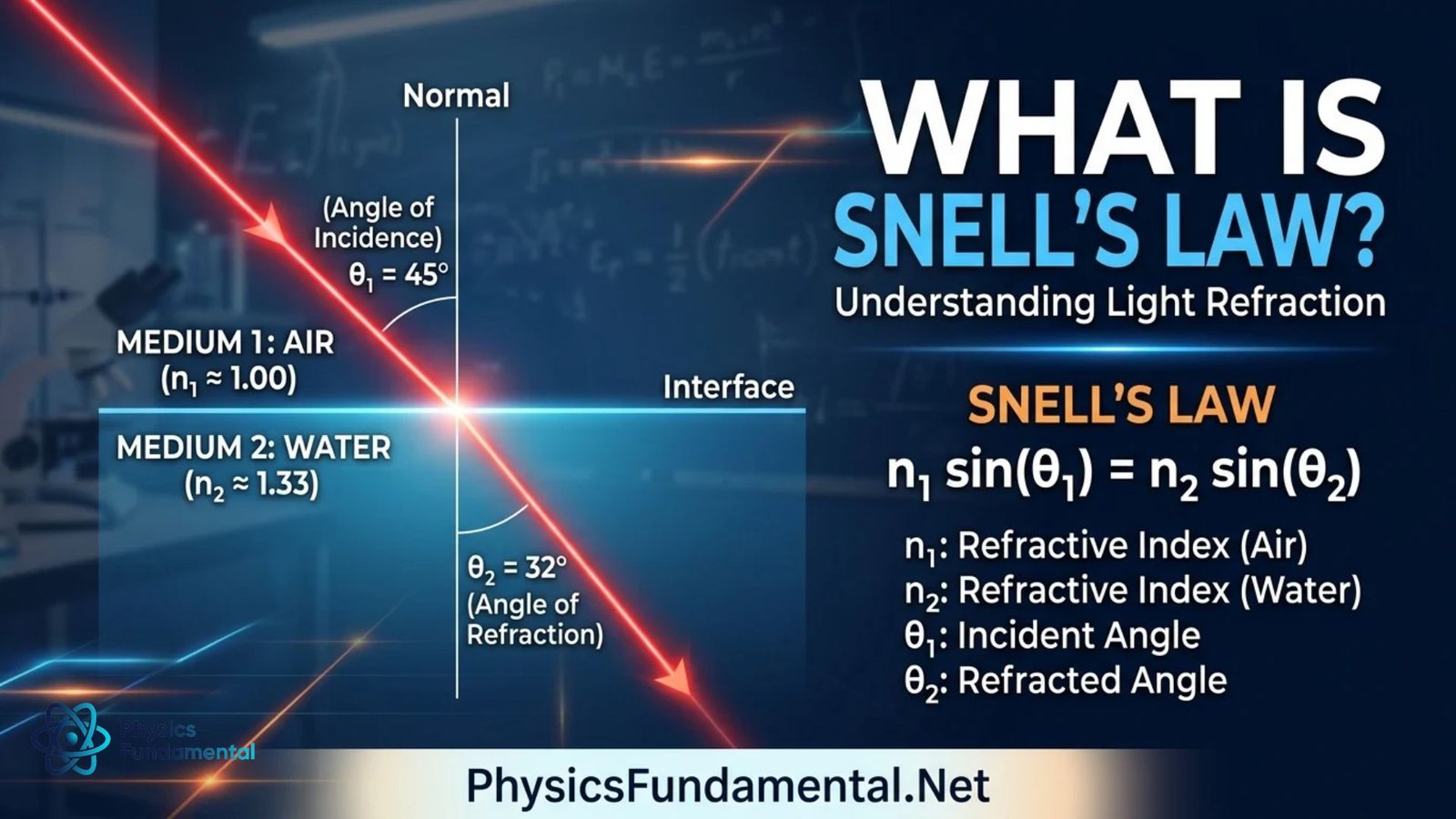
Snell’s Law describes the relationship between the angle of incidence and the angle of refraction when light passes from one medium to another.
The equation is:
n₁sinθ₁ = n₂sinθ₂
where:
- n₁ = refractive index of the first medium
- n₂ = refractive index of the second medium
- θ₁ = angle of incidence
- θ₂ = angle of refraction
The angles are measured from the normal, which is an imaginary line perpendicular to the boundary between the two media.
This last point is extremely important. The angles in Snell’s Law are not measured from the surface itself.
Understanding Refraction
Refraction is the bending of light as it passes from one transparent medium into another because its speed changes.
For example, when light travels from air into glass, its speed decreases. As a result, the direction of the light ray generally changes.
When light moves from glass into air, its speed increases and the ray generally bends away from the normal.
The amount of bending depends on:
- The refractive index of each medium
- The angle at which the light arrives
- The direction of travel
What Is Refractive Index?
The refractive index tells us how much the speed of light is reduced in a material compared with its speed in vacuum.
It is defined as:
n = c/v
where:
- n = refractive index
- c = speed of light in vacuum
- v = speed of light in the material
Since light travels at its maximum speed in vacuum:
c ≈ 3.00 × 10⁸ m/s
For example, the refractive index of ordinary glass is often around 1.5, depending on the type of glass and wavelength.
If n = 1.5, then:
v = c/n
v = (3.00 × 10⁸)/1.5
v ≈ 2.00 × 10⁸ m/s
Thus, light travels more slowly in the glass than in vacuum.
The Meaning of n₁sinθ₁ = n₂sinθ₂
The equation:
n₁sinθ₁ = n₂sinθ₂
shows that the product of refractive index and the sine of the angle remains equal across the boundary.
If the refractive index increases, the angle of refraction generally decreases for a ray entering the medium from a lower-index material.
If the refractive index decreases, the refracted angle generally becomes larger.
For example, when light travels from air into glass:
n₁ < n₂
Therefore:
θ₂ < θ₁
The ray bends toward the normal.
When light travels from glass into air:
n₁ > n₂
Therefore:
θ₂ > θ₁
The ray bends away from the normal, provided refraction occurs.
Why Are the Angles Measured From the Normal?
The normal is a line drawn perpendicular to the boundary between two media.
The angle of incidence is the angle between the incoming ray and the normal.
The angle of refraction is the angle between the refracted ray and the normal.
This convention is used because Snell’s Law is based on the geometry of wave propagation at the interface.
If you measure the angles from the surface instead, you will need to convert them before applying the equation.
Because the normal and surface are 90° apart:
Angle from surface = 90° − angle from normal
Derivation of Snell’s Law
Snell’s Law can be derived from the wave nature of light using the principle of stationary optical path, often expressed through Fermat’s principle.
Consider light traveling from medium 1 into medium 2 across a flat boundary.
The speed of light in each medium is:
v₁ = c/n₁
and:
v₂ = c/n₂
According to Fermat’s principle, the actual path taken by light between two points makes the travel time stationary with respect to small changes in the path.
The travel time is:
t = distance₁/v₁ + distance₂/v₂
Because:
v₁ = c/n₁
and:
v₂ = c/n₂
the travel time can be expressed in terms of the refractive indices.
Minimizing this travel time with respect to the point where the ray crosses the boundary gives:
sinθ₁/v₁ = sinθ₂/v₂
Substitute:
v₁ = c/n₁
and:
v₂ = c/n₂
Then:
sinθ₁/(c/n₁) = sinθ₂/(c/n₂)
This becomes:
n₁sinθ₁/c = n₂sinθ₂/c
Cancel c:
n₁sinθ₁ = n₂sinθ₂
Therefore, Snell’s Law is:
n₁sinθ₁ = n₂sinθ₂
This derivation shows why the refractive indices and angles appear together in the equation.
A Wave-Based Explanation
Snell’s Law can also be understood using the wave behavior of light.
When a wave reaches a boundary at an angle, different parts of the wavefront enter the second medium at different times. If the wave travels at a different speed in the second medium, the wavefront changes orientation.
The change in orientation causes the direction of propagation to change.
This is why the light ray bends.
A useful relationship is:
n₁sinθ₁ = n₂sinθ₂
The equation describes exactly how the direction changes at the boundary.
Worked Example 1: Air to Glass
A light ray travels from air into glass. Suppose:
n₁ = 1.00
n₂ = 1.50
and the angle of incidence is:
θ₁ = 30°
Find the angle of refraction.
Start with:
n₁sinθ₁ = n₂sinθ₂
Substitute:
(1.00)sin30° = (1.50)sinθ₂
Since:
sin30° = 0.5
we get:
0.5 = 1.50sinθ₂
Therefore:
sinθ₂ = 0.5/1.50
sinθ₂ = 0.333
Taking the inverse sine:
θ₂ ≈ 19.5°
So the refracted angle is approximately:
19.5°
Because the light entered a higher-index medium, it bent toward the normal.
You May Like to Read: Electric Field and Potential — Formulas and Worked Examples 2026
Worked Example 2: Water to Air
A ray travels from water into air.
Take:
n₁ = 1.33
n₂ = 1.00
and:
θ₁ = 30°
Using:
n₁sinθ₁ = n₂sinθ₂
we get:
1.33sin30° = sinθ₂
Since:
sin30° = 0.5
then:
sinθ₂ = 1.33 × 0.5
sinθ₂ = 0.665
Therefore:
θ₂ ≈ 41.7°
The refracted angle is larger than the incident angle, so the light bends away from the normal.
Worked Example 3: Finding the Refractive Index
Suppose light enters an unknown material from air at an incidence angle of 45°. The refracted angle is 28°.
Take:
n₁ = 1.00
Using Snell’s Law:
n₁sinθ₁ = n₂sinθ₂
Rearrange:
n₂ = n₁sinθ₁/sinθ₂
Substitute:
n₂ = sin45°/sin28°
Using approximate values:
n₂ ≈ 0.707/0.469
n₂ ≈ 1.51
Therefore, the material has a refractive index of approximately 1.51.
When Light Enters Along the Normal
What happens if light enters a new medium directly along the normal?
In that case:
θ₁ = 0°
Since:
sin0° = 0
Snell’s Law becomes:
n₁(0) = n₂sinθ₂
Therefore:
sinθ₂ = 0
and:
θ₂ = 0°
So the light does not change direction.
Its speed and wavelength can change, but its direction remains unchanged.
What Happens to Frequency During Refraction?
A common misconception is that the frequency of light changes when it enters another medium.
The frequency remains essentially constant at the boundary.
However, the speed changes.
Since:
v = fλ
if the speed decreases while frequency remains constant, the wavelength must also decrease.
Therefore, when light enters a medium with a higher refractive index:
- Speed decreases.
- Frequency stays the same.
- Wavelength decreases.
When light enters a lower-index medium:
- Speed increases.
- Frequency stays the same.
- Wavelength increases.
This distinction is important when applying Snell’s Law.
Total Internal Reflection
Snell’s Law also helps explain total internal reflection.
This phenomenon occurs when light travels from a higher refractive-index medium to a lower refractive-index medium and the angle of incidence becomes greater than the critical angle.
Instead of passing into the second medium, the light is completely reflected back into the first medium.
For the critical angle:
sinθc = n₂/n₁
where:
- θc = critical angle
- n₁ = refractive index of the higher-index medium
- n₂ = refractive index of the lower-index medium
The condition is:
n₁ > n₂
For example, light traveling from glass into air can undergo total internal reflection.
Critical Angle Example
Suppose glass has:
n₁ = 1.50
and air has:
n₂ = 1.00
Then:
sinθc = 1.00/1.50
sinθc ≈ 0.667
Therefore:
θc ≈ 41.8°
So the critical angle is approximately 41.8°.
For incidence angles greater than this value, total internal reflection can occur.
Applications of Snell’s Law
Snell’s Law is not just a theoretical equation. It is used in many practical technologies.
Eyeglasses
Lenses in eyeglasses bend light so that images are focused correctly on the retina.
Cameras
Camera lenses use refraction to focus light onto an image sensor.
Microscopes
Optical microscopes use multiple lenses to manipulate and focus light.
Telescopes
Telescopes rely on carefully designed optical systems to collect and focus light from distant objects.
Fiber Optics
Fiber-optic cables transmit information using light traveling through thin glass or plastic fibers.
Total internal reflection helps keep the light confined within the fiber.
Prisms
Prisms use refraction to change the direction of light. They can also separate white light into different colors because the refractive index depends on wavelength.
Medical Imaging
Various optical instruments used in medicine rely on the principles of refraction to form images.
Snell’s Law and Optical Lenses
Lenses work because light changes direction when it enters and exits a transparent material.
A converging lens can bend parallel rays toward a focal point, while a diverging lens can cause rays to spread apart.
At each curved surface, the local angle of incidence and refractive index determine how the ray bends.
Snell’s Law therefore provides one of the fundamental principles behind lens design.
Snell’s Law and Dispersion
The refractive index of a material can depend on the wavelength of light.
This phenomenon is called dispersion.
Because different wavelengths can experience slightly different refractive indices, they may bend by different amounts when passing through a prism.
This is why white light can be separated into a spectrum of colors.
For visible light in many transparent materials, shorter wavelengths generally experience a somewhat larger refractive index than longer wavelengths, although the exact behavior depends on the material and wavelength range.
Common Mistakes When Using Snell’s Law
Measuring the angle from the surface
The angles must be measured from the normal, not from the boundary surface.
Forgetting which medium is first
Make sure n₁ and θ₁ refer to the incident medium and n₂ and θ₂ refer to the refracted medium.
Using degrees incorrectly
Most basic Snell’s Law problems use angles in degrees. Make sure your calculator is set to the correct angle mode.
Forgetting the inverse sine
If you are solving for an unknown angle:
θ₂ = sin⁻¹[(n₁sinθ₁)/n₂]
Do not confuse sin⁻¹ with 1/sin. Here, it means the inverse sine function.
Ignoring total internal reflection
If the calculation produces:
sinθ₂ > 1
there is no real refracted angle. This indicates that total internal reflection occurs under the relevant conditions.
Snell’s Law Formula Summary
The main equation is:
n₁sinθ₁ = n₂sinθ₂
To find the refracted angle:
θ₂ = sin⁻¹[(n₁sinθ₁)/n₂]
To find the first refractive index:
n₁ = n₂sinθ₂/sinθ₁
To find the second refractive index:
n₂ = n₁sinθ₁/sinθ₂
Refractive index is:
n = c/v
Critical angle:
sinθc = n₂/n₁
when n₁ > n₂.
Frequently Asked Questions
What is Snell’s Law?
Snell’s Law describes how light bends when it passes between two media with different refractive indices. Its main equation is n₁sinθ₁ = n₂sinθ₂.
What does n₁sinθ₁ = n₂sinθ₂ mean?
It means that the product of refractive index and the sine of the angle remains equal across the boundary between two optical media.
Why does light bend during refraction?
Light bends because its speed changes when it enters a material with a different refractive index. Its frequency remains constant, while its wavelength changes.
From where are the angles measured in Snell’s Law?
The angles of incidence and refraction are measured from the normal, which is perpendicular to the boundary between the two media.
What is the critical angle?
The critical angle is the angle of incidence that produces a refracted angle of 90° when light travels from a higher-index medium to a lower-index medium.
Conclusion
Snell’s Law, expressed as n₁sinθ₁ = n₂sinθ₂, is one of the most important equations in geometric optics. It explains how light changes direction when passing from one transparent medium into another with a different refractive index.
The law connects the refractive indices of the two materials with the angles of incidence and refraction. By using it, we can calculate unknown angles, determine refractive indices, and understand why light bends toward or away from the normal.
Snell’s Law also provides the foundation for understanding critical angles and total internal reflection. Its principles are used in lenses, cameras, eyeglasses, prisms, microscopes, telescopes, and fiber-optic communication. Once the relationship between refractive index and angle is understood, many important problems in optics become much easier to solve.