Buoyancy Archimedes Principle: Powerful F = ρVg Facts & Examples 2026
Why does a huge steel ship float on water while a small steel ball sinks? The answer is not simply about how heavy an object is. It depends on the relationship between the object’s weight, its volume, and the upward force produced by the surrounding fluid.
The Buoyancy Archimedes Principle explains this upward force. According to Archimedes’ principle, an object partially or completely immersed in a fluid experiences an upward buoyant force equal to the weight of the fluid displaced by the object. For a fluid of density ρ and displaced volume V, the buoyant force is F = ρVg.
This principle explains floating and sinking, ships and submarines, hydrometers, hot-air balloons, and many other everyday and engineering phenomena. Once buoyant force and fluid displacement are understood, these situations become much easier to analyze.
What Is Buoyancy?
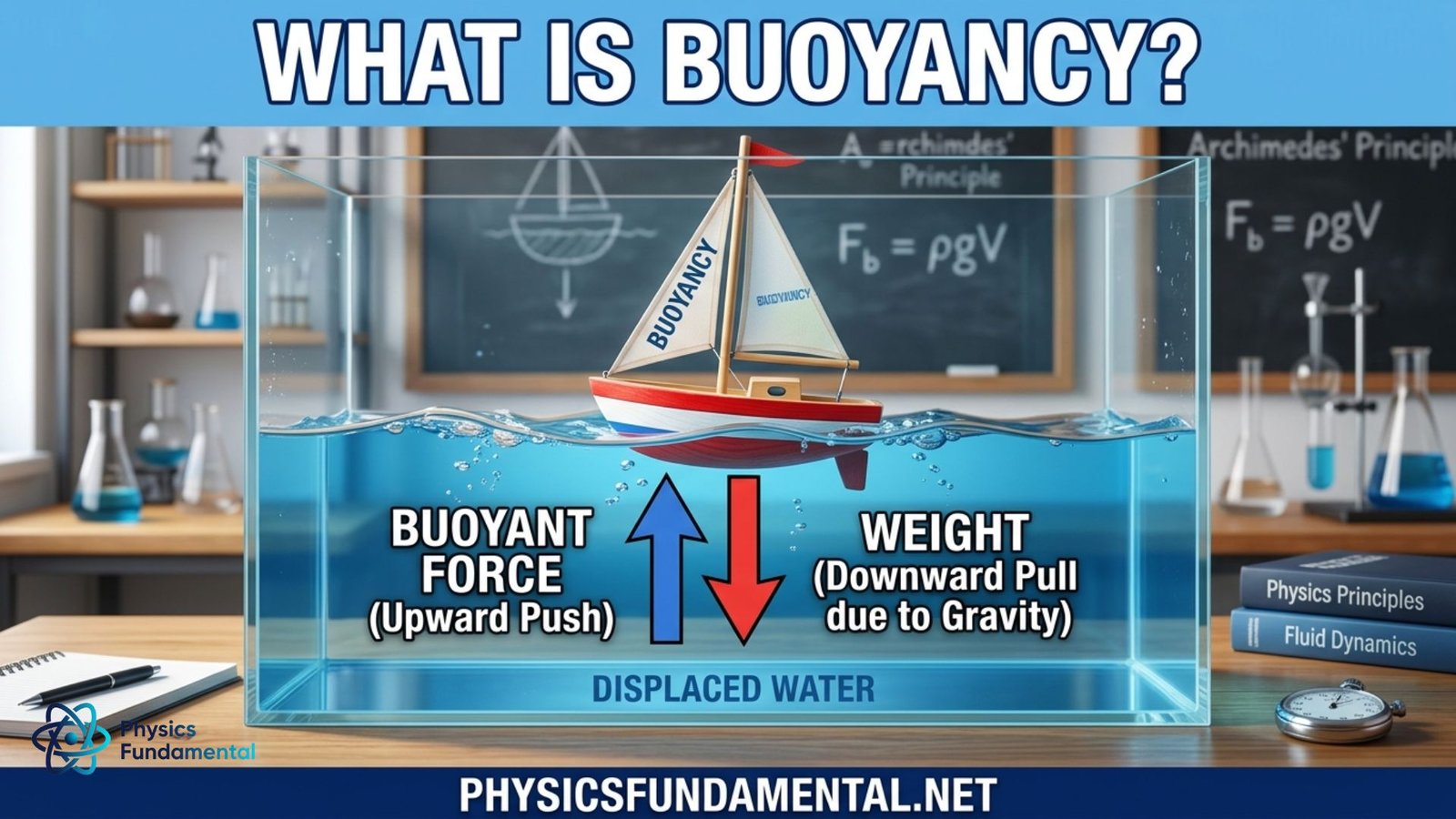
Buoyancy is the upward force exerted by a fluid on an object that is partially or completely immersed in it.
A fluid can be a:
- Liquid
- Gas
Water produces buoyancy on objects placed in it, while air produces buoyancy on objects surrounded by the atmosphere.
Buoyant force acts upward because fluid pressure generally increases with depth. The bottom of an immersed object experiences greater pressure than the top, creating a net upward force.
The magnitude of this force depends on the density of the fluid and the volume of fluid displaced.
What Is Archimedes’ Principle?
Archimedes’ principle states that:
An object immersed in a fluid experiences an upward buoyant force equal to the weight of the fluid displaced by the object.
In equation form:
F_b = ρVg
Where:
- F_b = buoyant force in newtons
- ρ = density of the fluid in kg/m³
- V = volume of displaced fluid in m³
- g = acceleration due to gravity in m/s²
This relationship is the foundation of many buoyancy calculations.
The principle is part of Archimedes’ principle and buoyancy and is widely used in fluid mechanics and hydrostatics.
Understanding F = ρVg
The formula:
F_b = ρVg
shows that buoyant force depends on three main factors.
Fluid Density
A denser fluid produces a larger buoyant force for the same displaced volume.
For example, seawater is denser than freshwater, so the same submerged volume generally experiences greater buoyant force in seawater.
Displaced Volume
A larger displaced volume means more fluid is displaced and therefore a greater buoyant force.
Gravitational Acceleration
The weight of the displaced fluid depends on gravitational acceleration.
Near Earth’s surface:
g ≈ 9.8 m/s²
Therefore, the buoyant force can be calculated when the fluid density and displaced volume are known.
Why Does Buoyant Force Act Upward?
The upward force can be understood using fluid pressure.
Pressure in a stationary fluid increases with depth:
P = P₀ + ρgh
where:
- P = pressure at a given depth
- P₀ = pressure at the reference surface
- ρ = fluid density
- g = gravitational acceleration
- h = depth
Imagine a rectangular object completely submerged in water.
The water pushes on the top surface downward and on the bottom surface upward.
Because the bottom is deeper, the pressure there is greater.
Therefore:
Upward force on bottom > downward force on top
The difference creates the net upward buoyant force.
Buoyant Force and Weight
An immersed object is affected by at least two important vertical forces:
- Weight acting downward
- Buoyant force acting upward
Weight is:
W = mg
Buoyant force is:
F_b = ρ_fV_dg
where ρ_f is fluid density and V_d is displaced fluid volume.
The object’s behavior depends on the comparison between these forces.
If F_b > W
The net force is upward, so the object rises.
If F_b < W
The net force is downward, so the object sinks.
If F_b = W
The object is in vertical equilibrium.
This simple force comparison explains much of floating and sinking.
Floating Objects
An object floats when its weight is balanced by the buoyant force.
Therefore:
F_b = W
So:
ρ_fV_dg = mg
The gravitational acceleration cancels:
ρ_fV_d = m
Since:
m = ρ_oV_o
we can relate the object’s average density to the fraction of its volume that is submerged.
For a floating object:
ρ_o/ρ_f = V_d/V_o
This means a floating object displaces an amount of fluid whose weight equals the object’s weight.
Example: Floating Wooden Block
A wooden block has a volume of 0.020 m³ and a mass of 12 kg. It floats in water.
The block’s weight is:
W = mg
W = 12 × 9.8
W = 117.6 N
Because the block floats:
F_b = W
Therefore, the buoyant force is:
F_b = 117.6 N
The displaced water volume can be found from:
F_b = ρVg
For water:
ρ = 1000 kg/m³
So:
117.6 = 1000 × V × 9.8
Therefore:
V = 0.012 m³
The block displaces 0.012 m³ of water, which is less than its total volume of 0.020 m³.
That is why part of the block remains above the surface.
Sinking Objects
An object sinks when its weight is greater than the maximum buoyant force available.
For a completely submerged object:
F_b = ρ_fVg
If:
W > F_b
the net force is downward.
For an object made from a material denser than the surrounding fluid, sinking is generally expected when the object cannot displace enough fluid to balance its weight.
For example, a solid steel sphere placed in water sinks because its average density is much greater than the density of water.
Neutral Buoyancy
An object has neutral buoyancy when its weight equals its buoyant force while it is fully immersed.
Therefore:
F_b = W
or:
ρ_fVg = ρ_oVg
So:
ρ_f = ρ_o
The object’s average density equals the density of the surrounding fluid.
The object can remain suspended at a particular depth without rising or sinking, assuming the forces remain balanced.
Scuba divers can achieve approximately neutral buoyancy by adjusting their buoyancy control equipment and lung volume.
Apparent Weight
When an object is immersed in a fluid, its measured weight can appear smaller.
This is called apparent weight.
The relationship is:
W_apparent = W − F_b
Where:
- W = actual weight
- F_b = buoyant force
- W_apparent = apparent weight while immersed
For example, if an object weighs 50 N in air and experiences a 15 N buoyant force in water:
W_apparent = 50 − 15
W_apparent = 35 N
The object still has the same mass, but the upward buoyant force reduces the force measured by a scale or spring balance.
Worked Example: Buoyant Force
A completely submerged object displaces 0.005 m³ of water. Calculate the buoyant force.
Given:
ρ = 1000 kg/m³
V = 0.005 m³
g = 9.8 m/s²
Use:
F_b = ρVg
Substitute:
F_b = 1000 × 0.005 × 9.8
F_b = 49 N
Therefore, the buoyant force is:
49 N upward
Worked Example: Buoyancy in Seawater
Suppose an object displaces 0.10 m³ of seawater. Take the density of seawater as approximately 1025 kg/m³.
Using:
F_b = ρVg
we get:
F_b = 1025 × 0.10 × 9.8
F_b ≈ 1004.5 N
Therefore, the buoyant force is approximately:
1005 N upward
This demonstrates why fluid density matters.
Why Do Ships Float?
Ships are often made from steel, which is denser than water. Yet steel ships can float.
The reason is that a ship is not a solid block of steel.
A ship contains a large volume of air and has a hollow structure. Its average density, considering the steel and enclosed air together, can be lower than the density of water.
The ship’s hull displaces a large volume of water.
When the weight of the displaced water equals the ship’s weight:
F_b = W
the ship floats in equilibrium.
If the ship takes on enough water, its average density increases. It may then displace insufficient water to support its weight and can sink.
You May Like to Read: Bohr Model of the Atom Explained: Powerful Energy Levels & Formula 2026
Why Does a Steel Ball Sink?
Consider a solid steel ball and a hollow steel ship.
The steel ball contains much less volume for its mass than the ship.
When the ball is submerged, it displaces only its own volume of water.
The buoyant force is therefore:
F_b = ρ_waterV_ballg
For a dense steel ball, its weight is greater than this buoyant force.
Therefore:
W > F_b
and the ball sinks.
The difference between the ball and ship demonstrates why average density and displaced volume are crucial.
Archimedes’ Principle and Density
Archimedes’ principle can be used to determine the density of an unknown object.
If the object’s mass is known and its volume is measured, its density is:
ρ = m/V
Alternatively, buoyant force measurements can be used to determine volume or density.
This makes buoyancy useful in laboratory experiments and instruments designed to compare densities.
Hydrometers
A hydrometer is an instrument used to measure the density or specific gravity of a liquid.
It floats vertically in the liquid.
A denser liquid provides more buoyant force for a given submerged volume, so the hydrometer floats higher.
In a less dense liquid, it must displace more liquid to produce enough buoyant force to balance its weight.
Hydrometers are used in areas such as:
- Battery testing
- Brewing
- Food processing
- Chemical analysis
- Industrial processes
Submarines and Buoyancy
Submarines use buoyancy to control whether they rise, sink, or remain at a particular depth.
They contain ballast tanks that can be filled with water or air.
When water enters the ballast tanks, the submarine’s average density increases.
When air replaces water, its average density decreases.
By controlling ballast, a submarine can change its buoyancy.
In simplified terms:
Average density < water density → rises
Average density = water density → neutral buoyancy
Average density > water density → sinks
Real submarine operations involve additional hydrodynamic forces and control systems, but Archimedes’ principle provides the basic buoyancy concept.
Buoyancy in Air
Archimedes’ principle applies to gases as well as liquids.
Air exerts an upward buoyant force on objects because atmospheric pressure acts on their surfaces.
For a balloon:
F_b = ρ_airVg
If the upward buoyant force is greater than the total downward weight of the balloon system, the balloon rises.
Hot-air balloons take advantage of this principle by heating the air inside the envelope.
The heated air becomes less dense than the surrounding air, reducing the total average density of the balloon system.
Buoyancy and Hot-Air Balloons
A hot-air balloon experiences:
- Upward buoyant force from surrounding air
- Downward weight from the balloon, basket, equipment, and heated air
The balloon rises when the upward force exceeds its total weight.
It can stop rising when the forces become approximately balanced.
The basic buoyancy equation remains:
F_b = ρ_airVg
Thus, buoyancy is not limited to water-based situations.
Buoyancy and Pressure
The pressure explanation of buoyancy is important.
For a fluid at rest:
P = P₀ + ρgh
As depth increases, pressure increases.
For an immersed object, the lower surface is deeper than the upper surface.
Therefore, the pressure force on the lower surface can be greater than the pressure force on the upper surface.
The resulting force is upward.
Archimedes’ principle provides a convenient way to calculate the net result without calculating every pressure force separately.
Fully Submerged vs Partially Submerged Objects
The volume used in:
F_b = ρVg
is the volume of fluid displaced, not automatically the object’s total volume.
Fully Submerged Object
If the object is completely submerged:
V_displaced = V_object
Therefore:
F_b = ρ_fV_objectg
Partially Submerged Object
If only part of the object is below the surface:
V_displaced < V_object
Therefore, only the submerged volume is used to calculate buoyant force.
This distinction is one of the most important points in buoyancy problems.
Common Mistakes in Buoyancy Problems
Using the Object’s Mass Instead of Displaced Volume
The formula is:
F_b = ρ_fV_displacedg
The volume must correspond to the fluid displaced.
Forgetting Fluid Density
The density in the buoyancy equation is the density of the fluid, not necessarily the object.
Assuming Floating Means No Forces Act
A floating object still experiences weight downward and buoyant force upward.
They are simply balanced in static equilibrium.
Thinking Heavy Objects Always Sink
An object’s total mass alone does not determine whether it floats. Volume and average density are also important.
Using the Entire Volume for a Partially Submerged Object
Only the submerged volume displaces fluid.
Confusing Buoyant Force With Weight
Buoyant force acts upward, while gravitational weight acts downward.
How to Solve Buoyancy Problems
Use this simple method:
Step 1: Identify the surrounding fluid.
Step 2: Find its density, ρ.
Step 3: Determine the displaced volume, V.
Step 4: Use:
F_b = ρVg
Step 5: Compare buoyant force with weight if the question asks whether the object floats or sinks.
Weight is:
W = mg
Then:
- F_b > W → object accelerates upward
- F_b < W → object accelerates downward
- F_b = W → vertical equilibrium
Always check whether the object is fully or partially submerged before choosing the volume.
Applications of Archimedes’ Principle
Archimedes’ principle has many practical applications.
Ships
Ship hulls displace enough water to produce a buoyant force equal to their weight.
Submarines
Ballast systems change the submarine’s average density and buoyancy.
Hydrometers
Hydrometers use floating behavior to estimate liquid density.
Hot-Air Balloons
The buoyant force of surrounding air allows balloons to rise.
Scuba Diving
Divers control buoyancy to remain underwater, rise, or descend.
Density Measurements
Buoyant-force measurements can be used to determine the volume or density of objects.
Marine Engineering
Engineers use buoyancy calculations when designing floating platforms, vessels, and other structures.
Buoyant Force Formula Summary
The key equations are:
Buoyant force:
F_b = ρVg
Weight:
W = mg
Density:
ρ = m/V
Apparent weight:
W_apparent = W − F_b
Floating equilibrium:
F_b = W
Fluid pressure:
P = P₀ + ρgh
For a floating object:
ρ_fluidV_displaced = m_object
These equations provide the foundation for most introductory buoyancy calculations.
Frequently Asked Questions
What is Archimedes’ Principle?
Archimedes’ principle states that an immersed object experiences an upward buoyant force equal to the weight of the fluid it displaces.
What is the formula for buoyant force?
The basic formula is F_b = ρVg, where ρ is fluid density, V is displaced volume, and g is gravitational acceleration.
Why do objects float?
An object floats when the upward buoyant force balances its downward weight.
Why does a ship float but a steel ball sink?
A ship has a large hollow volume, giving it a lower average density and allowing it to displace enough water to support its weight.
Does Archimedes’ principle work in air?
Yes. Archimedes’ principle applies to gases as well as liquids because gases also exert pressure and produce buoyant forces.
Conclusion
The Buoyancy Archimedes Principle provides a simple and powerful explanation for why objects float, sink, or remain suspended in fluids. The central equation, F = ρVg, shows that buoyant force depends on the density of the fluid, the volume displaced, and gravitational acceleration.
The principle also explains why ships can float despite being made from dense materials, how submarines control their depth, why hydrometers can measure liquid density, and how hot-air balloons rise through the atmosphere.
The key idea to remember is that buoyant force is determined by the weight of the displaced fluid. Once this relationship is understood, a wide range of fluid mechanics and everyday floating phenomena can be analyzed using a few straightforward equations.