Photoelectric Effect Explained: Powerful Einstein Theory & Key Facts 2026
How can shining light on a metal surface cause electrons to escape from the metal? This question became one of the most important clues that classical physics could not fully explain the behavior of light.
The Photoelectric Effect occurs when light with sufficient frequency strikes a material and causes electrons to be emitted from its surface. In 1905, Albert Einstein explained this phenomenon by proposing that light transfers energy in discrete packets called photons.
Einstein’s explanation showed that the energy of light depends on its frequency, not simply on its intensity. This idea became a major foundation of quantum physics and helped establish the concept of wave-particle duality.
What Is the Photoelectric Effect?

The photoelectric effect is the emission of electrons from a material when electromagnetic radiation of sufficient frequency falls on its surface.
The emitted electrons are called photoelectrons.
The basic process is:
Light → material → electron emission
The effect is most commonly demonstrated using metals because some metals have electrons that can be released when they absorb enough energy.
The important factors are:
- Frequency of incident light
- Intensity of light
- Work function of the material
- Maximum kinetic energy of emitted electrons
The phenomenon is a key part of the photoelectric effect and quantum physics.
Why Was the Photoelectric Effect Important?
Before Einstein’s explanation, physicists had strong evidence that light behaved like a wave.
Classical wave theory suggested that increasing the intensity of light should increase the energy delivered to electrons. It also suggested that electrons might gradually accumulate enough energy to escape from a metal.
Experiments did not behave this way.
Several observations were difficult to explain using classical wave theory:
- There is a minimum frequency required for electron emission.
- Electrons can be emitted almost immediately when the frequency is high enough.
- Increasing light intensity increases the number of emitted electrons, but not necessarily their maximum kinetic energy.
- Increasing frequency increases the maximum kinetic energy of the emitted electrons.
Einstein’s photon model provided a simple explanation for these observations.
Einstein’s Explanation of the Photoelectric Effect
In 1905, Einstein proposed that light is made of individual packets of energy called quanta, now known as photons.
The energy of one photon is:
E = hf
Where:
- E = photon energy
- h = Planck’s constant
- f = frequency of light
The important idea is that a photon transfers its energy to an electron as a discrete interaction.
If the photon has enough energy, the electron can escape from the material.
The photon energy is used in two ways:
Photon energy = energy needed to escape + kinetic energy of electron
Therefore:
hf = φ + K_max
This is called the Einstein photoelectric equation.
Einstein’s Photoelectric Equation
The most important equation is:
K_max = hf − φ
Where:
- K_max = maximum kinetic energy of emitted electrons
- h = Planck’s constant
- f = frequency of incident light
- φ = work function of the material
The equation tells us that the energy supplied by the photon first has to overcome the material’s work function.
Any remaining energy becomes the kinetic energy of the emitted electron.
What Is the Work Function?
The work function is the minimum energy required to remove an electron from the surface of a material.
It is usually represented by:
φ
The work function depends on the material.
It is commonly measured in:
electron volts (eV)
It can also be measured in joules.
If:
hf < φ
the photon does not have enough energy to eject an electron.
If:
hf = φ
the electron can just escape with zero maximum kinetic energy.
If:
hf > φ
the electron is emitted with kinetic energy.
Threshold Frequency
The minimum frequency required to produce photoelectric emission is called the threshold frequency.
It is represented by:
f₀
At the threshold:
K_max = 0
Therefore, from Einstein’s equation:
hf₀ = φ
So:
f₀ = φ/h
This equation shows why every material has a characteristic threshold frequency.
Below the threshold frequency, increasing the intensity of the light does not cause photoelectric emission.
Threshold Wavelength
Because:
c = fλ
the threshold frequency can be related to a maximum wavelength that can cause photoemission.
At the threshold:
φ = hf₀
Since:
f₀ = c/λ₀
we get:
φ = hc/λ₀
Therefore:
λ₀ = hc/φ
This is called the threshold wavelength.
Photoelectric emission occurs when the incident wavelength is short enough, meaning its frequency is high enough, to provide the required photon energy.
Frequency vs Intensity
One of the most important distinctions in the photoelectric effect is the difference between frequency and intensity.
Increasing Frequency
Increasing frequency increases the energy of each photon.
Since:
E = hf
a higher frequency means a higher photon energy.
If the frequency is above the threshold, increasing it increases the maximum kinetic energy of the emitted electrons.
Increasing Intensity
Increasing intensity means more photons are arriving per unit time, assuming the frequency remains fixed.
More photons can produce more emitted electrons, so the photoelectric current can increase.
However, increasing intensity does not increase the energy of each individual photon.
Therefore, above the threshold frequency:
Higher intensity → more photoelectrons
Higher frequency → more energetic photoelectrons
This distinction is central to Einstein’s explanation.
Why Is There No Significant Time Delay?
Classical wave theory might suggest that an electron should gradually absorb energy from a weak light wave.
Einstein’s photon model gives a different picture.
A single photon carries a definite energy:
E = hf
If that energy is greater than the work function, the electron can receive enough energy in a single interaction.
Therefore, photoemission can occur essentially immediately once suitable light reaches the surface.
The exact timing and microscopic details involve quantum mechanics, but the absence of a significant energy-accumulation delay was a major success of the photon explanation.
Worked Example: Photon Energy
Suppose light has a frequency of:
f = 6.0 × 10¹⁴ Hz
Use Planck’s constant:
h = 6.626 × 10⁻³⁴ J·s
The photon energy is:
E = hf
E = (6.626 × 10⁻³⁴)(6.0 × 10¹⁴)
E ≈ 3.98 × 10⁻¹⁹ J
So each photon carries approximately:
3.98 × 10⁻¹⁹ J
of energy.
Worked Example: Maximum Kinetic Energy
Suppose the photon energy is 5 eV and the work function of the material is 2 eV.
Using:
K_max = hf − φ
and treating the photon energy as 5 eV:
K_max = 5 − 2
K_max = 3 eV
Therefore, the maximum kinetic energy of the emitted electron is:
3 eV
Worked Example: Finding Threshold Frequency
Suppose a material has a work function of:
φ = 2.0 eV
Convert this to joules:
φ = 2.0 × 1.602 × 10⁻¹⁹ J
φ ≈ 3.204 × 10⁻¹⁹ J
Use:
f₀ = φ/h
Therefore:
f₀ ≈ (3.204 × 10⁻¹⁹)/(6.626 × 10⁻³⁴)
f₀ ≈ 4.84 × 10¹⁴ Hz
So the approximate threshold frequency is:
4.84 × 10¹⁴ Hz
Photoelectric Current
When photoelectrons are emitted and collected by an electrode, an electric current can flow.
The number of electrons emitted per second affects the photoelectric current.
If the intensity of light increases while the frequency remains above the threshold, more photons reach the surface per second.
This can result in more emitted electrons and a larger photocurrent.
The maximum current is related to the number of photoelectrons that can be collected.
Stopping Potential
The maximum kinetic energy of photoelectrons can be measured using a stopping potential.
A reverse voltage is applied to prevent emitted electrons from reaching the collecting electrode.
At the stopping potential V_s, even the fastest photoelectrons are stopped.
The relationship is:
K_max = eV_s
where:
- e = elementary charge
- V_s = stopping potential
Combining this with Einstein’s equation:
eV_s = hf − φ
Therefore:
V_s = (h/e)f − φ/e
This relationship provides experimental evidence for the quantized nature of light.
You May Like to Read: Buoyancy Archimedes Principle: Powerful F = ρVg Facts & Examples 2026
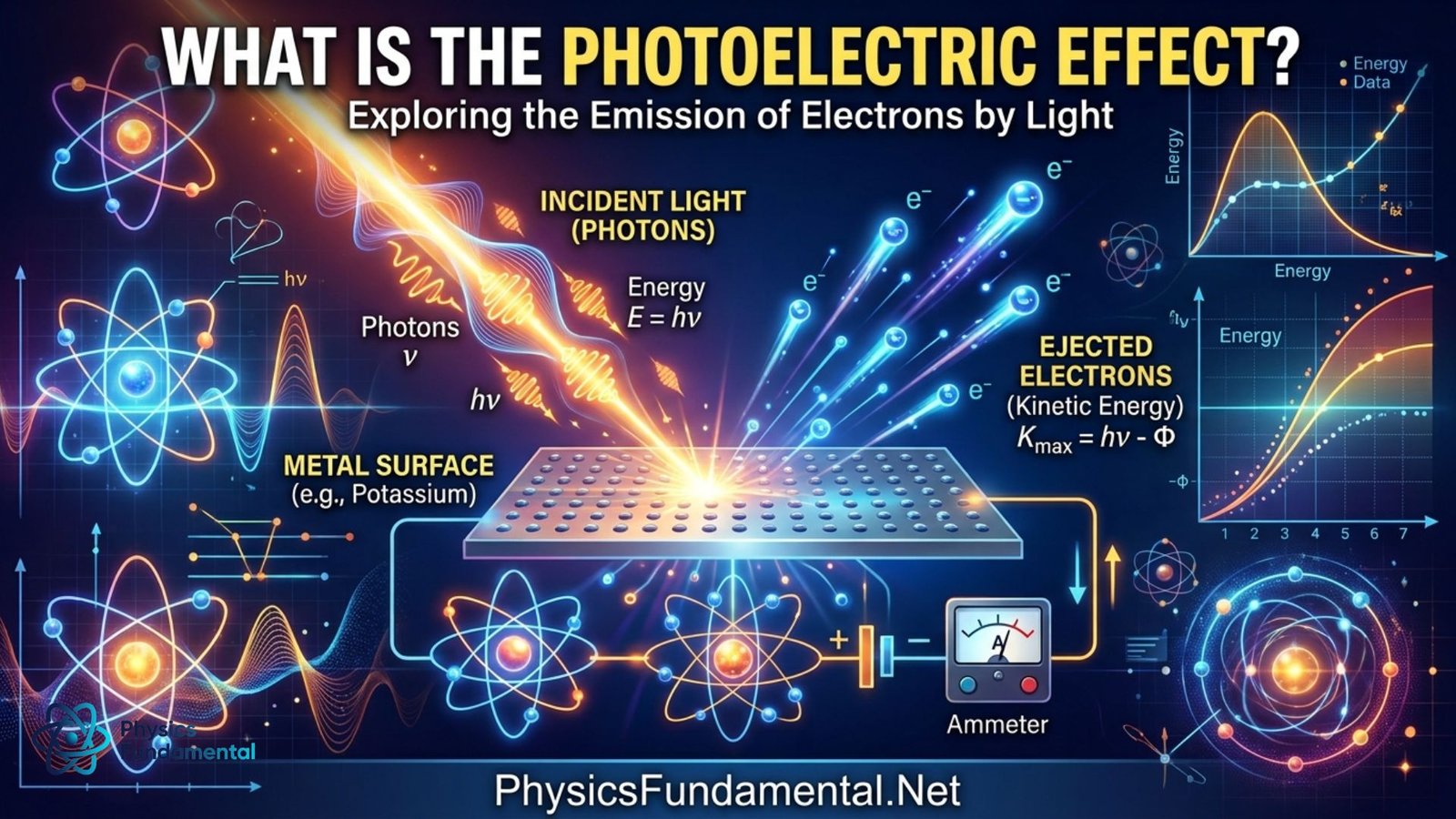
Photoelectric Effect Experimental Setup
A basic photoelectric experiment can contain:
- A light source
- A photosensitive metal surface
- An electrode to collect electrons
- A voltage source
- An ammeter
- A variable reverse voltage
- A measuring circuit
Light strikes the photosensitive surface.
If its photon energy is sufficiently high, electrons are emitted.
The emitted electrons can travel toward the collecting electrode, producing a measurable current.
By changing the frequency, intensity, and applied voltage, scientists can investigate the photoelectric effect.
Main Observations of the Photoelectric Effect
The experimental observations can be summarized as follows.
Observation 1: Threshold Frequency Exists
For each material, there is a minimum frequency below which electrons are not emitted.
Observation 2: Emission Can Be Immediate
When the frequency is above the threshold, electrons can be emitted without an observable buildup period.
Observation 3: Intensity Affects Photocurrent
Increasing intensity generally increases the number of emitted electrons when the frequency is above threshold.
Observation 4: Frequency Affects Kinetic Energy
Increasing frequency increases the maximum kinetic energy of the photoelectrons.
Observation 5: Maximum Kinetic Energy Is Independent of Intensity
For fixed frequency above threshold, increasing intensity does not increase the maximum kinetic energy of individual photoelectrons.
These observations are naturally explained using the photon model.
Photoelectric Effect and Wave-Particle Duality
The photoelectric effect played a major role in establishing that light cannot always be described only as a classical wave.
Light demonstrates both wave-like and particle-like behavior.
In the photoelectric effect, the particle-like description is especially useful because light transfers energy in discrete photons.
The photon has:
E = hf
and momentum:
p = h/λ
This helped establish the broader concept of wave-particle duality.
Einstein’s Nobel Prize and the Photoelectric Effect
Einstein received the 1921 Nobel Prize in Physics, which was awarded in 1922, for his services to theoretical physics and especially for his discovery of the law of the photoelectric effect.
This work was one of the major contributions that established Einstein’s role in the development of modern physics.
Interestingly, his explanation of the photoelectric effect was distinct from his later-famous work on special relativity.
Photoelectric Effect vs Photovoltaic Effect
The photoelectric effect and photovoltaic effect are related to light interacting with matter, but they are not identical phenomena.
Photoelectric Effect
Electrons are emitted from a material surface after absorbing sufficiently energetic photons.
Photovoltaic Effect
Light creates an electrical potential or current within a material, particularly in semiconductor devices such as solar cells.
The photovoltaic effect is central to converting sunlight into electrical energy.
Applications of the Photoelectric Effect
The principles associated with photoelectric emission have many applications.
Photocells
Photosensitive devices can detect light and convert changes in light intensity into electrical signals.
Automatic Doors
Light sensors can detect when a person approaches an entrance and trigger an automatic opening system.
Light Meters
Photodetectors can measure light intensity in cameras and other instruments.
Flame Detectors
Photosensitive sensors can detect radiation from flames.
Optical Sensors
Photoelectric detection is used in many industrial and scientific measurement systems.
Imaging Technology
Photodetectors are fundamental components of many electronic imaging systems.
Solar Technology
The broader interaction of light with semiconductors is essential to photovoltaic devices and solar cells.
Why Intensity Alone Cannot Cause Photoemission
Suppose light has a frequency below the threshold frequency.
Each photon then has energy:
E = hf < φ
No individual photon has enough energy to overcome the work function.
Increasing intensity increases the number of low-energy photons, but it does not increase the energy of each photon.
Therefore, simply making the light brighter does not overcome the threshold.
This is one of the clearest ways to understand why frequency is so important.
Common Mistakes About the Photoelectric Effect
Thinking Brighter Light Always Produces Electrons
It does not if the frequency is below the threshold.
Confusing Frequency With Intensity
Frequency determines the energy per photon, while intensity is related to the number of photons arriving per unit time.
Forgetting the Work Function
Photon energy must first overcome the work function:
hf ≥ φ
Assuming All Photon Energy Becomes Kinetic Energy
Part of the energy is used to remove the electron from the material.
The remainder becomes kinetic energy.
Forgetting the Maximum Kinetic Energy
Einstein’s equation gives the maximum kinetic energy:
K_max = hf − φ
Individual electrons can have lower kinetic energies because of interactions within the material.
Using the Wrong Units
Work function may be given in eV while Planck’s constant is often used with joules. Convert units consistently when necessary.
How to Solve Photoelectric Effect Problems
A reliable method is:
Step 1: Identify the frequency or wavelength of the incident light.
Step 2: Determine the material’s work function.
Step 3: Calculate photon energy using:
E = hf
or:
E = hc/λ
Step 4: Compare photon energy with the work function.
If:
E < φ
there is no photoelectric emission.
If:
E ≥ φ
photoemission is possible.
Step 5: If electrons are emitted, use:
K_max = E − φ
Step 6: If stopping potential is required, use:
K_max = eV_s
This method works for most introductory photoelectric-effect problems.
Important Photoelectric Effect Formulas
Photon Energy
E = hf
Photon Energy From Wavelength
E = hc/λ
Einstein Photoelectric Equation
K_max = hf − φ
Threshold Frequency
f₀ = φ/h
Threshold Wavelength
λ₀ = hc/φ
Stopping Potential
K_max = eV_s
Combined Equation
eV_s = hf − φ
These equations connect light frequency, wavelength, work function, electron kinetic energy, and stopping potential.
Key Facts to Remember
The most important ideas are:
- Light can transfer energy in discrete packets called photons.
- Photon energy is E = hf.
- Higher frequency means higher energy per photon.
- Every material has a characteristic work function.
- Photoelectric emission requires photon energy at least equal to the work function.
- The threshold frequency is f₀ = φ/h.
- Increasing intensity generally increases the number of emitted electrons above threshold.
- Increasing frequency increases maximum electron kinetic energy.
- The photoelectric effect provided major evidence for the quantum description of light.
- Einstein’s explanation was a foundational contribution to quantum physics.
Frequently Asked Questions
What is the Photoelectric Effect?
The Photoelectric Effect is the emission of electrons from a material when light of sufficient frequency strikes its surface.
What was Einstein’s explanation of the Photoelectric Effect?
Einstein proposed that light consists of photons with energy E = hf. A photon can eject an electron when its energy is at least equal to the material’s work function.
What is the photoelectric equation?
The main equation is K_max = hf − φ, where K_max is maximum kinetic energy and φ is the work function.
What is threshold frequency?
Threshold frequency is the minimum frequency of light required to eject electrons from a particular material.
Does increasing light intensity increase electron kinetic energy?
No. Above the threshold frequency, increasing intensity generally increases the number of emitted electrons, while increasing frequency increases their maximum kinetic energy.
Conclusion
The Photoelectric Effect provided one of the strongest early clues that light has a quantum, particle-like nature. Einstein explained the phenomenon by proposing that light consists of photons, each carrying energy according to E = hf.
When a photon strikes a material, its energy must first overcome the material’s work function. Any remaining energy appears as the maximum kinetic energy of the emitted electron, giving the central equation K_max = hf − φ.
The ideas behind the photoelectric effect remain fundamental to modern physics. They help explain quantum behavior and underpin technologies involving light detection, photodetectors, and many electronic and optical systems.