Specific Heat Capacity: Powerful Formula, Examples & Facts 2026
Why does a metal spoon become hot quickly when placed in hot water, while a large amount of water can absorb plenty of heat without its temperature changing as quickly? The answer is related to a physical property called specific heat capacity.
Specific heat capacity tells us how much thermal energy is needed to raise the temperature of a particular amount of a substance. Because different materials have different specific heat capacities, they do not all heat up or cool down at the same rate.
Understanding the specific heat capacity formula makes thermal physics much easier. Once you know what each variable represents, how to use the correct units, and how to work through examples, you can solve many heat-energy problems confidently.
What Is Specific Heat Capacity?

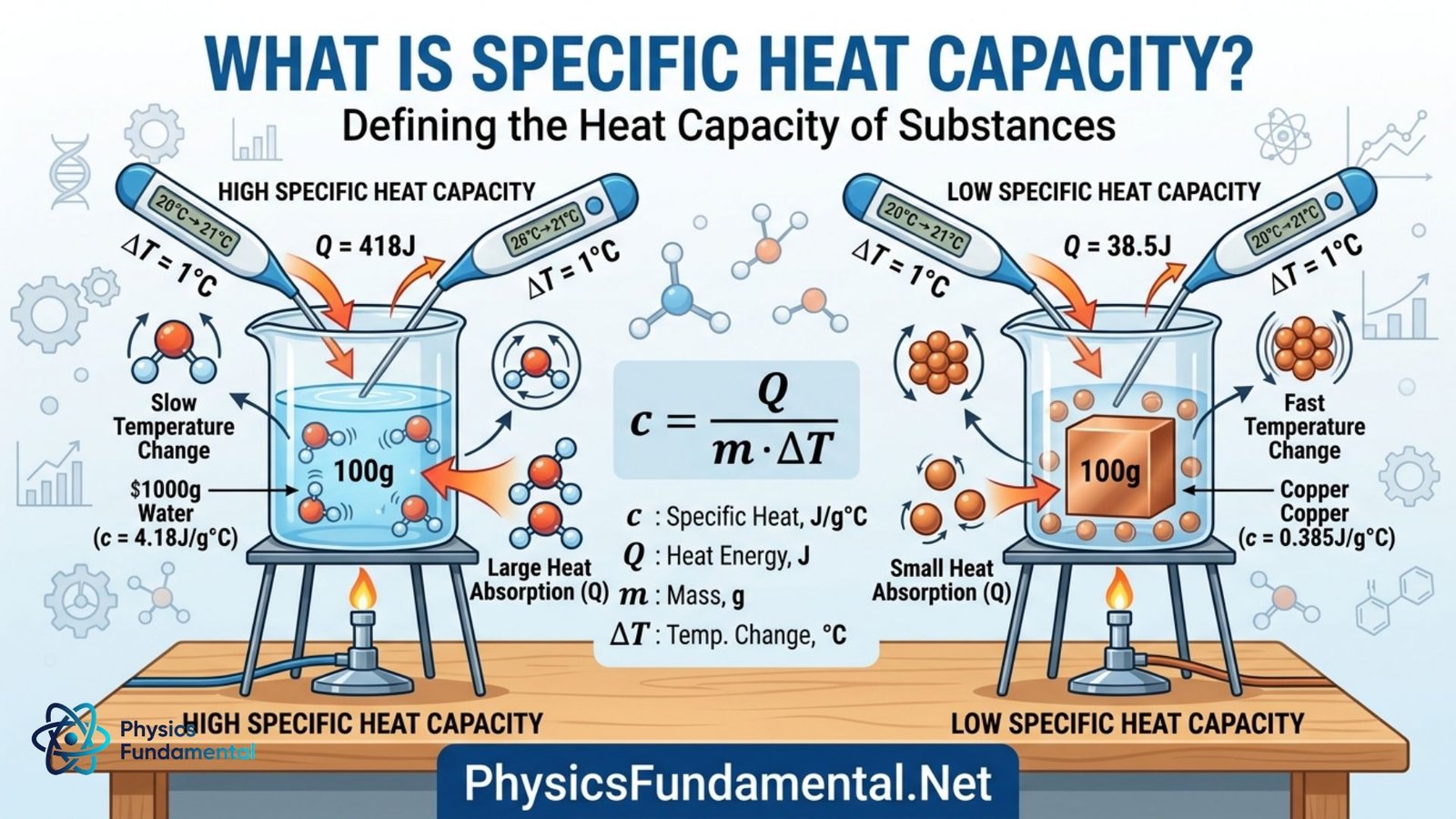
Specific heat capacity is the amount of thermal energy required to raise the temperature of 1 kilogram of a substance by 1°C.
It is commonly represented by the symbol c and measured in:
J/kg°C
It can also be expressed as:
J/(kg·K)
For temperature differences, a change of 1°C has the same magnitude as a change of 1 K.
In simple terms, specific heat capacity tells us how much energy a material needs before its temperature changes.
A substance with a high specific heat capacity requires more energy to increase its temperature.
A substance with a low specific heat capacity requires less energy to produce the same temperature increase.
This is why different materials respond differently when they are heated or cooled.
Specific Heat Capacity Formula
The main formula used to calculate heat energy is:
Q = mcΔT
Where:
- Q = thermal energy transferred in joules (J)
- m = mass of the substance in kilograms (kg)
- c = specific heat capacity in J/kg°C
- ΔT = change in temperature
The temperature change is calculated using:
ΔT = final temperature − initial temperature
The formula is part of the wider study of thermal energy, which examines the relationships between heat, temperature, and energy.
The equation shows that the amount of energy required depends on three main factors: the mass of the material, its specific heat capacity, and the change in temperature.
How to Rearrange the Specific Heat Capacity Formula
The basic equation can be rearranged depending on which quantity you need to find.
To calculate thermal energy:
Q = mcΔT
To calculate specific heat capacity:
c = Q/(mΔT)
To calculate mass:
m = Q/(cΔT)
To calculate temperature change:
ΔT = Q/(mc)
Learning these rearrangements is useful because physics questions can give different pieces of information and ask for different unknown values.
What Does Specific Heat Capacity Mean?
Imagine you have 1 kg of water and 1 kg of copper.
You provide the same amount of thermal energy to both materials.
The copper will experience a much larger temperature increase than the water because copper has a much lower specific heat capacity.
This demonstrates an important idea: a higher specific heat capacity means that more energy is required to produce the same temperature increase.
Therefore, specific heat capacity provides a way to compare how different materials respond to thermal energy.
Specific Heat Capacity Units
The common units of specific heat capacity are:
J/kg°C
and:
J/(kg·K)
The joule is the unit of energy, while the kilogram represents the mass of the substance.
The temperature component can be written using either Celsius or kelvin when describing a temperature difference.
For example, an increase from 20°C to 50°C is:
30°C
The same temperature interval is:
30 K
This is why specific heat capacity can be expressed using either unit for the temperature difference.
Worked Example 1: Finding Thermal Energy
Suppose 2 kg of water is heated from 20°C to 50°C.
Take the specific heat capacity of water as:
4,200 J/kg°C
Find the thermal energy required.
Step 1: Identify the Values
Mass:
m = 2 kg
Specific heat capacity:
c = 4,200 J/kg°C
Initial temperature:
20°C
Final temperature:
50°C
Step 2: Calculate the Temperature Change
ΔT = 50 − 20
ΔT = 30°C
Step 3: Apply the Formula
Q = mcΔT
Substitute the values:
Q = 2 × 4,200 × 30
Q = 252,000 J
Therefore, approximately 252,000 J of thermal energy is required to raise the temperature of the water by 30°C, assuming no energy is lost to the surroundings.
Worked Example 2: Finding Specific Heat Capacity
A 5 kg metal block absorbs 45,000 J of thermal energy. Its temperature increases by 30°C.
What is its specific heat capacity?
Use:
c = Q/(mΔT)
Substitute the values:
c = 45,000/(5 × 30)
c = 45,000/150
c = 300 J/kg°C
Therefore, the specific heat capacity of the metal is:
300 J/kg°C
Worked Example 3: Finding Temperature Change
A material has a mass of 4 kg and a specific heat capacity of 500 J/kg°C. It receives 20,000 J of thermal energy.
What is its temperature increase?
Start with:
Q = mcΔT
Rearrange:
ΔT = Q/(mc)
Substitute the values:
ΔT = 20,000/(4 × 500)
ΔT = 20,000/2,000
ΔT = 10°C
Therefore, the temperature of the material increases by 10°C.
Worked Example 4: Finding Mass
Suppose 84,000 J of thermal energy is transferred to water, causing its temperature to increase by 10°C.
Use:
c = 4,200 J/kg°C
Find the mass of the water.
Start with:
Q = mcΔT
Rearrange:
m = Q/(cΔT)
Substitute:
m = 84,000/(4,200 × 10)
m = 84,000/42,000
m = 2 kg
Therefore, the mass of water is 2 kg.
Why Does Water Have a High Specific Heat Capacity?
Water has a relatively high specific heat capacity compared with many common materials. This means that a considerable amount of energy is needed to increase its temperature.
This property is particularly important in nature.
Large bodies of water can absorb and store substantial amounts of thermal energy without experiencing an equally large temperature increase. As a result, oceans and lakes can influence the temperatures of nearby environments.
Water’s thermal properties also make it useful in cooling systems and other applications where absorbing heat is important.
Specific Heat Capacity of Common Materials
The following values are approximate:
| Material | Approximate Specific Heat Capacity |
|---|---|
| Water | 4,200 J/kg°C |
| Ice | 2,100 J/kg°C |
| Aluminium | 900 J/kg°C |
| Iron | 450 J/kg°C |
| Copper | 385 J/kg°C |
| Lead | 130 J/kg°C |
These values are approximate because the specific heat capacity of a material can vary depending on factors such as temperature and physical conditions.
The table also demonstrates why materials heat differently. Water, for example, requires considerably more energy per kilogram for a given temperature increase than copper or lead.
Specific Heat Capacity vs Heat Capacity
Specific heat capacity and heat capacity are related, but they are not the same thing.
Specific heat capacity describes the energy required to raise the temperature of a unit mass of a material by one degree.
Heat capacity describes the energy required to raise the temperature of an entire object by one degree.
Their relationship is:
C = mc
Where:
- C = heat capacity
- m = mass
- c = specific heat capacity
This means that two objects made from the same material can have different heat capacities if they have different masses.
A larger object generally requires more energy to produce the same temperature increase because it contains more material.
Why Do Different Materials Have Different Specific Heat Capacities?
Different materials are made from different atoms, molecules, and structures. These microscopic differences affect how energy is stored within the material.
When thermal energy enters a substance, it can influence the motion and interactions of its particles. The exact way this energy is distributed depends on the material.
Because of these differences, some materials require much more energy than others to increase their temperature by the same amount.
Specific heat capacity can also change with temperature and other physical conditions, especially in more advanced thermal calculations.
What Happens When a Substance Is Heated?
When thermal energy is transferred to a substance, its temperature can increase.
For a substance that remains in the same physical state, the relationship can often be described using:
Q = mcΔT
If the mass and specific heat capacity remain constant, increasing the amount of energy transferred generally increases the temperature change.
For example, if you double the amount of energy supplied to the same mass of material under the same conditions, the temperature change would also double.
Similarly, if you double the mass while keeping the supplied energy and material the same, the temperature increase would be smaller.
You May Like to Read: WallPostMedia Com Review 2026: Powerful Benefits, Hidden Risks & The Truth
Real-World Applications of Specific Heat Capacity
Specific heat capacity is used in many practical situations.
Climate and Oceans
Water can absorb significant amounts of thermal energy because of its relatively high specific heat capacity. Oceans therefore play an important role in Earth’s thermal environment.
Vehicle Cooling Systems
Vehicle engines produce large amounts of heat during operation. Cooling systems transfer heat away from engine components, and the thermal properties of the coolant are important in this process.
Cooking
Water’s relatively high specific heat capacity allows it to absorb a large amount of energy. This affects how water heats food during boiling and other cooking processes.
Building Design
Engineers consider thermal properties when selecting construction materials. Materials that store or transfer heat in particular ways can influence how buildings respond to heating and cooling.
Industrial Equipment
Factories and engineering systems often involve heating and cooling processes. Understanding specific heat capacity helps engineers calculate the energy required to change temperatures.
Specific Heat Capacity and Temperature
In introductory physics problems, specific heat capacity is often treated as a constant.
This makes the calculation using:
Q = mcΔT
relatively straightforward.
In real-world scientific calculations, however, the specific heat capacity of a substance may vary with temperature and other conditions.
Therefore, a value given in a textbook problem should normally be treated as the appropriate value for the conditions specified in that problem.
Specific Heat Capacity During a Phase Change
The formula Q = mcΔT is used for temperature changes when the substance remains in the relevant phase.
During a phase change, such as melting or boiling, energy can be transferred without the temperature changing in the same way.
For these situations, the concept of latent heat is used.
The equation for energy during a phase change is:
Q = mL
Where:
- Q = energy transferred
- m = mass
- L = specific latent heat
Therefore, if a question involves melting, freezing, boiling, or condensation, check whether the problem requires a latent-heat equation rather than the specific heat capacity equation.
Common Mistakes in Specific Heat Capacity Calculations
Using Grams Instead of Kilograms
If the specific heat capacity is given in J/kg°C, the mass should normally be in kilograms.
For example:
500 g = 0.5 kg
Using 500 instead of 0.5 would make the calculation incorrect.
Forgetting to Calculate Temperature Change
Do not simply use the final temperature.
Always calculate:
ΔT = final temperature − initial temperature
For example:
80°C − 20°C = 60°C
Using the Wrong Formula
If the question asks for specific heat capacity, use:
c = Q/(mΔT)
If it asks for temperature change, use:
ΔT = Q/(mc)
Writing the main equation first can make rearranging easier.
Forgetting Units
A physics answer should include the appropriate unit.
For specific heat capacity, this is commonly:
J/kg°C
or:
J/(kg·K)
Ignoring Energy Losses
In a real experiment, some thermal energy may be transferred to the container or surrounding environment.
Basic textbook calculations often assume that these losses are negligible unless the question specifically includes them.
How to Solve Specific Heat Capacity Problems
A simple process can be used for most introductory questions.
Step 1: Write down the known values.
Identify the mass, energy, specific heat capacity, initial temperature, and final temperature.
Step 2: Calculate the temperature change.
Subtract the initial temperature from the final temperature.
Step 3: Write the main equation.
Start with:
Q = mcΔT
Step 4: Rearrange the equation if needed.
Move the unknown quantity to one side.
Step 5: Substitute the values.
Check that the units are compatible.
Step 6: Calculate and check the result.
Make sure the answer has the correct unit and is physically reasonable.
Frequently Asked Questions
What is specific heat capacity?
Specific heat capacity is the amount of thermal energy required to raise the temperature of 1 kg of a substance by 1°C or 1 K.
What is the formula for specific heat capacity?
The main equation is Q = mcΔT. To find specific heat capacity, rearrange it to c = Q/(mΔT).
What is the unit of specific heat capacity?
Specific heat capacity is commonly measured in J/kg°C or J/(kg·K).
Why does water have a high specific heat capacity?
Water requires a relatively large amount of energy to produce a given temperature increase, allowing it to absorb substantial thermal energy without rapidly changing temperature.
What is the difference between heat capacity and specific heat capacity?
Heat capacity describes the thermal behavior of an entire object, while specific heat capacity describes the energy required per unit mass of a material to increase its temperature.
Conclusion
Specific heat capacity is an important concept in thermal physics because it explains why different substances heat up and cool down differently. It describes the amount of energy required to raise the temperature of 1 kg of a material by 1°C or 1 K.
The key equation is Q = mcΔT. By rearranging this formula, you can calculate thermal energy, specific heat capacity, mass, or temperature change. Careful attention to units and temperature differences makes these calculations much easier.
From water and metals to engines, buildings, oceans, and industrial systems, specific heat capacity helps us understand and calculate how materials respond to thermal energy.