Young’s Modulus: 7 Powerful Benefits, Facts & Formula Explained 2026
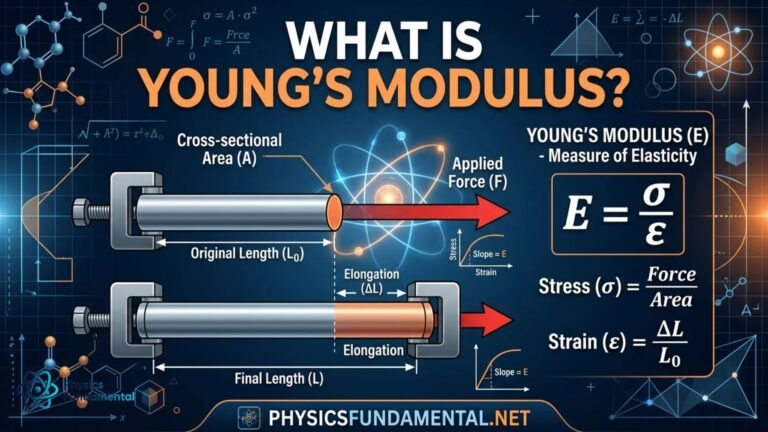
Stress σ = F/A (Pa), strain ε = ΔL/L₀ (dimensionless), Young’s modulus E = σ/ε (Pa). Elastic and plastic deformation, stress-strain graph, and 4 worked examples.

Stress σ = F/A (Pa), strain ε = ΔL/L₀ (dimensionless), Young’s modulus E = σ/ε (Pa). Elastic and plastic deformation, stress-strain graph, and 4 worked examples.
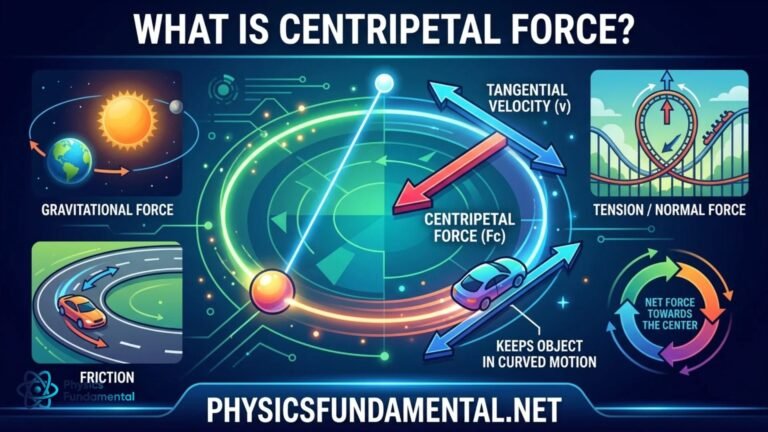
Why does a car stay on a curved road instead of continuing straight? Why does a ball tied to a string move in a circle instead of flying away? The answer is centripetal force. It is the inward-directed force that continually changes an object’s direction and keeps it moving along a circular path. Centripetal force…
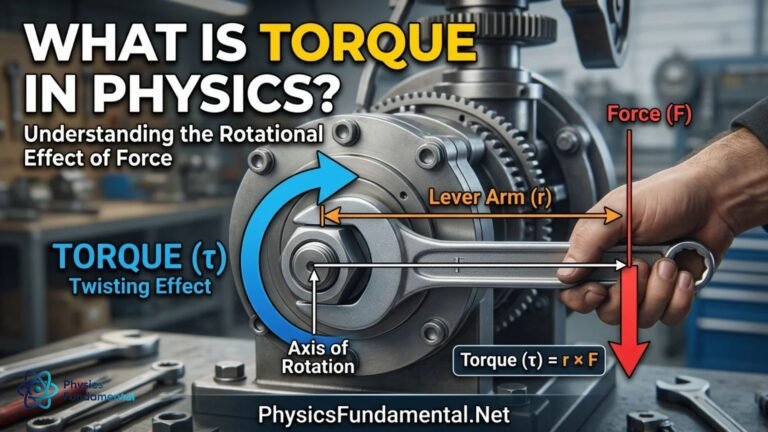
Why is it easier to open a door by pushing near the handle than by pushing close to the hinges? The force may be the same, but the distance from the pivot changes the turning effect. This turning effect is known as torque. Torque is one of the most important concepts in rotational motion. It…
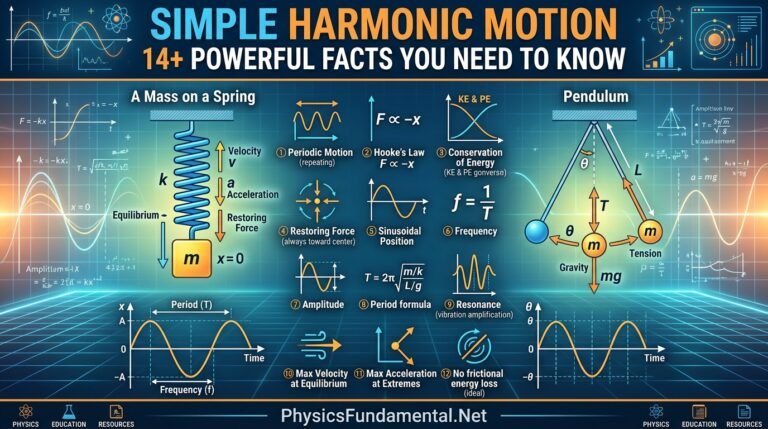
Have you ever watched a pendulum swing back and forth or seen a mass attached to a spring move repeatedly from one side to another? These are common examples of Simple Harmonic Motion, a type of periodic motion that appears throughout physics. Simple harmonic motion occurs when an object moves repeatedly around an equilibrium position…
Have you ever wondered why catching a fast-moving ball by moving your hands backward makes it hurt less? The answer comes from Impulse and Momentum, two closely related concepts that help explain how forces affect moving objects. Momentum describes the motion an object has because of its mass and velocity. Impulse describes the effect of…
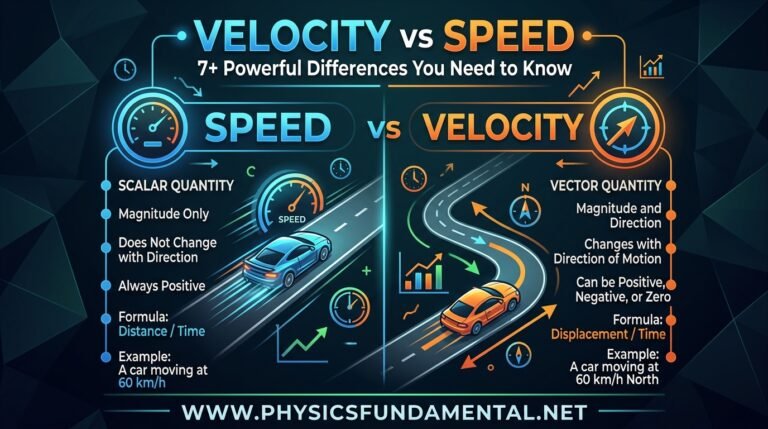
Have you ever wondered why velocity and speed are treated as two different concepts when both seem to describe how fast something is moving? The difference is simple but important: speed tells you how quickly an object moves, while velocity tells you how quickly it moves in a particular direction. Both speed and velocity are…
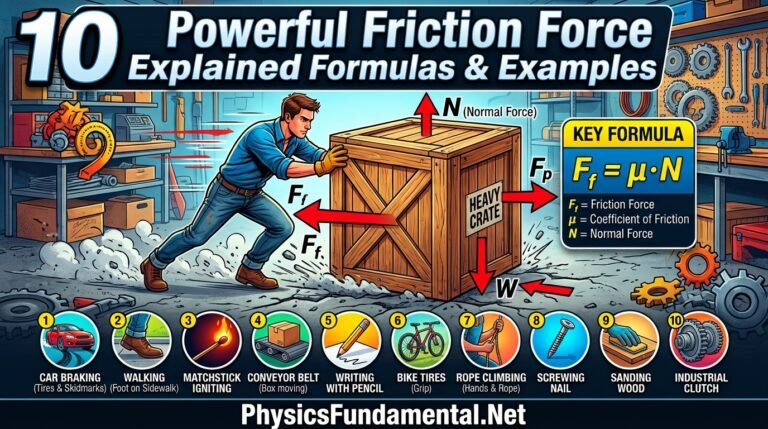
Friction Force Explained is an important topic in physics because friction affects almost every type of motion we experience in daily life. Walking, driving a car, stopping a bicycle, writing with a pencil, and even holding an object all depend on friction. Whenever two surfaces come into contact, they interact in ways that can resist…
Potential Energy is a fundamental concept in physics that describes the energy stored in an object or system because of its position, arrangement, or configuration. Unlike kinetic energy, which is associated with motion, Potential Energy is connected to what can happen when an object or system changes its position or configuration. A raised object has…
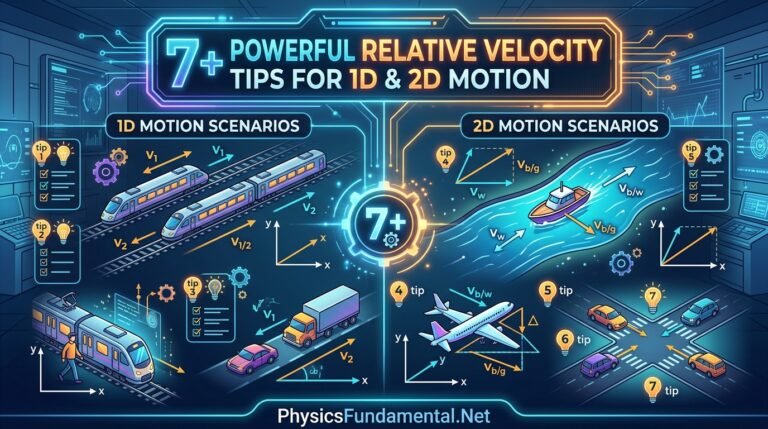
Relative Velocity is a fundamental concept in physics that describes how fast one object appears to move from the perspective of another object. Instead of measuring an object’s motion only relative to the ground, Relative Velocity helps us understand motion between two moving objects. For example, imagine two cars traveling on the same straight road….