Skip to content
Physics-Fundamental-logo
  • Home
  • About Us
  • Menu
  • Tech
  • Modern Physics
  • Waves & OpticsExpand
    • Thermodynamics
    • Electromagnetism
  • Classical Mechanics
  • Contact Us
Physics-Fundamental-logo
  • what-is-ohms-law
    Electromagnetism

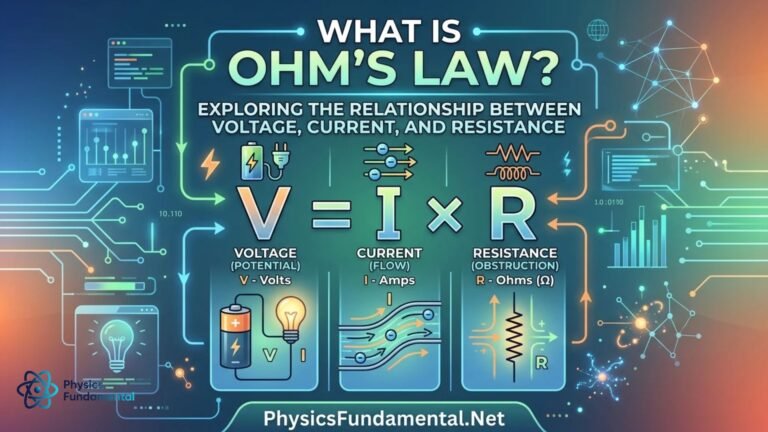
    V = IR — Ohm’s Law: 7 Powerful Circuit Examples & Facts 2026

    ByMuhammad September 24, 2026September 24, 2026

    Why does a light bulb glow brighter when you increase the voltage? Why does a circuit draw more current when its resistance is reduced? These questions can be answered with one of the most important relationships in basic electricity: V = IR. Known as Ohm’s Law, the equation connects three fundamental electrical quantities: voltage, current,…
    Read More V = IR — Ohm’s Law: 7 Powerful Circuit Examples & Facts 2026Continue

  • what-is-snells-law
    Waves & Optics

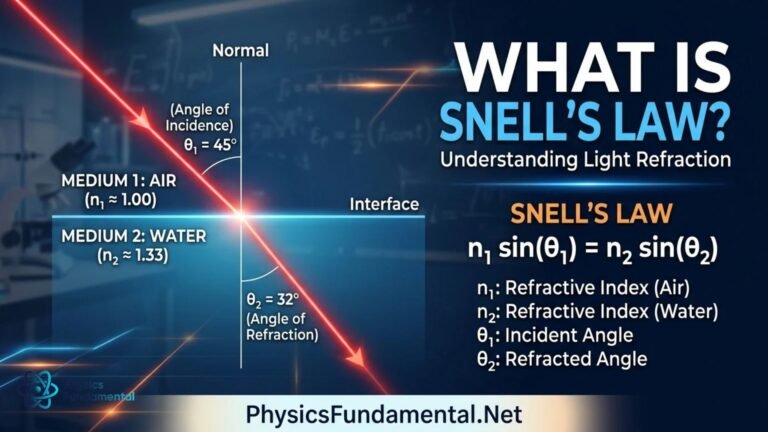
    Snell’s Law Explained: 7 Powerful Formulas, Examples & Facts 2026

    ByMuhammad September 24, 2026September 24, 2026

    Snell’s law n₁sinθ₁ = n₂sinθ₂ explains refraction at boundaries. Refractive index, critical angle, total internal reflection, and fibre optics explained with worked examples.

    Read More Snell’s Law Explained: 7 Powerful Formulas, Examples & Facts 2026Continue

  • what-is-an-electric-field
    Electromagnetism

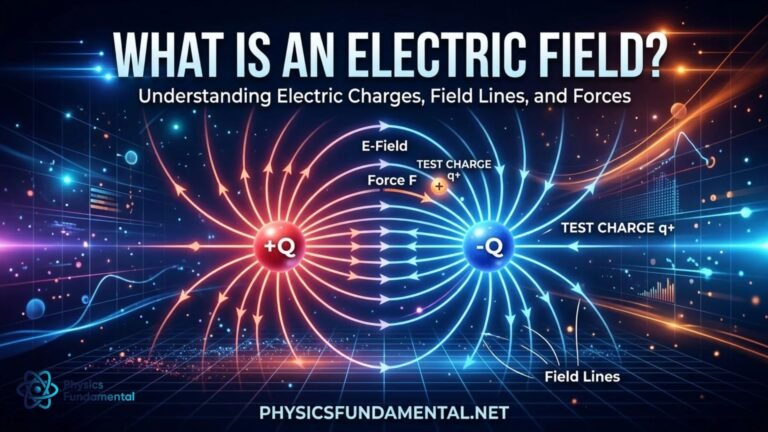
    Electric Field and Potential — Formulas and Worked Examples 2026

    ByMuhammad September 24, 2026September 24, 2026

    Electric charges can influence objects around them without physically touching them. A charged particle can push or pull another charge from a distance, and this interaction is described using two important concepts in electrostatics: electric field and electric potential. The electric field describes the force that a charge would experience at a particular location, while…

    Read More Electric Field and Potential — Formulas and Worked Examples 2026Continue

  • what-is-mechanical-energy
    Classical Mechanics

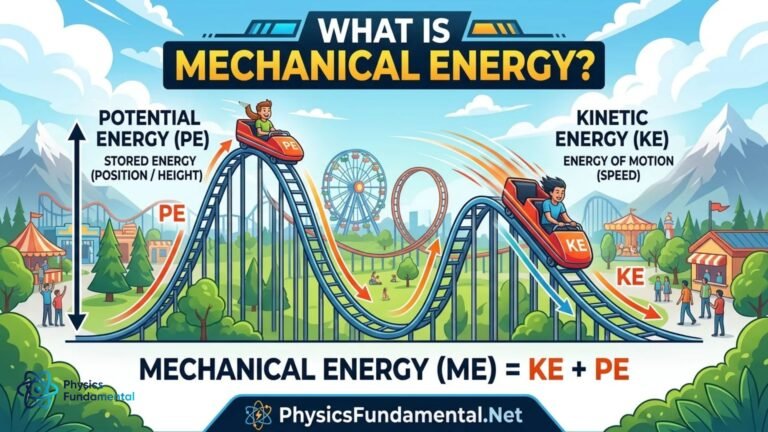
    Mechanical Energy Explained: 7 Powerful KE + PE Facts & Examples 2026

    ByMuhammad September 24, 2026September 24, 2026

    What happens to the energy of a roller coaster as it climbs a hill and then races downward? It does not simply disappear. Instead, energy shifts between different forms, especially kinetic energy and potential energy. This everyday example provides a simple way to understand mechanical energy. Mechanical energy is the energy an object has because…

    Read More Mechanical Energy Explained: 7 Powerful KE + PE Facts & Examples 2026Continue

  • what-are-electromagnetic-waves
    Waves & Optics

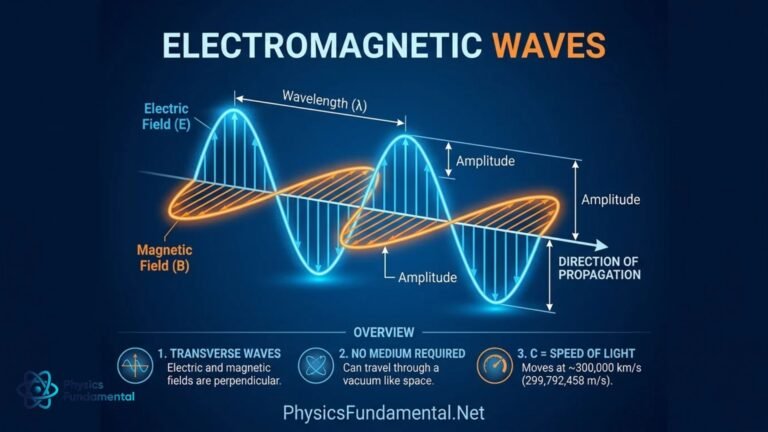
    What Are Electromagnetic Waves? Speed, Spectrum and Properties

    ByMuhammad September 24, 2026September 24, 2026

    Light from the Sun, radio signals, Wi-Fi, X-rays, and microwaves may seem completely different, but they all belong to the same family: electromagnetic waves. These waves can travel through empty space without needing air, water, or another material medium. Electromagnetic waves are waves made of oscillating electric and magnetic fields that propagate through space. In…

    Read More What Are Electromagnetic Waves? Speed, Spectrum and PropertiesContinue

  • what-is-a-heat-engine
    Thermodynamics

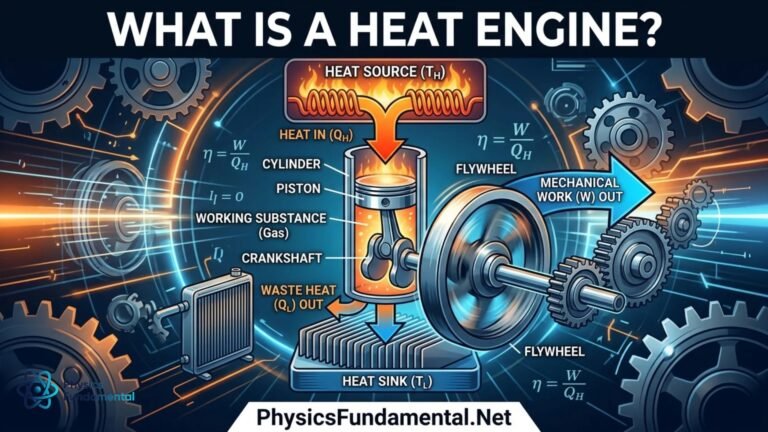
    Carnot Cycle Explained: Powerful Heat Engine Efficiency Guide 2026

    ByMuhammad September 24, 2026September 24, 2026

    The Carnot cycle explained: maximum possible heat engine efficiency, eta = 1 – Tc/Th, the four-stage cycle, and why no real engine can beat it. Worked examples.

    Read More Carnot Cycle Explained: Powerful Heat Engine Efficiency Guide 2026Continue

  • what-is-the-kinetic-theory-of-gases
    Thermodynamics

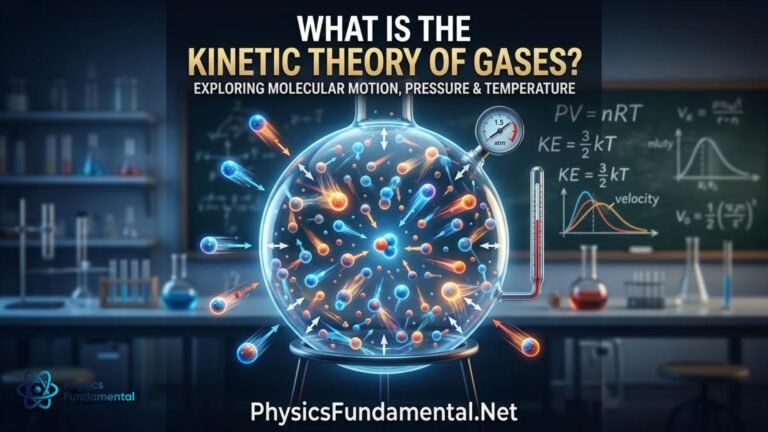
    Kinetic Theory of Gases: Powerful Pressure & Molecular Motion Guide 2026

    ByMuhammad September 24, 2026September 24, 2026

    Kinetic molecular theory: how molecular motion creates pressure and temperature. Covers the 5 postulates, RMS speed, and ideal gas law derivation.

    Read More Kinetic Theory of Gases: Powerful Pressure & Molecular Motion Guide 2026Continue

  • what-are-quantum-numbers
    Modern Physics

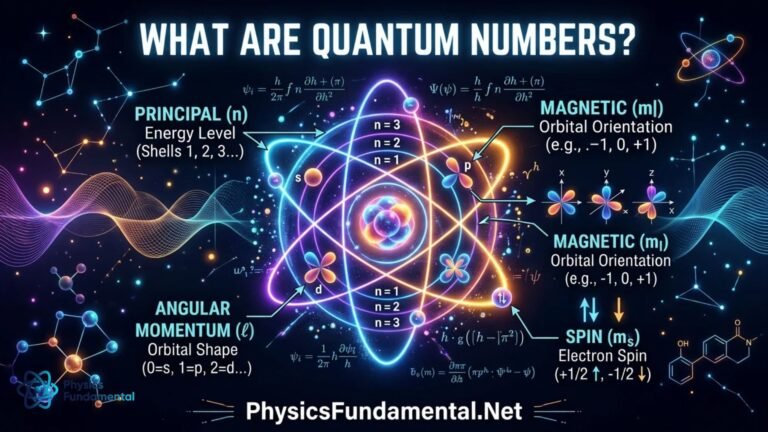
    Quantum Numbers Explained: Powerful n, l, mₗ, mₛ Guide 2026

    ByMuhammad September 24, 2026September 24, 2026

    Four quantum numbers n, l, m_l, m_s describe each electron state. Principal, angular momentum, magnetic, spin. Pauli exclusion principle and electron configuration explained.

    Read More Quantum Numbers Explained: Powerful n, l, mₗ, mₛ Guide 2026Continue

  • what-is-free-fall
    Classical Mechanics

    Free Fall and Terminal Velocity: Powerful Facts, Formulas & Examples 2026

    ByMuhammad September 23, 2026September 23, 2026

    What happens when an object falls through the air? At first, it may speed up rapidly, but after some time, its acceleration can decrease until it moves at a constant speed. This change in motion is explained by two important physics concepts: free fall and terminal velocity. Free fall describes motion under the influence of…

    Read More Free Fall and Terminal Velocity: Powerful Facts, Formulas & Examples 2026Continue

  • what-is-momentum
    Classical Mechanics

    Momentum Conservation: Powerful Elastic vs Inelastic Collisions 2026

    ByMuhammad September 23, 2026September 23, 2026

    How momentum is conserved in collisions — the key difference between elastic and inelastic impacts, the impulse-momentum theorem, and worked examples.

    Read More Momentum Conservation: Powerful Elastic vs Inelastic Collisions 2026Continue

Page navigation

Previous PagePrevious 1 … 16 17 18 19 20 21 Next PageNext
Facebook X Instagram
  • About Us
  • Contact Us
  • Home

© 2026 Physics Fundamental - WordPress Theme by Kadence WP

  • Home
  • About Us
  • Menu
  • Tech
  • Modern Physics
  • Waves & Optics
    • Thermodynamics
    • Electromagnetism
  • Classical Mechanics
  • Contact Us